Daedong Robotics testet Agrar-Transportroboter 24 Tage auf GS-E&C-Baustelle
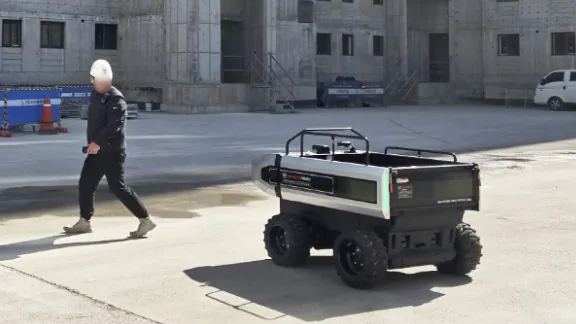
Daedong Robotics, die Robotertochter des koreanischen Landmaschinenherstellers Daedong, teilte am 12. November mit, dass das Serienmodell RT100 TS seines Transportroboters RT100 vom 7. bis 30. Oktober auf einer großen Wohnbaustelle von GS Engineering and Construction westlich von Seoul Material für Mauer-, Putz-, Installations- und Ausbauarbeiten transportiert hat.
Als Nächstes sollen Arbeitszeit und Personaleinsatz vor und nach dem Robotereinsatz verglichen werden; geplant sind zudem ein Mietmodell und ein Roboter für Lasten ab einer Tonne.
Daedong Robotics hat nach eigenen Angaben vom 12. November einen Praxistest seines Transportroboters RT100, den die Mitteilung als autonom bezeichnet, mit GS Engineering and Construction abgeschlossen, einem der größten Baukonzerne Koreas. Das Serienmodell RT100 TS fuhr vom 7. bis 30. Oktober auf einer großen Wohnbaustelle im westlichen Großraum Seoul, nach Vorabtests auf dem Versuchsgelände von GS E&C. Auf der Website von Daedong Robotics wird der RT100 TS als manuell gesteuertes Modell geführt, autonom fährt der RT100 TA. Beide Unternehmen hatten im Juni eine Absichtserklärung zur Automatisierung von Baustellen unterzeichnet.
Vom Obstgarten auf die Baustelle
Der allradgetriebene RT100 wurde für schwere Lasten in Obstplantagen entwickelt. Auf der Baustelle transportierte er Material über unebenes und geneigtes Gelände. Laut Daedong Robotics fuhr er stabil, und Arbeiter lobten den Folgemodus sowie die Funkfernbedienung. Nutzlast, Fahrtenzahl oder Zeitersparnis nennt die Mitteilung nicht. Geplant sind Vergleiche von Arbeitszeit und Personal, Navigation in Untergeschossen ohne Satellitenortung, automatisches Be- und Entladen, ein Roboter ab einer Tonne Nutzlast und ein Robot-as-a-Service-Angebot.
MEKAWIRE-Analyse
Daedong testet mit vorhandenen Agrarrobotern einen zweiten Markt, spart Entwicklungskosten, hat aber kein für Baustellen entworfenes Produkt.
Der Test dauerte nach MEKAWIRE-Zählung 24 Tage und lieferte bislang nur qualitative Ergebnisse. Für europäische Anbieter von Baustellenlogistik zeigt der Fall, dass koreanische Großbauunternehmen den Materialtransport zu automatisieren beginnen. Entscheidend werden die Produktivitätszahlen und ein bezahlter Mietvertrag.
- Sep 9
- On-device AI chip for unmanned farm robots (lead)
- KRW 43.1bn project
- Oct 15
- K-GX AI electric tractor programme
- 55 kW, by 2030
- Oct 21
- Daegu AI factory projects (Daedong and partners)
- KRW 18.7bn
- Late Oct
- Daedong Gear and Eyou actuator MOU, China JV targeted by Jan 2027
- 30,000-set annual line planned; Korea production from 2029
- Nov 12
- RT100 construction-site PoC with GS E&C
- 24 days, no figures yet
From MEKAWIRE stories based on company and government releases, as of Nov 14, 2026.
- 7. bis 30. Oktober 2026 (24 Tage)
- RT100 TS, Transportroboter mit Allradantrieb; Serienmodell, laut Hersteller manuell gesteuert
- Große Wohnanlage im westlichen Großraum Seoul
- GS Engineering and Construction, Absichtserklärung Juni 2026
- Mauer-, Putz-, Installations- und Ausbauarbeiten
- Produktivitätsvergleich, Innennavigation, Roboter ab 1 t, RaaS
Warum das wichtig ist
The 24-day GS E&C trial tested whether Daedong Robotics' orchard transport platform can serve construction logistics across masonry, plastering, plumbing and finishing work. The planned comparison of working time and crew size will determine whether that application has a measurable economic case. Completion of the trial alone does not establish productivity gains or commercial demand.
Wettbewerbsanalyse
No competing suppliers, prices or comparative performance results are supplied, so a competitive ranking is premature. Daedong's production-platform reuse and GS E&C relationship provide a route to construction-site evaluation. The tested RT100 TS is listed by the maker as manually driven; the separately listed RT100 TA is autonomous, so this trial should not be treated as proof of autonomous capability.
Bewertungskontext
Daedong and Daedong Gear are public companies, but the supplied material provides neither market capitalizations nor disclosed valuations. No separate valuation or funding figure is supplied for Daedong Robotics. Without RaaS pricing, deployment commitments or measured savings, any estimate of the partnership's financial contribution would be speculative.
Zugrunde liegende Forschung
No research papers are supplied; the evidence consists of company announcements, product listings and a media report. These sources describe the trial and roadmap but provide no quantified productivity comparison or autonomy benchmark.
Folgen für die Lieferkette
Daedong Gear and Eyou signed an MOU to pursue a China actuator joint venture by January 2027. That is a separate development: the supplied facts do not identify either company as a supplier to the RT100 TS. Component sourcing, manufacturing capacity and costs for the planned one-tonne-plus hauler are not disclosed.
Worauf jetzt zu achten ist
Watch for the planned before-and-after measurements of working time and crew size, followed by RaaS pricing and deployment commitments. Indoor and outdoor autonomy and the one-tonne-plus hauler remain roadmap items, with no delivery dates supplied. Future announcements should identify the operating mode actually tested.
Analystensicht
This is evidence of application testing beyond agriculture, with the commercial case still unproven. The decisive next step is measured labor and time savings sufficient to support a RaaS offer. Investors should distinguish the completed manual-drive platform trial from the planned autonomy and higher-payload developments.
Offene Fragen
How much did working time and crew size change for each material-handling task? What RaaS price, service costs and utilization would make deployments economic for both parties? When will indoor and outdoor autonomy and the one-tonne-plus hauler be tested, and against which acceptance criteria?