Daedong Robotics tests RT100 farm hauler on GS E&C apartment site for 24 days, plans RaaS
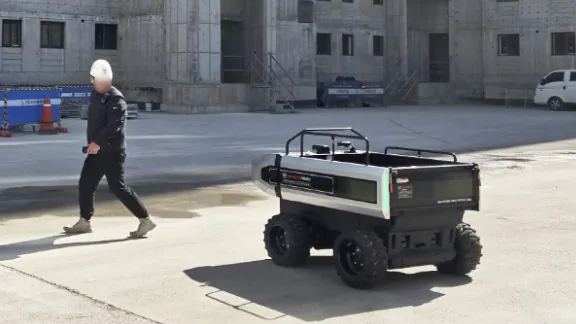
Daedong Robotics, the robot affiliate of Korean farm-machinery maker Daedong, said on Nov 12 it completed a proof of concept with GS Engineering and Construction in which the RT100 TS, the production model of its RT100 orchard transport robot, carried masonry, plastering, plumbing and finishing materials on a large apartment construction site west of Seoul from Oct 7 to 30.
The two companies will next measure working time and crew size before and after the robot, and Daedong Robotics plans a robot-as-a-service offer and a hauler of one tonne or more.
Daedong Robotics said in a release on Nov 12 that it had finished a field test of its RT100 transport robot, which the release calls autonomous, with GS Engineering and Construction, one of Korea's largest builders. The production model, RT100 TS, ran on a large apartment construction site in the western Seoul metropolitan area from Oct 7 to Oct 30 after earlier checks at GS E&C's test ground. It carried materials for masonry, plastering, plumbing and finishing work over sloped and uneven ground. Daedong Robotics' website lists the RT100 TS as its manually driven model and the RT100 TA as the autonomous one. The two companies signed a memorandum on construction automation and smart construction technology in June; this proof of concept is the first step under it.
A farm robot on a building site
The RT100 was developed to haul heavy loads in orchards and open fields and uses four-wheel drive. Daedong Robotics said it drove stably on irregular surfaces and that workers rated two functions well: a follow mode in which the robot tracks a worker, and a wireless remote control that needs little training. The release gives no payload figure for the test, no count of trips, and no time savings.
Next steps, according to the company: compare working time and the number of workers before and after the robot to quantify cost savings; develop combined indoor and outdoor autonomy for basements where satellite positioning fails, plus autonomous loading and unloading; apply a large autonomous robot of one tonne or more for heavy materials; upgrade a fleet management system for robots spread across sites; and offer robots as a service, bundling rental, deployment, operation, monitoring and maintenance.
- Sep 9
- On-device AI chip for unmanned farm robots (lead)
- KRW 43.1bn project
- Oct 15
- K-GX AI electric tractor programme
- 55 kW, by 2030
- Oct 21
- Daegu AI factory projects (Daedong and partners)
- KRW 18.7bn
- Late Oct
- Daedong Gear and Eyou actuator MOU, China JV targeted by Jan 2027
- 30,000-set annual line planned; Korea production from 2029
- Nov 12
- RT100 construction-site PoC with GS E&C
- 24 days, no figures yet
From MEKAWIRE stories based on company and government releases, as of Nov 14, 2026.
MEKAWIRE analysis
Daedong is using construction as a second market for robots it already builds for farms, which keeps development cost low but means the first product was never designed for a building site.
The test lasted 24 days by MEKAWIRE's count and produced qualitative results only; the quantified comparison is still to come. Daedong's robot work has been framed around agriculture in MEKAWIRE's coverage this autumn, from a KRW 43.1bn on-device AI chip project for unmanned farm robots in September to the K-GX 55 kW AI electric tractor programme in October, and its gear affiliate Daedong Gear signed a memorandum of understanding with China's Eyou in Shanghai in late October to pursue a Chinese actuator joint venture by January 2027. A construction customer of GS E&C's size would be the group's first non-farm reference for field robots. Counter-argument: construction sites need indoor navigation and lift access that orchard robots lack, which Daedong itself lists as development work. Signals to watch: the before-and-after productivity numbers, a priced RaaS contract, and the one-tonne robot.
- Productivity comparison, indoor and outdoor autonomy, 1-tonne-plus robot, RaaS
- Large apartment construction site, western Seoul metropolitan area
- RT100 TS, four-wheel-drive transport robot; production model, listed by the maker as manually driven
- GS Engineering and Construction, MOU signed in June 2026
- Oct 7 to Oct 30, 2026 (24 days)
- Masonry, plastering, plumbing and finishing
Why it matters
The 24-day GS E&C trial tested whether Daedong Robotics' orchard transport platform can serve construction logistics across masonry, plastering, plumbing and finishing work. The planned comparison of working time and crew size will determine whether that application has a measurable economic case. Completion of the trial alone does not establish productivity gains or commercial demand.
Rival analysis
No competing suppliers, prices or comparative performance results are supplied, so a competitive ranking is premature. Daedong's production-platform reuse and GS E&C relationship provide a route to construction-site evaluation. The tested RT100 TS is listed by the maker as manually driven; the separately listed RT100 TA is autonomous, so this trial should not be treated as proof of autonomous capability.
Valuation context
Daedong and Daedong Gear are public companies, but the supplied material provides neither market capitalizations nor disclosed valuations. No separate valuation or funding figure is supplied for Daedong Robotics. Without RaaS pricing, deployment commitments or measured savings, any estimate of the partnership's financial contribution would be speculative.
Related papers
No research papers are supplied; the evidence consists of company announcements, product listings and a media report. These sources describe the trial and roadmap but provide no quantified productivity comparison or autonomy benchmark.
Supply-chain implications
Daedong Gear and Eyou signed an MOU to pursue a China actuator joint venture by January 2027. That is a separate development: the supplied facts do not identify either company as a supplier to the RT100 TS. Component sourcing, manufacturing capacity and costs for the planned one-tonne-plus hauler are not disclosed.
Signals to watch
Watch for the planned before-and-after measurements of working time and crew size, followed by RaaS pricing and deployment commitments. Indoor and outdoor autonomy and the one-tonne-plus hauler remain roadmap items, with no delivery dates supplied. Future announcements should identify the operating mode actually tested.
Analyst view
This is evidence of application testing beyond agriculture, with the commercial case still unproven. The decisive next step is measured labor and time savings sufficient to support a RaaS offer. Investors should distinguish the completed manual-drive platform trial from the planned autonomy and higher-payload developments.
Questions you should be asking
How much did working time and crew size change for each material-handling task? What RaaS price, service costs and utilization would make deployments economic for both parties? When will indoor and outdoor autonomy and the one-tonne-plus hauler be tested, and against which acceptance criteria?