Gradient leads US$7.6 million round for Feather, which sells a US$29,990 two-armed robot and lets buyers pick the brain
Feather Robotics, a US startup selling an open-hardware wheeled robot with two arms for US$29,990, raised US$7.6 million in a round led by Gradient, the lead investor said on 30 September 2026. Gradient said Feather has already passed US$1 million in revenue, with robots at work in manufacturing and food service.
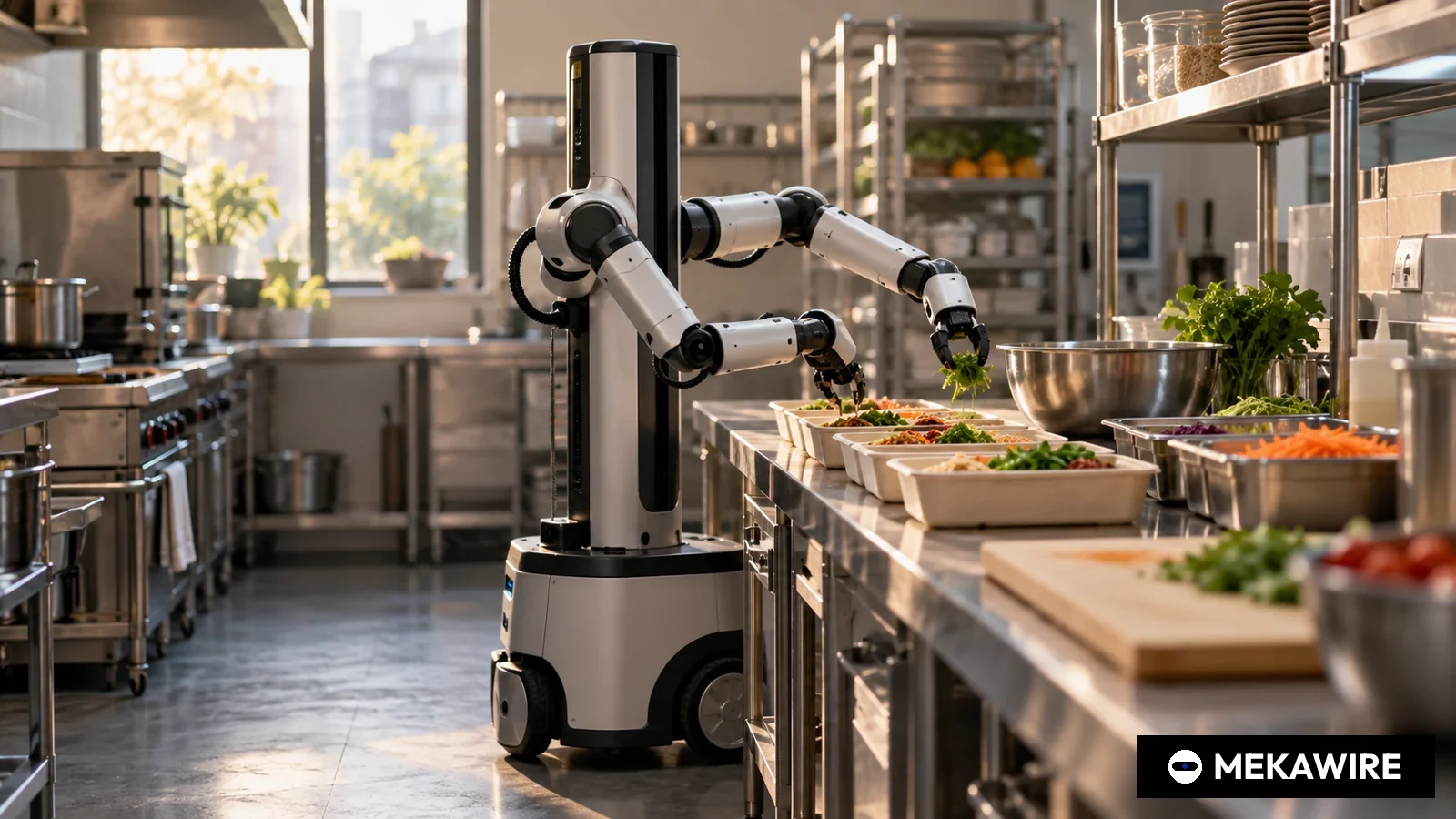
Feather Robotics, which sells a wheeled two-armed robot for US$29,990 and leaves the choice of computer and AI model to the buyer, has raised US$7.6 million in a round led by Gradient, the venture firm said in its September 2026 newsletter published on 30 September. BuilderVC, Geometry, SEED Innovations and Virgo VC joined. Gradient said Feather came out of stealth in September and has passed US$1 million in revenue, with robots working in manufacturing and food service. Neither Gradient nor Feather's website gave a round name, a valuation or a split of the money.
Feather's website lists the platform at US$32,990, with US$29,990 as a launch price, and describes open hardware with 600 mm of vertical travel, 1 m of reach, a 360-degree holonomic base rated up to 1.3 m/s and two hot-swappable batteries for 10 hours of work. The company says it is shipping. Gradient's newsletter framed the pitch in labour terms: a worker costs US$50,000 to US$60,000 a year, and a Feather robot can be bought instead. Co-founder and CEO Hoa Mai, formerly of Google and Apple, co-founded Kind Humanoid, which 1X acquired; co-founder Parsa Bakhtiari worked at Tesla during the Model 3 ramp, the company's mission page says.
MEKAWIRE analysis
Feather is betting that the money in general-purpose robots will go to whoever owns the model, so the body should be cheap, open and someone else's problem to program.
At US$7.6 million the round is the third largest of five early-stage robotics rounds the desk verified between 29 and 30 September, and 19% of their combined US$40.1 million. The strongest counter-argument is margin: an open platform sold near US$30,000 competes on price with Chinese hardware and leaves software value to customers. The bull case is that research labs and model companies standardise on Feather as a test body; the bear case is that they buy cheaper Chinese arms instead. Signals to watch by 30 June 2027 are a named Series A, disclosed unit shipments and any model company announcing Feather as its reference robot.
- 2026-09-30
- Not named
- 7.6
- Gradient
Only round disclosed. Date is that of Gradient's newsletter; Gradient says Feather came out of stealth in September 2026. Valuation not disclosed. Figures disclosed, not estimated.
As of Oct 1, 2026
- Inbolt
- AI vision for industrial robots
- Unnamed
- 12.5
- 2026-09-30
- Destro AI
- Warehouse robot orchestration
- Seed
- 8
- 2026-09-29
- Feather Robotics
- Open two-armed robot platform
- Not named
- 7.6
- 2026-09-30
- Aleph Surgical
- Autonomous surgical robots
- Pre-seed
- 7.5
- 2026-09-30
- Tangent Robotics
- Tactile robot hands
- Pre-seed
- 4.5
- 2026-09-30
Amounts from each primary announcement. Total 40.1; Feather share = 7.6 / 40.1 = 19%. Figures disclosed, not estimated.
As of Oct 1, 2026
- Not named
- 600 mm vertical travel, 1 m reach, base up to 1.3 m/s, 10 h on two hot-swappable batteries
- US$7.6 million
- Open-hardware wheeled robot with two arms; US$32,990 list, US$29,990 launch price
- Passed US$1 million (Gradient)
- 30 September 2026 (Gradient newsletter)
- Not disclosed
- Gradient
- BuilderVC, Geometry, SEED Innovations, Virgo VC
Why it matters
Feather sells a two-armed mobile platform to developers rather than building its own end-to-end robot product. If model companies and labs want a standard body to train and test on, a cheap open platform with a hot-swappable battery and a holonomic base is the kind of product that becomes infrastructure.
The US$1 million revenue figure, if confirmed by the company itself, would put Feather ahead of most pre-seed and seed robotics peers on commercial traction.
Rival analysis
Feather's rivals are low-cost Chinese research platforms and robot arms, which compete on price, and integrated humanoid makers such as 1X, which sell complete robots with their own software. Feather's founder sold Kind Humanoid to 1X, so it knows the integrated model from the inside and has chosen the opposite approach.
Within the desk's late-September sample, Feather is the only hardware platform; Inbolt sells vision software, Destro AI sells orchestration software, Tangent Robotics builds tactile hands and Aleph Surgical builds autonomous surgical systems.
Valuation context
No valuation was disclosed. US$7.6 million is 19% of the US$40.1 million in five early-stage robotics rounds the desk verified on 29 and 30 September 2026. At a launch price of US$29,990, the round equals the list value of about 253 robots, a ratio that only shows scale and says nothing about margins.
Supply-chain implications
Feather has not disclosed suppliers, assembly location or the source of its actuators and batteries. An open-hardware platform near US$30,000 has little room for expensive Western components, which makes the bill of materials and any tariff exposure a key question.
Signals to watch
First, a named Series A with a valuation by 30 June 2027. Second, disclosed unit shipments or named customers in manufacturing and food service. Third, a robot model company or university lab naming Feather as its reference hardware.
Analyst view
Thesis: Feather is a low-cost body for other people's robot brains. Confidence: low. The revenue claim comes from the investor, not the company, and there are no unit numbers or named customers. We would raise confidence on disclosed shipments and repeat buyers.
Questions you should be asking
How many robots have shipped and to whom? Where is the robot built and which actuators does it use? What gross margin does the US$29,990 launch price allow? Does Feather plan its own software or models? What is the round called and on what terms?