US Army names IHMC's Alex humanoid and four component makers as xTechHumanoid winners
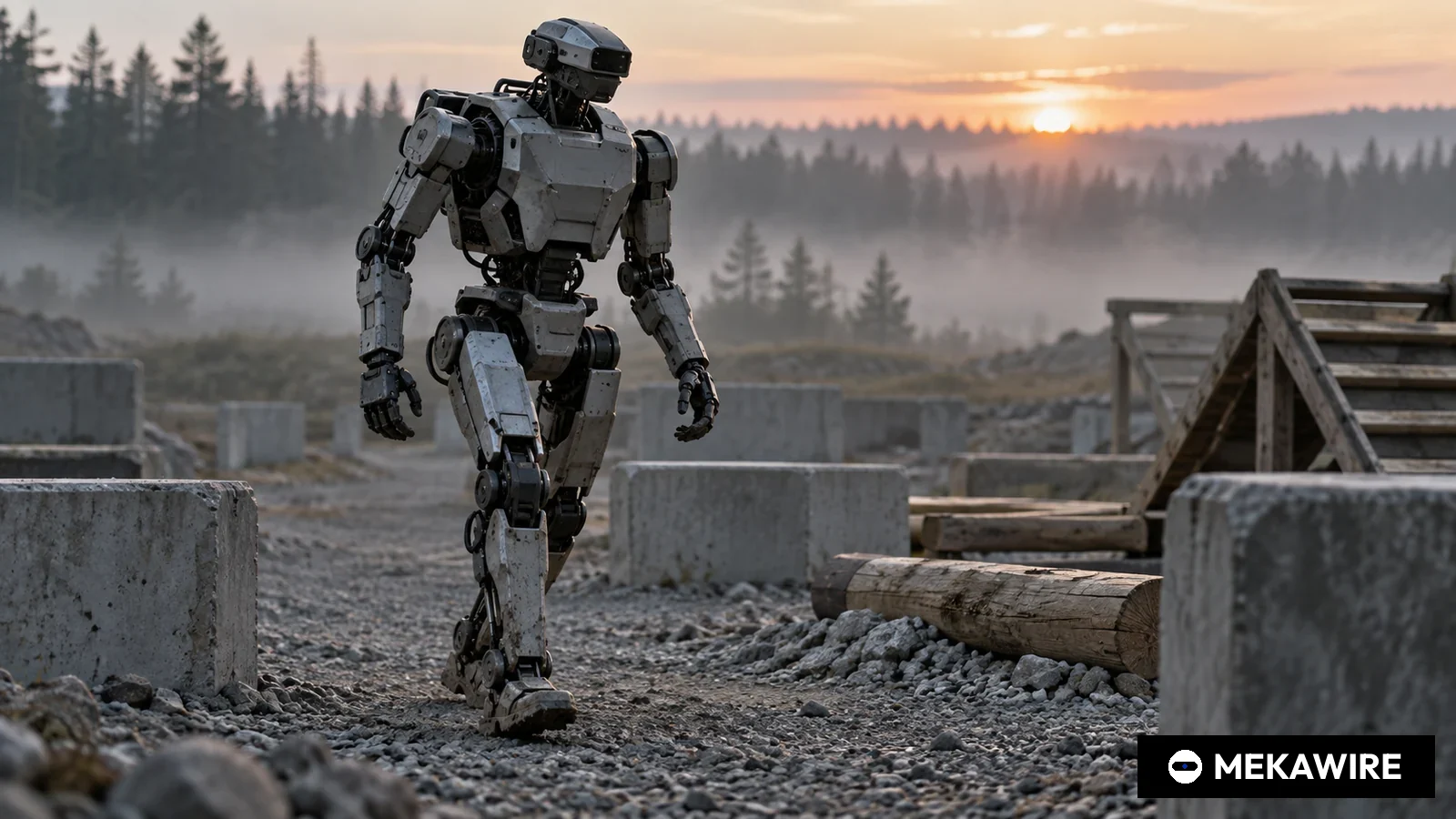
The U.S. Army has named five winners of its xTechHumanoid competition after final demonstrations at Marine Corps Base Quantico, and only one of them, IHMC's Alex, is a complete humanoid robot. The other four supply power, touch sensing and command software, a mix that shows where the Army sees the bottlenecks in military humanoids.
The U.S. Army has named five winners of its xTechHumanoid competition, and only one of them builds a complete humanoid robot. The Florida Institute for Human and Machine Cognition (IHMC) won with Alex, a humanoid the Army described as having impact-resilient actuators, ballistic protection and hybrid autonomy that combines artificial intelligence with human control. The other four winners supply pieces of the system around the robot: an integrated power system from ACEs Group, mobile power generation from Hydroplane, fingertip tactile sensors from Ras Labs and command-and-control software from Velocity Explorations, according to an Army FUZE article published on army.mil on Sept. 30, 2026.
The winners were selected on Sept. 11 after a final experimentation event at Marine Corps Base Quantico, Virginia, on Sept. 9 and 10. The Army said the competition drew 103 white papers covering both baseline humanoid platforms and advanced subsystems. Ten companies advanced as finalists and nine demonstrated their technology at Quantico in front of military leaders, technical experts and evaluators. The Army did not name the finalists that did not win or say which finalist did not demonstrate.
The sums involved are small by venture standards. The competition page on xtech.army.mil lists $490,000 in cash prizes and up to $1.25 million in potential follow-on contracts. In the first phase, a white paper round that ran from Aug. 6 to Oct. 1, 2025, up to ten finalists were eligible for $25,000 each. The second phase ran from Aug. 1 to Sept. 11, 2026, and its rules allowed up to two baseline humanoid systems an additional $75,000 each and up to three advanced subsystems an additional $30,000 each. The Army's winners article does not say which prize each winner received, and no follow-on contract has been announced. The rules state only that the government may award follow-on work to one or more winners from the $1.25 million pool.
The Army's descriptions of the four component winners are specific. ACEs Group offered a power system with scalable energy storage that runs from larger operational infrastructure down to individual robot batteries. Hydroplane entered a lightweight mobile power-generation system meant to supply long-duration power in contested logistics settings; on its own website the Lancaster, California company describes itself as a developer of hydrogen fuel cell power plants and lists the award as a subsystem win for an advanced power system. Ras Labs won with fingertip sensors that detect force, object form and slip, a product its website markets as Tactile Fingertip for robotic grippers. Velocity Explorations entered software that extends its existing command-and-control technology to turn trusted information and commander intent into discrete actions for humanoid robots.
Alex itself is a government-funded research platform rather than a commercial product. IHMC introduced the robot on Nov. 19, 2025, as a multi-year, multimillion-dollar project funded through the Office of Naval Research. The institute said custom high-powered actuators were the key design change and put Alex's estimated weight at 85 kilograms with a battery, against about 100 kilograms for its predecessor Nadia. Team lead Robert Griffin, a senior research scientist, said at the time that the aim was to take the robot out of the lab and push humanoids toward human-level speed. IHMC's launch post did not mention armour; the ballistic protection appears in the Army's description of the competition entry.
The competition was run by Army FUZE's xTech programme with the Humanoid Community of Collaboration (HCoC), a joint-service and Defense Department group the Army said was set up in December 2023 to push technical development and operational integration of humanoid systems across the joint force. The competition page names the Assistant Secretary of the Army for Acquisition, Logistics and Technology as sponsor alongside HCoC. According to the Army, xTech has awarded more than $3 million in non-dilutive prizes since 2018, and FUZE also coordinates the Small Business Innovation Research programme, technology transfer, manufacturing technology and technology maturation work.
Army chief technology officer Alex Miller framed the effort as part of a wider autonomy push and said xTech lets the service survey industry and fast-track promising technology rather than wait on studies that take years. Alec Leesberg, president of Velocity Explorations, said the format let companies pressure test their technology in a field exercise. Hydroplane founder and chief executive Anita Sengupta urged other firms to enter, saying competition connects companies to a network across the military and industry.
The winners list leaves out the best-funded U.S. humanoid developers. Figure AI raised a $1 billion Series C at a $39 billion post-money valuation in September 2025, Apptronik disclosed a $520 million Series A extension in February 2026 and Agility Robotics raised a $150 million Series B in 2022, according to those companies. Because the Army has not published the full finalist list, it is not possible to say whether any of them entered. The rules opened the competition to domestic and foreign companies but excluded any entity controlled by, funded by or under the direction of a foreign adversary.
The component mix is the technical message. A humanoid that walks into a building has to carry its own energy, sense what its hands touch and take orders it can trust. Two of the five winners address power, and the Army said HCoC's next lines of effort include work on power and energy constraints that could shape how humanoid and other robots are used in operations. Tactile fingertips matter because a gripper that can feel slip can hold an unfamiliar object without crushing or dropping it, a basic requirement for handling tools, doors and equipment in the field.
The open questions are about scale and follow-through. Prize money of $490,000 spread over ten finalists and five winners is a scouting budget, not a procurement signal, and the $1.25 million follow-on pool remains discretionary. The Army has not released test results from Quantico, so claims such as ballistic protection cannot yet be compared with any other platform. The next markers are any follow-on award from the xTech pool, the outputs of HCoC's power and energy work and further field testing of Alex under its Navy-funded programme.
- Phase 1 finalists (white papers)
- 2025-08-06 to 2025-10-01
- 10
- 25,000
- 250,000
- Phase 2 baseline humanoid system
- 2026-08-01 to 2026-09-11
- 2
- 75,000
- 150,000
- Phase 2 advanced humanoid subsystem
- 2026-08-01 to 2026-09-11
- 3
- 30,000
- 90,000
- Potential follow-on contracts (pool)
- No data
- No data
- No data
- 1,250,000
Source: xtech.army.mil competition page. Max payout = max awardees x prize per awardee; cash prizes total $490,000. The Army has not disclosed which prize each winner received. Figures disclosed, not estimated.
As of Oct 1, 2026
- Figure AI
- Series C
- 2025-09-16
- 1,000,000,000
- 39,000,000,000
- 574.7
- Apptronik
- Series A extension
- 2026-02-11
- 520,000,000
- No data
- 298.9
- Agility Robotics
- Series B
- 2022-04-22
- 150,000,000
- No data
- 86.2
- 1X Technologies
- Series B
- 2024-01-13
- 100,000,000
- No data
- 57.5
- Persona AI
- Private offering (Form D, partial)
- 2026-09-14
- 65,363,626
- No data
- 37.6
- xTechHumanoid (cash prizes + follow-on pool)
- Competition budget
- 2026-09-11
- 1,740,000
- No data
- 1
Multiple = round amount / $1,740,000 (xTechHumanoid $490,000 cash prizes + up to $1.25 million follow-on contracts). Rounds from company announcements and SEC filings in the MEKAWIRE database. None of these companies is named among the winners; the Army has not published the full finalist list. Figures disclosed, not estimated.
As of Oct 1, 2026
MEKAWIRE analysis
The Army's first humanoid prize tells suppliers less about which robot it will field than about where it thinks the bottlenecks sit: energy, touch and trusted command software.
The evidence is in the selection. Four of five winners are subsystems, two of them power, and the Army's own closing paragraph points HCoC at power and energy constraints next. The only complete humanoid among the winners comes from a research institute funded by the Navy, not from a venture-backed developer.
The strongest counter-argument is that the result reflects the rules more than Army priorities. The prize structure reserved most slots for subsystems from the start, and well-funded humanoid makers may simply have had little reason to chase a $75,000 prize and a share of a $1.25 million pool.
Bull case: the competition gives small component firms a route into defence demand at a moment when commercial humanoid makers are scaling. If follow-on contracts land and HCoC turns its power work into requirements, winners such as Hydroplane and Ras Labs could become reference suppliers for any future military humanoid, whoever builds the body.
Bear case: the dollar amounts are too small to move any supply chain, and no procurement line exists. Without published test data the competition may remain a scouting exercise that informs doctrine papers while operational units keep relying on wheeled and tracked robots.
Signals to watch:
- Any follow-on contract from the $1.25 million xTech pool, which would be the first money beyond prizes, through the first quarter of 2027.
- Output from HCoC's power and energy line of effort, including any request for information or new competition, over the next six months.
- Outdoor field results from IHMC's Office of Naval Research programme for Alex in 2027.
- ACEs Group, IHMC (Alex), Hydroplane, Ras Labs, Velocity Explorations
- Army FUZE xTech and Humanoid Community of Collaboration (est. Dec. 2023)
- $490,000
- Sept. 11, 2026
- Sept. 9 to 10, 2026, Marine Corps Base Quantico, Virginia
- 103
- 10 / 9
- 85 kg with battery, vs about 100 kg for Nadia
- up to $1.25 million
Why it matters
This is the first time the U.S. Army has run a prize competition specifically for humanoid robots and published winners, which makes the selection a rare public statement of military requirements for the form factor. Rather than picking a robot to buy, the Army chose a research humanoid plus four enabling technologies, signalling that it sees the humanoid as a system whose limits sit in energy, perception at the hand and command software.
For commercial humanoid developers, the result matters because it defines a parallel demand channel with different priorities from factory and warehouse buyers. Factory customers ask about cycle time and cost per hour; the Army's list asks about endurance away from the grid, ballistic survivability and whether an operator can trust what the robot does with an order.
Rival analysis
IHMC competes in a field where most U.S. humanoid capital sits with venture-backed firms. Figure AI's disclosed Series C of $1 billion at a $39 billion post-money valuation, Apptronik's $520 million Series A extension and Agility Robotics' $150 million Series B dwarf the entire xTechHumanoid budget. None of these companies appears among the winners, and the Army has not said whether they entered.
On the component side, the winners are small specialists. Ras Labs competes with in-house tactile programmes at humanoid makers and with larger sensor suppliers; Hydroplane's hydrogen fuel cell approach competes with conventional battery packs; Velocity Explorations competes with defence software primes building autonomy and command tools. The Army's choice gives each of them a public reference that their larger rivals do not yet hold in this specific programme.
Valuation context
No valuations or funding rounds were disclosed for the winners, and the prize amounts are too small to anchor any valuation. The total competition budget of $1.74 million, combining $490,000 in cash prizes and the $1.25 million follow-on pool, equals about 0.17 percent of Figure AI's $1 billion Series C.
The value for winners is therefore indirect: access to Army evaluators, a reference for later Small Business Innovation Research or follow-on awards, and credibility with defence-focused investors. Hydroplane already lists prior Air Force, Army and Navy work on its website, suggesting the prize adds to an existing government pipeline rather than creating one.
Supply-chain implications
Two of the five winners address energy, from robot-level batteries to field power generation, which reflects a real constraint: a humanoid deployed away from charging infrastructure needs either very dense storage or a way to generate power locally. Hydroplane's hydrogen fuel cell route points to a supply chain built around hydrogen logistics rather than lithium-ion cells.
The competition rules excluded entities controlled by, funded by or directed by foreign adversaries, which in practice separates any future military humanoid supply chain from suppliers the U.S. government treats as foreign-adversary controlled, whatever their weight in commercial humanoid supply chains. If the Army turns the HCoC power and sensing work into requirements, domestic and allied suppliers of actuators, cells and tactile sensors would be the beneficiaries.
Signals to watch
The first concrete signal is whether any winner receives a follow-on contract from the $1.25 million pool. The rules make such awards optional, so an award would show the Army moving from scouting to funded development.
The second is the HCoC power and energy line of effort the Army said is already under way. A new request for information, a dedicated power competition or published technical baselines would show how the Army intends to specify endurance for humanoid systems. The third is IHMC's Office of Naval Research programme, where outdoor tests of Alex would provide the first public data on the platform the Army chose.
Analyst view
Thesis: the xTechHumanoid result is a requirements signal, not a procurement signal, and its main beneficiaries over the next two years will be component suppliers rather than humanoid platform makers.
Confidence: medium. The selection and the Army's stated next steps on power support the thesis, and the budget is plainly too small to be procurement. Confidence is not high because the Army has published neither test results nor the finalist list, so it is possible that commercial humanoid makers simply did not compete, which would weaken any inference about platform preference.
Questions you should be asking
Which prize category did each winner fall into, given that the rules allowed at most two baseline humanoid winners and three subsystem winners? Who were the five finalists that did not win, and which finalist did not demonstrate at Quantico?
What level of ballistic protection did Alex demonstrate, and how was it tested? Will the Army publish the technical baselines it said the competition established, and will any follow-on contract be awarded before the end of fiscal 2027?