RLWRLD veröffentlicht DexBench für Roboterhände und bestätigt NVIDIA-Beteiligung
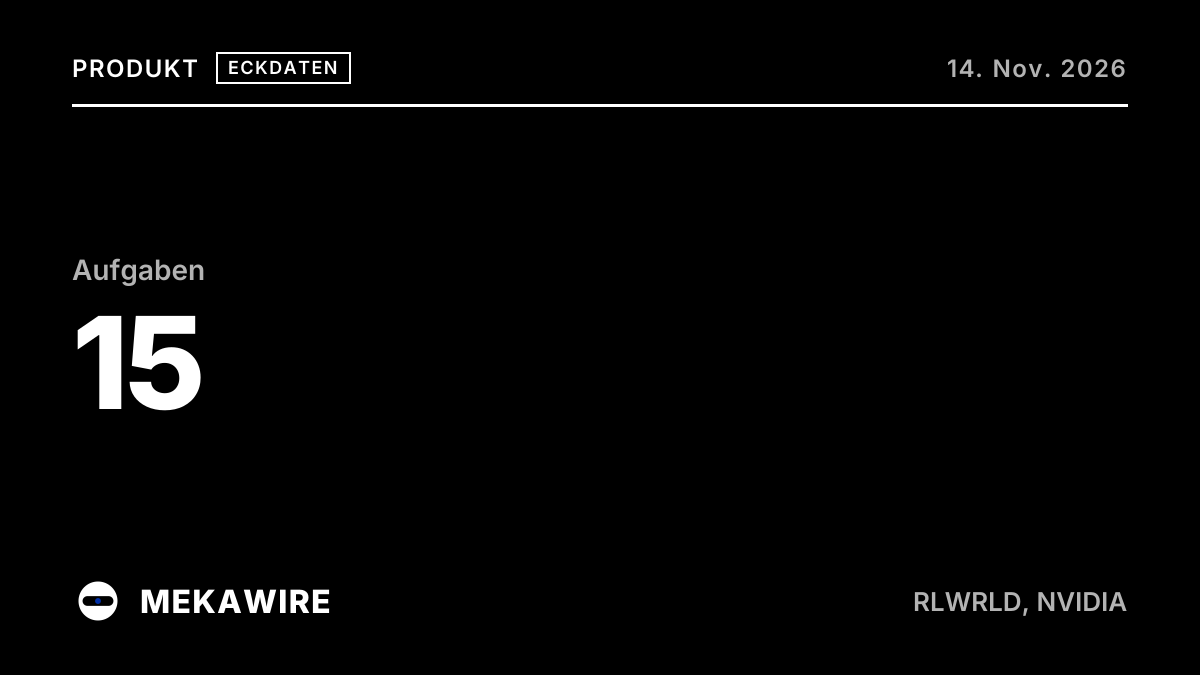
Das Physical-AI-Start-up RLWRLD hat am 9. November DexBench vorgestellt, einen offenen Benchmark mit 15 Aufgaben für fünffingrige Roboterhände in Handel, Logistik, Montage und Hotelgastronomie, aufgebaut auf NVIDIA Isaac Lab-Arena und der Physik-Engine Newton.
Zugleich bestätigte das Unternehmen eine Investition von NVIDIA, ohne Betrag.
RLWRLD teilte am 9. November mit, DexBench veröffentlicht zu haben, einen Benchmark für geschickte Manipulation durch humanoide Hände in der Industrie. Vorgestellt wurde er auf NVIDIAs AI Day Seoul 2026. Das Unternehmen bestätigte außerdem eine von NVIDIA angekündigte Investition; Betrag, Runde und weitere Investoren nannte es nicht.
DexBench umfasst 15 Aufgaben in vier Branchen, darunter das Entladen von Rollcontainern, das Stecken von Steckverbindern und das Verschrauben. Getestet wird die Verallgemeinerung auf unbekannte Objekte, veränderte Physik und neue räumliche Anordnungen. Code, Umgebungen, Trainingsdaten, Basismodelle und eine Rangliste sind unter dexbench.ai offen; die Basiswerte stammen vom eigenen Modell RLDX 1.1.
MEKAWIRE-Analyse
Wer den Test für Roboterhände schreibt, bestimmt, was Käufer als gut ansehen.
Für Montageanwendungen in der deutschen Industrie wären vergleichbare Werte für Steck- und Schraubaufgaben nützlich. Der Haken: DexBench ist reine Simulation, Ergebnisse auf echter Hardware fehlen noch.
- 9. November 2026
- 15
- Handel, Logistik, Montage, Hotelgastronomie
- Objekt, Physik, Raum
- NVIDIA Isaac Lab-Arena und Newton
- Code, Umgebungen, Daten, Basismodelle, Rangliste
- Bestätigt, Betrag nicht genannt
Warum das wichtig ist
DexBench gives five-finger humanoid-hand developers 15 tasks across retail, logistics, assembly and hotel food and beverage, with open code, environments, training data, baselines and a leaderboard. Its object, physics and spatial generalisation axes could help buyers compare adaptability across conditions. The supplied material does not establish whether benchmark results predict performance in deployed operations.
Wettbewerbsanalyse
RLWRLD develops RLDX robot foundation models using in-house motion-capture data, while NVIDIA supplies the underlying simulation platform and is a confirmed investor. That relationship places NVIDIA in both infrastructure and financing roles; it does not establish RLWRLD's technical lead. No competing developers' scores or comparable deployment results are supplied, so a competitive ranking is unsupported.
Bewertungskontext
NVIDIA's investment amount and terms are undisclosed, and no RLWRLD valuation, total funding or financing stage is supplied. NVIDIA is publicly listed, but its market capitalisation is not provided; market cap is distinct from a disclosed private financing valuation. The supplied facts support neither a valuation estimate nor an assessment of the investment's financial materiality.
Zugrunde liegende Forschung
RLWRLD lists PointWAM: 3D World Action Modeling for Dexterous Robotic Manipulation and PaceVLA: Adaptive Temporal Action Quantization in Vision-Language-Action Models. NVIDIA lists ChunkTrust, Magic-W0 and AlphaNIST; no paper results or demonstrated links to DexBench performance are supplied.
Folgen für die Lieferkette
DexBench is built on NVIDIA Isaac Lab-Arena and the Newton physics engine, making that software stack a relevant dependency for users adopting its environments. RLWRLD also identifies in-house motion-capture data as an input to its RLDX models. Hand hardware suppliers, compute procurement, component costs and manufacturing arrangements are not disclosed.
Worauf jetzt zu achten ist
Watch for independent leaderboard submissions and results across all three generalisation axes. Evidence connecting benchmark scores to physical-hand reliability, throughput and intervention rates would clarify commercial relevance, but none is supplied. Disclosure of NVIDIA's investment amount and terms would allow a more grounded financing assessment.
Analystensicht
DexBench could give RLWRLD influence over how dexterous manipulation is evaluated if outside developers adopt it. Open assets lower access barriers, but adoption, commercial traction and a durable model advantage are not established by this release. Investors should treat the benchmark launch and NVIDIA investment as developments to investigate, with technical and financial significance still unquantified.
Offene Fragen
How closely do DexBench scores track physical-hand performance, and which independent developers have submitted results? What investment amount, ownership terms and commercial commitments accompany NVIDIA's backing? Which hand platforms are supported, and what compute and integration costs do users face?