LG and NVIDIA sign robotics pact; LG to unveil bipedal humanoid built with group parts in early 2027
LG Group and NVIDIA signed a strategic collaboration MOU on Aug. 13 covering robots, AI factories and mobility, LG Corp. said. LG will unveil a bipedal humanoid on Jetson Thor and Isaac GR00T in the first quarter of 2027 using LG Electronics actuators, LG Innotek sensors and LG Energy Solution batteries, and will test its wheeled CLOiD on a Tennessee washing-machine line this year.
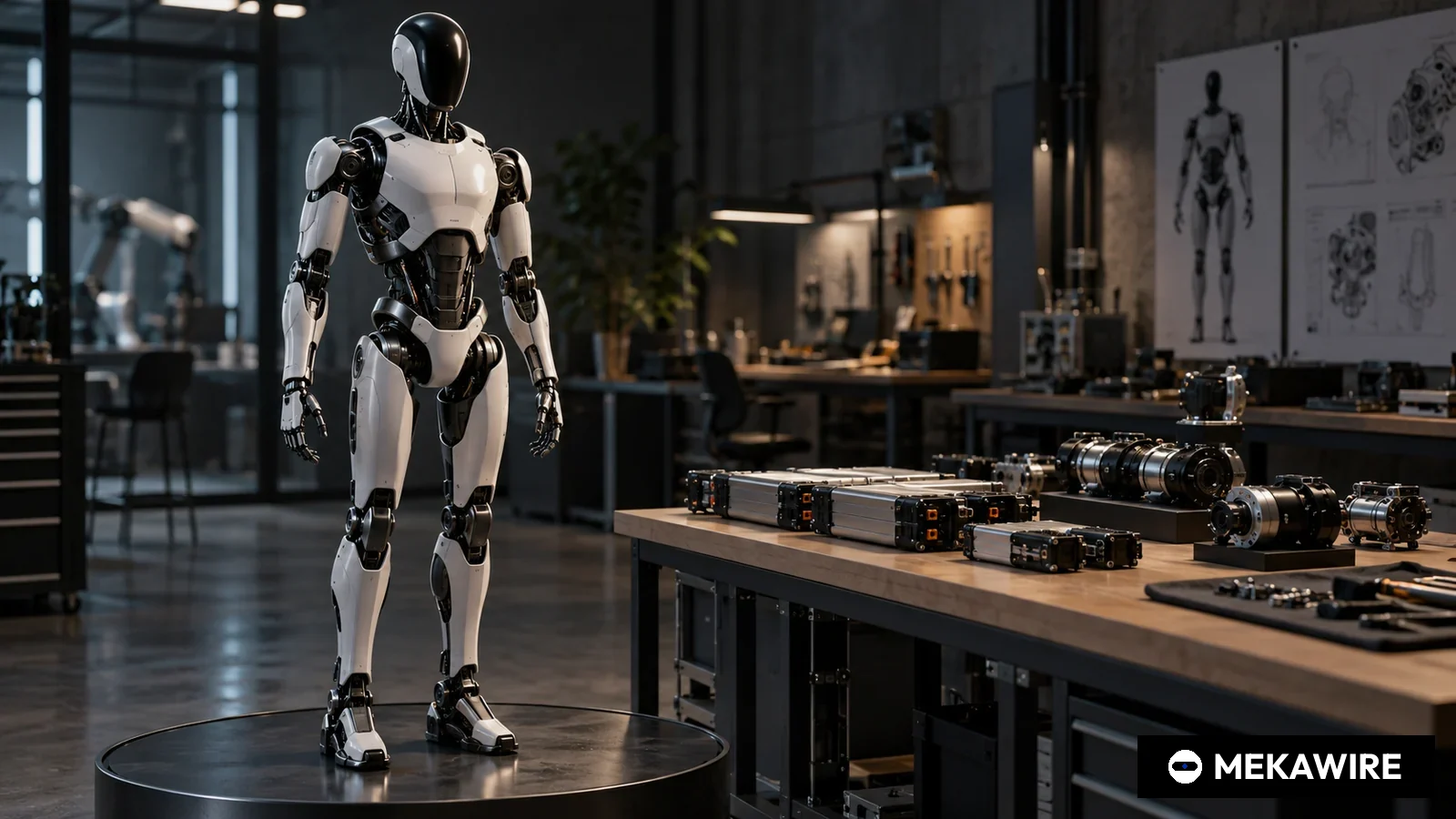
LG Group and NVIDIA signed a strategic business collaboration agreement under which LG will unveil a bipedal humanoid robot built on NVIDIA's platform in the first quarter of 2027, LG Corp. said on Aug. 14. The memorandum was signed on Aug. 13 at NVIDIA's headquarters in Santa Clara, California, by LG Corp. Chief Executive Koo Kwang-mo and NVIDIA founder and CEO Jensen Huang, with the chief executives of LG Electronics, LG Uplus and LG CNS in attendance.
The agreement covers three areas: robots, AI factories and mobility. LG said the humanoid will carry NVIDIA's Jetson Thor computer for onboard reasoning and control, and will be developed on NVIDIA's Isaac GR00T open humanoid foundation model and the Halos for Robotics safety system. LG will put its own affiliates' parts into the robot: actuators from LG Electronics, sensors from LG Innotek and batteries from LG Energy Solution.
LG also said it will deploy its wheel-based CLOiD robot on the washing-machine production line at LG Electronics' plant in Tennessee within this year for a proof of concept in a real manufacturing setting, and then extend deployment to other global plants, homes and commercial spaces. The two companies will work on a robot data factory based on LG CNS's PhysicalWorks platform, and LG said the data and factory experience will feed its own robot foundation model. A joint task force of technical and business staff will run research, field testing and commercialization.
Four days after the signing, the companies met again at LG's Data Factory on the Yangjae R&D Campus in Seoul, LG Electronics said on Aug. 18. The facility covers 10,000 square meters over four floors, one below ground, and is scheduled to be completed by year-end, when it will house several hundred robots. It includes a replicated home for cleaning tasks, a manufacturing area modeled on the Tennessee washing-machine plant, LG CNS logistics automation zones and an LG Innotek space for training robot hands. LG Electronics said it expects to generate 100,000 hours of training data by year-end, equivalent to about 12 years.
LG Electronics set up a Robotics Business Center this year reporting directly to the CEO, the company said, and plans to expand from industrial and commercial robots into home robots using its experience in components such as actuators. The data factory uses NVIDIA's Omniverse libraries, Cosmos world models and Isaac robotics platform. "Through the synergy built on One LG, we will secure our competitiveness in physical AI and become a comprehensive robotics solutions provider," said LG Electronics CEO Lyu Jae-cheol.
The AI factory part of the deal is large. LG will build a reference site based on NVIDIA's Vera Rubin platform in the first half of 2027 to test its cooling, power and IT technologies, then expand to an 80-megawatt AI factory in Cheonan, South Chungcheong Province, in the first half of 2028. LG said a prefabricated modular design will cut construction time by more than 20%, and that the facility will be used for physical AI work including robot foundation models. In mobility, LG plans a high-performance computing platform for AI-defined vehicles that combines NVIDIA DRIVE Hyperion with LG's in-vehicle infotainment business.
"The most important opportunity physical AI offers is giving every machine the ability to understand and reason about the real world and act safely alongside people," Huang said, according to LG. Koo said the collaboration had made clear the tasks the two companies would pursue in AI factories, physical AI and mobility. LG said the agreement follows a meeting of top executives in June at LG Twin Tower in Seoul.
The plan places LG alongside two other Korean groups with humanoid strategies. Hyundai Motor Group's Boston Dynamics opened an Atlas training center at Hyundai's Georgia plant in September and said Hyundai plans to deploy 25,000 Atlas units and build a US factory able to make 30,000 robots a year. Samsung Electronics holds 35.0% of Rainbow Robotics, according to its half-year report. LG's distinctive move is to source the robot's core parts from inside its own group.
- LG
- Bipedal reference humanoid with NVIDIA
- 2,027
- unveiling year (Q1)
- first quarter of 2027
- LG Corp.
- LG
- Robot training data target
- 100,000
- hours
- by end of 2026
- LG Electronics
- LG
- Yangjae data factory floor area
- 10,000
- square meters
- completion by end of 2026
- LG Electronics
- Hyundai Motor Group
- Planned Atlas deployment
- 25,000
- units
- next few years
- Boston Dynamics
- Hyundai Motor Group
- US robot factory capacity
- 30,000
- robots per year
- not disclosed
- Boston Dynamics
- Samsung Electronics
- Stake in Rainbow Robotics
- 35
- percent
- as of half-year report 2026
- Samsung Electronics
- Wonik Holdings
- Wonik Robotics capital raise
- 349,999.98
- million won
- payment Nov. 20, 2026
- Wonik Holdings
Figures as disclosed in company releases and DART filings; no estimates. Units differ by row and are not comparable across groups.
As of Oct 1, 2026
The approach has risks. A reference robot due in the first quarter of 2027 will be a prototype, and LG has given no production volume, price or customer beyond its own plants. The humanoid's intelligence will rest heavily on NVIDIA's models and computers, which NVIDIA also supplies to competing developers. And the Tennessee pilot uses a wheeled robot, not the bipedal design.
The next markers are the CLOiD deployment on the Tennessee washing-machine line before the end of 2026, completion of the Yangjae data factory by year-end, the humanoid unveiling in the first quarter of 2027 and the Vera Rubin reference site in the first half of that year.
MEKAWIRE analysis
LG is building a humanoid out of its own group's parts on NVIDIA's software, which makes the robot as much a showcase for LG components as a product in its own right.
The evidence is in the bill of materials. LG named actuators from LG Electronics, sensors from LG Innotek and batteries from LG Energy Solution, and a data factory built with LG CNS. Those choices turn the humanoid into a reference design that LG affiliates can sell into other robot makers' supply chains.
The strongest counter-argument is dependence. The brain, the onboard computer and the safety stack come from NVIDIA, which offers the same tools to every rival. If differentiation lives in the model rather than the hardware, LG risks building a well-made body that others can match.
Bull case: the first-quarter 2027 robot performs credibly, LG's actuators and batteries win orders from other humanoid makers, and the 100,000-hour data set plus LG's own robot foundation model give it a factory-data edge in home and appliance tasks.
Bear case: the reveal slips or underwhelms, the Tennessee pilot shows the wheeled robot is enough for LG's own lines, and the humanoid becomes a technology demonstrator while NVIDIA captures most of the value.
Signals to watch:
- By end of 2026: CLOiD on the Tennessee washing-machine line and completion of the Yangjae data factory.
- First quarter of 2027: unveiling of the bipedal reference humanoid.
- First half of 2027: Vera Rubin reference AI factory; first half of 2028: 80-megawatt Cheonan site.
- Bipedal reference robot, unveiling targeted for Q1 2027
- LG Electronics actuators, LG Innotek sensors, LG Energy Solution batteries
- Strategic Business Collaboration MOU, signed Aug. 13, 2026, Santa Clara
- Vera Rubin reference site H1 2027; 80 MW in Cheonan H1 2028
- 10,000 m2, Yangjae campus, 100,000 hours of data by end-2026
- Jetson Thor, Isaac GR00T, Halos for Robotics
- Wheeled CLOiD on Tennessee washing-machine line in 2026
Why it matters
The deal is LG's clearest statement that it intends to compete in humanoids, and it does so by tying three listed affiliates to one robot. For LG Electronics, LG Innotek and LG Energy Solution, a working humanoid is a reference design that can open component sales to other robot makers.
For NVIDIA, the agreement spans compute, models, safety, simulation and a large AI factory with one conglomerate, giving it a showcase for its full physical AI stack in a manufacturing-heavy economy.
Rival analysis
Hyundai Motor Group leads Korean rivals on disclosed scale, with 25,000 planned Atlas units and a 30,000-unit US robot factory, and owns its robot developer outright. Samsung's route runs through its 35.0% stake in Rainbow Robotics, which is designing its own reducer modules and actuator controllers.
LG's differentiation is component depth across affiliates and a home and appliance angle, backed by the Tennessee pilot and a home-task area in the data factory. Its weakness is reliance on NVIDIA for the robot's intelligence, which rivals can also license.
Valuation context
No price, investment amount or equity stake was disclosed for the MOU. The financial effect will come through LG affiliates' component revenue, AI factory contracts and any robot sales, none of which are quantified yet.
The 80-megawatt Cheonan AI factory is the only element with a physical scale, and LG said it will serve physical AI and robot foundation model work as well as reference sales of LG cooling, battery and power equipment.
Supply-chain implications
LG intends to supply the robot's actuators, sensors and batteries from inside the group, which narrows openings for outside Korean suppliers but strengthens LG's own position as a component vendor to other humanoid makers.
Korea's 2027 budget raises spending on sensors, actuators and humanoid batteries to 62 billion won, aligned with LG's parts list. LG's suppliers of reducers and other precision mechanical parts were not named and remain an open question.
Signals to watch
Watch the Tennessee CLOiD pilot results, the completion of the Yangjae data factory and whether the 100,000-hour target is met by year-end. The first-quarter 2027 unveiling will show whether the humanoid is a research platform or a product with a launch customer.
Also watch for any external customer for LG actuators or batteries in humanoids, which would validate the component strategy.
Analyst view
Thesis: LG's humanoid is primarily a vehicle to sell group components and NVIDIA-based solutions, with the robot itself a reference design. Confidence: medium. The parts sourcing, NVIDIA stack and timelines are disclosed by LG. Confidence is limited because LG has disclosed no volumes, prices or external customers.
We would raise confidence if LG announces humanoid component supply deals with third-party robot makers or a production plan for the bipedal robot.
Questions you should be asking
What production volume and price does LG target for the bipedal robot after the 2027 reveal. How much of the robot's control software will be LG's own foundation model versus NVIDIA's GR00T.
What results from the Tennessee CLOiD pilot will LG publish, and will the wheeled robot or the humanoid be the main factory product.