Inside Unitree Robotics, where humanoids now outsell robot dogs but nearly three-quarters go to labs and classrooms
Unitree Robotics, the Hangzhou maker of quadruped and humanoid robots that listed on Shanghai's STAR Market in August 2026, now earns more from humanoids than from robot dogs. Its filings show 73.6% of humanoid revenue in the first nine months of 2025 came from research and education buyers, the central question for a company worth about RMB61 billion at its issue price.
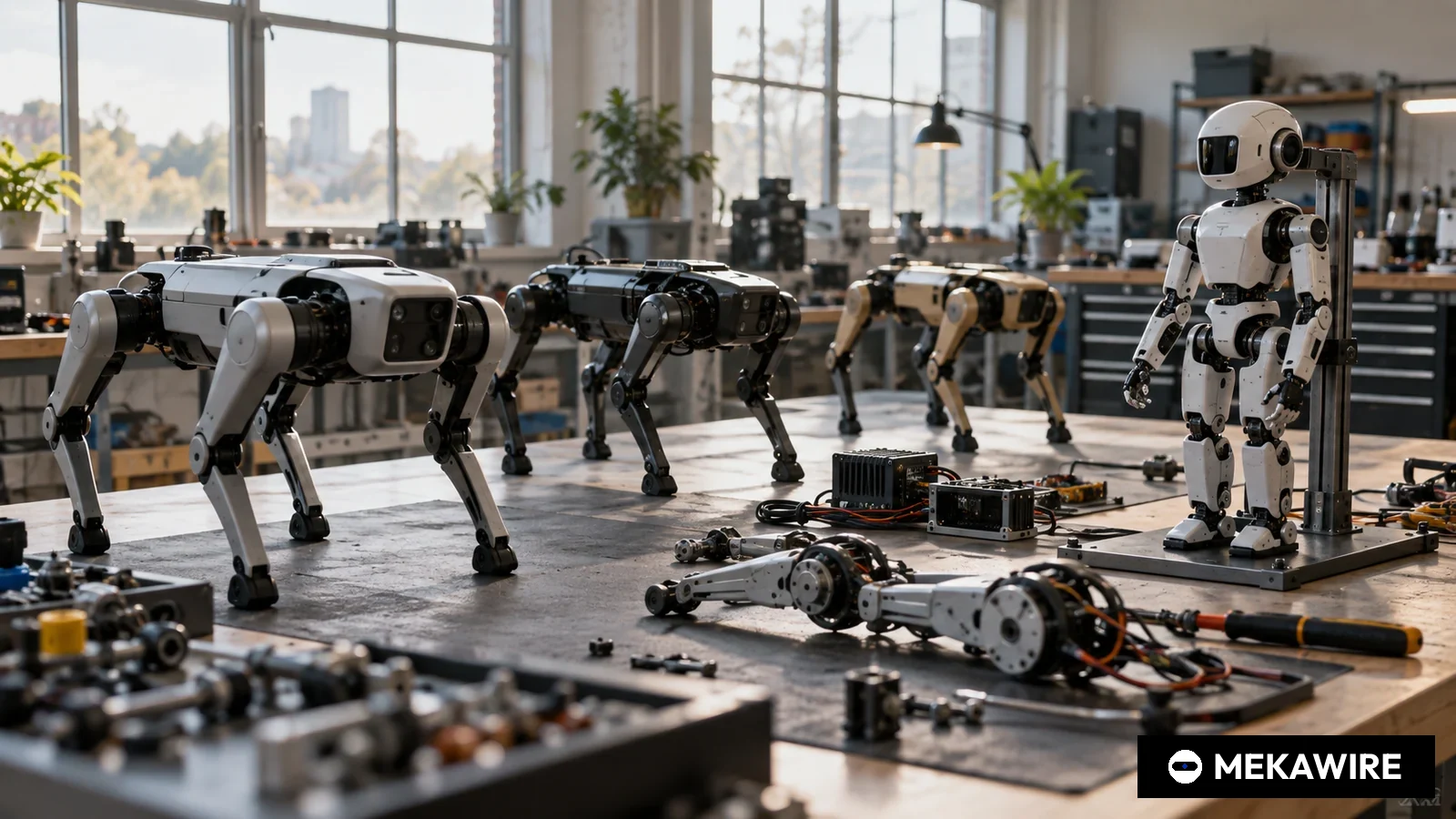
Unitree Robotics is a Hangzhou-based maker of four-legged and humanoid robots, founded in 2016 by Wang Xingxing and listed on the Shanghai Stock Exchange's STAR Market on 19 August 2026 under the code 688836. Its filings show that humanoids overtook quadrupeds as its largest product line in the first nine months of 2025, yet 73.6% of that humanoid revenue came from universities, research institutes and schools, while industrial customers accounted for 9.0%.
That split matters more than the growth rate. Revenue rose from RMB159.1 million in 2023 to RMB1.70 billion in 2025, and investors paid 219 times earnings for the shares. MEKAWIRE covered the filing in March and the listing in August; this profile sets that news aside and asks what kind of business the numbers describe, who buys the robots, how Unitree compares with its rivals and what would have to happen for the price to hold.
A student's robot dog became a company controlled by one founder
Wang built a quadruped called XDog while studying for his master's degree between 2013 and 2016 and started Unitree with angel money, according to the company's website. The company was registered on 26 August 2016 and converted into a joint-stock company on 28 May 2025, the listing announcement shows. Its own timeline runs from the Laikago quadruped in 2017 through AlienGo in 2019, the A1 shown at CES in 2020 and the Go1 in 2021, to the Go2 and the H1 humanoid in 2023, the G1 in 2024 and the R1 and A2 in 2025. The company says it was the first to sell high-performance quadrupeds at retail.
Wang still runs the company and its votes. After the offering he held 21.44% of the shares directly but, through shares carrying ten votes each, up to 65.31% of the voting rights, according to the listing announcement. The next largest holders were Shanghai Yuyi with 9.85%, Hanhai Information with 6.85% and a Sequoia vehicle registered in Ningbo with 5.59%. Strategic placees included the National Council for Social Security Fund and Hangzhou DeepSeek Artificial Intelligence Basic Technology Research, which took 933,399 shares under a 36-month lock-up, worth about RMB140.8 million at the issue price. At the end of 2024 Unitree employed 328 people, 124 of them in research and development, its March application draft says.
The product ladder runs from a US$1,600 dog to a US$29,900 humanoid
Unitree sells across a wide price range. On its website on 1 October 2026 the Go2 quadruped started at US$1,600 for the AIR version and US$2,800 for the PRO, the R1 humanoid at US$4,900, the 1.32-metre G1 at US$13,500 and the 1.82-metre, 31-degree-of-freedom H2 at US$29,900. Industrial quadrupeds such as the B2, rated IP67 with a walking payload above 40 kg, sit alongside dexterous hands, robot arms, the company's own 4D LiDAR sensors and the joint motors used in all of them.
- Go2 AIR
- Quadruped
- 70 x 31 x 40 cm standing
- 15
- No data
- 1,600
- B2
- Industrial quadruped
- IP67
- 60
- No data
- No data
- R1 AIR
- Humanoid
- 123 cm
- 27
- 20
- 4,900
- G1
- Humanoid
- 132 cm
- 35
- 23
- 13,500
- H1
- Humanoid
- about 180 cm
- 47
- 18
- No data
- H2
- Humanoid
- 182 cm
- 70
- 31
- 29,900
Source: unitree.com product pages, read 1 Oct 2026. Null where the page states no figure. Weights as stated by the company.
As of Oct 1, 2026
The engineering approach is vertical. Unitree designs its own joint motors and also sells them as components, so one actuator family serves a 15 kg dog and a 70 kg humanoid. Gross margin rose from 44.22% in 2023 to 56.41% in 2024 and 59.45% in the first nine months of 2025, according to the filings, which do not split margin by product. The company says the G1's motion control is driven by imitation and reinforcement learning, and NVIDIA chose Unitree's H2 Plus for its reference laboratory humanoid in June 2026. The question is who pays for all this hardware.
Humanoids passed quadrupeds in 2025, mostly on lab budgets
The March application draft breaks main-business revenue down by product. Quadrupeds made up 75.78% in 2023 and 59.53% in 2024, then fell to 42.25% in January to September 2025, when humanoids reached 51.53%, or RMB595.2 million. Components slid from 17.09% to 5.76%. Unitree told the exchange it shipped more than 5,500 humanoids in 2025 and more than 30,000 quadrupeds over the reporting period.
- Quadruped robots
- 119.38
- 75.78
- 230.54
- 59.53
- 487.99
- 42.25
- Humanoid robots
- 2.97
- 1.88
- 106.9
- 27.6
- 595.19
- 51.53
- Robot components
- 26.92
- 17.09
- 44.54
- 11.5
- 66.54
- 5.76
- Other
- 8.27
- 5.25
- 5.29
- 1.37
- 5.24
- 0.45
Source: Unitree STAR Market application draft, March 2026. Figures disclosed, not estimated; RMB 10,000 figures converted to millions and rounded. Shares are of main-business revenue.
As of Oct 1, 2026
The customer mix differs sharply by product. In the first nine months of 2025 consumer buyers took 42.29% of quadruped revenue, research and education 31.58% and industry 26.12%, according to Unitree's reply to the exchange's second round of questions. For humanoids, research and education took 73.60%, commercial and consumer uses 17.39% and industry 9.01%. More than 40% of revenue came from outside China in each year from 2023 to 2025, and the US share fell from 19.54% in 2024 to 13.30% in 2025, the prospectus says.
Profit is harder to read than revenue. A RMB349.1 million share-based payment charge in 2025, tied to capital increases at Shanghai Yuyi, left net profit attributable to shareholders at RMB278.2 million on the lower of the pre- and post-non-recurring measures, the filings show. In the first half of 2026 revenue rose 48.54% to RMB1.15 billion, while net profit excluding non-recurring items fell 19.34% to RMB243.9 million. The listing announcement had already flagged that first-quarter revenue growth slowed to 68.49%.
- Revenue (RMB m)
- 159.13
- 392.37
- 1699.27
- 1152.25
- Revenue growth (%)
- No data
- 146.6
- 333.1
- 48.54
- Net profit attributable, lower of pre- and post-non-recurring (RMB m)
- -18.02
- 77.5
- 278.21
- 243.93
- Gross margin (%)
- 44.22
- 56.41
- 59.45
- No data
Sources: listing announcement 18 Aug 2026 (2023, 2025, H1 2026), March 2026 application draft (2024 revenue and profit, gross margins). Revenue growth = revenue / prior-year revenue minus 1; H1 2026 growth as disclosed. 2025 gross margin is the Jan-Sep 2025 figure. 2025 profit includes a RMB349.1m share-based payment charge.
As of Oct 1, 2026
Rivals report on different yardsticks, which flatters nobody
Unitree's peers fall into three groups. UBTech, listed in Hong Kong since December 2023, sold 1,079 full-size humanoids in 2025 and 921 in the first half of 2026, according to its results as covered by MEKAWIRE. AgiBot, founded in 2023, said its 2025 revenue exceeded RMB1 billion and rolled out its 10,000th humanoid on 30 March 2026, while Galbot closed a growth round in June 2025. In the US, Figure AI raised US$1 billion at a US$39 billion post-money value in September 2025, and Agility Robotics, heading to Nasdaq through a SPAC, reported US$1.8 million of 2025 sales in its S-4. Unitree's own listing documents named UBTech and Dobot as listed comparables.
- Unitree
- 2016
- STAR-listed (688836)
- IPO, 19 Aug 2026 (RMB6.10bn)
- No data
- No data
- >5,500 humanoids shipped, 2025
- UBTech Robotics
- 2012
- HKEX-listed (9880)
- H-share placing, 25 Nov 2025
- No data
- No data
- 1,079 full-size humanoids sold, 2025
- AgiBot
- 2023
- Private
- Strategic round, Aug 2025
- No data
- No data
- 10,000th humanoid produced, 30 Mar 2026
- Galbot
- 2023
- Private
- Growth round, 24 Jun 2025
- No data
- No data
- No data
- Figure AI
- No data
- Private
- Series C, 16 Sep 2025
- 1000
- 39
- No data
- Agility Robotics
- 2015
- SPAC merger pending
- Series B, 22 Apr 2022
- 150
- No data
- US$1.8m revenue, 2025 (S-4)
MEKAWIRE database and company disclosures, as of 1 Oct 2026. Amounts and values disclosed, not estimated; null where undisclosed. Volume figures use different definitions and are not comparable.
As of Oct 1, 2026
These volume figures are not on one basis. Unitree reports humanoid shipments including the 1.32-metre G1, UBTech counts full-size units sold and AgiBot counts units produced, so they should not be added up or ranked as market shares.
MEKAWIRE analysis
Unitree is a profitable hardware company whose humanoid business still runs on research budgets, and its share price assumes it can move those robots into paid industrial work faster than Chinese rivals cut prices.
The evidence starts with the price. At RMB150.80 a share and 404.46 million shares after the offering, Unitree's equity was worth about RMB61.0 billion at the issue price, 35.9 times 2025 revenue, matching the 35.89 price-to-sales multiple in the listing announcement. The company raised RMB6.10 billion, 1.45 times the RMB4.2 billion its March filing sought. Of the four funded projects, two are research on robot models and robot bodies, one is new products and one is a manufacturing base. None is a sales channel into factories, the source of only 9.01% of humanoid revenue.
The strongest counter-argument is that the research market is the moat. Labs that publish on Unitree hardware train engineers on its interfaces, and NVIDIA's choice of the H2 Plus suggests that standard is spreading. A default developer humanoid can earn margins near 60% without winning a single car plant.
Bull case. Volume keeps cutting unit costs, the R1 and G1 price points widen the education and consumer base worldwide, and new models funded by the IPO open inspection and light handling, where the B2 quadruped already sells. Revenue growth stays above 40% and margins hold near 60%.
Bear case. Well-funded Chinese rivals match Unitree on price, lab budgets saturate and trade restrictions shrink a US market that still supplied 13.3% of 2025 revenue. Recurring profit, already down 19.34% in the first half of 2026, keeps falling while the share price rests on humanoid hopes.
Three dated signals would confirm or break the thesis.
- By 31 October 2026, the third-quarter report. A return to growth in recurring profit would weaken the bear case.
- 19 February 2027, when the six-month lock-up on 10% of offline allocations ends, a first test of demand at 219 times earnings.
- By 30 April 2027, the 2026 annual report, which should show whether industry rises above 9.01% of humanoid revenue.
The deeper unknown is whether a company that sells robots to people who study robots can become one that sells robots to people who need work done.
- 26 August 2016, Hangzhou; founder and chairman Wang Xingxing
- revenue +48.54% to RMB1.15 billion; recurring profit -19.34%
- STAR Market 688836, 19 August 2026, RMB150.80 per share
- RMB1.70 billion; 2023 RMB159.1 million
- RMB6.10 billion gross, RMB5.92 billion net
- 73.60% research and education, 9.01% industry (Jan-Sep 2025)
- more than 5,500 in 2025 (company filing)
- about RMB61.0 billion (404.46m shares x RMB150.80)
- up to 65.31% after IPO, 21.44% of shares
- 51.53% in Jan-Sep 2025 (27.60% in 2024)
Why it matters
Unitree is now a profitable humanoid and quadruped maker with shares trading on the mainland STAR Market, which turns it into a public benchmark for the category in China. Every private rival raising money in 2026 and 2027, from AgiBot and Galbot to EngineAI and LimX Dynamics, is likely to be priced against Unitree's revenue multiple and its disclosed margins rather than against loss-making US peers.
The filings also give the industry its first exchange-reviewed look at who actually buys humanoids at volume. The answer, 73.60% research and education in January to September 2025, is a useful corrective to the assumption that factory deployment is already the main market. Investors and suppliers planning capacity on industrial adoption curves should read that number first.
Rival analysis
UBTech is the closest listed comparison and the one Unitree itself named. It sells fewer but larger humanoids, 1,079 full-size units in 2025, and has pushed into manufacturing by lifting its stake in Shenzhen-listed Zhejiang Fenglong to 43%. Its pitch is industrial deployment, the segment where Unitree earns 9.01% of humanoid revenue. If UBTech's factory orders convert to repeat volume, it will own the narrative Unitree's valuation depends on.
AgiBot is the volume threat. It said its 2025 revenue exceeded RMB1 billion and produced its 10,000th humanoid in March 2026 while launching a rental network. Galbot, EngineAI and LimX are smaller but well funded; EngineAI raised a US$200 million Series B in April 2026 and LimX a US$200 million pre-IPO round in July 2026. In the US, Figure's US$39 billion post-money value and Agility's US$1.8 million of 2025 revenue show how far private valuations can sit from sales, which makes Unitree's 35.9 times revenue look less extreme by comparison than by any absolute measure.
Valuation context
At the issue price Unitree was worth about RMB61.0 billion, 35.9 times 2025 revenue and 219 times 2025 earnings on the exchange's lower-of measure. Adding back the RMB349.1 million share-based payment charge would lower the earnings multiple materially, which is why the recurring profit line matters more than the headline one. The first-half 2026 decline of 19.34% in recurring profit cuts the other way.
Disclosed private valuations in the category are sparse. Figure's US$39 billion post-money in September 2025 is the only disclosed humanoid valuation above Unitree's issue-price value in the MEKAWIRE data, and it was set in a private round rather than by a public market. A fair reading is that public investors are paying for Unitree's profitability and the scarcity of listed Chinese humanoid shares; the multiple will compress if AgiBot or another rival lists with similar growth.
Supply-chain implications
Unitree's main structural difference from most rivals is that it designs its own joint motors and sells them as components, alongside its own LiDAR. That limits exposure to the reducer and actuator suppliers, such as Harmonic Drive Systems, Nabtesco and Leaderdrive, on which many humanoid makers depend. Components fell from 17.09% to 5.76% of main-business revenue as robot sales outgrew outside sales of parts.
The exposures that remain are compute and batteries. The H2 offers Intel Core processors and a module rated at 2,070 TOPS, and G1 EDU buyers can add NVIDIA Orin, according to Unitree's product pages, so high-end compute still comes from US designs. With more than 40% of revenue from abroad and the US at 13.30% in 2025, Unitree is exposed on both sides of the trade relationship: inputs from US chip designers and sales into US labs.
Signals to watch
The third-quarter report, due by 31 October 2026, is the first clean read on whether recurring profit can grow again after the first-half fall. Watch the humanoid share of revenue and any update to customer mix by application, which the company has so far reported only in its exchange replies.
On 19 February 2027 the six-month lock-up on 10% of offline allocations ends, and on 19 August 2027 the 12-month lock-ups for most strategic placees expire under the terms in the listing announcement. The 2026 annual report, due by 30 April 2027, should show progress on the four IPO projects and whether industrial uses gain share.
Analyst view
Thesis: Unitree is a profitable hardware company whose humanoid business still runs on research budgets, and its valuation assumes a shift into paid industrial work before price competition erodes a near-60% gross margin.
Confidence: medium. The revenue, margin and customer-mix data come from audited and exchange-reviewed filings, which is unusually solid for this category. What lowers confidence is that the most recent customer-mix figure covers only January to September 2025, and the first-half 2026 profit decline could reflect either price cuts or spending on the funded projects; the filings do not yet say which. A rise in the industrial share above 15% of humanoid revenue, or a recovery in recurring profit, would raise confidence in the bull case.
Questions you should be asking
What share of 2026 humanoid revenue comes from industry, and which customers have moved from pilots to repeat orders?
How much of the first-half 2026 fall in recurring profit came from lower selling prices versus higher spending, and what gross margin does the company expect on the H2?
How does Unitree plan to protect US research sales, still 13.30% of 2025 revenue, if trade restrictions on Chinese robots tighten?
What does DeepSeek's affiliate expect from its strategic placement, and is there a technical collaboration on robot models?