A humanoid robot wins Beijing's half marathon in 50 minutes 26 seconds, 17 minutes ahead of the fastest human
The 2026 Beijing E-Town humanoid half marathon on April 19 drew more than 100 robot teams from 13 provinces, against five provinces a year earlier, and about 40% of robots navigated on their own. The winning robot, Lightning of the Qitian Dasheng team, finished the 21.0975-kilometre course in 50:26 while the men's human winner ran 1:07:47, according to the Beijing municipal government.
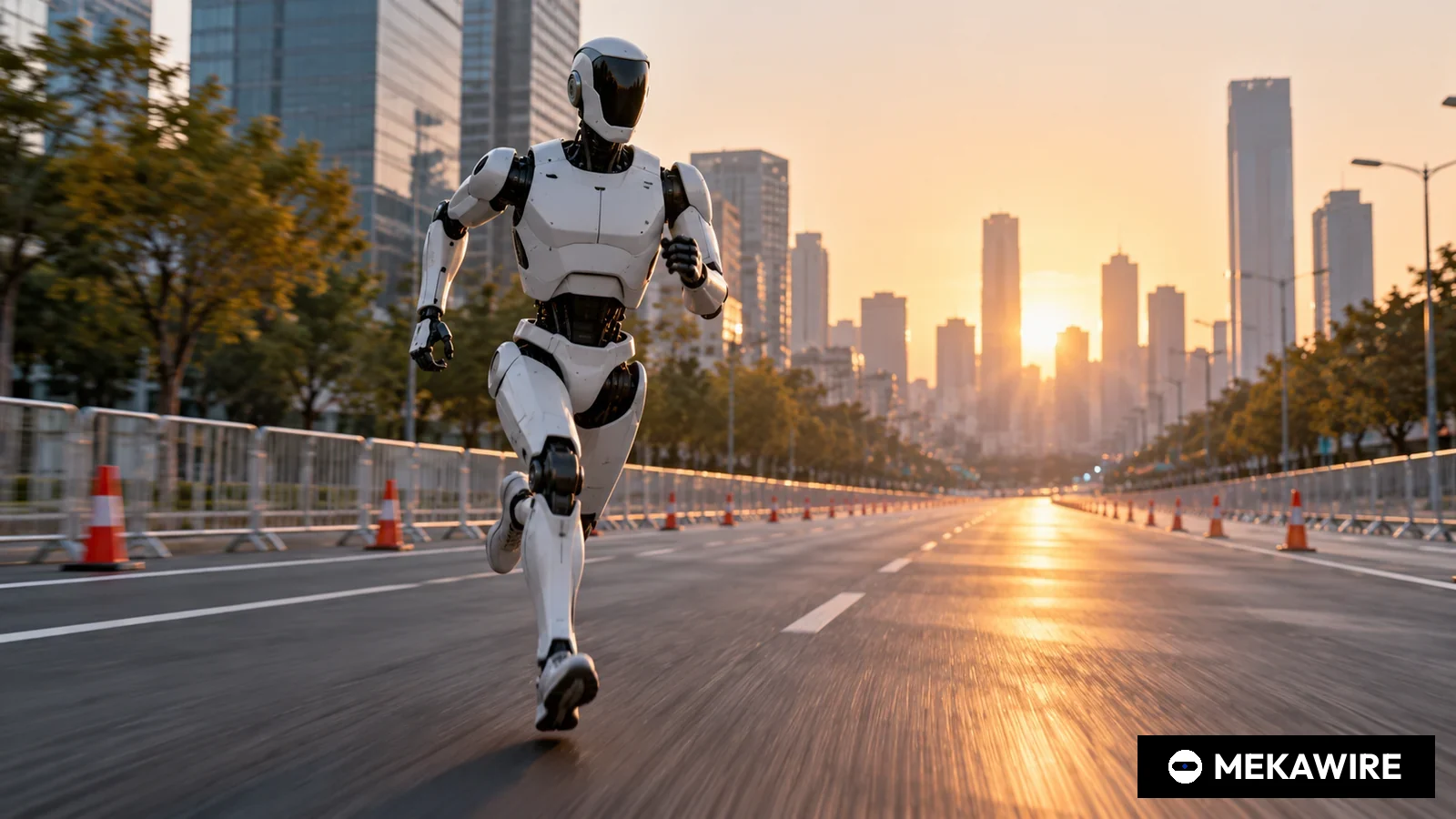
A humanoid robot won the 2026 Beijing E-Town half marathon on April 19 in 50 minutes 26 seconds, finishing 17 minutes 21 seconds ahead of the fastest human in the parallel race, according to a summary published by the Beijing municipal government on April 21, 2026.
The robot, named Lightning and entered by a team called Qitian Dasheng, covered the standard 21.0975-kilometre course at an average of about 25.1 kilometres per hour. The Leiting Shandian and Xinghuo Liaoyuan teams took second and third. In the human race, Zhao Haijie won the men's title in 1:07:47 and Wang Qiaoxia the women's in 1:18:06. The government release did not name the manufacturer of the winning robot.
Scale grew sharply from the first edition. More than 100 humanoid robot teams took part, alongside about 12,000 human runners. Teams came from 13 provinces, against five the year before, and five international teams entered from countries including Germany, France, Portugal and Brazil. The race was certified as an A1 event by the Chinese Athletic Association.
The main technical change was autonomy. The organisers said the 2026 race was the first to apply autonomous humanoid navigation at scale, with about 40% of entrants navigating on their own. Autonomous and remotely controlled robots ran on the same course under a mixed timing system with a single ranking, which means a self-navigating robot competed directly against teleoperated rivals.
The event was hosted by the Beijing Municipal People's Government, China Media Group, the Chinese Institute of Electronics and the World Robot Cooperation Organization. Companies named among participants include Honor, Unitree and Songyan Power, with university teams from Tsinghua University, Peking University and the University of Science and Technology of China.
The race sits within a wider Beijing push to make Yizhuang, the Beijing Economic-Technological Development Area, a base for humanoid robotics. According to the city government, Yizhuang has issued a ten-point support policy for embodied intelligence, built a full-stack developer community for embodied AI robots called Future Machine Domain, opened Beijing's first humanoid robot pilot-production platform and is speeding up construction of the first embodied intelligence super factory in the Beijing, Tianjin and Hebei region. Public competitions have become a tool for that push because they offer a standard test, a fixed date and broad media exposure, and because endurance running stresses the components that most limit humanoids in commercial work: joint heat, battery capacity, foot impact and balance control over long periods.
For the industry the result has a clear reading and a limit. A humanoid sustaining more than 25 km/h for 50 minutes shows how far bipedal locomotion, motor cooling and power management have advanced in Chinese hardware. Running on a closed, marked road is, however, a narrow task. It says little about manipulation, which is where most paid work for humanoids lies, and the release does not give any data on battery swaps, falls or human assistance during the race.
Competition in China's humanoid market is now as much about visibility as specification. Unitree, which is pursuing a STAR Market listing, has long used public demonstrations to sell research and entertainment platforms. Honor, a smartphone maker, uses the event to signal its entry into robotics. Songyan Power and university teams use it to prove engineering against larger rivals.
The official summary leaves several questions open, including the maker and specifications of the winning robot, how many robots finished, and how the organisers verified that robots in the autonomous group were not remotely guided.
- Robot winner: Lightning (Qitian Dasheng)
- 0:50:26
- 50.43
- 25.1
- Navigation mode not stated in release
- Men's human winner: Zhao Haijie
- 1:07:47
- 67.78
- 18.67
- No data
- Women's human winner: Wang Qiaoxia
- 1:18:06
- 78.1
- 16.21
- No data
- Robot teams (count)
- No data
- No data
- No data
- More than 100 from 13 provinces; 5 provinces in 2025
- Autonomous share of robot entrants (%)
- No data
- No data
- No data
- About 40
Times from the Beijing municipal government release of April 21, 2026. Average speed = 21.0975 km / time in hours, rounded. Minutes rounded to two decimals.
As of Oct 1, 2026
MEKAWIRE analysis
Beijing's half marathon has moved from spectacle to benchmark, and the 40% autonomy share is a more important number than the winning time.
The evidence is the change in format. Putting self-navigating and remotely piloted robots in one ranking turns the race into a public test of autonomy under the same conditions, and the jump from five to 13 provinces shows that local governments now see value in fielding teams.
The strongest counter-argument is that running is a solved, narrow problem. Gains in speed come from tuning legs and motors for one task, while the commercial bottlenecks are dexterous manipulation, reliability over shifts and cost, none of which a road race measures.
Bull case: the race pushes suppliers of motors, reducers, batteries and thermal management to harden components that also go into industrial humanoids, and autonomy shares rise each year, producing data on outdoor navigation that transfers to inspection and logistics.
Bear case: teams build single-purpose racers, the event rewards spending on publicity, and results do not translate into buyer confidence for factory robots.
Signals to watch:
- Any company statement identifying the winning robot and its specifications.
- The share of autonomous entrants in the next Beijing E-Town race.
- Whether components proven in the race appear in commercial humanoids announced later in 2026.
- April 19, 2026
- 21.0975 km, Chinese Athletic Association A1 event
- About 40% navigated autonomously; mixed timing, single ranking
- More than 100, from 13 provinces (five a year earlier)
- Lightning (Qitian Dasheng team), 50:26
- About 12,000
- Zhao Haijie 1:07:47; Wang Qiaoxia 1:18:06
- Five, including from Germany, France, Portugal and Brazil
Why it matters
Beijing has turned a showcase into a measured comparison. Running autonomous and remote-controlled robots in one ranking allows a public, if rough, read on how far self-navigation has come in Chinese humanoids, and the 40% autonomy share is a baseline that later editions can be measured against.
The event also shows breadth. Teams from 13 provinces suggest that humanoid development is spreading beyond Beijing, Shanghai and Shenzhen, as provincial governments and universities back their own entrants.
Rival analysis
Unitree is the best-known name among participants and benefits from any event that showcases Chinese bipedal hardware. Honor's participation marks a consumer electronics brand entering the field, in the way that carmakers such as XPeng have moved into humanoids. Songyan Power represents the cohort of smaller hardware start-ups that use competitions to gain recognition.
Outside China, few humanoid developers publish comparable outdoor endurance results. That makes the event a distinctively Chinese marketing and testing channel, which foreign makers have only begun to join through the five international teams.
Valuation context
There is no direct financial disclosure in the release. The market effect is indirect: public wins build brand value for companies preparing listings or fundraising, and for components suppliers that can cite race performance.
Investors should treat race performance as evidence of locomotion engineering, not of commercial traction. Revenue in this sector still depends on research, education and early industrial deployments.
Supply-chain implications
Endurance running at 25 km/h stresses motor windings, reducer wear, joint thermal management and battery discharge rates. Suppliers whose parts survive such loads gain credibility for industrial uses that demand long shifts.
Autonomous navigation on a public road also requires robust perception and localisation hardware, such as depth cameras and lidar, and on-board computing that can handle real-time planning without a remote operator.
Signals to watch
Look for company statements that claim the winning robot, which would reveal specifications and the maker. Watch whether the autonomy share rises in later Beijing events and whether organisers publish completion counts.
Also watch whether the World Humanoid Robot Games and other Beijing events adopt the same mixed-ranking format, which would make autonomy a standard competition variable.
Analyst view
Thesis: the 2026 race is a credible indicator of progress in Chinese bipedal hardware and autonomy, but a weak indicator of commercial readiness.
Confidence: medium. The official release confirms times, scale and autonomy share. It omits finisher counts, assistance data and the winning maker, which limits how much can be inferred.
Questions you should be asking
Which company built Lightning, and what are its height, weight and battery configuration?
How many robots finished, and how many required battery changes or human help?
How did organisers verify autonomy in the self-navigating group?
Will future races add manipulation or load-carrying tasks that matter more to industry?