Koreas Robotik-Börsenwerte im dritten Quartal: Raon und MakinaRocks wachsen, Neuromeka und Curexo schwächeln
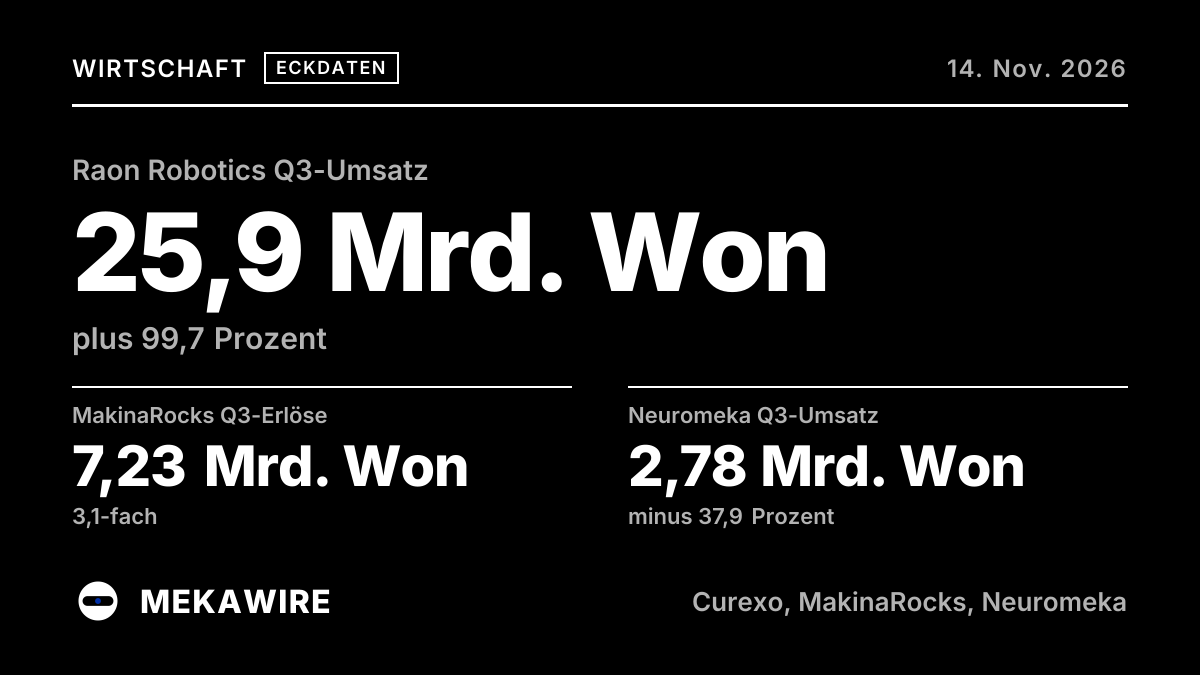
Vier an der KOSDAQ notierte koreanische Robotikunternehmen haben am 13. November ihre Quartalsberichte bei DART eingereicht. Raon Robotics verdoppelte den Q3-Umsatz auf 25,9 Mrd. Won, MakinaRocks verdreifachte ihn auf 7,2 Mrd.
Won. Der Cobot-Hersteller Neuromeka verlor 37,9 Prozent Umsatz, der Chirurgierobotik-Anbieter Curexo rutschte in die operativen Verluste.
Raon Robotics, MakinaRocks, Neuromeka und Curexo haben am 13. November ihre Berichte zum 30. September bei der koreanischen Offenlegungsplattform DART eingereicht. MEKAWIRE hat die konsolidierten Gewinn- und Verlustrechnungen ausgewertet.
- Raon Robotics
- 25,92
- +99,7%
- 3,71
- 1,03
- 58,31
- +50,3%
- Curexo
- 14,75
- -14,4%
- -1,88
- 0,34
- 54,46
- +1,4%
- MakinaRocks
- 7,23
- +213,8%
- -4,39
- -2,57
- 14,26
- +189,5%
- Neuromeka
- 2,78
- -37,9%
- -7,00
- -3,15
- 8,59
- -22,5%
DART-Quartalsberichte vom 13. November 2026; Raten von MEKAWIRE berechnet.
Stand: 14. Nov. 2026
Raon Robotics, Hersteller von Vakuum-Waferhandling-Robotern, steigerte den Umsatz im dritten Quartal um 99,7 Prozent auf 25,9 Mrd. Won, das operative Ergebnis lag bei 3,71 Mrd. Won nach 1,03 Mrd. Die vorläufigen Zahlen vom 30. Oktober entsprechen dem Einzelabschluss; konsolidiert liegt das Neunmonats-Ergebnis bei 5,02 statt 5,44 Mrd. Won.
MakinaRocks, Anbieter industrieller KI-Software, erlöste 7,23 Mrd. Won, das 3,1-Fache des Vorjahres, bei einem operativen Verlust von 4,39 Mrd. Won. Neuromeka meldete 2,78 Mrd. Won Umsatz (minus 37,9 Prozent) und 7,0 Mrd. Won operativen Verlust; Finanzaufwendungen von 24,7 Mrd. Won trieben den Neunmonatsverlust auf 37,6 Mrd. Won. Curexo verlor 14,4 Prozent Umsatz und schrieb 1,88 Mrd. Won operativen Verlust.
MEKAWIRE-Analyse
Bei Koreas börsennotierten Robotikfirmen folgt der Umsatz inzwischen dem Investitionszyklus von Chip- und KI-Kunden, nicht dem Cobot-Markt.
Für europäische Cobot-Anbieter ist Neuromekas Einbruch ein Hinweis auf den Preisdruck chinesischer Wettbewerber. Gegenargument: Raon und MakinaRocks wachsen von kleiner Basis.
- 25,9 Mrd. Won, plus 99,7 Prozent
- 7,23 Mrd. Won, 3,1-fach
- 2,78 Mrd. Won, minus 37,9 Prozent
- minus 1,88 Mrd. Won nach plus 0,34 Mrd.
- 37,6 Mrd. Won
- Vorläufig 5,44 Mrd. (Einzel) vs 5,02 Mrd. konsolidiert
- DART-Quartalsberichte vom 13. November
Warum das wichtig ist
The filings show sharply diverging revenue trends: Raon grew 99.7% to KRW 25.9bn and MakinaRocks reached KRW 7.23bn, 3.1 times a year earlier, while Neuromeka fell 37.9% to KRW 2.78bn. Curexo moved from KRW 0.34bn operating profit to a KRW 1.88bn operating loss. Investors should assess each business separately because these companies serve different markets.
Wettbewerbsanalyse
Neuromeka's collaborative robots overlap with offerings from Rainbow Robotics and Doosan Robotics, but the input provides no rival financial results or market shares. Rainbow's status as a Samsung subsidiary is relevant strategic context, although no resulting orders are disclosed here. Raon's semiconductor and biotech automation, MakinaRocks' industrial AI and Curexo's medical robots limit the usefulness of treating all four reporting companies as direct competitors.
Bewertungskontext
The input supplies no market capitalizations, disclosed valuations or valuation estimates, so revenue growth alone cannot establish relative investment value. Share prices, share counts and comparable financial metrics are missing. For earnings comparisons, Raon's preliminary nine-month operating profit of KRW 5.44bn was on a separate basis, versus KRW 5.02bn consolidated; these figures should not be treated as interchangeable.
Zugrunde liegende Forschung
The supplied title Safety Standards and Deployment Patterns of Collaborative Robots in Korean SMEs is relevant to cobot deployment, but no findings are provided. DexStitch concerns dexterous skills learned from human videos; the input establishes no connection to these companies' financial results.
Folgen für die Lieferkette
Raon supplies wafer transfer robots for semiconductor equipment, while MakinaRocks sells AI software to manufacturers and defence customers. Neuromeka supplies cobots and automation systems, and Curexo supplies surgical and rehabilitation robots. Supplier identities, component sourcing, inventory, production capacity and delivery lead times are missing, preventing a grounded assessment of supply constraints.
Worauf jetzt zu achten ist
Watch whether Raon and MakinaRocks sustain revenue growth and whether that growth translates into consolidated operating profit and cash generation. For Neuromeka, track liquidity and financing after its KRW 37.6bn nine-month net loss, alongside the outcome of the April 24 rights offering. Curexo's next operating result will help show whether its Q3 loss persists; the input gives no explanation for the reversal.
Analystensicht
These results support selective analysis rather than a single Korean robotics growth thesis: revenue momentum differs sharply, and the companies have distinct business models. Neuromeka warrants closer balance-sheet scrutiny because its nine-month net loss already exceeds FY2025's KRW 22.0bn loss. Cash balances, debt, cash flow and order backlogs are missing, so the filings summarized here cannot establish funding runway or recovery prospects.
Offene Fragen
What drove Raon's and MakinaRocks' revenue increases, and how much came from repeat customers or recurring contracts? What are Neuromeka's cash balance, cash burn and rights-offering proceeds, and what caused Curexo's operating reversal?