韩国机器人上市公司三季报:Raon和MakinaRocks增长,Neuromeka和Curexo下滑
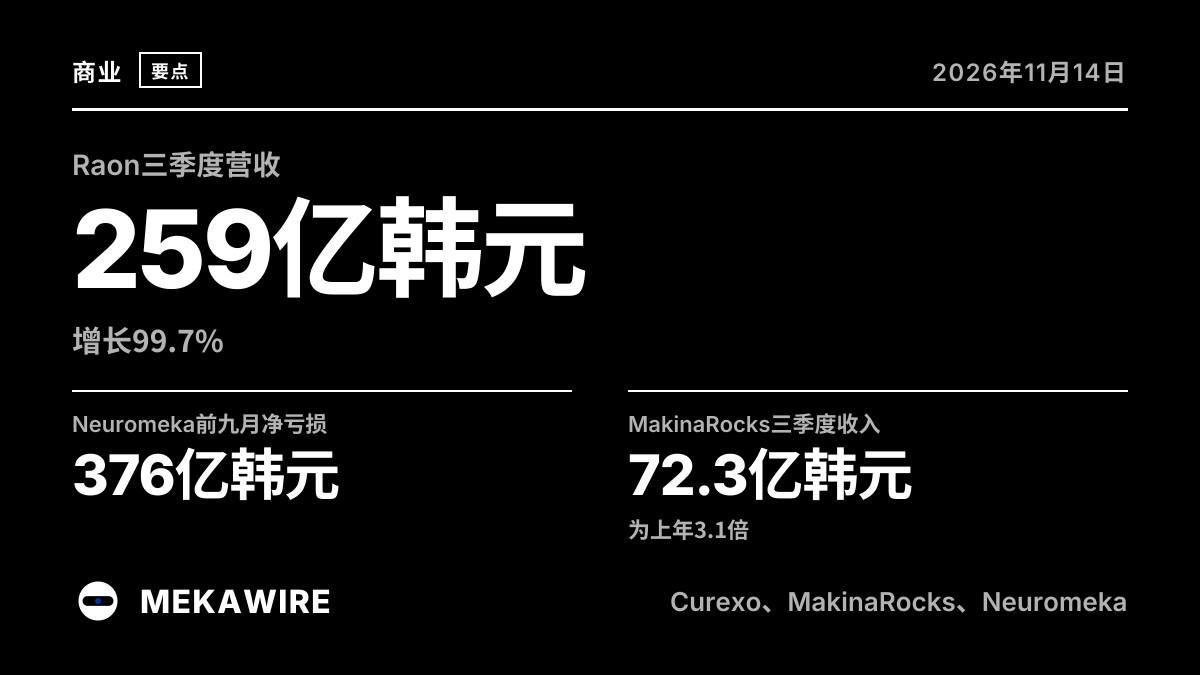
四家韩国科斯达克上市机器人公司于11月13日向DART提交三季报。晶圆搬运机器人厂商Raon Robotics三季度营收翻倍至259亿韩元,工业AI公司MakinaRocks营收增至3倍;协作机器人厂商Neuromeka营收下降37.9%,手术机器人厂商Curexo转为经营亏损。数据由MEKAWIRE根据合并报表整理。
Raon Robotics、MakinaRocks、Neuromeka和Curexo于11月13日向韩国DART提交截至9月30日的季度报告。MEKAWIRE比对四家公司的合并损益表发现,面向晶圆厂和工厂AI的两家公司快速增长,协作机器人和手术机器人厂商则走弱。
- Raon Robotics
- 259
- +99.7%
- 37
- 10
- 583
- +50.3%
- Curexo
- 147
- -14.4%
- -19
- 3
- 545
- +1.4%
- MakinaRocks
- 72
- +213.8%
- -44
- -26
- 143
- +189.5%
- Neuromeka
- 28
- -37.9%
- -70
- -32
- 86
- -22.5%
11月13日DART季度报告合并损益表,增速为MEKAWIRE计算。
截至 2026年11月14日
Raon Robotics三季度营收259亿韩元,同比增长99.7%,经营利润37.1亿韩元。其10月30日业绩预告中的前九月营收589亿韩元和经营利润54.4亿韩元,与本次报告的单体报表一致;合并口径分别为583亿和50.2亿韩元。
MakinaRocks三季度营业收入72.3亿韩元,为上年同期的3.1倍,但经营亏损扩大至43.9亿韩元;9月末现金331亿韩元。Neuromeka三季度营收27.8亿韩元,同比下降37.9%,经营亏损70亿韩元;前九月财务费用247亿韩元,净亏损376亿韩元,超过2025年全年的220亿韩元。Curexo三季度营收下降14.4%,经营亏损18.8亿韩元。
MEKAWIRE 分析
韩国上市机器人公司的营收如今跟随半导体和AI资本开支周期,而不是协作机器人周期。
Neuromeka面临的正是遨博、节卡、越疆等中国协作机器人厂商的价格竞争。反方观点是基数效应:Raon和MakinaRocks去年同期规模较小。
- 259亿韩元,增长99.7%
- 72.3亿韩元,为上年3.1倍
- 27.8亿韩元,下降37.9%
- 亏损18.8亿韩元,上年盈利3.4亿
- 376亿韩元
- 预告54.4亿为单体,合并50.2亿
- DART季度报告,11月13日
为何重要
The filings show sharply diverging revenue trends: Raon grew 99.7% to KRW 25.9bn and MakinaRocks reached KRW 7.23bn, 3.1 times a year earlier, while Neuromeka fell 37.9% to KRW 2.78bn. Curexo moved from KRW 0.34bn operating profit to a KRW 1.88bn operating loss. Investors should assess each business separately because these companies serve different markets.
竞争对手分析
Neuromeka's collaborative robots overlap with offerings from Rainbow Robotics and Doosan Robotics, but the input provides no rival financial results or market shares. Rainbow's status as a Samsung subsidiary is relevant strategic context, although no resulting orders are disclosed here. Raon's semiconductor and biotech automation, MakinaRocks' industrial AI and Curexo's medical robots limit the usefulness of treating all four reporting companies as direct competitors.
估值背景
The input supplies no market capitalizations, disclosed valuations or valuation estimates, so revenue growth alone cannot establish relative investment value. Share prices, share counts and comparable financial metrics are missing. For earnings comparisons, Raon's preliminary nine-month operating profit of KRW 5.44bn was on a separate basis, versus KRW 5.02bn consolidated; these figures should not be treated as interchangeable.
研究依据
The supplied title Safety Standards and Deployment Patterns of Collaborative Robots in Korean SMEs is relevant to cobot deployment, but no findings are provided. DexStitch concerns dexterous skills learned from human videos; the input establishes no connection to these companies' financial results.
供应链影响
Raon supplies wafer transfer robots for semiconductor equipment, while MakinaRocks sells AI software to manufacturers and defence customers. Neuromeka supplies cobots and automation systems, and Curexo supplies surgical and rehabilitation robots. Supplier identities, component sourcing, inventory, production capacity and delivery lead times are missing, preventing a grounded assessment of supply constraints.
后续看点
Watch whether Raon and MakinaRocks sustain revenue growth and whether that growth translates into consolidated operating profit and cash generation. For Neuromeka, track liquidity and financing after its KRW 37.6bn nine-month net loss, alongside the outcome of the April 24 rights offering. Curexo's next operating result will help show whether its Q3 loss persists; the input gives no explanation for the reversal.
分析师观点
These results support selective analysis rather than a single Korean robotics growth thesis: revenue momentum differs sharply, and the companies have distinct business models. Neuromeka warrants closer balance-sheet scrutiny because its nine-month net loss already exceeds FY2025's KRW 22.0bn loss. Cash balances, debt, cash flow and order backlogs are missing, so the filings summarized here cannot establish funding runway or recovery prospects.
值得追问的问题
What drove Raon's and MakinaRocks' revenue increases, and how much came from repeat customers or recurring contracts? What are Neuromeka's cash balance, cash burn and rights-offering proceeds, and what caused Curexo's operating reversal?