Korean robot makers' Q3 filings: Raon and MakinaRocks grow, Neuromeka and Curexo slip
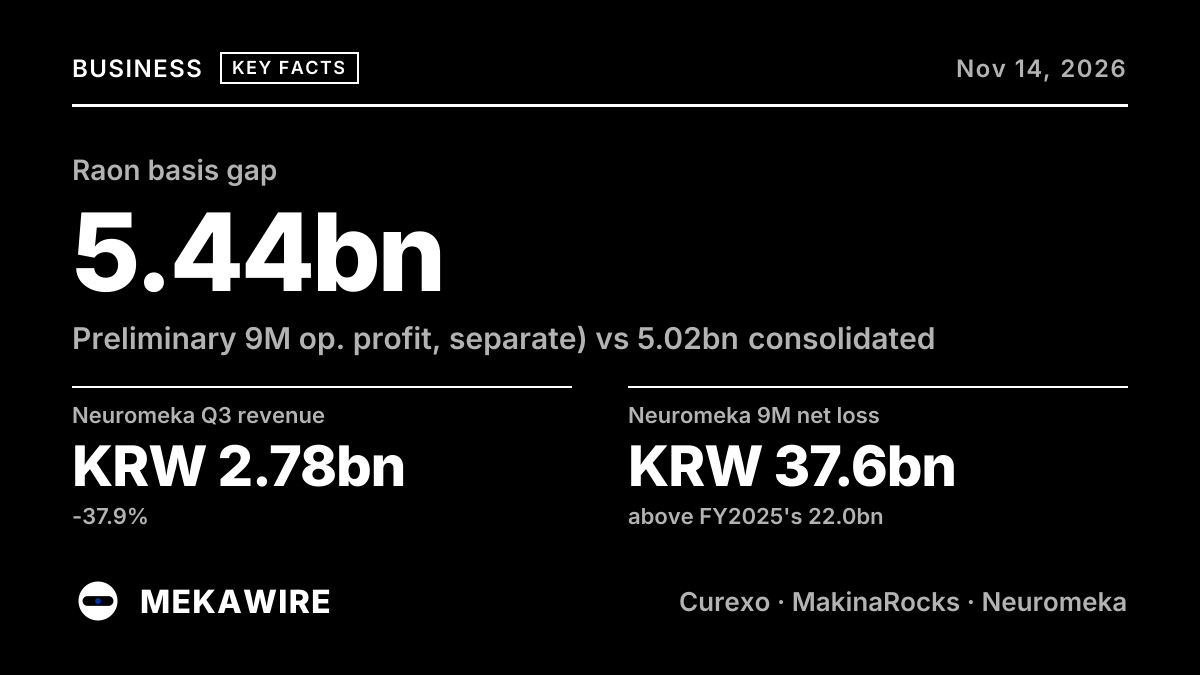
Four KOSDAQ-listed Korean robotics companies filed third-quarter reports to DART on Nov 13. Raon Robotics doubled Q3 revenue to KRW 25.9 billion and MakinaRocks tripled it to KRW 7.2 billion, while Neuromeka's revenue fell 37.9% to KRW 2.8 billion and Curexo swung to an operating loss of KRW 1.9 billion.
Neuromeka's nine-month net loss of KRW 37.6 billion already exceeds any full year in its last two annual reports. MEKAWIRE compiled the figures from the consolidated statements.
Four listed Korean robotics companies filed their quarterly reports for the period to Sept 30 with DART on Nov 13. MEKAWIRE read the consolidated income statements of all four: the two companies selling into chip fabs and factory AI grew fast, while the cobot maker and the surgical-robot maker lost ground.
The quarter in one table
- Raon Robotics
- 25.92
- +99.7%
- 3.71
- 1.03
- 58.31
- +50.3%
- Curexo
- 14.75
- -14.4%
- -1.88
- 0.34
- 54.46
- +1.4%
- MakinaRocks
- 7.23
- +213.8%
- -4.39
- -2.57
- 14.26
- +189.5%
- Neuromeka
- 2.78
- -37.9%
- -7.00
- -3.15
- 8.59
- -22.5%
Consolidated income statements in the quarterly reports filed to DART on Nov 13, 2026. MakinaRocks reports operating revenue. Growth rates are MEKAWIRE calculations from the filed won amounts.
As of Nov 14, 2026
Raon Robotics, which makes vacuum wafer-transfer robots, reported Q3 revenue of KRW 25.9 billion, up 99.7% from KRW 13.0 billion a year earlier, and operating profit of KRW 3.71 billion against KRW 1.03 billion. Nine-month operating profit rose 81.6% to KRW 5.02 billion. These consolidated figures sit below the preliminary numbers Raon filed on Oct 30 (nine-month revenue KRW 58.9 billion, operating profit KRW 5.44 billion), which match the separate, parent-only statements in the new report. Both are correct for their basis; the consolidated set is the one comparable with peers.
MakinaRocks, the industrial AI software company, booked Q3 operating revenue of KRW 7.23 billion, 3.1 times the KRW 2.30 billion of a year earlier, but its operating loss widened to KRW 4.39 billion. Cash and equivalents stood at KRW 33.1 billion on Sept 30, against KRW 4.6 billion at the end of 2025.
Neuromeka's Q3 revenue fell to KRW 2.78 billion from KRW 4.47 billion, and its gross profit for the quarter was KRW 0.12 billion. Its operating loss doubled to KRW 7.0 billion. Finance costs of KRW 24.7 billion over nine months pushed the net loss to KRW 37.6 billion, above its full-year losses of KRW 22.0 billion for 2025 and KRW 16.8 billion for 2024. Equity rose to KRW 104.6 billion from KRW 13.9 billion at the end of 2025, with share capital and capital surplus both higher.
Curexo, maker of the Cuvis joint and spine robots, saw Q3 revenue drop 14.4% to KRW 14.7 billion and posted an operating loss of KRW 1.88 billion against a KRW 0.34 billion profit. Nine-month revenue was flat at KRW 54.5 billion (+1.4%).
MEKAWIRE analysis
In Korea's listed robotics group, revenue now follows the semiconductor and AI capex cycle, not the cobot cycle.
Raon sells into fabs and MakinaRocks into factory AI projects; both rode customer capex. Neuromeka and Curexo depend on unit sales of cobots and surgical systems, where price competition from China and hospital budgets weigh. The counter-argument is base effects: MakinaRocks' and Raon's year-earlier quarters were small. What to watch: whether Rainbow Robotics and Doosan Robotics show the same split in their Q3 reports, and how Neuromeka spends its new capital on the China joint venture and POSCO robot foundry plans covered in our Neuromeka explainer.
- DART quarterly reports, Nov 13, 2026
- Preliminary 9M op. profit 5.44bn (separate) vs 5.02bn consolidated
- KRW 2.78bn, -37.9%
- KRW 37.6bn, above FY2025's 22.0bn
- KRW 7.23bn, 3.1x a year earlier
- KRW 25.9bn, +99.7%
- KRW -1.88bn vs +0.34bn
Why it matters
The filings show sharply diverging revenue trends: Raon grew 99.7% to KRW 25.9bn and MakinaRocks reached KRW 7.23bn, 3.1 times a year earlier, while Neuromeka fell 37.9% to KRW 2.78bn. Curexo moved from KRW 0.34bn operating profit to a KRW 1.88bn operating loss. Investors should assess each business separately because these companies serve different markets.
Rival analysis
Neuromeka's collaborative robots overlap with offerings from Rainbow Robotics and Doosan Robotics, but the input provides no rival financial results or market shares. Rainbow's status as a Samsung subsidiary is relevant strategic context, although no resulting orders are disclosed here. Raon's semiconductor and biotech automation, MakinaRocks' industrial AI and Curexo's medical robots limit the usefulness of treating all four reporting companies as direct competitors.
Valuation context
The input supplies no market capitalizations, disclosed valuations or valuation estimates, so revenue growth alone cannot establish relative investment value. Share prices, share counts and comparable financial metrics are missing. For earnings comparisons, Raon's preliminary nine-month operating profit of KRW 5.44bn was on a separate basis, versus KRW 5.02bn consolidated; these figures should not be treated as interchangeable.
Related papers
The supplied title Safety Standards and Deployment Patterns of Collaborative Robots in Korean SMEs is relevant to cobot deployment, but no findings are provided. DexStitch concerns dexterous skills learned from human videos; the input establishes no connection to these companies' financial results.
Supply-chain implications
Raon supplies wafer transfer robots for semiconductor equipment, while MakinaRocks sells AI software to manufacturers and defence customers. Neuromeka supplies cobots and automation systems, and Curexo supplies surgical and rehabilitation robots. Supplier identities, component sourcing, inventory, production capacity and delivery lead times are missing, preventing a grounded assessment of supply constraints.
Signals to watch
Watch whether Raon and MakinaRocks sustain revenue growth and whether that growth translates into consolidated operating profit and cash generation. For Neuromeka, track liquidity and financing after its KRW 37.6bn nine-month net loss, alongside the outcome of the April 24 rights offering. Curexo's next operating result will help show whether its Q3 loss persists; the input gives no explanation for the reversal.
Analyst view
These results support selective analysis rather than a single Korean robotics growth thesis: revenue momentum differs sharply, and the companies have distinct business models. Neuromeka warrants closer balance-sheet scrutiny because its nine-month net loss already exceeds FY2025's KRW 22.0bn loss. Cash balances, debt, cash flow and order backlogs are missing, so the filings summarized here cannot establish funding runway or recovery prospects.
Questions you should be asking
What drove Raon's and MakinaRocks' revenue increases, and how much came from repeat customers or recurring contracts? What are Neuromeka's cash balance, cash burn and rights-offering proceeds, and what caused Curexo's operating reversal?