ASUS targets 2H 2028 for Gallop humanoid, sets 99.5% in 20 seconds as its factory test
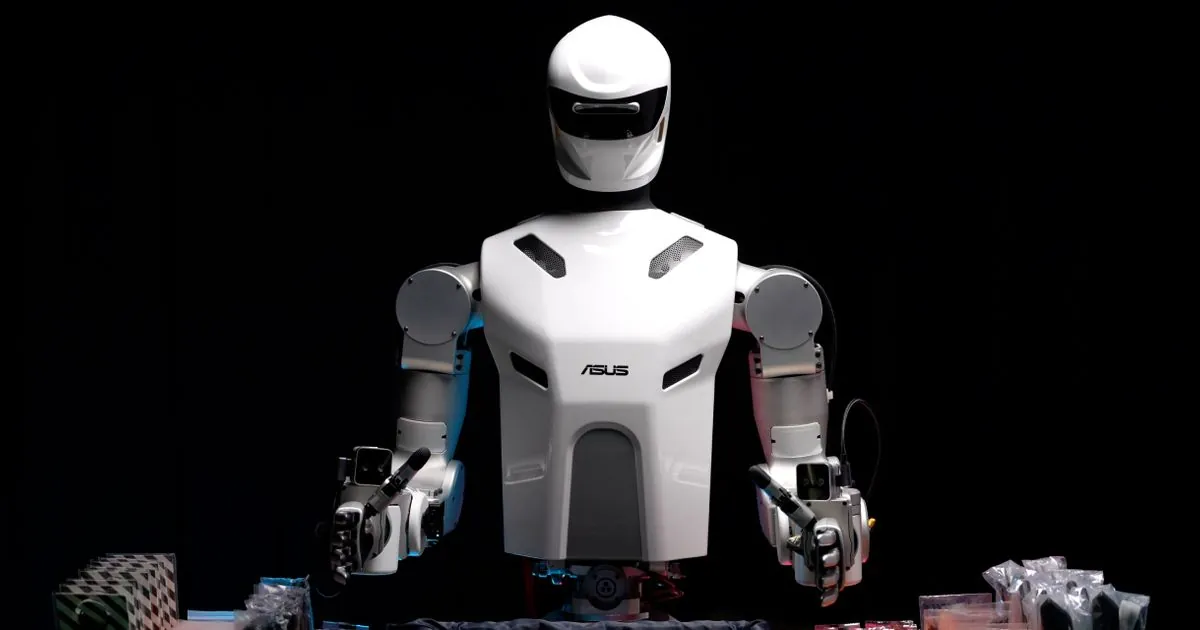
ASUS said on Nov 13 that its first humanoid robot, Gallop, is being tested packing motherboard accessories at an ASUS group electronics factory, with a target of 99.5% success within 20 seconds per board, the standard it applies to a person.
Customer pilots are planned for 2027 and market availability is targeted for the second half of 2028. The robot runs on one NVIDIA Jetson AGX Thor, and ASUS did not disclose its current success rate or a price.
ASUS said in a post on its press site on Nov 13 that its first humanoid robot, Gallop, is being tested at a motherboard accessory packing station in an ASUS group electronics factory, with a target of 99.5% success within 20 seconds per board. The Taiwanese computer maker plans customer pilots in 2027 and is targeting the second half of 2028 for market availability.
A packing station with 15 parts is the first test
The post, written by Albert Chang of ASUS, describes one workstation. It has 15 small parts, many of them in thin, clear bags, and a board takes about 20 seconds. ASUS said the 99.5% target within that time is the same standard it applies to a person. The company said the full loop now works, meaning a person shows the task, the robot learns it and the result is tested on the line. It did not publish the success rate Gallop reaches today.
Gallop currently works from a fixed base with two arms. ASUS said that over the coming year it will fit its own dexterous hand, which has a sense of touch, put the robot on wheels and show it to customers at Computex 2027. The programme started in early 2026 and sits in the Humanoid Robotics business unit of the Physical AI Solutions Business Group.
ASUS builds the body and hand and takes the base model from others
ASUS said it does not build its own large AI model and starts from open models. Skilled workers wear a small head camera, with their consent, so the robot can learn from how the job is done. Simulation produces variations of each example, and an operator wearing a virtual reality headset and gloves guides the robot on the same parts. The software has four layers, a planner, a supervisor that checks each step, a skills layer and a control layer, and all of it runs on a single NVIDIA Jetson AGX Thor computer inside the robot, according to the post. ASUS designs the body and hand itself and buys motors and other standard components from partners.
NVIDIA describes the Jetson Thor series as its Blackwell-based Jetson for high-end physical AI at the edge. MEKAWIRE covered the launch of that computer in August 2025.
MEKAWIRE analysis
ASUS has published a pass mark before it has published a result, and the pass mark is a human cycle time at one of its own stations.
- Programme start
- Early 2026
- First workstation
- Motherboard accessory packing at an ASUS group EMS factory
- Station
- 15 small parts, about 20 seconds per board
- Target
- 99.5% success within 20 seconds
- Current form
- Fixed base, two arms
- Next year
- In-house dexterous hand, wheeled version, customer showing at Computex 2027
- Customer pilots
- Planned for 2027
- Market availability
- Targeted for the second half of 2028
- Onboard computer
- One NVIDIA Jetson AGX Thor
Source: ASUS press site blog post, Nov 13, 2026. MEKAWIRE calc.: 20 seconds divided by 15 parts is about 1.3 seconds a part, 3,600 seconds divided by 20 is 180 boards an hour, and 99.5% leaves five failures per 1,000 boards.
As of Nov 16, 2026
MEKAWIRE worked the station figures through. Fifteen parts in 20 seconds is about 1.3 seconds a part, and a 20-second cycle is 180 boards an hour if the station runs without a pause (MEKAWIRE calc.). A 99.5% success rate allows no more than five failed boards in every 1,000 (MEKAWIRE calc.). The programme began in early 2026 and market availability is targeted for the second half of 2028, roughly two and a half years later.
The open questions are the ones the post leaves out: the current success rate, the price and the number of robots ASUS intends to build. ASUS said electronics manufacturing comes first, with hospitals and service sites later. For how the market counts humanoids today, see the MEKAWIRE shipments explainer. The next dated checkpoints are Computex 2027 and the 2027 customer pilots.
- 99.5% success within 20 seconds per board
- 15 small parts, about 20 seconds per board
- Planned for 2027
- Early 2026
- 1 NVIDIA Jetson AGX Thor
- Second half of 2028, targeted
- 180 boards an hour at a 20-second cycle