NVIDIA GR00T 2 hits 71% on 50 tasks from one demo each, 95% from five
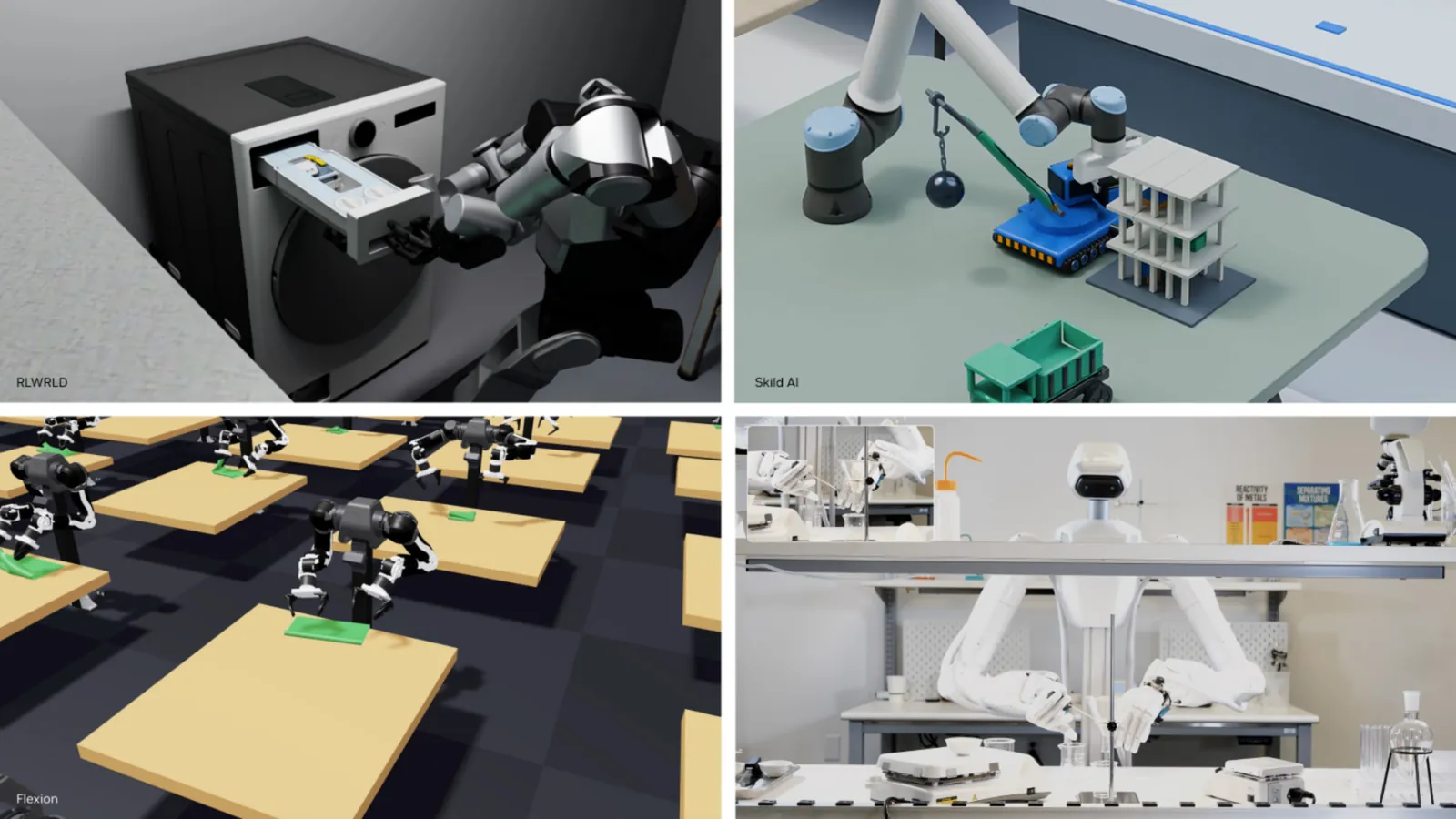
NVIDIA said in a blog post on Nov 9 at the CoRL conference in Austin that GR00T 2, its new world action model built on Cosmos, reached 71% average success across 50 tasks with one demonstration per task and 95% with five, and completed 40 of the 50 at least once with no task-specific demonstration.
Its pretraining mix includes 402,730 hours of egocentric human video, of which 100,000 hours are openly released, NVIDIA's research page says, about 19 times the 20,854 hours NVIDIA gives for GR00T N1.7.
NVIDIA also released Isaac Lab 3.0, which it said trains up to 2.5 times faster with the Newton physics engine.
NVIDIA introduced GR00T 2 on Nov 9 at the Conference on Robot Learning (CoRL) in Austin, describing it in a company blog post as an open world action model built on its Cosmos platform. With one demonstration per task the model reached 71% average success across 50 evaluated tasks, rising to 95% with five demonstrations, NVIDIA said. It completed 40 of the 50 tasks at least once without any task-specific demonstration, and NVIDIA said it learns from human demonstrations and moves skills between different robot bodies without robot demonstrations.
The training mix is where NVIDIA put its weight. The blog says GR00T 2 learned from robot and human data, including 100,000 hours of NVIDIA's open-source egocentric human video. That figure is the openly released subset. NVIDIA's GR00T 2 research page says the pretraining mix holds 402,730 hours of egocentric video of people at work, alongside 23,500 hours of robot teleoperation and 10,184 hours of handheld-gripper demonstrations, and that 100,000 hours of the human video are public on Hugging Face. NVIDIA's GitHub repository for the GR00T family still lists GR00T N1.7 as the current public release and says N1.7 used 20K hours of EgoScale human video in pretraining; NVIDIA's Hugging Face post on N1.7 gives the precise figure as 20,854 hours. GR00T 2's pretraining therefore draws on about 19 times as much human footage by MEKAWIRE's calculation (402,730 / 20,854). NVIDIA said GR00T 2 ranks in the top three across vision-language-action and world-action-model categories on the RoboCasa365, RoboLab, RoboDojo and MolmoSpaces benchmarks. Nexuni is testing it for laundry handling, Foxconn is applying it to server manufacturing and Siemens is evaluating it, according to the post. AI agents can call the model through an API to chain skills and recover from errors.
Isaac Lab 3.0 moves the training into Newton
Isaac Lab 3.0, NVIDIA's open-source robot-learning framework, lets agents build training environments, switch between the PhysX and Newton physics solvers and run a new reinforcement post-training library on models such as GR00T. With Newton it can model deformable objects such as cables and cloth and many-jointed robot hands. In a vision-based dexterous manipulation benchmark, Isaac Lab 3.0 with Newton delivered up to 2.5 times the training throughput of Isaac Lab 2.3 with PhysX, NVIDIA said. Skild AI announced STEEL, a rigid-body solver built on Newton, and Flexion, FieldAI and RLWRLD were among the partners NVIDIA named.
How GR00T 2 compares
- NVIDIA GR00T N1.7
- Current GitHub release
- 20,854 hours (EgoScale)
- Yes, 3B parameters, NVIDIA Open Model License
- Comparable to N1.6 per README, about 40 Hz on RTX PRO 6000
- NVIDIA GR00T 2
- Nov 9, 2026
- 402,730 hours in pretraining (100,000 open), plus robot data
- Not in public repo as of Nov 14
- Top three on four leaderboards
- Runway Praxis-1
- Sept 30, 2026 (open weights Nov 11)
- Not disclosed
- Yes, 27B, Apache 2.0
- 46.2% on RoboLab-120
Sources: NVIDIA blog (Nov 9), NVIDIA GR00T 2 research page, NVIDIA Isaac-GR00T GitHub README (checked Nov 14), Runway posts (Sept 30 and Nov 11). Ratio of human video hours is a MEKAWIRE calculation.
As of Nov 14, 2026
The benchmark claims are not directly comparable: Runway gave a single RoboLab-120 score for Praxis-1 on Nov 11, while NVIDIA gives rank bands across four leaderboards and no single score.
MEKAWIRE analysis
In the week OpenAI folded its robotics team into general research, NVIDIA doubled down on a robot-specific world action model trained mostly on human video, and the two bets cannot both be the cheapest route.
The 71% to 95% curve is the commercially useful number: if five demonstrations reach 95% on real tasks, integration cost falls sharply for factory users. The counter-argument is that the 50 tasks and their conditions are NVIDIA's own, and the weights were not yet in the public repository when MEKAWIRE checked on Nov 14. Signals to watch: a GR00T 2 model card with weights and license, independent leaderboard entries, and Foxconn or Siemens naming a production line that runs it.
- Nov 9, 2026, CoRL, Austin
- 40 of 50 tasks completed at least once without task demos
- Top three on RoboCasa365, RoboLab, RoboDojo, MolmoSpaces (NVIDIA)
- 402,730 hours in GR00T 2 pretraining (100,000 openly released), about 19x the 20,854 hours for GR00T N1.7 (MEKAWIRE calc.)
- Nexuni, Foxconn, Siemens, MicroAGI
- Up to 2.5x training throughput vs Isaac Lab 2.3 with PhysX
- 71% average over 50 tasks with 1 demo per task, 95% with 5 (NVIDIA)
Why it matters
NVIDIA reports 71% average success across 50 tasks with one demonstration per task and 95% with five, suggesting lower task-specific data requirements if results transfer to production. Completing 40 of 50 tasks at least once without task demonstrations indicates breadth but leaves repeatability unresolved. Named users are Nexuni, Foxconn, Siemens and MicroAGI, while deployment volumes and commercial terms are absent.
Rival analysis
The supplied material lists Physical Intelligence as a direct rival to Skild AI in robot foundation models, and Skild AI builds a general-purpose model meant to run on many robot types. Runway released Praxis-1 with open weights on Nov 11 and is extending its world models into robot control, per the supplied company description. RLWRLD, Flexion and FieldAI are also building robot foundation or autonomy stacks, but the input does not position them against GR00T 2, and it provides no matched benchmark comparison with NVIDIA.
Valuation context
NVIDIA is public, but the supplied material gives no market cap or valuation estimate, so no pricing assessment is possible here. For peer context only, Skild AI's $14B valuation is disclosed, with $1.7B total funding including a $1.4B Series C. Flexion's $50M and FieldAI's $405M are funding figures, and no valuation is supplied for either.
Related papers
The supplied NVIDIA papers are ChunkTrust, Magic-W0 and AlphaNIST, whose titles cover execution horizons, world-action modeling and assembly skills. RLWRLD lists PointWAM and PaceVLA, and Skild AI lists a sim-to-real humanoid locomotion paper. No results or direct links to GR00T 2's reported gains are supplied.
Supply-chain implications
NVIDIA supplies Isaac, GR00T, Cosmos and Jetson Thor, giving it several points of participation in robot development. GR00T 2 pretraining uses 402,730 hours of egocentric human video, of which 100,000 hours are openly released, about 19 times the 20,854 hours NVIDIA gives for GR00T N1.7 (MEKAWIRE calculation). Hardware requirements, component suppliers and deployment costs are not specified.
Signals to watch
Watch for independent replication of the 71% and 95% success rates, including repeated trials of tasks completed without demonstrations. Production volumes and paid deployments among named users would clarify commercial adoption. Check whether Isaac Lab 3.0's claimed throughput of up to 2.5x versus Isaac Lab 2.3 with PhysX translates into lower training costs on comparable workloads.
Analyst view
If fewer demonstrations and faster simulation reduce development effort, NVIDIA's physical-AI stack could see broader adoption. The supplied evidence, which is NVIDIA's own reporting, supports technical progress, while revenue impact is unquantified. Repeatable production performance and deployment economics should drive any commercial assessment.
Questions you should be asking
How many trials underpin each success rate, and what hardware, task selection and evaluation conditions were used? Which named users have paid production deployments, and what are their intervention rates, training costs and deployment volumes?