NVIDIA details SOMA Retargeter, mapping human motion onto five Chinese humanoids
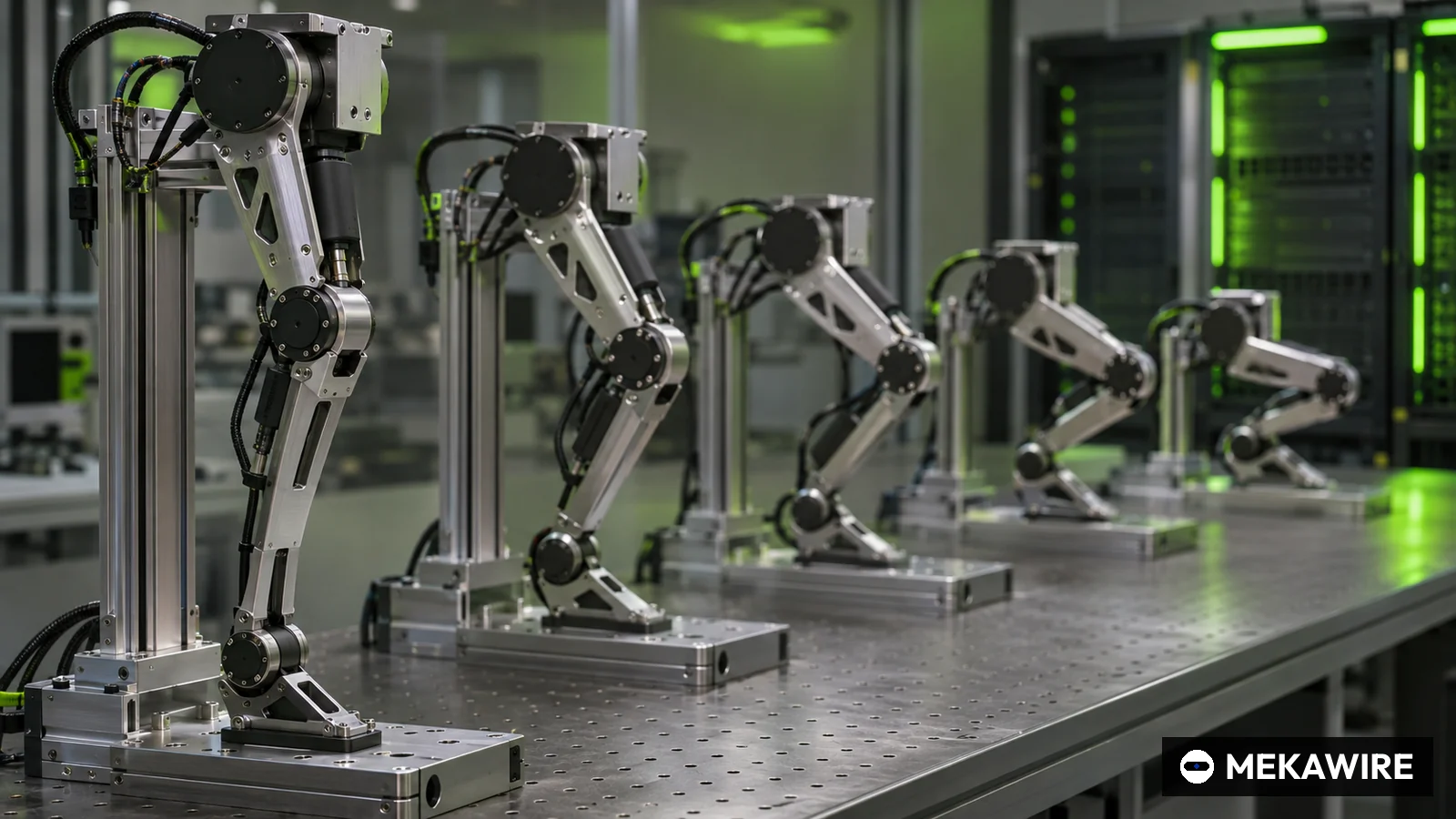
NVIDIA detailed in a technical blog post on Nov 13 version 0.2 of SOMA Retargeter, an open-source tool under the Apache 2.0 licence that converts human motion on its SOMA skeleton into joint trajectories for humanoid robots.
The version, first tagged on GitHub on Sept 15, ships reference configurations for five robots, the Unitree G1 and H2, the Booster T1 and the AgiBot X2 Ultra and A3T3, all from Chinese makers, and feeds NVIDIA's SONIC whole-body control workflow.
The repository calls the software beta and its output kinematic, to be checked in simulation before use on hardware.
NVIDIA described version 0.2 of SOMA Retargeter, a tool that turns recordings of human movement into joint trajectories a humanoid robot can follow, in a technical blog post on Nov 13. The code is public on GitHub under the Apache 2.0 licence; the project changelog dates version 0.2.0 to Sept 15 and a 0.2.1 patch to Oct 1, so the post presents a release that developers could already download. It reads a human animation in BVH format on NVIDIA's SOMA base skeleton, scales it to a robot's proportions, solves inverse kinematics frame by frame and writes a CSV file with the robot's root position, orientation and joint angles for every frame.
The problem it addresses is old: a human and a robot have different limb lengths, joint layouts and ranges of motion, so motion capture cannot be replayed on a robot directly. Every lab training humanoid control policies on human data has had to build this conversion step itself.
What ships in version 0.2
According to the blog post and the repository, the release includes reference configurations for five robots: the Unitree G1 and H2, the Booster T1, and the AgiBot X2 Ultra and A3T3. A Robot Configurator guides users through adding another robot; the tutorial uses the Unitree H1 as its example. The inverse kinematics come from Newton, built on NVIDIA Warp, with foot-plant correction during detected contact phases, joint-limit clamping, an experimental optimizer for inverse-kinematics weights and a headless mode for batch conversion. The repository bundles 10 example motions with matching CSV results for all five robots and 15 motions for weight optimization, drawn with permission from the BONES-SEED dataset of motion-capture company Bones.
NVIDIA lists three kinds of input: motion capture such as BONES-SEED, 3D motion reconstructed from video with its GEM-X model, and motion generated by its Kimodo and ARDY models. Downstream, a converter turns G1 output into the motion-library format of SONIC, NVIDIA's whole-body control workflow, and the blog names ProtoMotions as another tracking framework. NVIDIA said a G1 model in its MotionBricks project was trained partly on BONES-SEED motions adapted with the tool and was shown on a physical G1 with SONIC executing the targets.
The repository is explicit about limits: the software is in active beta, its APIs may change, and the motion it generates is kinematic, so safety, feasibility and controller compatibility must be validated in simulation before hardware use. NVIDIA published no accuracy or training-speed figures for this release.
- G1
- Unitree Robotics
- Hangzhou, China
- H2
- Unitree Robotics
- Hangzhou, China
- T1
- Booster Robotics
- Beijing, China
- X2 Ultra
- AgiBot
- Shanghai, China
- A3T3
- AgiBot
- Shanghai, China
Robots from NVIDIA's Nov 13 blog post and the GitHub repository; headquarters from the MEKAWIRE company database.
As of Nov 15, 2026
MEKAWIRE analysis: an American toolchain built on Chinese bodies
NVIDIA is standardising the data layer of humanoid training, and the robots it chose as reference bodies are all Chinese, which shows where affordable research humanoids come from today.
In the MEKAWIRE company database, all three makers behind the five bundled robots are based in China: Unitree in Hangzhou, AgiBot in Shanghai and Booster Robotics in Beijing. None of the US humanoid makers is among the reference configurations, although any team can add its own robot through the configurator. The strongest counter-argument is that the choice reflects which robots research labs already own, not a strategic preference, and that a configurator makes the default list less important than it looks.
The post follows NVIDIA's GR00T 2 world action model, announced on Nov 9 (our story) and fits the pattern in our NVIDIA robotics strategy explainer: free models and tools that make NVIDIA GPUs the default place to train robots. Company pages: NVIDIA, Unitree, AgiBot, Booster Robotics.
Bull case: SOMA becomes the common skeleton for human motion data, and robot makers ship their own configurations to stay compatible. Bear case: labs keep their own retargeting code and the tool stays a demo for NVIDIA's stack. Signals to watch: a US or European humanoid added to the reference set, a version 1.0 with stable APIs, and published accuracy numbers.
- CSV per clip: root position, orientation and joint angles per frame
- Beta; kinematic output, simulation check required before hardware
- Apache 2.0, code on GitHub
- 0.2.0 tagged Sept 15, 2026, 0.2.1 on Oct 1; blog post Nov 13
- 10 example motions with CSV results for all 5 robots, 15 motions for weight tuning
- 3 of 3 based in China (MEKAWIRE company database)
- 5: Unitree G1 and H2, Booster T1, AgiBot X2 Ultra and A3T3