NVIDIA's robotics strategy explained: open robot models and a $3,499 robot computer, paid for by data-centre GPUs and stakes in 20 robot start-ups
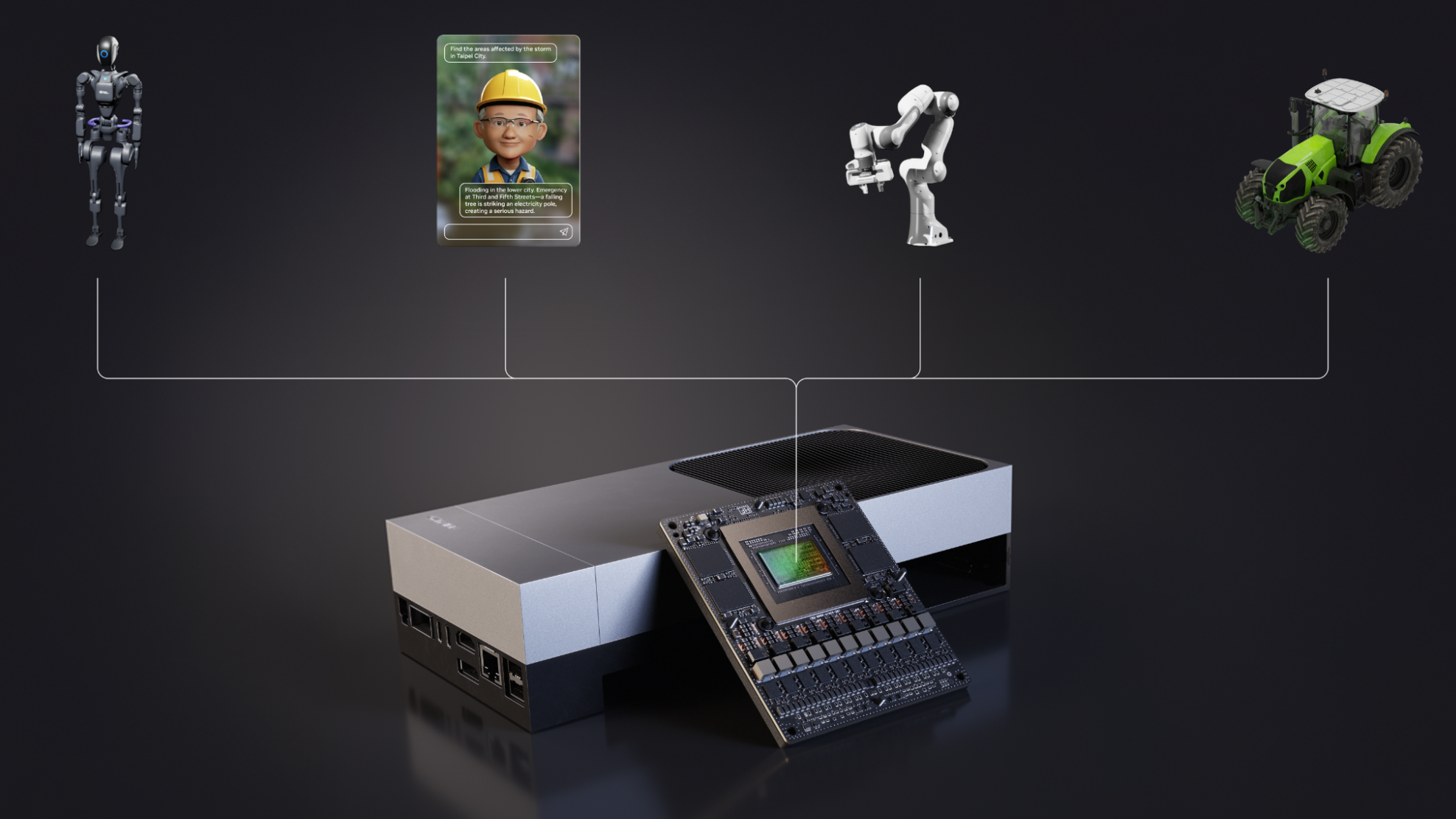
NVIDIA's robotics strategy gives away the software layer of the robot, open GR00T robot models, Cosmos world models and a reference humanoid, sells the onboard Jetson Thor computer from $3,499, and earns where it already dominates, in the data-centre GPUs that train robot models.
Robotics revenue is not disclosed: it sits inside an Edge Computing line of $7.2 billion, 7.5% of NVIDIA's $96.2 billion quarter, while NVIDIA or its NVentures fund took part in 25 robotics rounds worth $5.77 billion in MEKAWIRE's database.
NVIDIA does not tell investors how much money it makes from robots. In its 10-Q for the quarter ended July 26, 2026, robotics sits inside a line called Edge Computing, which also holds gaming PCs, workstations and cars and brought in $7.2 billion of a $96.2 billion quarter, 7.5% of revenue. The other 92.5% came from data-centre GPUs. That split is the key to the company's robotics strategy.
NVIDIA gives away most of the robot's software, sells the robot's onboard computer at a modest price, and collects its real return in the data centres where robot models are trained and simulated. It also puts money into the companies that will buy that compute. This explainer sets out what NVIDIA sells to robot makers, what it gives away, whom it has backed, and where the plan could break.
- Hyperscale (Data Center)
- 48,710
- 50.6%
- +102%
- AI Clouds, Industrial and Enterprise (Data Center)
- 40,313
- 41.9%
- +138%
- Edge Computing (includes robotics, automotive, workstations, gaming PCs)
- 7,198
- 7.5%
- +27%
- Total
- 96,221
- 100%
- +106%
- Robotics revenue disclosed separately
- Not disclosed
- n/a
- n/a
Source: NVIDIA Form 10-Q filed Aug 26, 2026. Share = platform revenue / 96,221. NVIDIA changed its market-platform presentation in Q1 FY2027 and recast prior periods.
As of Jul 26, 2026
The robot business is too small to report, and that is deliberate
NVIDIA changed how it reports revenue in the first quarter of fiscal 2027. It now shows Hyperscale ($48.7 billion), AI Clouds, Industrial and Enterprise ($40.3 billion) and Edge Computing ($7.2 billion, up 27% from a year earlier). The 10-Q explains the Edge increase by Blackwell workstation sales, offset by slower consumer PC sales. Robots are not mentioned as a driver. Yet the same quarter's results release lists Cosmos 3, the Isaac GR00T reference humanoid and Halos for Robotics among the quarter's Edge highlights. The company puts robotics in its marketing every quarter, but the robotics revenue is too small to show up in the financial statements.
Why spend years and keynote time on something that small? The answer lies in what a robot company needs before it ships a single unit.
Every layer below the robot body is free or cheap, except the GPUs
NVIDIA has built a full robot stack in under two years. Cosmos world models, launched in January 2025 under a licence that permits commercial use, generate physics-aware video for training. GR00T N1, released as open weights in March 2025 with 1X, Agility Robotics, Boston Dynamics and NEURA Robotics among early partners, gave humanoid makers a starting robot model; GR00T N1.7, with 3 billion parameters, entered commercial early access in March 2026, and GR00T N2, which NVIDIA says succeeds at new tasks more than twice as often as leading VLA models, is due by the end of 2026. Cosmos 3 Edge, a 4-billion-parameter model released in July, runs on the robot itself and generates 32 actions per inference.
The hardware is priced to spread. The Jetson AGX Thor developer kit went on sale in August 2025 from $3,499, claiming 7.5 times the AI compute of Jetson Orin, with Figure, Agility, Boston Dynamics and Amazon Robotics among early adopters. The Jetson T4000 followed at CES 2026 at $1,999 in 1,000-unit volume. In June NVIDIA added a reference humanoid for researchers, built on Unitree's H2 Plus body with Sharpa hands and a Jetson Thor computer, which Unitree will sell from late 2026.
- Training compute
- Data-centre GPUs, Vera Rubin
- Hardware sales inside Data Center revenue
- Robot developers' own clusters on other chips; none disclosed at scale
- World models and synthetic data
- Cosmos (Jan 2025), Cosmos 3 (May 2026)
- Free models that consume GPU time
- Google DeepMind world models, Runway
- Robot foundation model
- GR00T N1 (Mar 2025) to N1.7; N2 due end of 2026
- Free models, ties developers to the stack
- Physical Intelligence pi models, Skild AI, Figure Helix
- Onboard computer
- Jetson AGX Thor from $3,499 (Aug 2025), T4000 $1,999 at volume (Jan 2026)
- Module sales inside Edge Computing
- Qualcomm Dragonwing IQ10 (Jan 2026)
- Reference hardware and safety
- GR00T reference humanoid on Unitree H2 Plus (June 2026), Halos for Robotics
- Pulls labs onto Thor and GR00T
- Unitree and other makers' own stacks
Product dates and prices from NVIDIA releases and technical blogs as covered by MEKAWIRE. Rival entries name products disclosed in primary releases only.
As of Oct 17, 2026
None of these layers costs a robot developer much on its own. What they share is that each one runs best on NVIDIA silicon, and the expensive part, training and simulating, runs on data-centre GPUs. Figure showed what that looks like in September, when it committed $3.5 billion to Nscale for up to 100,000 Vera Rubin GPUs to train its Helix model. That single commitment is far larger than any amount NVIDIA could plausibly earn from Thor modules in Figure's robots.
The free software explains how NVIDIA reaches developers. It does not explain who pays for their GPU bills, and that is where the investment portfolio comes in.
NVIDIA has joined 25 robotics rounds worth $5.77 billion
MEKAWIRE's database records 25 funding rounds since January 2023 in which NVIDIA or its venture arm NVentures invested in a robotics company, across 20 companies. Disclosed round totals add up to $5,771.4 million. NVIDIA's own cheque is never disclosed, so these are the sizes of rounds it joined, not its exposure.
- 2023
- 5
- 420.4
- 84.1
- Skydio Series E, 230
- 2024
- 7 (2 undisclosed)
- 953.0
- 190.6
- Figure Series B, 675
- 2025
- 6
- 1,858.0
- 309.7
- Figure Series C, 1,000 at a $39bn post-money valuation
- 2026 to Oct 17
- 7 (1 undisclosed)
- 2,540.0
- 423.3
- Skild AI Series C, 1,400 at a $14bn valuation
- Total
- 25 rounds, 20 companies
- 5,771.4
- 262.3
- No data
MEKAWIRE database, verified rows only (company or investor releases), as of Oct 17, 2026. Figures are total round sizes, not NVIDIA's own cheque, which is not disclosed. Average = disclosed totals / rounds with a disclosed amount (5, 5, 6, 6; 22 overall).
As of Oct 17, 2026
The pattern changed in 2025. Early bets were spread across delivery robots (Serve Robotics, where NVIDIA led a $30 million go-public financing in 2023), surgical robots (Moon Surgical, Neocis), metal forming (Machina Labs), yard trucks (Outrider) and drones (Skydio). Since 2025 the money has gone to the companies building robot brains: Field AI, Dyna Robotics, Figure, Skild AI, Generalist AI and Walden Robotics. Robot-brain companies, meaning humanoid, embodied-AI and robot-foundation-model developers in our categories, account for $4,300 million, or 74.5%, of all disclosed totals, and for $3,625 million of the $4,398 million in 2025 and 2026 rounds, 82.4%. The average disclosed round NVIDIA joined rose from $84.1 million in 2023 to $423.3 million in 2026, five times larger.
Method: brain-layer share = disclosed totals of rounds at companies categorised humanoid, embodied-ai or robot-foundation-model / all disclosed totals in the period; average = disclosed totals / rounds with a disclosed amount.
Those companies are the heaviest GPU users in robotics. By backing them, NVIDIA helps fund the customers who will spend that money on NVIDIA compute.
MEKAWIRE analysis
NVIDIA is not trying to win the robot; it is making sure that whoever wins trains on NVIDIA GPUs, and it uses free models and cheap modules to make that the default.
The evidence points the same way from three sides. The filings show robotics is too small to report, so the reward cannot be robot-computer sales today. The products show that the layers NVIDIA controls best, simulation, world models and training, are the ones it offers free or open, which raises usage of the compute underneath. The portfolio shows that NVIDIA's money follows the developers with the largest training budgets, not the ones shipping the most units. Unitree, which ships humanoids in the thousands, appears as a reference-design partner, not as an NVIDIA portfolio company.
The strongest counter-argument is that the onboard computer, not the data centre, will be the larger long-run market if humanoids reach millions of units, and NVIDIA has rivals there. Qualcomm's Dragonwing IQ10 launched at CES 2026 with Figure named as a partner, and Tesla designs its own chips for Optimus. If robot makers split training from inference, NVIDIA keeps the data-centre revenue but loses the volume part of the stack. We think that risk is real but distant: no filing yet shows humanoid volumes large enough to make the onboard socket worth more than the training clusters.
In the bull case, GR00T N2 ships on time, the reference humanoid becomes the default lab platform, and robot-brain start-ups raise more money that ends up spent on Vera Rubin capacity, so robotics becomes a disclosed growth line within two years. In the bear case, open models from Physical Intelligence, Google DeepMind and Chinese labs become the de facto standard, Qualcomm and in-house chips take the onboard socket, and robotics stays a marketing line inside Edge Computing.
Three signals that would confirm or break the thesis
First, whether NVIDIA's next quarterly filings give robotics its own revenue figure or a growth rate; a separate disclosure would mean the business has become material. Second, whether GR00T N2 arrives by the end of 2026 as promised, and whether makers outside NVIDIA's portfolio adopt it. Third, the onboard-chip choices of the volume makers: LG's bipedal humanoid, due in the first quarter of 2027, is being built on Jetson Thor and GR00T under its August MOU, while Tesla's Q3 results on Oct 21 may say more about its in-house compute. The open question is whether robot companies will keep paying NVIDIA for training if open models make their own training budgets smaller.
- NVIDIA reported revenue of $96,221 million for the quarter ended July 26, 2026; Data Center was $89.0 billion and Edge Computing, the line that holds robotics, gaming PCs, workstations and automotive, was $7,198 million, up 27% from a year earlier (10-Q filed Aug 26, 2026).
- Since the first quarter of fiscal 2027 NVIDIA presents revenue as Hyperscale, AI Clouds Industrial and Enterprise, and Edge Computing; no filing breaks out robotics revenue.
- Robot-side products: Jetson AGX Thor developer kit from $3,499 (Aug 25, 2025), Jetson T4000 at $1,999 in 1,000-unit volume (Jan 2026), open GR00T models from N1 (Mar 2025) to N1.7, with N2 due by the end of 2026.
- NVIDIA's Q2 fiscal 2027 release lists Cosmos 3, the Isaac GR00T reference humanoid built on Jetson Thor and Halos for Robotics among the quarter's Edge Computing highlights.
- In MEKAWIRE's database NVIDIA or NVentures joined 25 robotics funding rounds at 20 companies from January 2023 to October 2026, with $5,771.4 million in disclosed round totals; 2026 rounds alone total $2,540.0 million.
- Robot-brain companies (humanoid, embodied AI and robot foundation models) account for $4,300 million, 74.5%, of those disclosed totals, led by Skild AI's $1.4 billion Series C and Figure's $1 billion Series C.
- Figure committed $3.5 billion to Nscale for up to 100,000 Vera Rubin GPUs to train its Helix model (Sept 3, 2026), the clearest disclosed example of robot money flowing back to NVIDIA hardware.
- Qualcomm launched its Dragonwing IQ10 robot processor at CES 2026 and named Figure as a partner, the first direct challenge for the compute socket inside humanoids.
Why it matters
NVIDIA is the one company present at every layer of the robot stack, from training GPUs to the onboard computer, and it has joined several of the largest robot-brain rounds of the past two years. How it chooses to earn from robotics decides the cost structure of everyone else: which layers become free, which stay expensive, and where margins pool.
For investors the practical consequence is that NVIDIA's robotics exposure cannot be read from its filings. The Edge Computing line of $7.2 billion mixes PCs, workstations, cars and robots. The visible proxy is instead the GPU spending of robot-model developers, such as Figure's $3.5 billion Nscale commitment, and the funding those developers raise.
Rival analysis
At the onboard-computer layer, Qualcomm is the only rival with a launched, named-customer robot processor in our records, the Dragonwing IQ10 with Figure as a partner. Tesla builds its own inference chips for Optimus and does not disclose an NVIDIA dependency for the robot. Chinese humanoid makers face US export controls and a Chinese government that, according to NVIDIA's 10-Q, has encouraged customers to buy from domestic competitors.
At the model layer, the alternatives are Physical Intelligence's pi models, Google DeepMind's Gemini Robotics and the in-house models of Figure (Helix) and Skild AI. NVIDIA's position is unusual because it funds several of these rivals to its own GR00T models; it is indifferent to which model wins as long as training runs on its GPUs.
Valuation context
NVIDIA does not attach a value to its robotics effort and no analyst figure is used here. The disclosed post-money valuations of robot-brain companies it has backed give a sense of the stakes: Figure at $39 billion after its September 2025 Series C, Skild AI at $14 billion after its January 2026 Series C, Walden Robotics at $1.1 billion after a $300 million seed round in July 2026.
These valuations price the model companies on future robot volumes. For NVIDIA the return comes earlier, through GPU purchases funded by those same rounds, which is why a minority stake in a model company can be worth more to NVIDIA as a customer relationship than as an equity position.
Supply-chain implications
On the robot, NVIDIA supplies the Jetson Thor module and its software stack; the body, actuators, hands and sensors come from partners such as Unitree (H2 Plus body) and Sharpa (Wave hands) in the reference humanoid. In Korea, LG plans a bipedal humanoid with LG Electronics actuators, LG Innotek sensors and LG Energy Solution batteries on Thor and GR00T; Hyundai Motor Group and NVIDIA have put about $3 billion behind a physical-AI programme.
In Japan, Fujitsu is building a shared physical-AI platform with FANUC, Yaskawa and Kawasaki on NVIDIA Cosmos, Omniverse and Isaac. In Germany, Wandelbots and SCHUNK package NVIDIA Omniverse for mid-sized manufacturers, and NEURA Robotics counts NVIDIA among its Series C investors. The common thread is that partners own the physical product and NVIDIA owns the compute and simulation layers.
Signals to watch
1. NVIDIA's next 10-Q and results release: any separate robotics revenue figure, or a robotics driver named for Edge Computing growth. 2. GR00T N2 release by the end of 2026, and adoption by makers outside NVIDIA's portfolio. 3. Unitree's sales of the GR00T reference humanoid from late 2026, and its price. 4. LG's bipedal humanoid on Jetson Thor in Q1 2027; Doosan Robotics' industrial humanoid planned for 2028. 5. Further GPU-capacity commitments by robot-model developers on the scale of Figure and Nscale.
Analyst view
Thesis: NVIDIA's robotics strategy is a demand-creation programme for data-centre GPUs, run through free models, low-priced robot computers and minority investments in the heaviest-spending robot-brain developers. Confidence: medium. The filings and the portfolio pattern support it; what is missing is any disclosure of how much robot developers actually spend on NVIDIA compute beyond Figure's commitment.
What would change our view: a robotics revenue disclosure showing onboard modules as the main earner, or evidence that large robot developers train on non-NVIDIA hardware at scale. Either would mean the edge, not the data centre, is where NVIDIA's robot money comes from.
Questions you should be asking
1. What share of Edge Computing revenue comes from Jetson modules sold for robots, and is it growing faster than the line as a whole? 2. How much of the money raised in rounds NVIDIA joined has come back as GPU or cloud purchases on NVIDIA platforms? 3. Will GR00T N2 be released under the same open licence as earlier GR00T models? 4. How does NVIDIA plan to keep Chinese humanoid makers, the volume leaders today, on its stack under current export rules? 5. What price will the GR00T reference humanoid carry when Unitree begins selling it?