AgiBot G2 store trial: six robots, 1,730 tasks in 24 hours, two failed the assessment
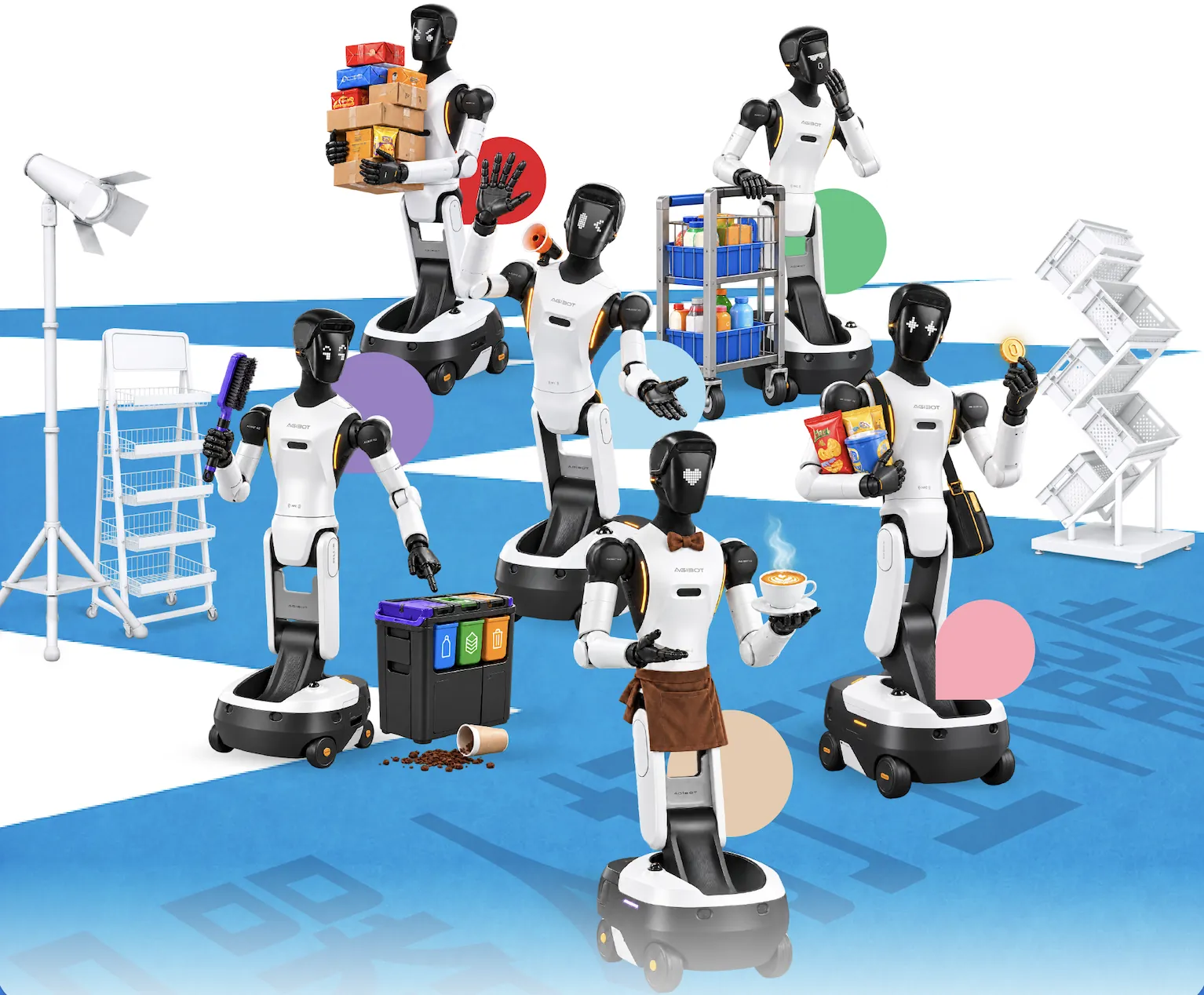
AgiBot said in a Nov 6 release that six of its G2 wheeled humanoid robots ran an operating convenience store in Shanghai's Xuhui District for 24 hours from 10 a.m. on Nov 2, completing 1,730 tasks, among them 683 customer-service interactions and 147 coffee orders.
Four of the six passed the company's final performance assessment and two did not meet all criteria. By MEKAWIRE's calculation the six robots averaged about 12 tasks per robot-hour.
AgiBot ran six G2 wheeled humanoid robots in a working convenience store in Shanghai's Xuhui District from 10 a.m. on Nov 2 to 10 a.m. on Nov 3, the company said in a release on Nov 6. The robots completed 1,730 tasks over the 24 hours, and four of the six passed the final performance assessment; two did not meet all criteria. AgiBot said the livestream drew more than two million viewers. The trial closed its AI WAVE series of releases that began on Oct 22.
What the six robots did
Each robot had a role: customer assistance, shelf inspection, restocking, coffee preparation, checkout and hot food, and cleaning. The release breaks the 1,730 tasks down into 683 customer-service interactions, 369 product pickups and deliveries, 147 coffee orders, 126 breakfast servings, 277 shelf inspections and restocking tasks, and 128 table-cleaning tasks. Robots were judged on time on duty, task completion, customer feedback, response time and handling of unexpected situations. Evaluators ran spot tests, such as ordering regular and sugar-free Coca-Cola to see if a robot could tell the cans apart, shuffling chewing gum on a shelf, and blocking an aisle with a person and a box. Tasks were coordinated by Genie Master, AgiBot's agent framework, which sends execution results back for analysis and turns corrected attempts into training data, the company said.
- Customer-service interactions
- 683
- 39.5%
- Product pickups and deliveries
- 369
- 21.3%
- Shelf inspections and restocking
- 277
- 16.0%
- Coffee orders
- 147
- 8.5%
- Table cleaning
- 128
- 7.4%
- Breakfast servings
- 126
- 7.3%
- Total
- 1,730
- 100%
Counts from AgiBot's Nov 6, 2026 release; shares are MEKAWIRE calculations. The release gives no failure or intervention counts.
MEKAWIRE analysis
The useful number in this demo is not 1,730 but two out of six: a one-third failure rate on a company-run test is the real state of retail humanoids.
MEKAWIRE's calculation: 1,730 tasks over six robots and 24 hours is about 12 tasks per robot-hour, and customer-service interactions are 39% of all tasks, the least physically demanding category. Coffee, breakfast and cleaning together are 401 tasks, 23%. The release does not give failure counts per task, human interventions, or which criteria the two robots missed, so the trial cannot be compared with a staffed store. AgiBot has used this kind of measure before: on Oct 30 MEKAWIRE covered its collective experience learning work with Tsinghua and Infinigence, in which 96 robots reached 98% success on phone packaging, and the company says it rolled out its 20,000th robot in September. Counter-argument: a 24-hour unscripted shift in a public store, livestreamed, is harder than most lab benchmarks. Signals to watch: a paying retail customer for G2, published intervention rates, and a repeat trial with all units passing. Company page: AgiBot.
- about 12 tasks per robot-hour (MEKAWIRE calc.)
- Nov 2, 10 a.m. to Nov 3, 10 a.m., Shanghai Xuhui
- 147
- 4 of 6 robots
- 1,730 by six G2 robots
- more than 2 million, company figure
- 683 (39% of tasks, MEKAWIRE calc.)
Why it matters
The company-reported trial puts a concrete workload behind AgiBot's retail pitch: six G2 robots completed 1,730 tasks over 24 hours, averaging about 12 tasks per robot-hour by MEKAWIRE's calculation. Only four passed AgiBot's assessment, making reliability a material qualification to the throughput claim. Labor savings cannot be assessed because staffing, intervention time and task duration were not disclosed.
Rival analysis
No rival performance data are supplied, so the trial does not establish a competitive lead. Customer interactions accounted for 39% of tasks by MEKAWIRE's calculation, meaning comparisons need matched task definitions and workload mixes. Investors should seek comparable intervention rates, assessment criteria and operating costs before ranking competing systems.
Valuation context
No AgiBot valuation, total funding amount or market capitalization is supplied, and there is no basis here for a valuation estimate. Official entries record a strategic financing on August 1, 2025 and a Series A extension on September 3, 2024, without amounts. AgiBot's holding platform controls STAR-listed Swancor, but that relationship does not establish AgiBot's valuation.
Related papers
The supplied AgiBot paper titles are Magic-W0: A Structured World-Action Foundation Model for Physical Intelligence; WorldOracle: Benchmarking Action-Conditioned World Models against Real-World Executions; and GreenWAM: A World Foundation Model for Robotics. No findings or evidence connecting these papers to G2's store performance are supplied.
Supply-chain implications
The supplied material identifies G2 as a wheeled humanoid but names no component suppliers, manufacturing partners or production capacity. Hardware costs, maintenance requirements and replacement-part availability are also missing, preventing an assessment of deployment economics or supply constraints. Control of Swancor alone establishes no specific G2 supply relationship.
Signals to watch
Watch for disclosure of the assessment criteria and why two robots failed to meet them. Repeat trials with intervention logs, staffing levels and consistent task definitions would make throughput more interpretable. Paid deployments and disclosed operating costs would help establish whether the demonstration translates into a commercial offering.
Analyst view
This is evidence of task execution in an operating store, but the company-reported results do not establish retail unit economics. The two assessment failures deserve as much attention as aggregate throughput. Treat the trial as a diligence starting point and seek repeatability, human-support requirements and customer payment evidence before assigning commercial significance.
Questions you should be asking
Which assessment criteria did the two robots miss, and how much human intervention did each robot require? What were deployment and operating costs, staffing levels and task completion times, and did the store pay for the trial?