AgiBot will put six G2 robots on a 24-hour convenience-store shift after seven launches
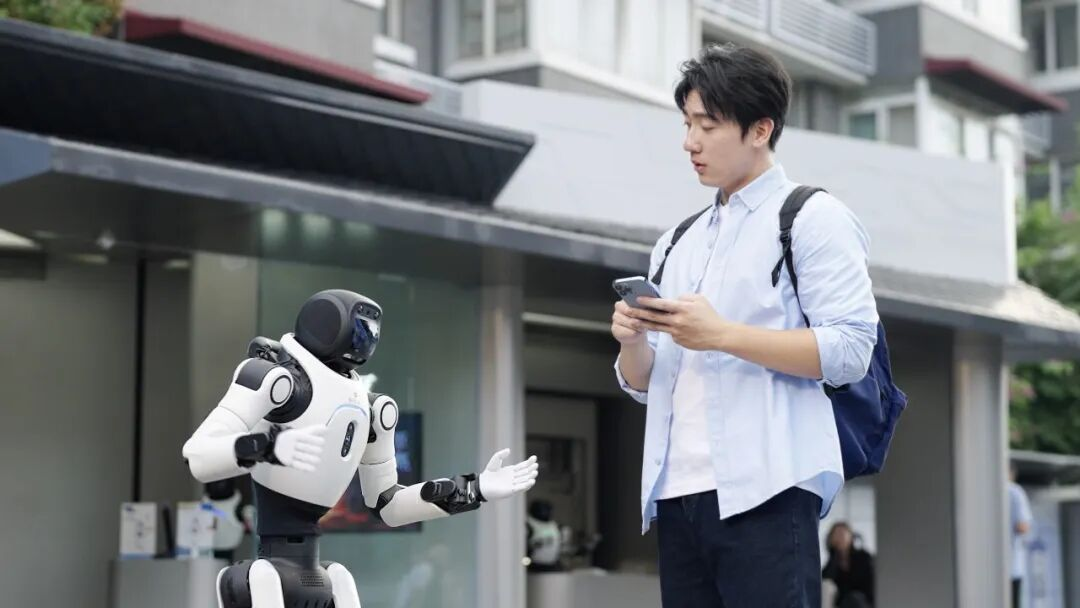
AgiBot said on Oct 22 that its "AI WAVE" campaign will release seven products in seven days, from a reasoning dataset and the Genie Studio 2.0 operations platform to a heavy-payload G2 Max, a simulation engine it says matches real robots above 95% on complex tasks and a new foundation model on Oct 29.
The test comes on Nov 2 and 3, when six G2 robots will run a real convenience store for 24 hours on a livestream.
AgiBot, the Shanghai company IDC ranked first in global humanoid shipments for the first half of 2026, has set itself a public exam. The company said on Oct 22 that after a run of seven product releases it will send six of its wheeled G2 robots into a real convenience store on Nov 2 and keep them working for 24 hours on a livestream, through the lunch rush, the evening peak, a night shift and breakfast preparation.
The store is where the campaign, which AgiBot calls "AI WAVE", stops being a product calendar and becomes a measurable test. That raises the question of what exactly the company is putting on the shelf first.
Seven releases in nine days
AgiBot said the releases cover every layer it thinks a deployed robot needs: data, tooling, hardware, an agent layer, simulation, a foundation model and a fleet-learning method. The first, on Oct 22, was the fourth AGIBOT WORLD 2026 dataset, which the company now describes as an initial 150 hours of real-robot data aimed at decisions rather than motion. Genie Studio 2.0 followed on Oct 23 as what AgiBot calls a one-stop platform for building and updating robot jobs. The G2 Max on Oct 26 is billed as a safety-rated heavy-payload industrial robot that still works at sub-millimetre precision.
- Oct 22
- AGIBOT WORLD 2026 Release 4, Physical Reasoning dataset
- First batch of 150 hours of real-robot data focused on decisions
- Oct 23
- Genie Studio 2.0
- One-stop platform for building, delivering and updating robot jobs
- Oct 26
- G2 Max
- Safety-rated heavy-payload embodied industrial robot with sub-millimetre precision
- Oct 27
- Genie Master
- Agent framework linked to robots; first "physical recursive self-improvement" in a real business setting
- Oct 28
- Genie Sim upgrade
- In-house physics engine for deformable objects; real-to-sim consistency above 95% on complex tasks
- Oct 29
- Foundation model
- Not described yet; launched at Innovation Day
- Oct 30
- Collective Experience Learning (CEL)
- Learning method prototyped on a fleet of about 100 real robots
- Nov 2 to 3
- Convenience-store shift
- Six G2 robots, 24 hours, livestreamed
Source: AgiBot newsroom, Oct 22, 2026. Claims are the company's own and had not been independently tested by Oct 24.
As of Oct 24, 2026
Two claims stand out. AgiBot says its upgraded Genie Sim, with an in-house physics engine for soft and deformable objects, matches real-robot results above 95% on complex tasks, and that Collective Experience Learning has been prototyped on a fleet of about 100 real robots. Neither figure comes with a method yet. The foundation model itself is held back for Innovation Day on Oct 29 at the Shanghai World Expo Center.
The store is the real product
AgiBot listed the store jobs as stocking, restocking, shelf tidying, making hot food, handling rubbish, making coffee and greeting customers, from 10:00 on Nov 2 to 10:00 the next day. A day earlier the company said three of its smaller X2 robots had started regular work at Kuanzhai Alley in Chengdu, where a retail cabinet run by its own vision-language-action (VLA) model handles more than 20 types of goods at over 98% success and about 30 seconds per task.
- Sept 28, 2026
- ASD retail stores, China
- 100 X2
- Sales assistants in 100 stores
- Oct 22, 2026
- Kuanzhai Alley, Chengdu
- 3 X2
- Greeting, culture guide, retail cabinet
- Nov 2 to 3, 2026 (planned)
- Convenience store (not named)
- 6 G2
- Full store operations for 24 hours
Source: AgiBot releases as reported by MEKAWIRE. Counts are as announced by the company.
As of Oct 24, 2026
MEKAWIRE analysis
The seven launches are the advertisement; the number that will matter is how many times a human has to step in during the 24 hours, and AgiBot has not promised to publish it.
Retail is where Beijing wants embodied AI to show up first. The nine-ministries opinion on technology for commerce, covered by MEKAWIRE on Oct 19, names retail and logistics as target scenes. AgiBot already placed 100 X2 units in ASD stores in September and says it built its 20,000th robot that month. A full overnight shift is a harder test than greeting shoppers: restocking and hot food mean grasping varied packaging, which is exactly what the reasoning dataset and the simulator are meant to fix.
The counter-argument is that a livestream is still a show. Six robots in one store for one day can be staged, and a vendor-run test is not a customer contract. Our VLA explainer explains why task success in a lab rarely survives a busy shop.
Why it matters
For buyers, the useful output is operating data: uptime, interventions, items handled per hour. If AgiBot publishes those on Nov 3, it sets a benchmark rivals such as Galbot and Unitree will be asked to match. More on the company: AgiBot profile.
The first dated check is Oct 29, when the foundation model and its benchmark figures appear.
- New foundation model on Oct 29, AgiBot Innovation Day, Shanghai World Expo Center
- Three X2 robots at Kuanzhai Alley; retail cabinet covers 20+ SKU types at over 98% success and about 30 s per task, per AgiBot
- AI WAVE, seven releases from Oct 22 to Oct 30, 2026
- G2 Max (Oct 26), a safety-rated heavy-payload industrial robot with sub-millimetre work, per AgiBot
- Genie Sim with an in-house physics engine (Oct 28), real-to-sim consistency above 95% on complex tasks, per AgiBot
- Six G2 robots, 10:00 Nov 2 to 10:00 Nov 3, four shifts, livestreamed
- Stocking, restocking, shelf tidying, hot food, rubbish, coffee, greeting customers
Why it matters
A 24-hour public store shift turns humanoid marketing into an operating test. Whatever AgiBot reports afterwards, or chooses not to report, becomes the reference point for retail robot buyers in China.
Rival analysis
Galbot pitches its AstraBrain whole-body model on general-purpose robots, and Unitree sells legged robots, humanoids and arms built around in-house motors. AgiBot is the first in our coverage to schedule a full shift in a live store with a published timetable. The risk for rivals is that buyers start asking for comparable shift data.
Valuation context
No financial terms were disclosed. AgiBot is unlisted in our database; the campaign matters for its commercial story ahead of any listing, because deployment hours are what investors in the sector now ask for after unit shipments.
Supply-chain implications
Store work stresses grippers, wrist sensors and wheeled bases more than legs. A heavy-payload G2 Max with sub-millimetre work implies precision reducers and force sensing that Chinese suppliers have been localising; AgiBot has not named its suppliers.
Signals to watch
Oct 26 G2 Max specifications (payload, safety certification named); Oct 29 foundation model benchmarks at Innovation Day; Nov 3 any published intervention count and items handled from the store shift.
Analyst view
We read AI WAVE as a deliberate shift from launch metrics to deployment metrics. The approach is right; the credibility depends on disclosure of failures, which AgiBot did for its dataset but has not promised for the store.
Questions you should be asking
Which convenience chain hosts the shift, and is it a paying customer? Will AgiBot publish human intervention counts and downtime? What method sits behind the 95% real-to-sim figure? How many of the 100 robots in the CEL fleet are G2 units?