Fourier unveils GR-3, a 55-joint 'Care-bot' humanoid that takes the rehabilitation specialist into companionship and eldercare
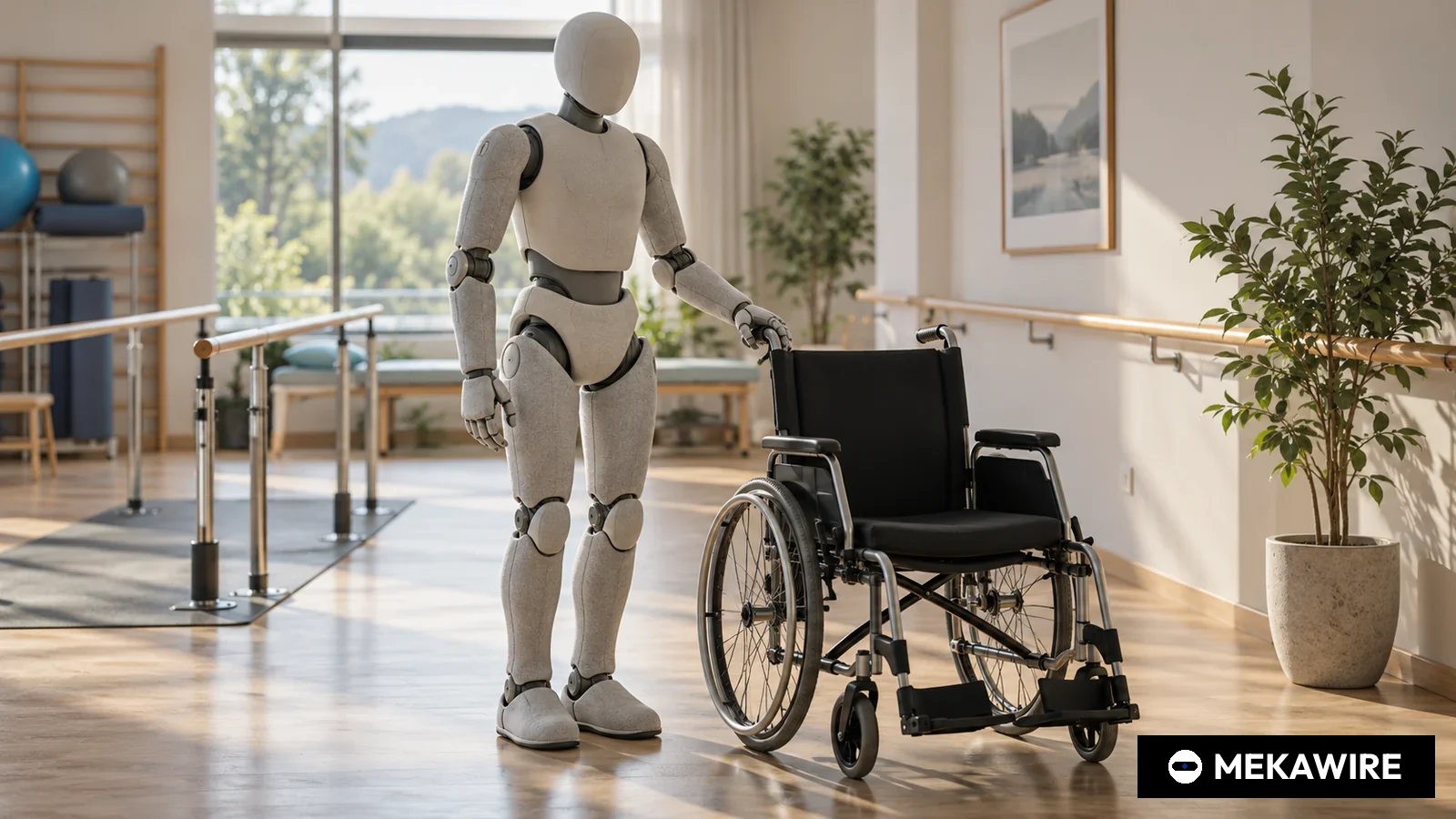
Shanghai-based Fourier on 6 August 2025 introduced GR-3, a 165 cm, 71 kg humanoid with up to 55 degrees of freedom, 31 tactile sensors and a padded exterior, which it calls its first full-size 'Care-bot'.
The third model in its GRx line is aimed at public service settings, children and older adults, with rehabilitation and health monitoring named as later uses. Fourier did not disclose a price.
Fourier, the Shanghai robotics company that spent its first decade building rehabilitation equipment for hospitals, on 6 August 2025 unveiled GR-3, a full-size humanoid it describes as its first "Care-bot". In a release issued from Beijing, the company said the robot is meant for social companionship in public settings, for service work, for children and for older adults, and that assistive care, mobility support, health monitoring and physical rehabilitation are on its roadmap.
GR-3 is the third generation of Fourier's GRx humanoid series. According to the company's product page, it stands 165 cm tall, weighs 71 kg and has 55 degrees of freedom: two in the head, three at the waist, seven in each arm, six in each leg and six in each basic hand. Fourier's release and developer documentation list an optional 12-DoF dexterous hand. The documentation gives a single-hand payload of about 3 kg and a maximum joint peak torque of 440 Nm.
Most of the engineering effort described by Fourier sits in sensing rather than strength. GR-3 carries 31 tactile sensors, 16 in the head and 15 in the torso, so it can register being touched and respond. A four-microphone array in the head locates a speaker's direction and turns the robot toward them, with echo cancellation, while a camera module combining RGB and structured-light depth sensing recognises faces and drives what Fourier calls dynamic gaze tracking. The company groups these into a "Full-Perception Multimodal Interaction System" that uses an attention-management layer to decide which input to prioritise.
On the software side, Fourier said GR-3 uses a dual-path response design: rule-based reflexes for immediate reactions and a large language model for contextual conversation. The release lists several gaits, including standard walking, bending, squatting, running, an energy-saving "fatigue mode" and a "bouncy walk". The developer documentation specifies an AMD Ryzen 7 8845HS processor running Ubuntu 22.04, lithium-ion batteries of 702 Wh plus 234 Wh, about three hours of endurance and about 1.5 hours of charging. Fourier's release adds that the battery is hot-swappable to support continuous operation.
The robot's look is part of the pitch. Fourier dressed GR-3 in Alcantara over GFOAM padding on an aluminium alloy and engineering plastics frame, in warm neutral tones, under the slogan "Love, above all functionality". The company's Chinese product page now lists a second version, GR-3C, which adds lidar and a hardened white shell for more precise work in complex environments. Fourier gave no price, no delivery date and no named customers in its launch material. Its product page lists a walking speed of 5.5 km/h, while the developer documentation gives 6.1 km/h.
The company's history explains the choice of market. Fourier's own timeline records its founding in 2015, a first upper-limb rehabilitation robot in 2016, and in 2017 the X1 lower-limb exoskeleton, which it calls China's first commercial product of its kind. It set up a Singapore unit in 2018, started its humanoid project in 2019 and built a first prototype in 2022. Fourier says it serves more than 2,000 institutions and hospitals in more than 40 countries and regions.
The humanoid line then moved quickly. GR-1, which Fourier says entered mass production in 2023, used the company's self-developed FSA actuators and, according to its documentation, weighed about 52 kg with 44 degrees of freedom and roughly an hour of runtime. GR-2 followed in 2024 at 175 cm and 63 kg with up to 53 degrees of freedom and about two hours of endurance. GR-3 is shorter than GR-2 and heavier than both predecessors, but carries about 936 Wh of battery and the longest stated runtime of the three.
- GR-1
- 2023
- 165
- 52
- 44
- 5
- 230
- 483
- 1
- GR-2
- 2024
- 175
- 63
- 53
- 5
- 436
- 950
- 2
- GR-3
- 2025
- 165
- 71
- 55
- 5.5
- 440
- 936
- 3
Specs as published by Fourier on fftai.com and support.fftai.com. GR-3 battery = 702 Wh + 234 Wh. GR-3 walking speed is 5.5 km/h on the product page and 6.1 km/h in developer documentation; the product page figure is shown. GR-1 runtime about 60 minutes. Launch years from Fourier's company timeline. Figures disclosed, not estimated.
As of Oct 1, 2026
GR-3 enters a crowded domestic field. UBTech, founded in 2012, Unitree, founded in 2016, and the younger AgiBot and Galbot, both founded in 2023, have all brought humanoids to market, alongside LimX Dynamics. Much of that sector's public positioning has centred on factories, logistics, research and education. Fourier's move is to compete on acceptance in shared human spaces, a niche where its hospital relationships give it a distribution channel few humanoid start-ups have.
- Fourier
- 2015
- No data
- No data
- No data
- UBTech Robotics
- 2012
- Placing (new H shares)
- 2025-11-25
- No data
- Unitree Robotics
- 2016
- IPO (STAR Market)
- 2026-08-18
- No data
- AgiBot
- 2023
- Strategic
- 2025-08-01
- No data
- Galbot
- 2023
- Growth (unnamed)
- 2025-06-24
- No data
- LimX Dynamics
- No data
- Pre-IPO
- 2026-07-14
- 200,000,000
From the MEKAWIRE verified company dataset as of 2026-10-01; rounds dated after GR-3's launch are shown as context. Amounts left as — where not disclosed in USD. Fourier has no disclosed round in the dataset.
As of Oct 1, 2026
The technical logic is straightforward. A robot that works next to frail or young people will be touched, bumped and spoken to from every direction, so touch sensing, sound localisation and a soft outer layer reduce both the physical and the social friction of contact. The split between reflexes and a language model is meant to keep the robot responsive when the slower model is still producing an answer.
Large questions remain. Fourier presented the care and rehabilitation functions as future applications, so GR-3 at launch is a companion and service robot, not a medical device, and the company published no clinical data or regulatory filings. Three hours of runtime limits shift length even with swappable packs, and a 71 kg walking machine near older adults raises safety certification questions that the launch material does not address. Without a price, buyers cannot yet compare it with service robots that cost far less.
Investors and hospital buyers will look for a published price, first named deployments in care homes or hospitals, and evidence that GR-3 can deliver the assistive functions Fourier has promised. Any move to certify the robot under medical or service robot safety standards would mark the shift from showcase to product.
MEKAWIRE analysis
GR-3 is Fourier's attempt to turn a decade of hospital access into a humanoid market that factory-focused rivals are not built to serve, but the product launched as a companion, not yet a care tool.
The evidence for the thesis sits in the specification sheet. Fourier spent its design budget on 31 touch sensors, a microphone array, gaze tracking and an upholstered body rather than on payload, which stays at about 3 kg per hand, the same figure listed for GR-1 and GR-2. Its customer base of more than 2,000 institutions and hospitals gives it a sales route into rehabilitation centres and care facilities that most Chinese humanoid makers lack.
The strongest counter-argument is that care is the hardest place to deploy a humanoid. The tasks that matter most in eldercare, such as lifting, transferring and supporting people, require strength, certified safety and reliability that GR-3 does not claim at launch, and companionship alone can be served by cheaper, smaller robots or tablets.
Bull case: Fourier converts its rehabilitation clients into GR-3 pilots, gathers interaction data in real care settings and adds rehabilitation functions within its existing hospital relationships. If care homes accept the robot socially, Fourier owns a defensible niche while rivals fight over factory contracts.
Bear case: GR-3 remains a showroom and reception robot, the promised care functions stay on the roadmap, and price-led rivals such as Unitree pull research and education buyers away. Without disclosed sales, the line risks being a costly brand exercise for a company built on rehabilitation equipment.
Signals to watch:
- By 31 December 2025: whether Fourier names the first paying care home, hospital or public venue customers for GR-3 and discloses a price.
- CES in January 2026: whether Fourier uses the show to launch GR-3 overseas and in which markets.
- First half of 2026: whether any rehabilitation or mobility support function moves from roadmap to Fourier's product documentation, with safety certification.
- 165 cm, 71 kg
- Not disclosed
- Fourier, founded 2015, serves 2,000+ institutions and hospitals in 40+ countries and regions
- AMD Ryzen 7 8845HS, Ubuntu 22.04
- GR-3, third-generation GRx humanoid, Fourier's first 'Care-bot'
- 6 August 2025 (Beijing dateline)
- Public-setting companionship, service, children, older adults; rehabilitation later
- 31 (16 head, 15 torso)
- 55 (optional 12-DoF hand)
- 702 Wh + 234 Wh, about 3 h, hot-swappable
Why it matters
GR-3 is a full-size humanoid specified around touch, hearing and appearance rather than payload or speed. Fourier has made a deliberate segment choice: social and care settings where acceptance by people matters more than throughput. If that segment opens, it will be served by companies with clinical channels, and Fourier is a humanoid maker that already sells rehabilitation systems into hospitals.
The launch also shows how quickly the GRx line is iterating. Fourier has released one generation a year since 2023, and each has added battery and joints. GR-3 roughly triples GR-1's stated runtime, from about one hour to about three, which is the minimum needed for a robot to cover a meaningful part of a care shift.
Rival analysis
UBTech, founded in 2012 and listed in Hong Kong, and Unitree, founded in 2016, are the scale players among Chinese humanoid makers; AgiBot and Galbot, both founded in 2023, and LimX Dynamics are newer entrants. GR-3's explicit care branding sets it apart from the factory, logistics and research framing that dominates much of the sector's marketing.
Fourier's differentiation is soft: upholstery, touch sensing and an interaction stack. Those are easier to copy than a hospital customer base. The durable advantage, if any, is the combination of a rehabilitation sales force, clinical relationships and a humanoid platform under one roof.
Valuation context
Fourier has not disclosed a funding round in the MEKAWIRE verified dataset, and its valuation is not public in any primary source we reviewed. Comparisons therefore cannot be made on valuation multiples. Among peers, Unitree and UBTech are listed, and LimX disclosed a USD 200 million pre-IPO round in July 2026.
For investors, GR-3 matters as evidence of whether Fourier can sell humanoids into its existing rehabilitation customers. Revenue mix disclosure, if Fourier moves toward a listing, will be the first hard test of whether the humanoid line earns money or consumes it.
Supply-chain implications
Fourier's developer documentation lists an AMD Ryzen 7 8845HS x86 processor running Ubuntu 22.04 as GR-3's computer, rather than an NVIDIA Jetson module. That choice suggests the onboard computer handles control and interaction while heavier language model work may run elsewhere, though Fourier does not spell out the split.
GR-1 introduced Fourier's self-developed FSA actuators, and the company lists core components as a product line of its own. The upholstery uses Alcantara over GFOAM padding on an aluminium alloy and engineering plastics frame, which brings automotive interior suppliers into a humanoid bill of materials.
Signals to watch
A disclosed price and the first named care home, hospital or public-venue customers would show whether GR-3 has moved past demonstration. Watch also for GR-3C, the lidar-equipped variant now listed on Fourier's product page, which points toward functional service work.
On the regulatory side, any safety certification or medical device filing tied to the rehabilitation functions Fourier has promised would be the strongest signal that the care positioning is real.
Analyst view
Thesis: GR-3 is a credible first step into care robotics by a company with genuine clinical distribution, but at launch it is a companion robot with care ambitions. Confidence: medium.
Reasons: the specifications Fourier published are consistent with an interaction-first design and its hospital footprint is verified on its own site, which supports the strategy. Confidence is not high because Fourier disclosed no price, customers, clinical data or delivery volumes, and the assistive functions that would justify a care label are described as future applications.
Questions you should be asking
What will GR-3 cost, and will Fourier sell it outright or as a service to care facilities? Which of its rehabilitation customers will pilot it first?
How will Fourier certify a 71 kg walking robot for close contact with older adults and children, and when will the promised rehabilitation, mobility support and health monitoring functions ship?