AgiBot open-sources a physical-reasoning robot dataset, but bars commercial use
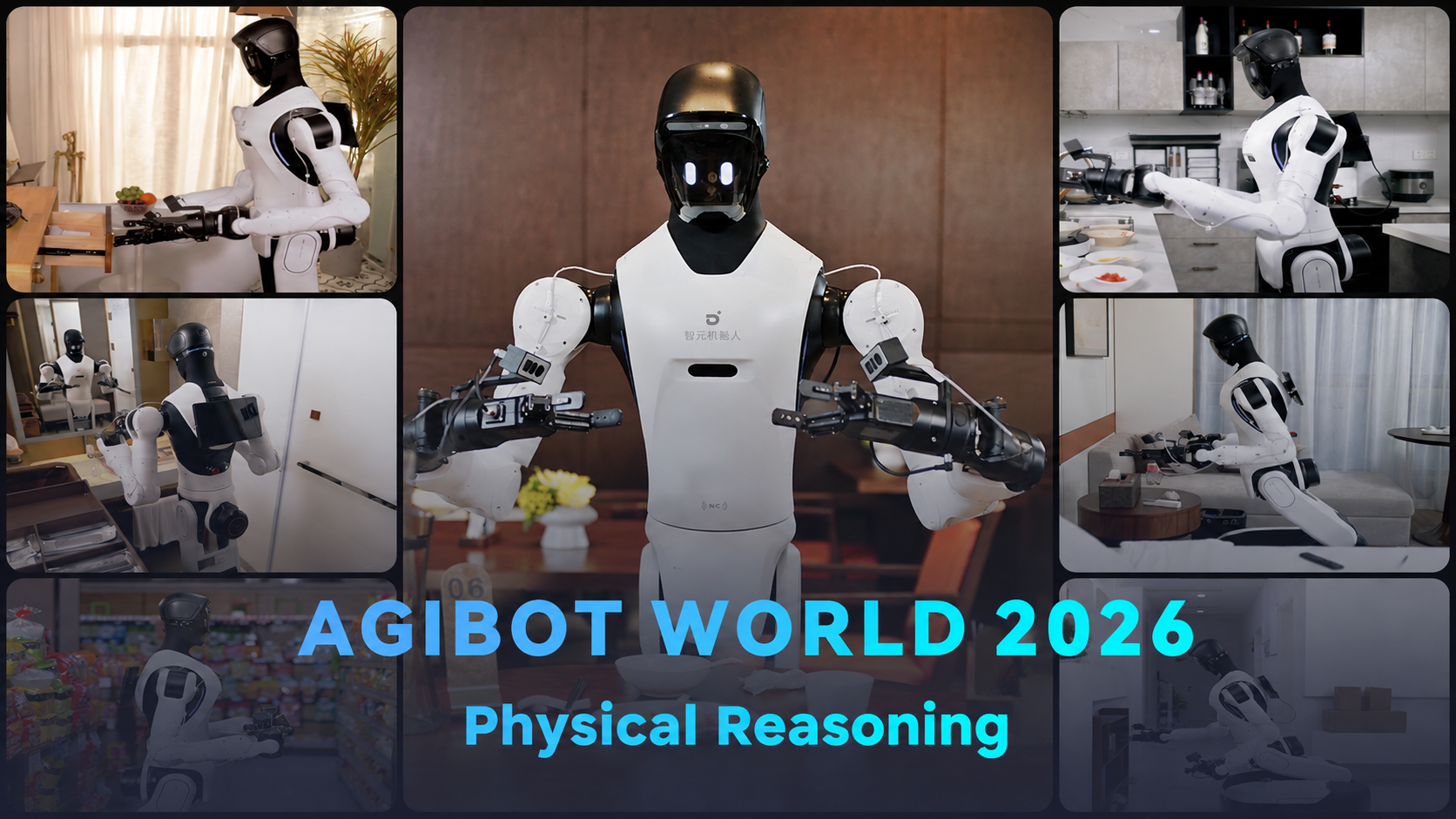
AgiBot said on Oct 22 that it has open-sourced "Physical Reasoning", the fourth release of its AGIBOT WORLD 2026 dataset, with tasks built around nine reasoning abilities and more than 10 categories of logic scenarios in which the right robot action depends on the scene.
The Hugging Face listing carries a CC BY-NC-SA 4.0 licence, so start-ups can study the data but not train commercial products on it without separate terms.
AgiBot, the Shanghai humanoid maker that IDC ranked first in global humanoid shipments for the first half of 2026, has released a dataset meant to teach robots when to change plans rather than how to move. The company said on Oct 22 that "Physical Reasoning", the fourth release of its AGIBOT WORLD 2026 programme, records the same household and hotel tasks under different starting states, so that a model sees how the correct action sequence shifts when a bottle is already full, a key is blocked by a box or a drawer has already been searched.
What is in the release
AgiBot said the tasks cover nine reasoning abilities, among them attribute-constrained selection, action preconditions, goal-directed search, quantity reasoning, long-horizon planning and subtask ordering, spread over more than 10 categories of logic scenarios and three difficulty tiers. Each episode pairs high-level question and answer data with low-level action trajectories, plus dense text descriptions of each arm's role, gripper state and expected outcome, and bounding-box, point and trajectory labels. Failed attempts are kept and weighted equally with successes, which the company said is meant for research on recovery after an error. AgiBot said the data already feeds its upcoming agent framework and its next foundation model.
The licence is the catch
The Hugging Face repository for AgiBotWorld2026 lists a CC BY-NC-SA 4.0 licence and is tagged for the LeRobot format and dual-arm robots; it showed 108,419 downloads on Oct 24. Non-commercial terms mean a robot start-up can benchmark on the data but would need a separate agreement to ship a product trained on it. That keeps the commercial value with AgiBot while the research community does the evaluation work.
Why it matters
Most open robot data so far teaches motion. A dataset that labels decisions, such as how many bottles to remove before restocking, targets the planning layer that vision-language-action models still handle poorly, the gap described in our VLA model explainer. For AgiBot, which said it built its 20,000th robot in September and has pledged robots and RMB 200 million to universities under its Yuansheng programme, open data is also a way to make its hardware the default research platform. MEKAWIRE context: IDC counted nearly 25,000 humanoid shipments worldwide in the first half, more than 95% from Chinese vendors, so the data race now runs alongside a volume race that Chinese makers lead.
What to watch: whether AgiBot publishes benchmark results for a model trained on Release 4, and whether a commercial licence tier appears.
- Nine reasoning abilities, more than 10 categories of logic scenarios
- CC BY-NC-SA 4.0 on Hugging Face (non-commercial)
- AGIBOT WORLD 2026, Release 4 "Physical Reasoning" (announced Oct 22, 2026)
- 108,419 for the AgiBotWorld2026 repository (Hugging Face, Oct 24)
- Easy, Medium and Hard task tiers
- High-level Q&A, subtask segments, dense action prompts, boxes, points, trajectories, success and error samples
- Already used for AgiBot's upcoming agent framework and next foundation model, per the company
Why it matters
Decision-labelled data is scarcer than motion data, and the first vendor whose format becomes the research default gains influence over how embodied models are evaluated.
Rival analysis
NVIDIA pushes synthetic data through its Cosmos and Isaac tools, while AgiBot is betting on real-robot episodes collected on its own dual-arm platforms. Unitree and UBTech have not published comparable decision-labelled corpora in our coverage.
Valuation context
No financial terms. The licence keeps commercial rights with AgiBot, so the release is better read as ecosystem marketing for its hardware than as a gift of training data.
Supply-chain implications
Episodes are tied to AgiBot's own arms and grippers; models trained on them transfer most easily to AgiBot hardware.
Signals to watch
Benchmark numbers from AgiBot's next foundation model; a commercial licence offer; uptake of the data in arXiv papers outside AgiBot within the next quarter.
Analyst view
A sensible move that costs AgiBot little: the non-commercial licence means rivals gain a benchmark, not a product shortcut.
Questions you should be asking
How many episodes and hours does Release 4 add? Will AgiBot license the data commercially, and on what terms? Which model results will it publish on the reasoning tiers?