What is Unitree? A RMB1.7bn robot maker where humanoids are now half of sales
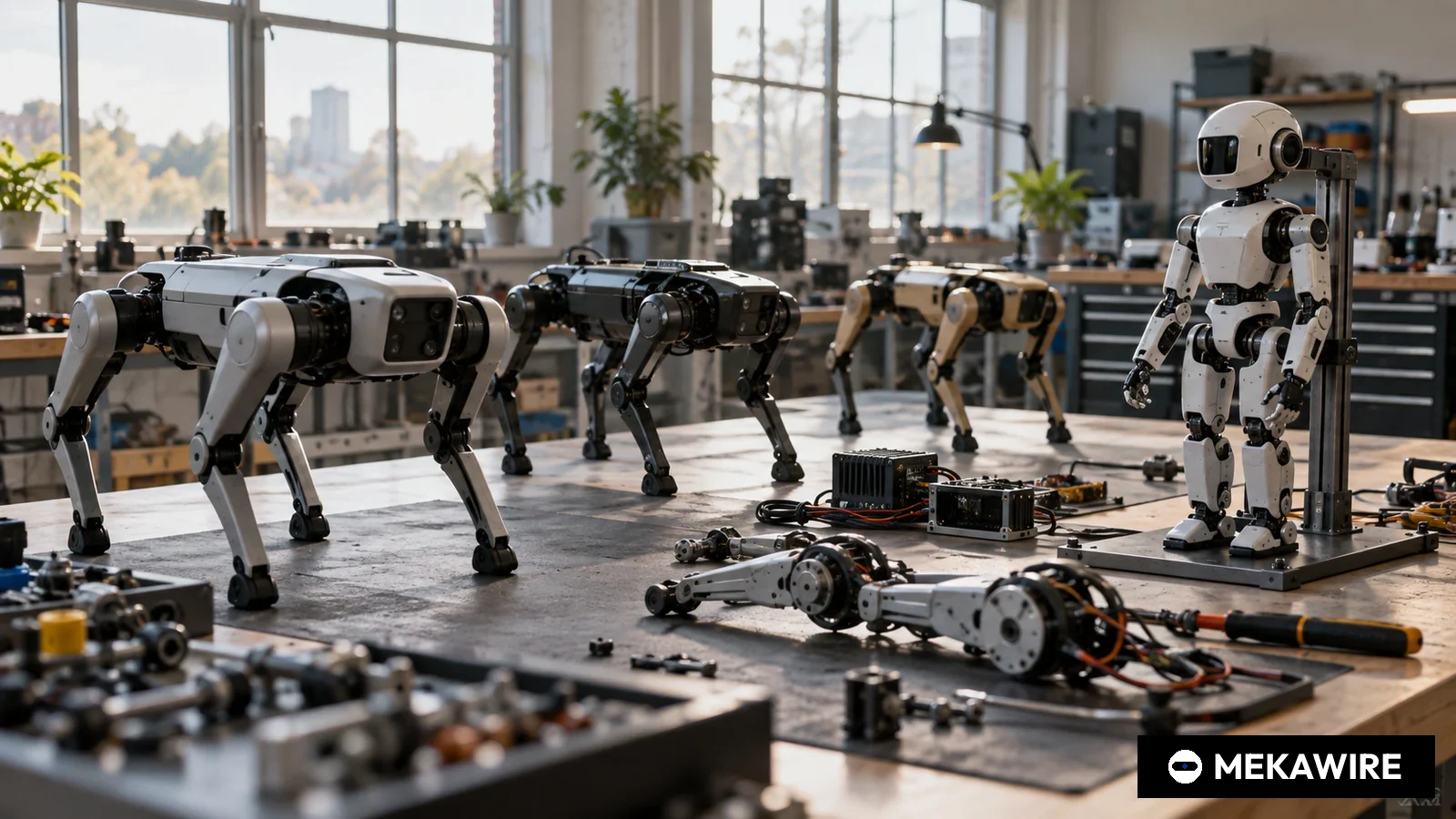
Unitree Robotics is a Hangzhou maker of legged robots that earned RMB1.70 billion of revenue in 2025 at a 59.45% gross margin, shipped more than 5,500 humanoids that year and listed on Shanghai's STAR Market on August 19, 2026 at about RMB61.0 billion.
Humanoids are now 51.53% of its sales, but 73.60% of humanoid revenue comes from research and education buyers. MEKAWIRE's executive summary, from the prospectus and listing filings.
Unitree Robotics is a Hangzhou company that designs and sells legged robots, and since 2025 it earns more from humanoids than from the robot dogs that made its name. The short answer for an executive: revenue of RMB1.70 billion in 2025, a main-business gross margin of 59.45% in the first nine months of that year, more than 5,500 humanoids shipped in 2025, and a Shanghai STAR Market listing on August 19, 2026 that valued the company at about RMB61.0 billion at the issue price. Its funding, products and filings are tracked on the MEKAWIRE profile [Unitree](/companies/unitree).
This brief answers a reader's request for an executive summary. It draws only on Unitree's STAR Market prospectus, its listing announcement and its own product pages, with comparisons from the MEKAWIRE database. The question it tries to settle is what a buyer of the shares, or a rival, is really looking at. A longer company history is in our [October profile](/news/unitree-robotics-company-profile-quadrupeds-humanoids-ipo-20261002).
Latest from MEKAWIRE
- Tesla starts Optimus production in Fremont as Q3 net income falls 43%
- Korea plans 1,700 public AI robots across 8 ministries in 2027; Hyundai warns on China
- Intel asks FCC to let it keep servicing foreign-made robots in its U.S. chip fabs
- China's 9-ministry plan brings embodied AI into retail and logistics
- How long does a humanoid robot battery last? 1.5 to 3 hours; refill speed decides
Revenue quadrupled in a year, profit stalled in 2026
- Revenue (RMB m)
- 159.13
- 392.37
- 1699.27
- 1152.25
- Revenue growth (%)
- No data
- 146.6
- 333.1
- 48.54
- Net profit attributable, lower of pre- and post-non-recurring (RMB m)
- -18.02
- 77.5
- 278.21
- 243.93
- Main-business gross margin (%)
- 44.22
- 56.41
- 59.45
- No data
Sources: Unitree listing announcement (18 Aug 2026) and STAR Market application draft (Mar 2026). 2025 gross margin is the Jan-Sep 2025 figure. Growth = revenue / prior-year revenue minus 1; H1 2026 growth as disclosed. 2025 profit includes a RMB349.1m share-based payment charge. Figures disclosed, not estimated.
As of Oct 22, 2026
Revenue rose from RMB159.13 million in 2023 to RMB392.37 million in 2024 and RMB1,699.27 million in 2025, a 333% jump in the last year by our calculation from the listing announcement. The first half of 2026 brought RMB1,152.25 million, up 48.54%, already 68% of the whole of 2025. Profit did not keep pace: the company disclosed that recurring net profit fell 19.34% in the half. The 2025 profit also carried a RMB349.1 million share-based payment charge, so the headline figure understates what the business earned that year. The next question is where the revenue comes from.
Humanoids overtook robot dogs, and laboratories buy most of them
Wang Xingxing founded Unitree on August 26, 2016 and remains chairman. The company built its name on quadrupeds such as the Go2 and the IP67-rated industrial B2, and it makes core parts such as motors and controllers in-house. In the first nine months of 2025 humanoids brought in RMB595.19 million, 51.53% of main-business revenue, up from 27.60% in 2024; quadrupeds fell to 42.25% and components to 5.76%.
The buyers are not factories. The prospectus shows that 73.60% of humanoid revenue in that period came from research and education customers and 9.01% from industry. List prices explain why: on unitree.com the G1 starts at US$13,500 and the full-size H2 at US$29,900, sums a university lab or a competition team can approve. Our [humanoid price explainer](/news/how-much-does-a-humanoid-robot-cost-2026-prices-unitree-r1-g1-h2-1x-neo-ff-nova-figure-agility-explained-20261016) sets these against every other verified price.
Gross margin climbed from 44.22% in 2023 to 56.41% in 2024 and 59.45% in January to September 2025. That is a hardware maker earning margins closer to a software company, and it raises the obvious comparison.
Priced at almost twice its listed Chinese peers
- Unitree
- SSE STAR 688836
- 35.89
- >5,500 humanoids shipped, 2025
- UBTech Robotics
- HKEX 9880
- 19.37
- 1,079 full-size humanoids sold, 2025
- Dobot
- Listed (Hong Kong)
- 20.12
- No data
- AgiBot
- Private
- No data
- 10,000th humanoid produced, 30 Mar 2026 (cumulative)
- Agility Robotics
- SPAC merger pending
- No data
- US$1.8m revenue, 2025 (S-4)
Price-to-sales multiples as stated in Unitree's STAR Market listing announcement of 18 Aug 2026 (value at issue price / 2025 revenue). Volume figures use different definitions (shipped, sold, produced) and are not comparable one to one. MEKAWIRE database, disclosed figures only.
As of Oct 22, 2026
Unitree's own listing document compared its valuation with two listed Chinese robot makers. At the RMB150.80 issue price it stood at 35.89 times 2025 sales, against 19.37 times for UBTech and 20.12 times for Dobot, and at 219.23 times 2025 earnings, against a sector average of 38.56 times. Volume points the same way. UBTech sold 1,079 full-size humanoids in 2025, and the International Federation of Robotics counted about 7,000 full-size units sold worldwide that year. Unitree's 5,500 includes smaller machines such as the 132 cm G1, so the numbers are not like for like; AgiBot reported its 10,000th humanoid produced on March 30, 2026, a cumulative production count rather than annual sales. In the US, Figure AI is private and gives no revenue, and Agility Robotics disclosed US$1.8 million of 2025 revenue in its merger filing.
MEKAWIRE analysis
Unitree leads humanoids on volume and margin because it sells affordable research machines; its RMB61 billion issue value is a bet that the same cost base will win industrial work before rivals close the gap.
The evidence for that bet is the cost base. No other humanoid maker in our database discloses a gross margin near 60% together with thousands of units a year. The issue value of RMB60.99 billion was 4.8 times the RMB12.7 billion post-money valuation of the June 2025 Series C (our calculation: value at issue price divided by Series C post-money), a step-up reached in about 14 months. Gross proceeds of RMB6.10 billion equal 3.6 times 2025 revenue, enough to fund several years of development without new equity.
The strongest counter-argument is the customer base. Laboratories and schools are a beachhead with a ceiling, and the fall in recurring profit in the first half of 2026 suggests that price competition or heavier spending is already biting. Industry customers bought only 9.01% of humanoid revenue in the period disclosed.
Bull case: industrial pilots turn into repeat orders, the six national humanoid standards Unitree helped draft favour designs like its own, and humanoid revenue keeps growing faster than the 48.54% of the first half. Bear case: research demand saturates, AgiBot and UBTech compete on price, and margins slide toward hardware norms, leaving a 219-times earnings multiple without support.
What would change our view: an industry share of humanoid revenue above 25% in the 2026 annual report would make the industrial thesis concrete, while a gross margin below 50% would weaken it.
Three dates that will test the story
The third-quarter report, due by October 31, 2026 under STAR Market rules, will show whether the first-half profit decline continued. China's first six national humanoid standards, with Unitree on every drafting list, take effect on April 1, 2027 ([our report](/news/china-first-humanoid-robot-national-standards-gb-t-48317-unitree-ubtech-xiaomi-drafted-all-six-20261019)). The 2026 annual report, due by April 30, 2027, should update the split between laboratory and industrial buyers, the number that decides whether RMB61 billion was a price for a research-equipment supplier or for the industry's next platform.
- revenue RMB1,152.25 million, +48.54%; recurring net profit -19.34%
- SSE STAR Market 688836, 19 Aug 2026, RMB150.80 per share, RMB6.10bn gross
- Hangzhou maker of quadruped and humanoid robots and robot components, founded 26 Aug 2016 by Wang Xingxing (chairman)
- G1 from US$13,500, H2 from US$29,900 (unitree.com)
- RMB1,699.27 million, up 333% (listing announcement)
- 59.45% (Jan-Sep 2025), from 44.22% in 2023
- 73.60% research and education, 9.01% industry (Jan-Sep 2025)
- more than 5,500 in 2025
- about RMB61.0bn; 219.23x 2025 earnings, 35.89x sales
- 51.53% (Jan-Sep 2025), 27.60% in 2024
Why it matters
Unitree is the only humanoid maker with audited-scale disclosure of revenue, margin, unit shipments and customer mix in one place, so it has become the reference company for valuing humanoids in China and abroad. Executives comparing suppliers, and investors pricing private rivals, are in effect benchmarking against its filings.
The filings show a profitable business, which is rare in the sector, but one whose humanoid demand rests on research and education. The investment case depends on that mix shifting to industry.
Rival analysis
UBTech is the closest listed peer: it sold 1,079 full-size humanoids in 2025 and 921 in the first half of 2026, and traded at 19.37 times sales in Unitree's comparison. Its pitch is factory pilots with carmakers rather than labs. AgiBot, private, reports cumulative production above 10,000 units and competes directly in data-collection and education sales.
In the US, Figure AI raised at a US$39 billion post-money valuation in September 2025 with no public revenue, and Agility Robotics reported US$1.8 million of 2025 revenue. Against them Unitree is the low-cost volume supplier; against Chinese rivals it is the margin leader.
Valuation context
At the RMB150.80 issue price Unitree was valued at about RMB60.99 billion, 35.89 times 2025 sales and 219.23 times 2025 earnings, against 19.37 times sales for UBTech, 20.12 times for Dobot and a 38.56 times sector P/E. The step-up from the June 2025 Series C post-money of RMB12.7 billion was 4.8 times.
We do not quote a current market value here because the desk has not verified a closing price; readers should compare the issue figures with the live quote.
Supply-chain implications
Unitree makes motors, controllers and other core components in-house, and sells components to third parties (5.76% of main-business revenue in Jan-Sep 2025). That vertical integration supports the near-60% gross margin and shields it from some actuator price swings.
Its exposure is in chips and sensors, where Chinese humanoid makers rely on imported compute and some imported vision parts; the filings we read do not quantify that share.
Signals to watch
Q3 2026 report by 31 Oct 2026: whether recurring profit is still falling.
National humanoid standards effective 1 Apr 2027: whether procurement starts to require compliance.
2026 annual report by 30 Apr 2027: industry share of humanoid revenue and full-year gross margin.
Analyst view
Thesis: Unitree's valuation rests on turning a profitable research-robot franchise into an industrial one. Confidence: medium. The filings are detailed and audited for past years, but they say little about industrial order books and nothing about 2026 unit volumes yet.
What would change our view: industry above 25% of humanoid revenue (positive) or gross margin below 50% (negative) in the 2026 annual report.
Questions you should be asking
How many humanoid units were shipped in the first half of 2026, and what share went to industrial customers?
What drove the 19.34% fall in recurring net profit in H1 2026: pricing, R&D spending or mix?
How are the IPO proceeds being deployed between humanoid R&D, production capacity and components?