What is Doosan Robotics? The Korean cobot maker now earns half its sales from US packaging cells, explained in numbers
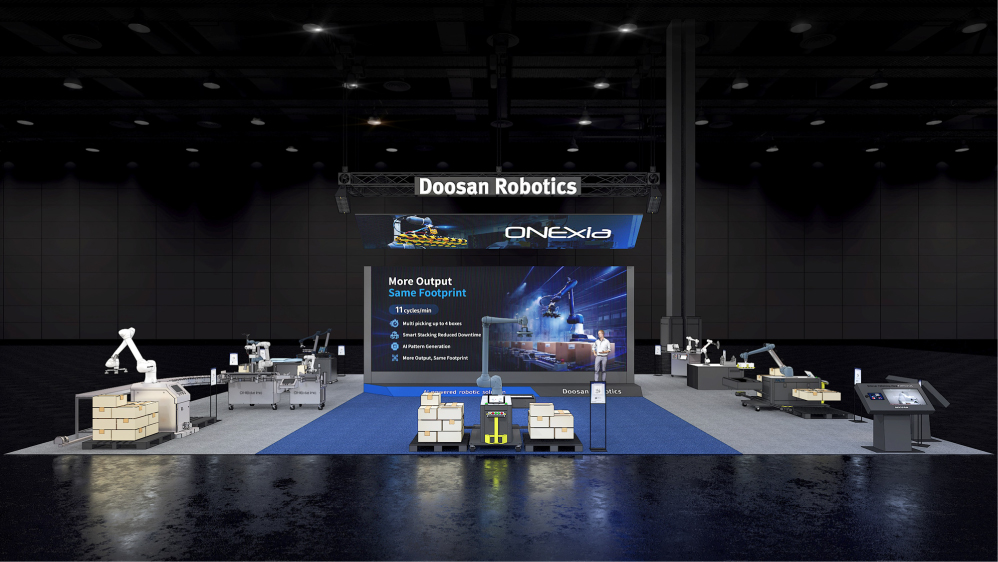
Doosan Robotics is the Doosan group's collaborative-robot maker, founded in 2015 and listed in Seoul, which sells cobot arms in 14 models through more than 100 sales channels. Its first-half 2026 revenue of KRW 32.97bn matched all of 2025 (99.97%), but the growth came from Doosan Robotics Americas, the former Pennsylvania integrator ONExia, which supplied 53% of sales, while operating losses still equalled 80% of revenue and its industrial humanoid is planned for 2028.
Doosan Robotics booked KRW 32.97bn of revenue in the first six months of 2026, 99.97% of everything it sold in 2025. On the surface that is a turnaround for the Doosan group's collaborative-robot maker. Underneath, it is a change of business. More than half of the first-half sales, 53% by the company's own count, came from automation solutions in North America, built by a Pennsylvania integrator Doosan bought a year ago, rather than from the cobot arms that made its name.
That shift matters for anyone trying to value the company or to understand where Korea's physical-AI money is going. This explainer sets out what Doosan Robotics makes, how its numbers have moved since 2022, how it compares with rivals, and what its 2028 industrial humanoid plan depends on.
A cobot maker with 14 models and a shrinking arm business
Doosan Robotics was founded in 2015, launched its first cobot in 2018 and counts Doosan Corp. as its major shareholder. Its April 2026 investor presentation lists 14 cobot models across payloads from about 5 kg to 30 kg, more than the line-ups it shows for Universal Robots, FANUC or Techman, and more than 100 sales channels, with over 60% of revenue earned outside Korea. Around the arms it sells Dart-Suite software and turnkey applications for palletising, welding, machine tending and food service.
The arm business has been shrinking. Audited revenue peaked at KRW 53.04bn in 2023, fell to KRW 46.83bn in 2024 and to KRW 32.98bn in 2025, a 37.8% drop in two years. The company told investors in March that North American demand for its arms fell about 50% in 2025 as US tariffs froze purchasing. Gross profit dropped from KRW 14.66bn to KRW 4.42bn over the same two years, so gross margin halved from 27.6% to 13.4%, while selling and administrative costs nearly doubled from KRW 33.83bn in 2023 to KRW 63.89bn.
- FY2022
- 44.95
- 14.24
- 13.23
- 29.4%
- FY2023
- 53.04
- 14.66
- 19.17
- 36.1%
- FY2024
- 46.83
- 9.53
- 41.20
- 88.0%
- FY2025
- 32.98
- 4.42
- 59.47
- 180.3%
- H1 2026
- 32.97
- not disclosed
- 26.49
- 80.3%
FY2022 to FY2025 audited K-IFRS consolidated figures from the April 2026 IR material; H1 2026 is Q1 plus Q2 preliminary figures from the company's earnings releases. Loss ratio = operating loss / revenue.
As of Oct 18, 2026
Method: loss ratio = operating loss divided by revenue. H1 2026 combines the Q1 and Q2 preliminary releases.
The question this raises is where the 2026 rebound came from, if not from arms.
How a KRW 37bn purchase in Pennsylvania became half the company
In July 2025 Doosan Robotics agreed to buy 89.59% of ONExia, an Exton, Pennsylvania integrator of end-of-line packing and palletising cells, for KRW 37.41bn ($27.19m), according to its KRX filing; the deal closed on Sept 17, 2025. ONExia then absorbed Doosan's US sales arm and became Doosan Robotics Americas (DRA). In March 2026 the parent put a further $16.0m into it to expand its factory.
The Q2 2026 earnings release shows what that bought. Group revenue rose 290% year on year to KRW 17.67bn, which the company attributed to larger orders from key customers and ONExia's contribution. DRA's own sales rose 127% to $6.8m in the quarter, with end-of-line systems up about 130% to $4.8m and arms and other items at $2.0m. The company expects DRA sales to grow 50% in 2026. North America solutions accounted for 53% of first-half revenue, or roughly KRW 17.5bn by our arithmetic (0.53 times KRW 32.97bn).
There is a caution in the same slide. DRA's order backlog was $12.4m at the end of June, down from $14.9m at the end of 2025, though still well above $3.8m at the end of 2024. Integration revenue is lumpy and is booked project by project.
- Doosan Robotics
- KR
- KRW 32.97bn
- H1 2026
- Q2 +290.0% y/y
- Company earnings releases
- Rainbow Robotics
- KR
- KRW 21.38bn
- H1 2026
- Mobile humanoids 40.5% of sales
- Half-year report
- Teradyne Robotics (Universal Robots, MiR)
- US/DK
- $191m
- H1 2026
- Q2 +33% y/y
- Company results
- Dobot
- CN
- RMB 492.2m
- FY2025
- +31.7% y/y
- HKEX annual results
Disclosed figures only, currencies not converted. Teradyne H1 = $91m (Q1) + $100m (Q2). Rainbow, Teradyne and Dobot figures from MEKAWIRE stories based on filings.
As of Oct 18, 2026
On disclosed figures Doosan out-sold Rainbow Robotics in the first half, KRW 32.97bn against KRW 21.38bn, but both are small next to Teradyne's Universal Robots and MiR unit, which reported $191m over the same six months, or Hong Kong-listed Dobot at RMB 492.2m for 2025. If the revenue is now coming from US integration, the next question is what it costs.
The losses are smaller, not small
The first-half operating loss was KRW 26.49bn, equal to 80.3% of revenue, against 180.3% in 2025. Net losses were KRW 9.17bn in Q1 and KRW 12.79bn in Q2. The balance sheet remains the company's main asset: KRW 252.4bn of cash at June 30, against KRW 50.0bn of debt that first appeared this year, leaving net cash of KRW 202.4bn and a liabilities-to-equity ratio of 34.2%.
MEKAWIRE number: at the first-half rate of operating loss, KRW 52.97bn a year, net cash covers about 3.8 years (202.4 divided by 52.97). Operating loss is not the same as cash burn, but it is the measure the company discloses quarterly.
The humanoid is mostly paid for by the state
Doosan Robotics said on April 29 that it will launch solutions on its Agentic Robot O/S in 2027 and an industrial humanoid in 2028, after talks with NVIDIA on linking that software to NVIDIA's simulation stack. On Oct 6 it said two projects it proposed to the trade ministry and KEIT had been selected, with R&D budgets of about KRW 98.9bn, KRW 68.1bn of it government funding (68.9%). One puts a Korean AI chip into new 5, 10 and 20 kg cobots and a two-armed industrial humanoid, with partners including AIDIN Robotics, aiming for standard products from 2031; the other automates nuclear-component welding for Doosan Enerbility. Five days earlier it named Kwon Young-min, head of Bobcat's hydraulics unit Doosan Mottrol since 2021, as chief executive.
- 2024-12-10
- Plan to put Doosan Bobcat under Doosan Robotics terminated
- n/a
- 2025-07-28
- Agreed to buy 89.59% of US integrator ONExia (closed 2025-09-17)
- KRW 37.41bn ($27.19m)
- 2026-03-26
- Capital injection into Doosan Robotics Americas
- $16.0m
- 2026-04-29
- Industrial humanoid set for 2028, Agentic Robot O/S solutions for 2027
- n/a
- 2026-06-30
- First borrowings on the balance sheet
- KRW 50.0bn
- 2026-10-01
- Kwon Young-min named chief executive
- n/a
- 2026-10-06
- Two national physical-AI projects awarded
- KRW 98.9bn budget, KRW 68.1bn state
From KRX and DART filings, company releases and the 2Q26 earnings release.
As of Oct 18, 2026
MEKAWIRE analysis: an integrator with a humanoid option
Doosan Robotics has become a US packaging-automation integrator that also makes cobots, and its humanoid is an option funded more by Korean taxpayers than by its own shareholders.
The evidence is in the mix. Solutions in one market now outweigh arm sales worldwide, the only line growing fast is end-of-line systems, and the humanoid budget is two-thirds public money with products dated 2028 at the earliest and 2031 in the state programme. Kwon's appointment from an industrial components business, rather than from AI, fits a company that is being run for operational scale.
The strongest counter-argument is that integration is how cobot makers now sell AI at all. Owning the integrator gives Doosan customer data from real lines and a US assembly base that tariffs reward, which is exactly what an AI-driven robot business needs.
Bull case: DRA hits its 50% growth target, backlog rebuilds above $15m, arm demand recovers as tariff rules settle and the national projects yield certified on-device-AI cobots ahead of schedule. Bear case: integration margins stay thin, backlog keeps falling, and losses consume the cash pile before the humanoid earns anything.
What would change our view: a quarter in which arm revenue, not solutions, drives growth, or a paying customer named for the humanoid before 2028.
Signals to watch
The third-quarter 2026 earnings release, for whether DRA backlog recovers from $12.4m; the relocation and expansion of the DRA factory funded by the March injection; and the first milestones of the national projects, including the planned 72-hour non-stop trials at two or more sites. Each will show whether Doosan is building a robot-intelligence company or a well-funded integrator.
- Doosan Robotics was founded in 2015, launched its first cobot in 2018 and has Doosan Corp. as its major shareholder; its April 2026 investor presentation lists 14 cobot models and more than 100 global sales channels, with over 60% of revenue from abroad.
- Revenue peaked at KRW 53.04bn in 2023 and fell to KRW 32.98bn in 2025, when the operating loss reached KRW 59.47bn, according to its audited figures.
- First-half 2026 revenue was KRW 32.97bn (Q1 KRW 15.30bn, Q2 KRW 17.67bn, up 290% year on year), on preliminary company figures; the operating loss was KRW 26.49bn.
- North America solutions supplied 53% of first-half 2026 revenue; Doosan Robotics Americas' Q2 sales rose 127% to $6.8m and its order backlog stood at $12.4m at the end of June.
- Doosan bought 89.59% of ONExia for KRW 37.41bn ($27.19m), closing on Sept 17, 2025, and injected another $16.0m in March 2026.
- At June 30, 2026 the company held KRW 252.4bn of cash against KRW 50.0bn of new debt, for net cash of KRW 202.4bn.
- On Oct 6, 2026 it won two national physical-AI projects with KRW 98.9bn of R&D budgets, KRW 68.1bn of it government money; an industrial humanoid product is planned for 2028.
- Kwon Young-min, previously head of Bobcat's hydraulics unit Doosan Mottrol, was named chief executive on Oct 1, 2026.
Why it matters
Doosan Robotics is the bellwether for Korea's listed robot makers and the largest Korean beneficiary of the national physical-AI programmes announced in October. Its 2026 numbers show that the fastest way for a cobot maker to grow in the US under tariffs has been to buy an integrator, not to sell more arms.
That has implications for Neuromeka, Rainbow Robotics and HD Hyundai Robotics, which face the same choice between selling hardware through partners and owning the application layer.
Rival analysis
Universal Robots, owned by Teradyne, remains the global reference with $191m of first-half 2026 revenue and growth of 33% in Q2. Dobot grew 31.7% in 2025 and is moving into embodied AI with its own capital markets access in Hong Kong, while FAIR Innovation expects 18,000 orders in 2026 on reported figures.
In Korea, Rainbow Robotics now earns 40.5% of sales from mobile humanoids with Samsung as its largest shareholder, Neuromeka leads a KRW 17.5bn welding project, and HD Hyundai Robotics has entered heavy-payload cobots with the HDC series. Doosan's edge is breadth of models and a US integration base; its weakness is that arm sales halved in 2025.
Valuation context
MEKAWIRE does not hold a verified current market capitalisation for Doosan Robotics, so we do not state a multiple. Book equity was KRW 329.2bn at June 30, 2026, about KRW 5,080 per share on the 64,819,980 shares outstanding at the end of 2025. For reference, the appraisal price set for dissenting shareholders in the abandoned 2024 Bobcat restructuring was KRW 80,472 a share.
Any valuation now has to price two businesses: a US integrator growing about 50% a year from a small base, and a cobot and humanoid R&D platform with heavy losses and substantial state co-funding.
Supply-chain implications
Doosan says it designs a unified joint module used across all its arm models. Its national project aims to put a Korean AI system-on-chip with an NPU into the controller, with AIDIN Robotics among the partners, which would reduce dependence on imported compute for on-device AI. Reducers and many sensors remain imported across the Korean cobot industry, as MEKAWIRE's Oct 16 parts comparison found.
The US unit assembles end-of-line cells in Pennsylvania, which gives the group a tariff-resilient route for systems, though arms shipped from Korea still face US duties.
Signals to watch
1) Q3 2026 earnings: DRA backlog versus $12.4m and the share of solutions in revenue. 2) DRA factory relocation and expansion funded by the $16.0m injection. 3) National project milestones, including the 72-hour non-stop trials and the 2027 Agentic Robot O/S launch.
Analyst view
Thesis: Doosan Robotics is now an integrator with a humanoid option. Confidence: medium. The revenue mix and the backlog are disclosed by the company, but the half-year figures are preliminary and one acquisition drives most of the change.
We would raise confidence in the integrator thesis if Q3 shows solutions above 55% of sales again, and lower it if arm revenue rebounds sharply.
Questions you should be asking
What gross margin does Doosan Robotics Americas earn on end-of-line systems compared with arm sales?
Why did DRA's backlog fall from $14.9m to $12.4m in the first half while sales grew?
How much of the KRW 98.9bn national project budget flows to Doosan itself rather than to partners, and over what years?
What is the KRW 50bn of new debt funding, given KRW 252bn of cash?