What is Skild AI? The $14bn robot-brain maker's funding, S1 model and $100m revenue run rate explained
Skild AI is a Pittsburgh company founded in 2023 that sells one robot foundation model, the Skild Brain, to run many kinds of robots; it raised $1.4 billion in January 2026 at a valuation above $14 billion and said in September that it had passed $100 million in annual recurring revenue with more than 60 paying customers.
MEKAWIRE's numbers show the valuation rose 9.3 times in 554 days, sits at about 140 times that revenue run rate, and that Skild took 48.6% of disclosed robot-model funding in the past 12 months.
Skild AI makes one product, a robot brain, and in less than three years it has become the most richly funded company of its kind. The Pittsburgh start-up, founded in 2023 by roboticists Deepak Pathak and Abhinav Gupta, sells the Skild Brain, a foundation model meant to drive quadrupeds, humanoids, robot arms and mobile manipulators alike. It raised $1.4 billion in January at a valuation of more than $14 billion and said on September 10 that it had passed $100 million in annual recurring revenue.
Those two numbers sit uneasily together. By MEKAWIRE's arithmetic, the January valuation is more than 140 times the revenue run rate Skild reported eight months later. This explainer sets out what Skild actually sells, where its money and revenue come from, how it compares with Physical Intelligence and other model makers, and what would have to be true for the price to make sense.
A model that is supposed to run any robot
Skild described the Skild Brain in July 2025 as a two-layer system: a low-frequency policy that decides what to do and a high-frequency policy that turns that into joint commands. It is pre-trained on large-scale simulation and internet video of people handling objects, then post-trained on teleoperation and on data from paying deployments. The company calls this omni-bodied: the same model, adapted by fine-tuning, controls bodies it was not designed around.
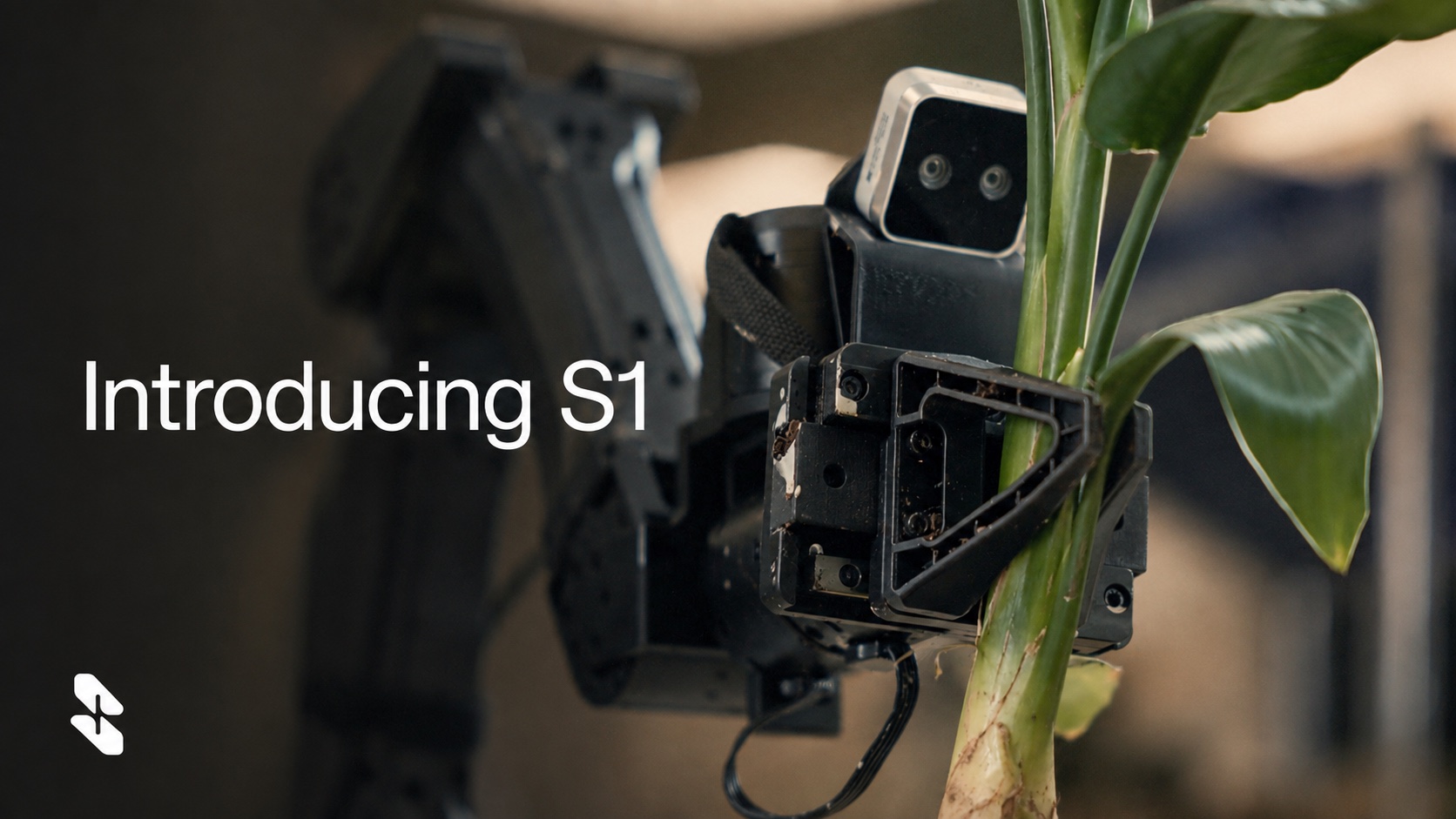
The second product step came on August 18 with S1, which Skild calls an in-context learner. An operator records one video of a new task and gives it to the robot as a prompt; the model's weights are not retrained. On long tasks of four to eight minutes that the model had not seen in training, Skild reports a 66% per-step success rate against 9% for a conventional language-prompted vision-language-action model, both at 100,000 hours of pre-training. It also says one in-context demonstration is worth about 380 fine-tuning examples, which took 50 to 100 hours of teleoperation to collect. On tasks the models had seen, the language-prompted policy did better at small scale, 53% against 43% at 1,000 hours. These are the company's internal benchmarks, not an independent test.
That bridge from research to sales is where Skild's story differs from most robot-model companies.
Where the revenue comes from
In its September post the founders said Skild had more than 60 paying customers ten months after its first commercial deployment, across moving goods, deliveries, site inspection, security, food preparation, warehouses, factories and data centres. About 90% of revenue comes from manipulation and 10% from mobility, of which 4% is autonomous mobile robots inherited from Zebra Technologies. It had recognised $50 million since deployments began. Named projects include dual-arm assembly of NVIDIA Blackwell systems with Foxconn, wire-harness work at Sumitomo Wiring Systems and kitchen pilots with Mitsui & Co., whose supply chains serve 1.4 million meals a day in Japan.
The numbers imply a business that is still accelerating. Recognised revenue averaged $5.0 million a month over ten months, while a $100 million run rate equals $8.3 million a month. Skild had said in January that 2025 revenue went from zero to about $30 million within a few months.
The Zebra deal shows how Skild buys distribution cheaply. Zebra's quarterly filing shows the sale of its robotics unit, the former Fetch Robotics, closed on March 27 for $20 million, made up of $9 million in cash, about $2 million in escrow and $9 million of Skild equity. Zebra had paid $301 million for Fetch in 2021, so the price was 6.6% of that. Skild also lists a March partnership with ABB Robotics and Universal Robots to put the Skild Brain on their arms.
How the money compares
- Skild AI
- US
- 1,700
- Series C $1,400m, Jan 14, 2026 (SoftBank)
- More than $14bn (disclosed)
- Physical Intelligence
- US
- 1,000
- Series B $600m, Nov 20, 2025 (CapitalG)
- $5.6bn (reported, not confirmed by the company)
- Rhoda AI
- US
- 450
- Series A $450m, Mar 10, 2026
- Not disclosed
- FieldAI
- US
- 405
- Two rounds $405m combined, Aug 20, 2025
- Not disclosed
- Generalist AI
- US
- 400
- $400m, Jun 4, 2026 (Radical Ventures)
- Not disclosed
- Walden Robotics
- US
- 300
- Seed $300m, Jul 15, 2026
- $1.1bn (disclosed)
- Spirit AI
- CN
- 280
- $280m, Feb 25, 2026
- Not disclosed
- Genesis AI
- FR
- 105
- $105m, Jun 30, 2025 (Eclipse)
- Not disclosed
MEKAWIRE database, verified rows only. Physical Intelligence's rounds are stored as reported by outlets. Amounts as disclosed, not estimated.
As of Oct 18, 2026
In MEKAWIRE's verified records, Skild's $1.4 billion Series C is 48.6% of all officially disclosed money raised by robot foundation-model and embodied-AI developers in the twelve months to October 18, across six rounds totalling $2.88 billion. Its valuation rose 9.3 times in 554 days, from $1.5 billion at the Series A of July 2024. Its closest rival by profile, Physical Intelligence, has $1.0 billion of funding in our records and a $5.6 billion valuation that rests on outlet reports rather than a company announcement. Figure AI, a humanoid maker that builds its own Helix model, carries a disclosed $39 billion valuation but sells hardware and software together.
- Jul 9, 2024
- Series A
- $300m at $1.5bn
- Skild blog
- Jul 29, 2025
- Skild Brain unveiled
- One model for quadrupeds, humanoids, arms
- Skild blog
- Jan 14, 2026
- Series C
- $1.4bn at more than $14bn; 2025 revenue from zero to about $30m
- Skild blog
- Mar 27, 2026
- Zebra robotics unit (ex-Fetch) bought
- $20m total consideration
- Zebra 10-Q
- Aug 18, 2026
- S1 in-context model
- 66% vs 9% on unseen tasks
- Skild blog
- Sep 10, 2026
- Revenue milestone
- More than $100m ARR, 60+ customers, $50m recognised
- Skild blog
- Sep 23, 2026
- Physical self-play
- More than 140 simulated years, no success rates
- Skild blog
Company and filing figures; ARR is the company's own measure and is not audited.
As of Oct 18, 2026
MEKAWIRE analysis: priced as software, earning like an integrator
Skild is valued as a software platform, but nine-tenths of its revenue today comes from manipulation deployments it runs with partners, so the $14 billion bet is that S1's one-video learning turns integration labour into software margin.
The evidence for the bull case is unusual for this sector. Skild has named industrial customers, a revenue figure, and a model change aimed squarely at the cost that kills robot projects, which is re-teaching every time a line changes. If one demonstration really replaces 50 to 100 hours of teleoperation, each new task costs Skild far less than it costs a conventional integrator, and margins could look like software over time.
The strongest counter-argument is about who set the price. SoftBank led the round, NVIDIA invested through NVentures and is also a deployment partner on the Foxconn Blackwell line, and strategic investors such as LG and Schneider Electric may value access over return. ARR is the company's own metric, unaudited, and recognised revenue so far is $50 million. A multiple above 140 times run-rate revenue leaves little room for slower deployments.
In the bull case, S1 holds up outside Skild's benchmarks, partners such as ABB and Universal Robots ship it on their arms, and revenue compounds as each deployment feeds data back to the model. In the bear case, deployments stay bespoke, gross margins look like services, and a cheaper open model from NVIDIA or Physical Intelligence narrows the gap.
- Valuation step-up, Series A to Series C
- 9.3x in 554 days
- $14bn / $1.5bn; Jul 9, 2024 to Jan 14, 2026
- Valuation to stated ARR
- More than 140x
- More than $14bn / $100m
- Monthly revenue, recognised average vs ARR run rate
- $5.0m vs $8.3m
- $50m / 10 months; $100m / 12
- Share of officially disclosed robot-model round money, 12 months
- 48.6%
- $1,400m / $2,880m across six rounds
- Fetch price vs Zebra's 2021 price
- 6.6%
- $20m / $301m
- S1 over language prompting, unseen tasks
- 7.3x
- 66% / 9%
Formula in each row. The 12-month window runs Oct 18, 2025 to Oct 18, 2026 and counts only OFFICIAL rounds with amounts in the robot-foundation-model and embodied-AI categories; with Physical Intelligence's reported $600m included the share is 40.2%.
As of Oct 18, 2026
Our view would change with an independent benchmark of S1 on unseen tasks, a disclosed gross margin, or a large customer moving a pilot into fleet-wide use.
What to watch next
Zebra's third-quarter 10-Q, due in late October or early November, will show how it carries its $9 million Skild stake, a rare outside mark on the price. SoftBank Group's results in November may say more about its exposure. The next test is whether Skild discloses a revenue figure that is recognised, not annualised, when it next raises money.
- Skild AI was founded in 2023 by roboticists Deepak Pathak and Abhinav Gupta and works from Pittsburgh and the San Francisco Bay Area, with an office in Bengaluru opened in February 2026.
- Series A: $300 million at a $1.5 billion valuation on July 9, 2024, led by Lightspeed, Coatue, SoftBank and Jeff Bezos, according to Skild's announcement.
- Series C: $1.4 billion led by SoftBank Group on January 14, 2026, at a valuation of more than $14 billion; NVIDIA's NVentures, Macquarie Capital and Bezos Expeditions joined, with LG, Schneider Electric, CommonSpirit and Salesforce Ventures as new strategic investors.
- Revenue: Skild said on September 10, 2026 it passed $100 million in annual recurring revenue ten months after its first commercial deployment, with more than 60 paying customers and $50 million already recognised.
- Revenue mix: mobility 10% (including 4% from AMRs inherited with Zebra's former Fetch Robotics unit) and about 90% manipulation.
- S1 model (August 18, 2026): learns a task from one video in its prompt; on unseen long tasks Skild reports 66% per-step success against 9% for a language-prompted VLA at 100,000 hours of pre-training.
- Fetch deal: Zebra's 10-Q shows the sale closed on March 27, 2026 for $20 million in cash, escrow and Skild equity, 6.6% of the $301 million Zebra paid in 2021.
- MEKAWIRE metrics: valuation up 9.3 times in 554 days; more than 140 times the stated revenue run rate; 48.6% of officially disclosed robot foundation-model and embodied-AI round money in the 12 months to October 18, 2026.
Why it matters
Skild is the clearest test of whether a robot model company can earn like a software company. It is the only robot-brain developer in our records that has published both a large valuation and a revenue figure with customer names, which makes it the reference point investors will use for Physical Intelligence, Generalist, Rhoda and others.
Its choice of manipulation work in factories, warehouses and kitchens, rather than humanoid demos, also shows where paying demand for general robot intelligence exists in 2026.
Rival analysis
Physical Intelligence is the closest rival: open-weight pi0 and pi0.5 models are widely used in academic papers, but it has not published revenue, and its valuation comes from outlet reports. Generalist AI ($400m) and Rhoda AI ($450m) pursue human-data and video-model approaches. NVIDIA gives away GR00T models to sell compute, which caps what a closed model can charge.
Humanoid makers with in-house models, such as Figure with Helix, compete for the same customers but bundle hardware. Skild's edge is hardware neutrality and revenue; its weakness is dependence on partners' hardware and integrators.
Valuation context
At more than $14 billion, Skild is valued above 140 times its stated $100 million run rate, and above 280 times the $50 million recognised so far. The Series C valuation was 9.3 times the Series A in 554 days.
The only outside mark is small: Zebra took $9 million of Skild equity in March. Its carrying value in Zebra's filings, and any secondary sales, are the first independent checks on the January price.
Supply-chain implications
Skild relies on others for bodies: Universal Robots and ABB arms, Foxconn's dual-arm cells, the Fetch AMR fleet and quadrupeds and humanoids from third parties. Compute comes from NVIDIA, which is also an investor and a deployment partner.
That concentration cuts both ways. NVIDIA's support speeds deployment on Blackwell lines but makes Skild exposed to a partner that also ships competing open robot models.
Signals to watch
1) Zebra's third-quarter 10-Q in late October or early November 2026: carrying value of the Skild stake. 2) SoftBank Group's results in November 2026: any disclosure on its Skild holding. 3) Skild's next revenue update or funding round: whether it gives recognised revenue and gross margin, not only ARR.
Analyst view
Thesis: Skild is priced as software and earns like an integrator; S1 is the bridge. Confidence: medium. The company has disclosed more commercial evidence than any peer, but its benchmarks are internal, its revenue measure is unaudited, and its lead investors have strategic interests.
We would raise confidence on an external S1 evaluation and a margin disclosure, and lower it if new deployments keep coming mainly from investor-partners.
Questions you should be asking
How much of the $100 million ARR comes from investors or their affiliates, such as NVIDIA and Foxconn? What gross margin do manipulation deployments earn after integration labour? How does S1 perform on customer tasks outside the internal benchmark? What does a customer pay per robot or per task, and for how long are contracts?