Generative Bionics plans 5,000 m² humanoid data factory in Italy on AMD Helios by Q4 2027
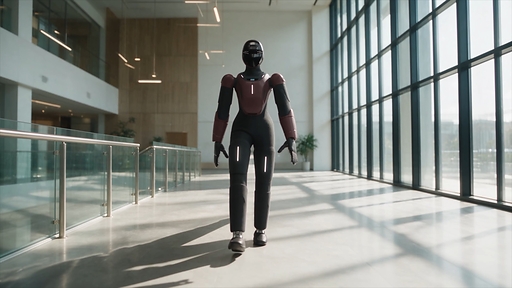
Italian humanoid maker Generative Bionics said on Oct 21 it will build a three-site Physical AI Data Factory, starting with a 5,000-square-metre hub in Italy due in the fourth quarter of 2027, where fleets of its GENE.01 robots will perform industrial tasks to generate training data that is multiplied in digital-twin simulation on AMD Helios systems.
A second European site and a third for global markets will follow; cost, location and fleet size were not disclosed.
Generative Bionics wants its humanoids to learn a factory before they ever enter one. The Genoa company said in a press release on Oct 21, issued at CES Unveiled Milan, that it will build a network of three Physical AI Data Factory sites, the first a 5,000-square-metre hub in Italy scheduled to be operational in the fourth quarter of 2027. The company called it Europe's largest physical AI training facility for humanoid robots.
The announcement is a statement about where the bottleneck in humanoid robotics sits. It is not the robot. It is the data, and the release lays out how the company intends to manufacture it.
A factory that produces data, not robots
According to the release, the hub will reproduce industrial environments chosen with industrial partners and let fleets of GENE.01 humanoids work through tasks continuously. Each environment and robot configuration is then rebuilt as a digital twin, where the same task is replayed across thousands of variations in layout, objects, materials, operating conditions and failure modes. Models trained and tested in simulation go back to the physical robots for validation, and data from robots deployed at customers feeds the next training cycle. The company uses the trained models, which it calls World Action Models, to configure and validate a complete robot for a specific site before delivery.
The data itself is the distinctive part. Beyond vision and motion, the dataset will include contact, force, proximity and temperature signals captured by GENE.01's full-body multimodal skin, the touch-sensing covering the company has made the centre of its safety pitch since the robot's launch. A second facility elsewhere in Europe and a third serving global markets will follow; the release gives no dates for those.
AMD moves from investor to infrastructure supplier
AMD will be the network's AI infrastructure partner, with the sites running on its Helios rack-scale systems for processing physical and synthetic data, training models and running digital-twin scenarios in parallel. The relationship is already deep: AMD Ventures invested in Generative Bionics' seed round and AMD compute sits on board GENE.01, the release said. Keith Strier, AMD's senior vice-president for global AI markets, framed the project as European AI and industrial sovereignty. The release describes the collaboration as planned and does not say whether AMD supplies the hardware on commercial terms, at a discount or as an investment.
What the release leaves out matters as much: no capital cost, no site location in Italy, no number of robots in the fleet, no named industrial partners and no customer contracts.
Where the money comes from
Generative Bionics raised €70 million in a seed round led by CDP Venture Capital, with AMD Ventures, Duferco, Eni Next, RoboIT and Tether, the company said. MEKAWIRE's database records that round on Dec 9, 2025 at $81 million. On Sep 30 Eni signed a memorandum to test GENE.01 in inspection and remote assistance, study battery production and recycling at Eni sites, and assess opening its high-performance computing to physical AI training.
| European humanoid developer | Latest disclosed round | Date | Amount (USD) | |---|---|---|---| | Humanoid (UK) | Series A | Jul 2026 | 152m | | Sereact (DE) | Series B | Apr 2026 | 116m | | Generative Bionics (IT) | Seed | Dec 2025 | 81m | | Flexion (CH) | Series A | Nov 2025 | 50m |
Source: MEKAWIRE database, disclosed rounds only, as of Oct 22, 2026. Sereact builds AI for robot arms and humanoid control rather than its own humanoid body.
MEKAWIRE analysis
Generative Bionics is trying to turn Europe's lack of a Chinese-style deployment base into a data plan: if it cannot ship thousands of robots quickly, it will stage the factory floor itself and multiply each hour of work in simulation.
The logic tracks what the larger players are doing. NVIDIA spent GTC Berlin the same day pushing Cosmos world models and Isaac simulation tools to European robot makers, and Korean and Chinese governments are funding shared data factories and training centres. The difference is that Generative Bionics proposes to own the whole loop on its own robot, with its own touch data, which is harder to copy than camera footage.
The strongest counter-argument is scale and money. A €70 million seed must fund the robot, its manufacturing and now a data plant whose cost is undisclosed; Humanoid in the UK has raised about twice as much in its latest round alone. Data collected in a staged hub may also transfer poorly to the messiness of a real line, which is why the plan to feed customer fleet data back matters more than the square metres.
Bull case: AMD and Eni bring compute and sites at low cost, the hub opens on time and the company enters 2028 with validated robot configurations and the only large European tactile dataset. Bear case: the hub slips, hardware partners remain announcements and a cheaper Chinese humanoid with good-enough software wins the same European pilots first.
What would change our view
Three signals: a disclosed site, budget and fleet size for the Italian hub; a named industrial customer moving from memorandum to paid deployment, Eni being the obvious candidate; and a new funding round, which a build-out of this kind will almost certainly need before the fourth quarter of 2027.
- GENE.01 humanoid with full-body multimodal skin
- AMD Helios rack-scale systems; AMD is the AI infrastructure partner
- €70M seed led by CDP Venture Capital (AMD Ventures, Duferco, Eni Next, RoboIT, Tether)
- Three sites: Italy, a second in Europe, a third for global markets
- Oct 21, 2026, Generative Bionics press release at CES Unveiled Milan
- 5,000 m² hub in Italy, operational target Q4 2027
- Vision, motion, contact, force, proximity, temperature
- Cost, exact location, fleet size, industrial partners, customers