Korean state lab makes NdFeB magnets without dysprosium or terbium for motors and humanoids
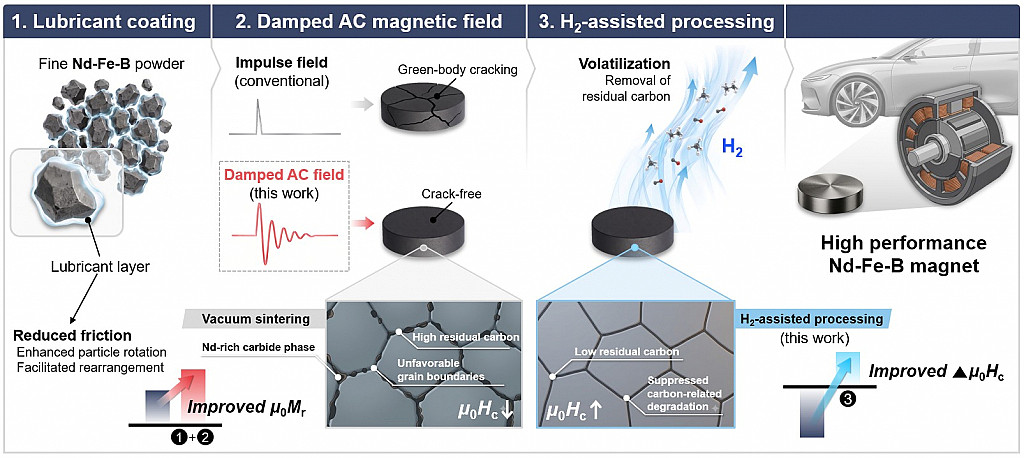
The Korea Institute of Materials Science (KIMS), a government research institute in Changwon, said in a press release on Oct 23 that a team in its nanomaterials division led by Kim Su-min, Kim Tae-hoon and Lee Jeong-gu has developed the core process steps to make high-performance sintered neodymium-iron-boron magnets with no heavy rare earths such as dysprosium and terbium.
Instead of adding those elements to keep coercivity at high operating temperatures, the team shrinks the grain size: it synthesises ultrafine Nd-Fe-B particles directly from rare-earth oxides by reduction-diffusion with a new post-treatment against oxidation, coats the powder with a lubricant and aligns it in a decaying alternating magnetic field, and uses a hydrogen-assisted step to cut residual carbon so coercivity does not fall after heat treatment.
KIMS said the work, published in Chemical Engineering Journal and Journal of Alloys and Compounds, still needs linked processes and mass-production technology before use in EV traction motors and humanoid robots, and the release gives no magnet performance figures.
MEKAWIRE context: magnets are the rare-earth exposure inside every robot joint motor, a supply risk MEKAWIRE tracked in LG's motor spin-off and its humanoid joint actuators.