Tractian raises $130M Series D at $1.4B to scale physical AI for industrial machines
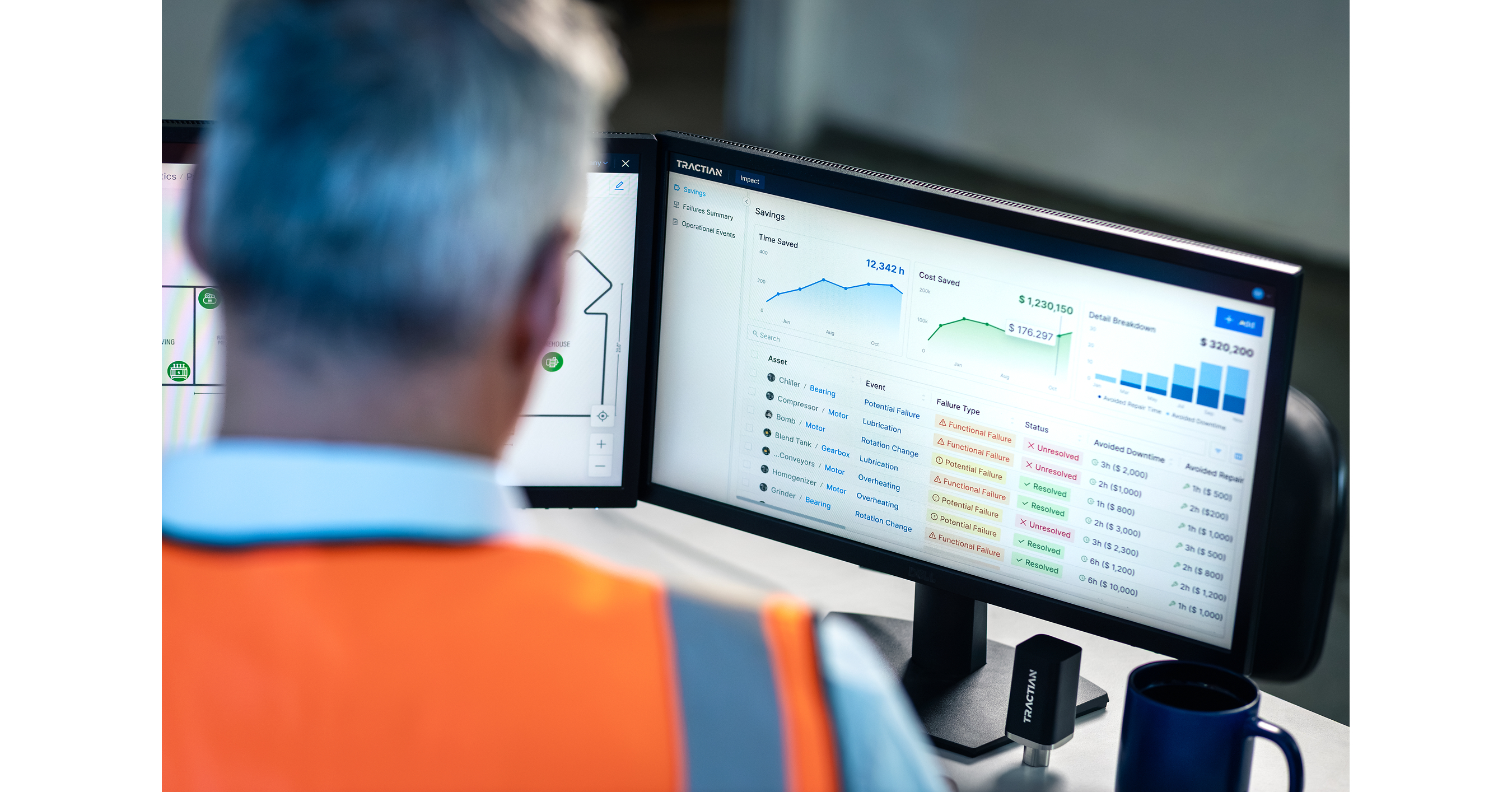
Tractian, an Atlanta company that puts vibration and ultrasound sensors on factory machines and uses AI to diagnose failures, raised a $130 million Series D at a $1.4 billion valuation, it said in a PR Newswire release on Oct 22.
Sapphire Ventures led and M&G's Catalyst strategy co-led; General Catalyst, Bosch Ventures and Y Combinator also took part.
Tractian does not build robots. It builds the nervous system that tells a plant when a pump, chiller or palletiser is about to fail, and investors have just priced that business at $1.4 billion. The Atlanta company said in a PR Newswire release on Oct 22 that it raised a $130 million Series D led by Sapphire Ventures and co-led by M&G's Catalyst strategy. Its MEKAWIRE profile is at Tractian.
The round matters to the robotics market for a simple reason. "Physical AI" money in the US is no longer flowing only to humanoids and robot brains; this month it reached a sensor-and-software company whose product never moves. The question is whether that is a sign of breadth or of a label stretched to fit a fundraising cycle.
The terms, as Tractian stated them
Sapphire Ventures, which also led Tractian's Series C, led again. N47, General Catalyst, Bosch Ventures, 53 Stations, Monashees, Endeavor Catalyst, Norte Ventures and Y Combinator joined as new and existing investors. The company gave the valuation as $1.4 billion and did not say whether that figure is pre- or post-money, nor what the Series C raised. Tractian says it employs more than 700 people, has offices in Monterrey, Sao Paulo and Poland, and that more than 2,000 facilities run its technology. Named customers include Eli Lilly, McKesson, Whirlpool, Coca-Cola bottling operations, Cummins and Embraer, alongside undisclosed data-centre and government operators.
The money, the company said, goes to scaling its multimodal platform and moving from predicting single failures to managing the overall health of every critical machine on a site. That shift is the real product bet.
How the product works
Tractian mounts sensors on rotating equipment and samples vibration, ultrasound and other signals at once. Its models, trained on what the company calls one of the largest industrial failure datasets, turn those readings into a condition picture, a probable root cause and a recommended action. An agentic layer then pushes that recommendation into the maintenance workflow. In practice this is predictive maintenance with a larger dataset and a tighter loop from alert to work order, which is where the company says most value is lost today.
The release leans on two outside numbers: a Siemens estimate that unplanned downtime costs the 500 largest industrial companies about 11% of revenue, roughly $1.4 trillion a year, and a Deloitte projection of more than 2.1 million unfilled US manufacturing jobs by 2030. Both are third-party estimates cited by Tractian, not its own measurements.
Where the round sits in MEKAWIRE's data
- General Intuition
- Agent and world models trained on game video
- Unnamed venture round
- $220M
- Not disclosed
- Sep 29, 2026
- Warp Sciences
- AI-run robotic chemistry labs
- Series A
- $215M
- Not disclosed
- Oct 22, 2026
- ICON
- Robotic 3D construction printing
- Series D
- $200M
- Not disclosed
- Oct 13, 2026
- SiMa.ai
- Edge AI chips for physical AI
- Series C
- $150M
- $1.45B
- Sep 28, 2026
- Tractian
- Machine-health sensors and AI
- Series D
- $130M
- $1.4B
- Oct 22, 2026
- Reliable Robotics
- Autonomous aircraft systems
- Series D extension
- $115M
- Not disclosed
- Oct 20, 2026
Disclosed figures only, from company or investor announcements stored in MEKAWIRE. Round as share of valuation = round amount / stated valuation: Tractian 9.3%, SiMa.ai 10.3%.
As of Oct 24, 2026
Among US physical-AI and robotics rounds of $100 million or more in the last 30 days, Tractian's is the second smallest, yet it is one of only two that came with a stated valuation. The other is SiMa.ai, the edge-AI chip maker, which raised $150 million at $1.45 billion on Sep 28. The two were priced almost identically: the new money is 9.3% of Tractian's stated valuation and 10.3% of SiMa.ai's.
MEKAWIRE analysis
Tractian's round shows that the cheapest way to sell physical AI into factories today is to sense machines, not replace workers with them.
Our reasoning: a sensor that clips onto an existing motor needs no line redesign, no safety recertification and no new floor space, which is exactly what slows humanoid and mobile-robot pilots. The data it collects about how machines fail is also the training material that robot makers will want once they start doing maintenance work themselves. The strongest counter-argument is that predictive maintenance is an old category with entrenched players, including the automation suppliers whose own venture arms now back Tractian; a $1.4 billion price assumes Tractian keeps winning against them, which the release does not prove with revenue.
Bull case: data-centre and defence demand turns a factory tool into infrastructure software, and the failure dataset becomes a moat. Bear case: sensor hardware commoditises, the large automation vendors bundle similar analytics, and growth slows into a services-heavy margin profile.
What to watch: whether Tractian discloses revenue or recurring-revenue figures with its next announcement; any named data-centre or defence customer; and whether Bosch Ventures' participation turns into a commercial channel through Bosch's own industrial business.
- Series D, $130 million (Oct 22, 2026)
- Atlanta HQ, offices in Monterrey, Sao Paulo and Poland, more than 700 employees
- $1.4 billion, as stated by the company
- More than 2,000 facilities; customers include Eli Lilly, Cummins, Whirlpool and Embraer
- Sapphire Ventures (also led the Series C); co-lead M&G's Catalyst strategy
- N47, General Catalyst, Bosch Ventures, 53 Stations, Monashees, Endeavor Catalyst, Norte Ventures, Y Combinator
Why it matters
It is the second US physical-AI round this month priced at about $1.4 billion, and the first for a company whose product is sensing rather than actuation. It tells robot makers that investors will pay for the data layer around machines, not only for the machines.
Rival analysis
Tractian competes with predictive-maintenance offerings from industrial automation suppliers and with sensor-plus-software startups. Its stated edge is the size of its failure dataset and an agentic layer that turns alerts into work orders. Bosch Ventures' presence among the investors is notable because Bosch is itself an industrial supplier.
Valuation context
The company stated $1.4 billion without saying pre or post money. The closest disclosed comparable in MEKAWIRE data is SiMa.ai at $1.45 billion after a $150 million Series C on Sep 28. No revenue figure was given, so no multiple can be computed.
Supply-chain implications
The product depends on low-cost vibration and ultrasound sensors and cloud inference. Offices in Monterrey, Sao Paulo and Poland point to a nearshore engineering and support base. Hardware sourcing was not disclosed.
Signals to watch
Revenue or ARR disclosure; named data-centre or defence contracts; a commercial tie-up with Bosch; expansion of the agentic layer into robot-executed maintenance.
Analyst view
Confidence medium. The investor syndicate is strong and the installed base of 2,000 facilities is concrete, but the release gives no revenue, so the valuation cannot be tested against fundamentals.
Questions you should be asking
What did the Series C raise and at what valuation? How much of revenue comes from sensors versus software? How many of the 2,000 facilities are paying enterprise contracts? Will Tractian's data be offered to robot makers building maintenance robots?