Unitree launches the R1 humanoid from RMB 39,900, cutting the entry price for a walking robot to 40% of its G1
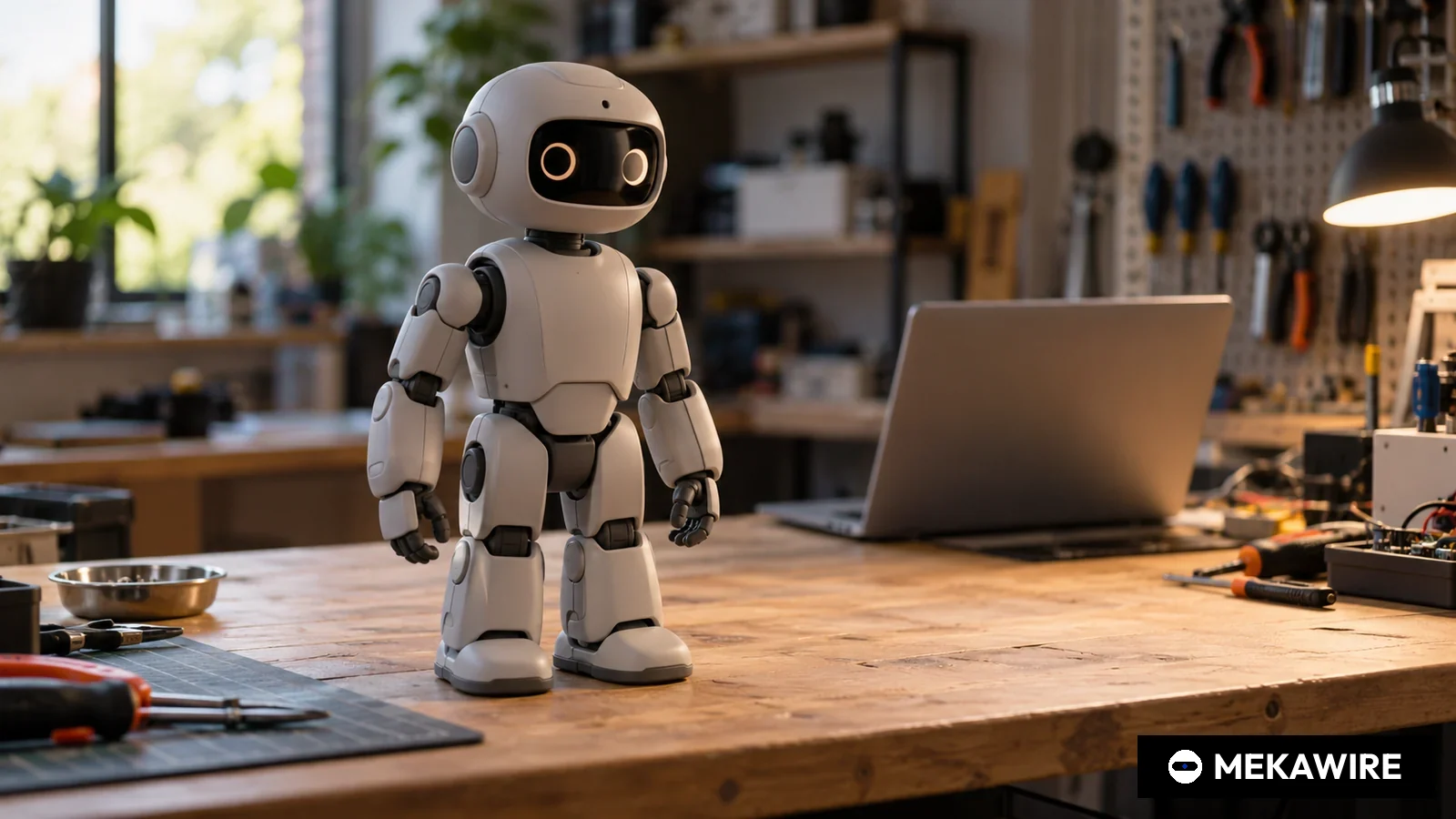
Unitree Robotics on 25 July 2025 launched the R1 humanoid, about 25 kg with 26 joints, from RMB 39,900 in China and US$5,900 abroad. The price is 40.3% of what the company charged for its G1 at launch and sets a public benchmark for low-cost humanoids.
Unitree Robotics on 25 July 2025 unveiled the R1, a humanoid robot it calls an intelligent companion, at a starting price of RMB 39,900 in China and US$5,900 on its international site. The Hangzhou company said the machine weighs about 25 kg and integrates large multimodal models for voice and images, according to the company's own timeline and product pages.
The price is the story. Unitree launched its previous humanoid, the G1, from RMB 99,000, or from US$16,000 abroad, in 2024, according to the company's news releases. The R1 costs 40.3% of the G1's Chinese launch price and 36.9% of its US launch price. Pollen Robotics' Reachy 2, an open-source research humanoid that Hugging Face began selling after buying Pollen in April 2025, is listed at US$70,000, about 12 times the R1's US price.
What Unitree is selling
Unitree's specification sheet gives the R1 26 joints in total: six in each leg, five in each arm, two in the waist and two in the head. Standing, it measures 1,230 by 357 by 190 mm. It sees through a binocular camera, hears through a four-microphone array and speaks through a built-in speaker. Computing runs on what the company describes as an eight-core high-performance processor, with Wi-Fi 6 and Bluetooth 5.2 for connectivity and software delivered through over-the-air updates.
The battery is the clearest trade-off. Unitree lists runtime at about one hour from a quick-release smart battery, against about two hours for the G1. The company does not publish battery capacity, payload or walking speed for the R1, and the arms end without dexterous hands, so the machine is built for movement, interaction and programming rather than for handling parts.
A ladder of price points
The R1 extends a pattern Unitree set with its quadrupeds. The company launched the Go2 robot dog in July 2023 from RMB 9,997, unveiled its first general-purpose humanoid, the H1, in August 2023, and introduced the G1, a robot of about 127 cm and 35 kg, on 13 May 2024, according to its website. Founder Wang Xingxing started the company in 2016 after building a quadruped called XDog during his master's studies. Unitree also sells joint motors, robot arms and its own 4D LiDAR, which gives it control over the parts that drive cost.
Where the R1 sits among rivals
Most humanoid makers have not published list prices, which makes the R1 hard to benchmark. MEKAWIRE could not find a published list price from UBTech Robotics, listed in Hong Kong since December 2023, from AgiBot, founded in 2023, or from Galbot, which closed a growth round in June 2025. In the United States, Figure AI raised US$675 million in its Series B in February 2024 and does not sell its robots on the open market. That leaves Unitree's own G1 and research machines such as Reachy 2 as the only comparable published prices.
- R1
- Unitree Robotics
- 2025-07-25
- 39,900
- 5,900
- 25
- 26
- G1
- Unitree Robotics
- 2024-05-13
- 99,000
- 16,000
- 35
- 23
- Reachy 2
- Pollen Robotics (Hugging Face)
- 2025-04-14
- No data
- 70,000
- No data
- No data
- Go2 (quadruped, for reference)
- Unitree Robotics
- 2023-07-14
- 9,997
- No data
- No data
- No data
Prices as published by the makers at launch, excluding tax and shipping; figures disclosed, not estimated. R1 US$ price from unitree.com/R1; G1 RMB and US$ prices from Unitree's 5 July 2024 release titles; Reachy 2 from Hugging Face's 14 April 2025 announcement (no RMB price or total DOF published). R1 price as share of G1 launch price = 39,900 / 99,000 = 40.3%; in US$ = 5,900 / 16,000 = 36.9%. G1 joints are the base version.
As of Oct 1, 2026
How a 25 kg humanoid stays upright
The R1 applies to a full body the approach Unitree built with its robot dogs, compact electric joint motors at every axis under software balance control, which a light body needs to recover from pushes and uneven ground. The binocular camera gives the robot depth perception, and the multimodal model lets it respond to spoken requests and recognise what it sees. Keeping the mass near 25 kg also lowers the energy each fall carries, which matters for a machine aimed at classrooms and homes.
What it means for the market
For universities, schools and software developers, a humanoid priced like a high-end laptop workstation changes procurement. A lab budget that bought one G1 could now buy two R1 units with money left over, and a teaching lab can put a full-body robot in front of students without capital approval. For rivals, Unitree has published a reference price that buyers will quote back at them.
The risks are real. A one-hour battery limits demonstrations and data collection, the absence of hands narrows research uses to locomotion, perception and interaction, and Unitree has not disclosed delivery dates, volumes or the price of developer versions. China's government named embodied AI a future industry in its 2025 Government Work Report, which adds policy support but also invites more entrants to compete on price.
What to watch
The first World Humanoid Robot Games, scheduled for 14 to 17 August 2025, will show how Unitree hardware performs against rivals in public. Watch for first R1 deliveries, the price of a developer edition and any matching price cuts from Chinese competitors in the second half of 2025.
MEKAWIRE analysis
The R1 turns the humanoid from a capital purchase into a consumer-electronics price point, and Unitree is betting that volume in labs and classrooms will come before anyone needs the robot to do paid work.
The evidence is in the numbers Unitree chose to publish. At RMB 39,900 the R1 is 40.3% of the G1's launch price and roughly one-twelfth of Reachy 2. Unitree did not cut performance evenly. It kept 26 joints and a binocular camera, and gave up runtime, which falls to about one hour, and hands. That is the trade a buyer who wants a moving, programmable body would make.
The strongest counter-argument is that a cheap humanoid without hands is a demonstration platform, not a product. Most paid humanoid work in factories and warehouses requires grasping, and a robot that cannot pick anything up competes with toys and robot dogs, not with labour.
Bull case. The price opens schools, universities and developers who never could afford a humanoid, and Unitree becomes the default teaching and research body for humanoids. Software built on the R1 then flows up to its larger robots.
Bear case. Rivals copy the price with similar specifications, margins compress, and buyers who discover the one-hour runtime and lack of hands treat the R1 as a novelty. Unitree is left defending a price point rather than a capability.
Signals to watch:
- 14 to 17 August 2025, the World Humanoid Robot Games, as a public test of Unitree hardware against rivals.
- By 31 December 2025, whether Unitree confirms R1 delivery volumes or posts a price for a developer edition.
- By 31 December 2025, whether any Chinese rival publishes a full-size or compact humanoid at or below RMB 39,900.
- integrated voice and image multimodal large models
- 26 in total: 6 per leg, 5 per arm, 2 waist, 2 head
- about 25 kg (Unitree launch statement)
- quick-release smart battery, about 1 hour runtime
- binocular camera, 4-microphone array, speaker
- 25 July 2025 (Unitree company timeline)
- 1,230 x 357 x 190 mm
- RMB 39,900 in China; US$5,900 on the international site, excluding tax and shipping
- 8-core high-performance processor; Wi-Fi 6, Bluetooth 5.2; OTA updates
- 40.3% (RMB 39,900 / RMB 99,000)
Why it matters
With the R1, an established humanoid maker has published a list price below RMB 40,000 in both renminbi and dollars. That turns an opaque category, where most makers quote prices only to enterprise buyers, into one with a visible floor. Every procurement officer at a university or school district now has a number to compare against.
The move also reframes what a humanoid is for. Unitree is not claiming the R1 will do factory work. It is selling a body that moves, sees, hears and talks, with a multimodal model on board, to people who want to program one. If that market proves large, the first mass market for humanoids will be education and development, not labour substitution.
Rival analysis
Unitree's closest competitor on price is itself. The G1, launched from RMB 99,000 in 2024, was already Unitree's entry humanoid, and the R1 undercuts it by about 60%. Unitree is willing to cannibalise its own product to hold the bottom of the market, which is what makes the move hard for rivals to answer.
UBTech, AgiBot and Galbot have no comparable published list prices, so they are not directly exposed yet. The exposure is greater for research platforms such as Pollen Robotics' Reachy 2 at US$70,000, which offers 7-DOF arms and VR teleoperation that the R1 lacks but costs about 12 times as much. Labs focused on locomotion and interaction rather than manipulation now have a far cheaper option.
Valuation context
Unitree is private and has not disclosed a valuation in its own releases around the R1 launch. Its last self-reported fundraising, in February 2024, was described in its news title as nearly RMB 1 billion. The R1 matters for any future valuation because it widens the unit base. A company that sells robots at RMB 39,900 can reach volumes that a RMB 99,000 product cannot, and investors will look for evidence of that volume.
The risk to valuation is margin. Unitree has not disclosed the R1's cost or gross margin. A low price funded by vertical integration, with Unitree's own motors and sensors, can still earn healthy margins, but a low price funded by thin margins would make the R1 a marketing expense rather than a business line.
Supply-chain implications
Unitree designs and sells its own joint motors, robot arms and 4D LiDAR, according to its product listings. That vertical integration is the most plausible explanation for how it can price a 26-joint humanoid at RMB 39,900, because the actuators are typically the largest cost in a legged robot.
The exposures are compute and batteries. Unitree describes the R1's processor only as an eight-core high-performance chip, without naming the supplier. A one-hour, quick-release battery suggests a small pack, which keeps weight and cost down but limits use. Any price war that follows will push suppliers of small motors, reducers and battery cells in China toward higher volumes at lower unit prices.
Signals to watch
The World Humanoid Robot Games from 14 to 17 August 2025 are the first public stage after the launch. Strong showings by Unitree hardware would reinforce the R1's appeal to schools and labs that buy on reputation.
By the end of 2025, look for three disclosures: confirmed R1 delivery volumes, a price for a developer edition with open interfaces, and any response from Chinese rivals with a published price near RMB 40,000. Any of these would show whether the R1 creates a new price band or remains a one-off.
Analyst view
Thesis: the R1 is a deliberate move to own the entry tier of humanoids by price, using Unitree's in-house motors to sell a moving, talking body to education and developer buyers before rivals publish prices at all.
Confidence: medium. The specifications and prices come directly from Unitree's own pages and are not in dispute. What lowers confidence is what Unitree has not said: battery capacity, payload, delivery timing, volumes and margin. Until the company shows that units ship in volume and that the price is sustainable, the R1 could equally be a halo product that draws attention to the G1. Confirmed volumes or a published developer edition would raise confidence.
Questions you should be asking
What gross margin does Unitree earn on the R1 at RMB 39,900, and how much of the cost advantage comes from its in-house motors?
When do deliveries start, and how many units does Unitree expect to ship in the first year?
What will a developer edition cost, and which software interfaces and compute options will it open?
How will Unitree support classroom users with a one-hour battery, and will spare battery packs be sold separately?