Unitree unveils the H2, a 182 cm humanoid with 31 joints and a bionic face, now listed at US$29,900
Unitree Robotics unveiled the H2 humanoid on 20 October 2025, a 1,820 mm, roughly 70 kg machine with 31 degrees of freedom and leg joints rated at up to 360 Nm. Its product pages now list the base model at US$29,900 before tax and shipping, or RMB 199,000 including tax, the only published price among the full-size humanoids compared here.
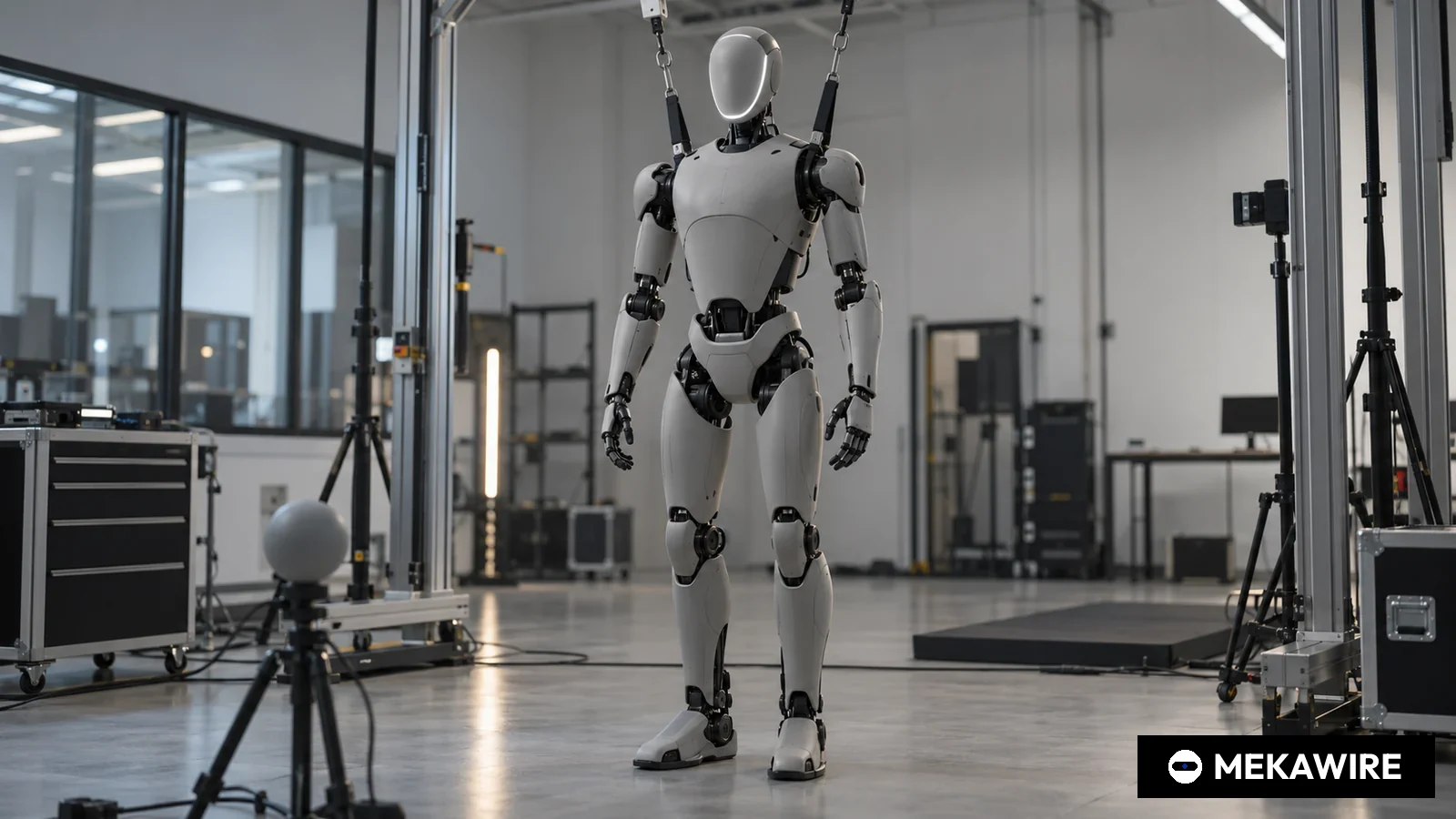
Unitree Robotics unveiled the H2 humanoid on 20 October 2025, its second full-size model after the H1 of August 2023, according to the Hangzhou company's official timeline. The entry describes a robot about 180 cm tall and 70 kg, fitted with bionic dual-eye cameras and a bionic face. The specification sheet Unitree published on its product page puts standing height at 1,820 mm, weight at about 70 kg including the battery and the joint count at 31.
Unitree's English product page now lists the base H2 at US$29,900 before tax and shipping, while its Chinese page lists RMB 199,000 with tax included. An education version, the H2 EDU, adds dexterous hands in several model options, a second onboard computer and access for secondary development, and is sold only through sales enquiries. Warranty runs 8 months on the base model and 12 months on the EDU. The timeline entry for the launch gives no price, so these are current list prices and not confirmed launch-day prices.
What is inside the H2
The 31 joints break down into six in each leg, seven in each arm, three in the waist and two in the head. Unitree rates the leg joints at up to 360 Nm of torque and the arm joints at up to 120 Nm, and gives each arm a rated payload of about 7 kg with a peak of about 15 kg. Thigh and calf together measure 1,045 mm and upper arm and forearm 690 mm. The structure combines aircraft-grade aluminium, titanium alloy and high-strength engineering plastics.
A 15 Ah lithium pack rated at 0.972 kWh and a maximum of 75.6 V supplies about three hours of operation, the company says. The base model computes on an Intel Core i5 and the EDU adds an Intel Core i7. The H2 page also cites a chip of up to 2,070 TOPS without naming it, and the H2 Plus page Unitree published in June 2026 identifies its module as NVIDIA's Jetson T5000, rated at 2,070 FP4 TFLOPS. Sensing relies on a wide-angle binocular camera, a microphone array and a speaker, with Wi-Fi 6, Bluetooth 5.2 and local air cooling.
From H1 to H2
Compared with the H1, the H2 is heavier and far more articulated. Unitree's H1 page lists the older robot at about 180 cm and 47 kg, with five joints per leg, four per arm and a 0.864 kWh battery. The H2 therefore adds one joint per leg, three per arm, about 23 kg of mass and 12.5% more battery energy. The H1's knee torque of about 360 Nm is matched by the H2's leg rating rather than exceeded. Unitree still advertises the H1's 3.3 m/s running speed, while the H2 page gives no speed at all.
Wang Xingxing founded Unitree in 2016, and the company says it holds more than 180 granted patents. It built its business on quadrupeds before adding humanoids, the G1 in May 2024 and the R1 in July 2025, and it listed on Shanghai's STAR Market in August 2026 under code 688836. The H2 returned to public view on 16 February 2026, when one H2 and 24 G1 robots performed on China Central Television's Spring Festival Gala. On 1 June 2026 Unitree introduced the H2 Plus, a research variant positioned as a reference humanoid for NVIDIA's Isaac GR00T tools, with Jetson Thor compute and two 22-joint SharpaWave hands from Sharpa.
A published price ladder
With the H2, Unitree now publishes a price for every size of humanoid it sells. At current US list prices before tax and shipping, the R1 costs US$5,900, the G1 US$13,500 and the H2 US$29,900. The H2 costs 2.2 times the G1 and 5.1 times the R1, or about US$427 per kilogram of robot against about US$386 for the G1 and US$203 for the R1.
- H2
- 1820
- 70
- 31
- 0.97
- 29,900
- 427
- H1
- 1800
- 47
- No data
- 0.86
- No data
- No data
- G1
- 1320
- 35
- 23
- No data
- 13,500
- 386
- R1
- 1230
- 29
- 26
- No data
- 5,900
- 203
Figures from Unitree's own product pages (unitree.com/H2, /h1, /g1, /R1) as of 3 October 2026; prices exclude tax and shipping; disclosed, not estimated. H1 height is given as about 180 cm and DOF only per limb (5 per leg, 4 per arm), so total is left blank; H1 has no list price on its page. G1 and R1 batteries are given in mAh only. US$ per kg = list price / published weight, rounded.
As of Oct 3, 2026
Against full-size rivals
Rivals publish specifications but not prices. Boston Dynamics lists the product version of Atlas at 1.9 m and 90 kg with 56 degrees of freedom, a 50 kg instant lift, 30 kg sustained and four hours of battery life. Figure AI gives Figure 03 a height of 5 ft 8 in, a weight of 61 kg, a 20 kg payload, five hours of runtime and a speed of 1.2 m/s. AgiBot's A2 service humanoid stands 169 cm, weighs 69 kg and has more than 40 active joints with a 700 Wh battery rated for two hours. UBTech says its Walker S2 lifts 15 kg and swaps its own battery within three minutes, but its product page does not give height, weight or joint count in text. Tesla's AI page describes Optimus as a general-purpose bipedal humanoid and publishes no specifications or price.
- H2
- Unitree Robotics
- 182
- 70
- 31
- 15
- 3
- 29,900
- Atlas (product version)
- Boston Dynamics
- 190
- 90
- 56
- 50
- 4
- No data
- Figure 03
- Figure AI
- 173
- 61
- No data
- 20
- 5
- No data
- A2
- AgiBot
- 169
- 69
- 40
- No data
- 2
- No data
- Walker S2
- UBTech Robotics
- No data
- No data
- No data
- 15
- No data
- No data
- Optimus
- Tesla
- No data
- No data
- No data
- No data
- No data
- No data
Makers' own pages as of 3 October 2026; disclosed, not estimated; blank = not published. H2 payload is peak per arm; Atlas is instant lift (30 kg sustained); Figure 03 is stated payload; Walker S2 is stated lift. Figure 03 height converted from 5 ft 8 in (172.7 cm). A2 DOF stated as 40+ active. Tesla publishes no Optimus specifications or price on tesla.com/AI. Payload definitions differ by maker.
As of Oct 3, 2026
On those published figures the H2 is lighter and less articulated than Atlas, and its 15 kg peak per arm sits below Atlas's 50 kg lift and Figure 03's 20 kg payload. Its three-hour runtime trails Atlas and Figure 03 but beats the A2. What none of the rivals offers is a price a laboratory or integrator can see before calling sales. For research groups already working on the H1 or the G1, the H2 provides a full-size body with seven-joint arms at a known cost.
Risks and open questions
Unitree has not disclosed H2 shipment volumes, the price of the EDU version or the price of the H2 Plus. The base model ships without hands or secondary development access, so buyers who want to train manipulation policies must move to an EDU whose price is not public. Payload comparisons are also loose. Unitree rates each arm, Boston Dynamics and Figure quote whole-robot figures, and none of the makers publishes test conditions.
What to watch
Under STAR Market rules Unitree must publish its third-quarter report by 31 October 2026. Any split of humanoid revenue by model would show whether the H2 sells beyond showcases and laboratories. Unitree's first annual report as a listed company, due by 30 April 2027, is the next chance for unit numbers.
MEKAWIRE analysis
The H2 matters less as a machine than as a price, because Unitree has put a public number on a full-size category that every rival still keeps private.
The evidence sits on the product pages. Unitree lists the H2 at US$29,900 and RMB 199,000, alongside public prices for the G1 and the R1. Boston Dynamics, Figure AI, AgiBot, UBTech and Tesla publish no list price for their full-size machines. On height and weight the H2 sits in the same band as Figure 03 and the A2, so buyers can now benchmark the category against a known figure.
The strongest counter-argument is that the advertised price buys a body, not a worker. The base H2 ships without hands and without development access, and the versions that matter for research and industry, the EDU and the H2 Plus, carry no public price. Industrial customers also buy full-size humanoids through pilots and service contracts in which list price barely figures.
Bull case. Universities and integrators standardise on the H2 because it is the only full-size humanoid they can budget from a web page, and the H2 Plus ties that installed base to NVIDIA's GR00T software. Proceeds from the STAR listing let Unitree scale output and push the price down further.
Bear case. The H2 stays a stage and laboratory robot. A 15 kg peak per arm and three hours of runtime keep it away from the heavy handling that Atlas's 50 kg lift is specified for, and the base model's lack of hands caps demand from research buyers.
Signals to watch:
- By 31 October 2026, Unitree's third-quarter report, for any revenue or unit split that names the H2.
- By 31 December 2026, whether Unitree publishes prices for the H2 EDU or the H2 Plus.
- By 30 April 2027, Unitree's 2026 annual report, for H2 shipments and customer mix.
- 15 Ah, 0.972 kWh, 75.6 V max; about 3 hours
- Intel Core i5 (H2); adds Intel Core i7 on H2 EDU; up to 2,070 TOPS chip cited
- 20 October 2025 (Unitree company timeline)
- 8 months (H2); 12 months (H2 EDU)
- US$29,900 excl. tax and shipping; RMB 199,000 incl. tax (H2 EDU on request)
- about 7 kg rated, about 15 kg peak
- +23 kg, +1 joint per leg, +3 per arm, +12.5% battery energy
- 1,820 mm standing; about 70 kg with battery
- legs up to 360 Nm; arms up to 120 Nm
- 31: 6 per leg, 7 per arm, 3 waist, 2 head
Why it matters
Full-size humanoids have been sold almost entirely through private quotes, pilots and service agreements. The H2 carries a list price on the open web, in both dollars and renminbi, which none of the full-size rivals compared here does. That gives procurement teams, investors and rivals a reference point the category lacked.
The launch also completes Unitree's product ladder. With the R1 at US$5,900, the G1 at US$13,500 and the H2 at US$29,900, the company now covers the compact, mid-size and full-size tiers with public prices, which lets a customer start small and move up within one software and hardware family.
Rival analysis
Boston Dynamics' product Atlas is the specification leader among the machines compared here, with 56 degrees of freedom, a 50 kg instant lift and IP67 protection, but it carries no public price. Figure 03 is lighter at 61 kg, quotes a 20 kg payload and five hours of runtime, and is also unpriced. The H2 does not try to match either on payload.
The closer comparison in China is AgiBot's A2, which at 169 cm and 69 kg is similar in mass to the H2 but is positioned as a service and reception robot with a two-hour battery. UBTech's Walker S2 is pitched at factories with autonomous battery swaps within three minutes and a 15 kg lift. Unitree's distinction is the openness of its pricing and its pull with research buyers, rather than a lead on any single published specification.
Valuation context
Unitree listed on the STAR Market in August 2026, and the H2 is one of the products investors will use to judge whether humanoid revenue can scale beyond education and research. The company has not broken out H2 sales, so the launch cannot yet be tied to revenue.
The published prices allow one simple unit metric. At US$29,900 for about 70 kg, the H2 is priced at about US$427 per kilogram, against about US$386 for the G1 and about US$203 for the R1. Rising price per kilogram up the ladder suggests Unitree is charging for articulation and torque rather than mass, which is the pattern investors should watch in gross margin once disclosed.
Supply-chain implications
The H2 uses a mixed compute stack, an Intel Core i5 for platform functions, an optional Core i7 for developers and support for a chip of up to 2,070 TOPS, which the H2 Plus page identifies as NVIDIA's Jetson T5000. That leaves the most capable configuration dependent on US silicon subject to export controls, a point to monitor for overseas and domestic buyers alike.
The joint ratings, 360 Nm in the legs and 120 Nm in the arms, match the knee torque Unitree already quotes for the H1, which suggests the company reused its own large actuator design. The battery, at 0.972 kWh and 75.6 V, is a modest step up from the H1's 0.864 kWh, which points to incremental rather than new cell and pack sourcing.
Signals to watch
Unitree's third-quarter report, due by 31 October 2026 under STAR Market rules, and its 2026 annual report, due by 30 April 2027, are the first filings that could disclose H2 shipments or revenue.
A public price for the H2 EDU or the H2 Plus would show how much Unitree charges for hands and NVIDIA compute, and would test whether the full-size price ladder holds once manipulation is included. Any price response from AgiBot, UBTech or other Chinese makers would show whether the H2 has set a market reference.
Analyst view
Thesis: the H2 turns the full-size humanoid from a quote-only product into a catalogue item, and Unitree is betting that transparent pricing wins research and integrator buyers before industrial capability decides the market.
Confidence: medium. The specifications and list prices come from Unitree's own pages and are not in doubt. Confidence is limited by what is missing, namely shipment volumes, the price of the EDU and Plus versions, and any customer deployments. A disclosed H2 unit count or a published EDU price would raise confidence; continued silence on both would lower it.
Questions you should be asking
How many H2 units has Unitree shipped since October 2025, and to which customer types?
What does the H2 EDU cost with dexterous hands, and how is the H2 Plus priced against it?
Was the US$29,900 price set at launch or introduced later, and has it changed since?
How much of the H2's actuator and battery design is shared with the H1, and what does that imply for margins?