NVIDIA brings Blackwell robot brains down to $1,999 with Jetson T4000 and opens GR00T N1.6 and Cosmos Reason 2 at CES
NVIDIA used CES 2026 to launch the Jetson T4000, a Blackwell robot computer priced at $1,999 at 1,000-unit volume, and to release the GR00T N1.6 humanoid model and the Cosmos Reason 2 reasoning model as open models. Qualcomm answered a day earlier with its Dragonwing IQ10 robot processor and named Figure as a partner, setting up a fight for the compute socket inside humanoids.
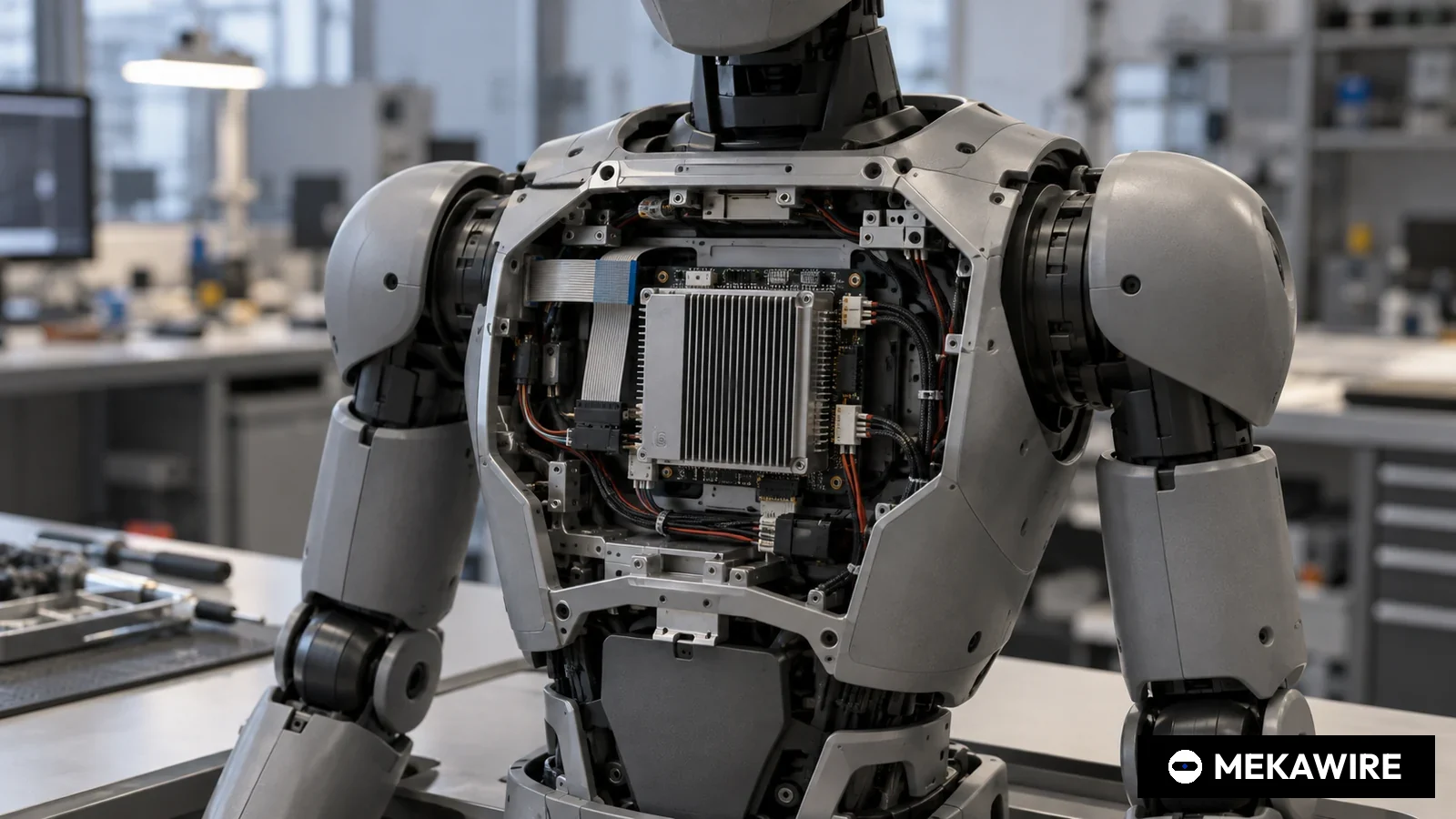
NVIDIA used the opening day of CES in Las Vegas on 5 January 2026 to push a cheaper Blackwell computer into robots and to release a new set of open models meant to run on it. The centrepiece for hardware buyers is the Jetson T4000 module, priced at $1,999 at 1,000-unit volume, alongside the Isaac GR00T N1.6 vision-language-action model for humanoids and the Cosmos Reason 2 vision-language model.
"The ChatGPT moment for robotics is here," chief executive Jensen Huang said in the company's announcement. NVIDIA said the T4000 delivers 1,200 FP4 TFLOPS with 64GB of memory inside a configurable power envelope that tops out at 70 watts, and that it offers four times the performance of the previous generation.
What NVIDIA announced
According to NVIDIA's developer blog, the T4000 carries a 1,536-core Blackwell GPU with fifth-generation Tensor cores, a 12-core Arm Neoverse-V3AE CPU and 64GB of 256-bit LPDDR5x memory at 273 GB/s, and runs between 40 and 70 watts. It shares the form factor and pin layout of the Jetson T5000, the 2,070-TFLOPS, 128GB module that NVIDIA put on sale in August 2025 inside a developer kit priced from $3,499. A robot maker can therefore design one carrier board and fit either module. The T4000 shipped with JetPack 7.1, which adds TensorRT Edge-LLM, an open-source C++ library for running language and vision-language models on edge devices.
On the software side NVIDIA released Cosmos Transfer 2.5 and Cosmos Predict 2.5, world models used to generate synthetic training data and to evaluate robot policies, together with Cosmos Reason 2 and GR00T N1.6. It also introduced Isaac Lab-Arena, an open-source framework for benchmarking robot policies at scale in simulation, and OSMO, an orchestration layer that NVIDIA said Hexagon Robotics uses and that has been integrated into Microsoft's Azure Robotics Accelerator. For regulated settings NVIDIA pointed to IGX Thor, an industrial version with functional-safety support.
NVIDIA also said it is folding Isaac and GR00T into Hugging Face's LeRobot library, linking what it described as its 2 million robotics developers with Hugging Face's 13 million AI builders. Hugging Face's Reachy 2 humanoid works with Jetson Thor, the company said. Boston Dynamics, London-based Humanoid and RLWRLD have integrated Jetson Thor into their humanoids, while NEURA Robotics, LG Electronics, Richtech Robotics and AGIBOT used the show to present new robots built around NVIDIA technology.
How the models work
GR00T N1.6 is a 3-billion-parameter model, according to its Hugging Face model card. NVIDIA's research page, first posted on 15 December 2025, says the model pairs an internal variant of the Cosmos 2B vision-language model with a diffusion transformer that is twice as deep as before, at 32 layers against 16 in N1.5. It predicts movements relative to the robot's current state instead of absolute joint positions, and its pretraining added several thousand hours of teleoperated data from bimanual YAM arms, AgiBot Genie-1, Unitree G1 locomanipulation and a simulated Galaxea R1 Pro. Cosmos Reason 2, first published on 19 December 2025, is built on Alibaba's Qwen3-VL-8B-Instruct in its 8B form and accepts up to 256,000 input tokens, its model card shows.
The licences differ. Cosmos Reason 2 is released under the NVIDIA Open Model License, which allows commercial use. GR00T N1.6 carries an NVIDIA noncommercial licence restricted to research and development, so a company that wants to ship the model inside a product needs a separate agreement.
Competition
Qualcomm moved a day earlier. On 4 January it introduced the Dragonwing IQ10 series for industrial mobile robots and full-size humanoids and said Figure was working with it to define next-generation compute architecture, while Booster, VinMotion and KUKA were also named. Qualcomm's later product brief lists up to 700 TOPS, 18 Oryon CPU cores and 64GB of LPDDR5x for its IQ10 reference design. The interesting detail is overlap. Figure was also on NVIDIA's August 2025 list of Jetson Thor adopters, together with Agility Robotics, Amazon Robotics, Boston Dynamics, Caterpillar, Hexagon, Medtronic and Meta.
- Jetson T4000
- NVIDIA
- 1200
- 64
- 70
- 12
- 17.1
- 1999
- Jetson T5000 (AGX Thor)
- NVIDIA
- 2070
- 128
- 130
- 14
- 15.9
- No data
- Dragonwing IQ10
- Qualcomm
- 700
- 64
- No data
- 18
- No data
- No data
NVIDIA figures are FP4 sparse TFLOPS from NVIDIA's Jetson T4000 technical blog (5 Jan 2026) and Jetson Thor release (25 Aug 2025). Qualcomm's figure is TOPS from its Dragonwing IQ10 Robotics Reference Design product brief (Rev. A, May 2026); precision not stated, so it is not directly comparable. Compute per max watt = AI compute / top of disclosed power envelope. T4000 price is per module at 1,000-unit volume; NVIDIA sells the T5000-based developer kit from $3,499 and has not published a module price. Figures disclosed, not estimated; null = not disclosed.
As of Oct 1, 2026
Risks and open questions
NVIDIA has not published a module price for the T5000, which makes a like-for-like cost comparison impossible. The headline TFLOPS figures are sparse FP4 numbers and do not translate directly into the TOPS that rival chipmakers quote. GR00T N1.6's noncommercial licence limits how much of the open-model push turns into deployed product without a commercial deal.
MEKAWIRE analysis
NVIDIA is pricing the robot computer like a component and giving the models away to keep humanoid makers on its stack before Qualcomm and in-house silicon catch up.
The evidence is in the design choices. A pin-compatible module at $1,999 lowers the entry price for Blackwell in robots, LeRobot integration puts GR00T in front of hobby and university users, and Cosmos Reason 2 is free for commercial use. Each step widens the funnel into Jetson hardware.
The strongest counter-argument is that the largest humanoid developers write their own models and can switch chips. Figure, an early Thor adopter, is now publicly working with Qualcomm, which suggests compute sockets in robots are still contestable.
Bull case. If mid-size robot makers standardise on T4000 boards and NVIDIA's open models, Jetson becomes the default bill-of-materials line for humanoids in the same way CUDA became the default for training. Volume shipments in 2026 would confirm it.
Bear case. Robot volumes remain small, the leading customers move to custom or Qualcomm silicon, and NVIDIA's open models mainly benefit rivals that fine-tune them and deploy elsewhere.
- Signal 1. NVIDIA's GTC conference in San Jose in March 2026, where the next GR00T generation and Thor customer counts are expected.
- Signal 2. Qualcomm partner announcements in the first half of 2026 that put IQ10 into a shipping humanoid.
- Signal 3. Whether NVIDIA moves GR00T to a commercial-use licence in its next release during 2026.
- 5 January 2026, CES Las Vegas
- 3B-parameter VLA, noncommercial licence
- 1,200 FP4 TFLOPS (sparse)
- Open reasoning VLM, 8B built on Qwen3-VL, 256K-token input
- $1,999 at 1,000-unit volume
- Isaac and GR00T integrated into LeRobot
- 2,070 FP4 TFLOPS, 128GB
- 64GB LPDDR5x, 40 to 70 W
Why it matters
The T4000 puts a Blackwell Jetson at a price aimed at production robots rather than development benches. At $1,999 in volume with 64GB of memory, it can hold a multi-billion-parameter VLA model and a reasoning VLM on the robot itself, which removes a cloud dependency that many factory and warehouse buyers will not accept.
The bundled model release matters as much as the silicon. GR00T N1.6 and Cosmos Reason 2 are tuned for NVIDIA hardware, and Isaac Lab-Arena gives labs a shared yardstick. NVIDIA is building the reference path from data to deployment, so the cheapest route for a new robot company runs through its tools.
Rival analysis
Qualcomm is the direct challenger. Its IQ10 announcement on 4 January named Figure, Booster, VinMotion and KUKA, and its product brief puts the reference design at up to 700 TOPS with 64GB of memory. Qualcomm's pitch, in the words of executive vice president Nakul Duggal, rests on low-latency, safety-grade, high-performance technology.
The other rivals are the robot makers themselves. Large humanoid developers such as Figure train their own foundation models and can choose the chip that runs them. NVIDIA's answer is breadth, signing up many mid-sized makers such as NEURA, RLWRLD, Richtech and AGIBOT at once.
Valuation context
NVIDIA does not break out robotics revenue, so the announcement cannot be sized against company results. What can be measured is unit economics. The T4000 offers 1,200 FP4 TFLOPS for $1,999, or about 0.6 TFLOPS per dollar at volume pricing, and 58% of the T5000's compute with half its memory.
For robot start-ups the relevant number is bill of materials. A sub-$2,000 brain moves compute from one of the largest line items in a humanoid toward the cost range of an actuator set, which matters for any maker trying to bring humanoid prices down.
Supply-chain implications
The T4000 uses LPDDR5x memory and Arm Neoverse-V3AE cores, the same building blocks as the T5000, and is pin-compatible with it, which simplifies carrier-board inventories for module makers such as Advantech, ADLINK and AAEON that NVIDIA lists as Thor partners.
Because availability runs through NVIDIA's store and distribution partners, lead times for 1,000-unit orders will be a practical test of how much Blackwell capacity NVIDIA allocates to edge modules while data-centre demand remains high.
Signals to watch
At GTC in March 2026, watch for the next GR00T generation and any update to the number of robot makers on Thor. Through the first half of 2026, watch Qualcomm partner launches using IQ10 and whether Figure ships hardware on either platform.
Also watch licensing. A move of GR00T from a noncommercial to a commercial licence would signal that NVIDIA wants deployments, not just research mindshare.
Analyst view
Thesis. NVIDIA is turning Jetson into the default robot computer by cutting the entry price and pairing it with free models, and the strategy will hold through 2026 for mid-tier humanoid and AMR makers.
Confidence medium. The price, specs and partner list are disclosed and concrete, but NVIDIA gives no shipment volumes, the T5000 module price is undisclosed, and the most valuable customers are hedging with Qualcomm and in-house chips.
Questions you should be asking
How many T4000 modules did NVIDIA allocate for 2026, and what is the T5000 module price at the same 1,000-unit volume?
Will GR00T N1.6 or its successor be licensed for commercial deployment, and on what terms? Which robot makers have committed to IQ10 production designs rather than evaluation?