Harmonic Drive Systems' orders jump 55.7% to ¥24.1 billion as robot, surgical and chip demand returns, and it lifts its profit forecast by 37%
Harmonic Drive Systems booked ¥24,128 million of orders in April to June 2026, up 55.7% from a year earlier, and lifted its operating profit forecast for the year to March 2027 from ¥6,200 million to ¥8,500 million on 7 August. A large North American surgical robot order and AI driven semiconductor spending led the recovery, while China delivered the smallest order intake of its four regions.
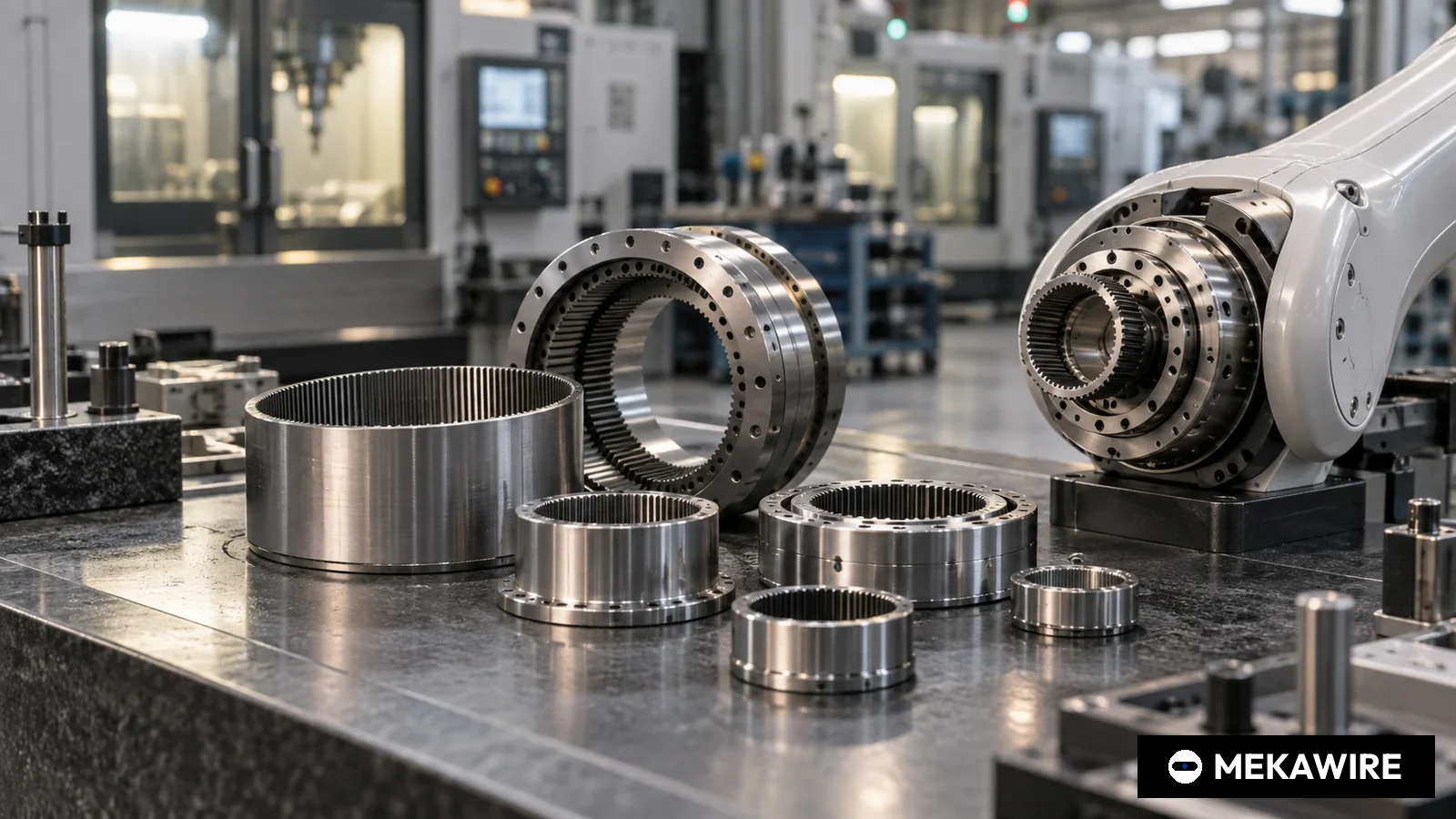
Harmonic Drive Systems, the Tokyo company whose strain wave gears sit inside the wrists of industrial robots and the arms of surgical systems, took ¥24,128 million of orders in the April to June quarter of 2026, up 55.7% from a year earlier, according to its first quarter earnings report filed with the Tokyo Stock Exchange on 7 August 2026. On the same day it raised its forecast for the year to March 2027, lifting expected operating profit by 37.1% to ¥8,500 million.
The quarter marks the clearest turn yet for a supplier whose profits had shrunk to almost nothing a year earlier. Consolidated net sales rose 23.6% to ¥16,681 million. Operating profit climbed to ¥1,840 million from ¥122 million, and ordinary profit to ¥1,719 million from ¥131 million. Net profit attributable to owners of the parent was ¥1,274 million against a loss of ¥38 million in the first quarter a year earlier.
Orders ran well ahead of shipments. The order backlog at the end of June stood at ¥29,457 million, 45.6% higher than a year before. Dividing quarterly orders by quarterly sales gives a book to bill ratio of 1.45, a MEKAWIRE calculation from the disclosed figures, meaning the company booked about ¥1.45 of new work for every yen it delivered.
The filing breaks orders down by region. Japan contributed ¥10,050 million, North America ¥7,079 million, Europe ¥5,864 million and China ¥1,130 million. North America stands out, with orders running at more than twice the segment's quarterly sales of ¥3,035 million and a backlog of ¥10,589 million, the largest of any region. The company said in its qualitative commentary that it received a sizeable block of orders for surgical support robots in the North American market, alongside steady global automation investment and expanding capital spending on advanced semiconductors driven by generative AI. It did not name the customer.
- Consolidated
- 24,128
- 29,457
- 16,681
- 23.6
- 1840
- 122
- 1.45
- Japan
- 10,050
- 8,433
- 8,090
- 36.2
- 2166
- No data
- 1.24
- North America
- 7,079
- 10,589
- 3,035
- 12.4
- 165
- -38
- 2.33
- Europe
- 5,864
- 9,332
- 4,547
- 25.5
- 140
- -79
- 1.29
- China
- 1,130
- 1,099
- No data
- No data
- No data
- No data
- No data
Source: Harmonic Drive Systems first quarter tanshin, 7 Aug 2026. Segment sales are segment sales as disclosed; consolidated row uses consolidated figures. Book to bill = orders / sales (MEKAWIRE calculation). China segment sales and profit not extracted, left null; Japan prior year OP not stated in absolute terms. Peer figures not included because comparable quarterly reducer orders were not verified on primary pages.
As of Oct 3, 2026
Profitability recovered across all three main segments. The Japan segment lifted segment sales 36.2% to ¥8,090 million and segment operating profit 214.0% to ¥2,166 million. North America swung to an operating profit of ¥165 million from a loss of ¥38 million, and Europe to ¥140 million from a loss of ¥79 million, on sales growth of 12.4% and 25.5%. The consolidated operating margin reached 11.0% in the quarter, against 0.9% a year earlier, both MEKAWIRE calculations.
In a separate notice the company revised its guidance for the year ending March 2027. Net sales are now expected at ¥74,500 million, up from ¥68,000 million in the forecast published on 13 May 2026, and 25.1% above the ¥59,557 million recorded in the year to March 2026. Operating profit guidance rose to ¥8,500 million from ¥6,200 million, ordinary profit to ¥8,200 million from ¥6,200 million and net profit to ¥6,000 million from ¥4,500 million. The company attributed the revision to rising demand for its speed reducers and mechatronics products across its main applications, led by industrial robots and semiconductor manufacturing equipment. The dividend forecast was kept at ¥20 per share, the same as the prior year.
- Net sales
- 59,557
- 68,000
- 74,500
- 9.6
- 25.1
- Operating profit
- 2,567
- 6,200
- 8,500
- 37.1
- 231
- Net profit attributable
- 1,608
- 4,500
- 6,000
- 33.3
- 272.9
Source: forecast revision notice and first quarter tanshin, 7 Aug 2026; prior year actuals from the first quarter results presentation, consistent with the YoY rates in the tanshin. Figures disclosed, not estimated.
As of Oct 3, 2026
The product explains why the numbers matter beyond one company. A strain wave gear uses an elliptical wave generator to flex a thin toothed steel cup inside a rigid ring with slightly more teeth, so each rotation of the motor advances the output by only a few teeth. The result is reduction ratios of around 100 to 1 in a single compact stage with almost no backlash, the property that lets a robot wrist, a wafer handling arm or a surgical instrument return to the same point repeatedly. Nabtesco supplies the larger RV cycloidal reducers used in robot bases, while Chinese makers led by Leaderdrive, listed on Shanghai's STAR Market, compete on price for harmonic reducer business with domestic robot builders.
That competitive pressure shows in the regional split. China delivered the smallest order intake of the four regions, at ¥1,130 million, with a backlog of ¥1,099 million. The strength of the quarter came from Japan, North America and Europe rather than from the Chinese robot market where local suppliers compete hardest on price.
The revised guidance still implies a slower pace later in the year. The company now expects first half sales of ¥35,700 million and operating profit of ¥3,700 million, which leaves about ¥19,019 million of sales and ¥1,860 million of operating profit for the July to September quarter by MEKAWIRE arithmetic. The full year operating profit target of ¥8,500 million implies a margin of 11.4%, close to the first quarter rate, so management is not yet assuming further margin expansion.
MEKAWIRE analysis
Harmonic Drive Systems' first quarter shows that the precision gear cycle has turned in Japan and the West, but the recovery is being led by medical and chip equipment demand as much as by factory robots, and China is not taking part.
The evidence for the turn is broad. Orders rose 55.7%, backlog 45.6% and every major segment returned to profit. A book to bill ratio of 1.45 is the kind of reading that usually precedes several quarters of rising shipments, and management raised full year operating profit guidance by more than a third only three months after setting it.
The strongest counter argument is concentration. The company itself pointed to a large North American surgical robot order, and a single block order can flatter one quarter's intake. North American orders of ¥7,079 million against segment sales of ¥3,035 million look exceptional rather than run rate, and the implied second quarter numbers do not extrapolate the first quarter order pace.
Bull case. Industrial robot makers in Japan and Europe restock reducers after two years of inventory correction, AI driven chip tool spending stays strong and humanoid developers begin ordering in volume. The backlog then converts into sales growth above the 25.1% now guided and margins move past the 11.4% target.
Bear case. The surgical order proves a one off, chip equipment spending pauses and Chinese harmonic reducer makers keep undercutting on price. Orders fall back toward the ¥15,496 million of a year ago and the revised profit target is exposed to a cut later in the year.
Signals to watch.
- The second quarter report covering April to September 2026, against the revised first half targets of ¥35,700 million in sales and ¥3,700 million in operating profit.
- Whether North American orders hold above segment sales once the surgical block order is absorbed, visible in the regional order table of the same report.
- China order intake in the quarters to December 2026 and March 2027, the clearest gauge of competition from Leaderdrive and other domestic suppliers.
- ¥16,681 million, +23.6%
- ¥1,274 million (prior year loss of ¥38 million)
- ¥20 per share
- ¥1,840 million (prior year ¥122 million)
- ¥7,079 million
- ¥29,457 million, +45.6% YoY
- ¥24,128 million, +55.7% YoY
- ¥74,500 million (was ¥68,000 million)
- 1.45
- ¥8,500 million (was ¥6,200 million)
Why it matters
Harmonic Drive Systems sells the strain wave gears that set the precision limit of robot wrists, collaborative arm joints, surgical instruments and wafer handlers. Its order book therefore reads as an early indicator for several automation markets at once, and the first quarter to June 2026 is the strongest signal from that indicator in the period MEKAWIRE has tracked. Orders rose 55.7% to ¥24,128 million and backlog rose 45.6% to ¥29,457 million.
The profit leverage matters as much as the volume. Sales rose 23.6% but operating profit rose fifteenfold, from ¥122 million to ¥1,840 million, because gear factories carry high fixed costs. That operating leverage is why management could lift its full year operating profit forecast by 37.1% after only one quarter.
Rival analysis
In robot drivetrains the company's closest Japanese counterpart is Nabtesco, whose RV reducers handle the heavy base and shoulder axes while strain wave gears take the lighter wrist and forearm axes. The two are complements inside one robot more often than direct substitutes, so a turn at one usually shows up at the other. Nabtesco's own reducer orders had already risen for four straight quarters by its February 2026 report, which MEKAWIRE covered separately.
The direct threat comes from China. Leaderdrive and other domestic harmonic reducer makers supply most Chinese robot builders and many humanoid start ups at lower prices. Harmonic Drive Systems' China order intake of ¥1,130 million was the smallest of its four regions in the quarter, which is consistent with a business that is defending premium niches rather than competing for volume in China. Schaeffler, which has committed to building humanoid joints for NEURA Robotics and Humanoid, is a newer European entrant into precision actuators.
Valuation context
MEKAWIRE does not cite a market value here because none is stated in the filings used. The disclosed figures still allow some framing. Revised guidance implies earnings per share of ¥63.38 for the year to March 2027 against a dividend of ¥20, a payout ratio of about 31.6% by MEKAWIRE calculation. The balance sheet is conservative, with total assets of ¥113,208 million and an equity ratio of 71.9% at 30 June 2026.
The guided full year operating margin of 11.4% compares with about 4.3% in the year to March 2026 (¥2,567 million on ¥59,557 million of sales). Any re rating rests on whether margins can return toward the levels of earlier peak cycles, which the current guidance does not yet assume.
Supply-chain implications
Strain wave gears depend on specialised steel, precision heat treatment and grinding, capacity that cannot be added quickly. A backlog equal to about 1.8 quarters of current sales (¥29,457 million against ¥16,681 million, a MEKAWIRE ratio) suggests customers are already ordering further ahead.
Capacity decisions are the swing factor. If customers place orders early to secure supply, part of the first quarter surge may be pull forward rather than end demand. The regional split also shows where supply is going: North America now carries the largest backlog, ¥10,589 million, ahead of Europe at ¥9,332 million and Japan at ¥8,433 million.
Signals to watch
The second quarter report for April to September 2026 will show whether sales of roughly ¥19,019 million and operating profit of about ¥1,860 million implied for the July to September quarter are achieved, and whether orders stay above sales.
Watch the China line in the regional order table each quarter, the mix commentary on surgical robots and semiconductor equipment, and any mention of humanoid or AI robot customers, a category the company has begun to highlight in investor material.
Analyst view
Thesis: the precision gear down cycle ended in the first half of 2026 for non Chinese demand, and Harmonic Drive Systems is now in an earnings recovery driven by operating leverage, with medical and semiconductor customers as important as industrial robots. Confidence: medium.
Reasons for medium rather than high: one disclosed block order from a North American surgical robot customer explains part of the jump, the company's own guidance implies a slower second quarter, and Chinese competitors limit pricing power in the largest robot market. Reasons for more than low: growth is spread across Japan, North America and Europe, all segments are profitable again and backlog rose 45.6%.
Questions you should be asking
How much of the ¥7,079 million North American order intake came from the single surgical robot order, and over how many quarters will it ship?
Is the improvement in Japan driven by domestic robot makers restocking reducers, by semiconductor equipment, or by both, and will the company disclose orders by application in the next report? What share of new orders comes from humanoid and other AI robot developers, and is that demand coming from Chinese or Western customers?