Korea opens 2027 smart-factory call: 1,021 firms, KRW 269.6bn, general track adds most
Korea's Ministry of SMEs and Startups opened a call on Nov 23 for its 2027 smart-factory construction programme, with a planned KRW 269.6bn for 1,021 small and mid-sized manufacturers across four tracks, Artificial Intelligence Times reported.
Applications run from Dec 7 to Jan 6 through smart-factory.kr. Measured against the ministry's 2026 integrated notice, the general government track rises from 265 to 428 projects and the manufacturing-AI track from 400 to 500, while the separate robot-adoption programme grows from 180 to 191 projects (MEKAWIRE comparison of the two notices).
The Ministry of SMEs and Startups (MSS) opened a call on Nov 23 for small and mid-sized manufacturers that want state support to build smart factories in 2027, Artificial Intelligence Times reported the same day. The call targets 1,021 companies with a planned budget of KRW 269.6bn and merges four tracks that used to recruit separately: the general government track, the manufacturing-AI track, the autonomous-factory track and a large-company "AX leading model" track. Applications open on Dec 7 and close on Jan 6, 2027, through the ministry's smart-factory.kr system. The ministry's Gyeonggi regional office lists the 2027 smart-factory recruitment notice on its board with a Nov 23 date; the budget, company count and application dates are as Artificial Intelligence Times reported them. The scale and terms of support may change with the National Assembly's budget review, Venture Square reported.
Build grants carry track caps from KRW 200M to KRW 1.2bn and cover AI and ICT operating software, automation equipment and sensors, Artificial Intelligence Times reported. The manufacturing-AI track also offers a data collection and validation step capped at KRW 50M, according to Venture Square. The period during which finished builds are inspected lengthens from three years to five.
Where the extra projects go
The track counts come from the ministry's 2027 smart manufacturing integrated notice (MSS notice 2026-620), which lists 428 general government projects, 500 manufacturing-AI projects, 30 autonomous factories and 63 AX leading-model projects. Those four add up to 1,021, the figure in the Nov 23 call (MEKAWIRE calc.). The same notice lists 230 general win-win projects, 191 manufacturing-robot adoption projects at up to KRW 250M each and 127 automated-process projects at up to KRW 95M each, with the robot-adoption call scheduled for December 2026.
- General government track
- 265
- 428
- +61.5%
- Manufacturing AI
- 400
- 500
- +25.0%
- Autonomous factory
- 30
- 30
- 0%
- Large and small company win-win (incl. AI track or AX leading model)
- 270 (250 + 20)
- 293 (230 + 63)
- +8.5%
- Manufacturing-robot adoption (cap KRW 250M)
- 180
- 191
- +6.1%
Sources: MSS notice 2025-574 (2026 integrated notice); MSS notice 2026-620 (2027 integrated notice). Change is the 2027 count minus the 2026 count, divided by the 2026 count (MEKAWIRE calc.). The four tracks in the Nov 23 call (428 + 500 + 30 + 63) total 1,021.
Against the ministry's 2026 integrated notice (MSS notice 2025-574), the general government track grows by 163 projects, or 61.5%, and manufacturing AI by 100 projects, or 25.0%, while autonomous factories stay at 30. The robot-adoption programme, the line that pays directly for robot automation systems at manufacturers, rises from 180 to 191 projects, or 6.1%, with the same KRW 250M cap per project. On a simple average, KRW 269.6bn spread over 1,021 companies comes to about KRW 264M per company (MEKAWIRE calc.), slightly above the robot programme's per-project cap.
The physical AI layer on top
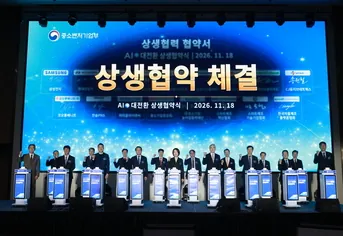
The call follows two MSS policy steps that MEKAWIRE covered. On Oct 29 the ministry announced a plan to invest at least KRW 5tn in smart manufacturing through 2030, bring AI to 6,000 firms and spread physical AI in SME factories, including through a physical-AI factory operating system developed at KAIST (MEKAWIRE, Oct 29). On Nov 18, 11 large companies and five organisations signed an AI transition win-win pact with MSS, and Samsung Electronics and Hyundai Motor presented their smart-factory work. The ministry said it aims to raise KRW 2tn with industry from 2027 through 2031 to support smart factories at 2,000 or more SMEs, and that it plans KRW 30bn of new 2027 funding to help 100 companies with a physical-AI business transition.
Artificial Intelligence Times reported that 19 large companies are taking part in the follow-up AX leading-model recruitment and will select SME partners. The ministry's press release, posted on Nov 19 about the Nov 18 pact, names 11 large companies as signatories; the two counts measure different things, pact signatories and recruitment participants. The integrated notice also lists physical-AI demonstration programmes, including 205 public-private physical-AI technology demonstrations at up to KRW 400M each and 40 integrated demonstrations, with the demonstration call expected in the first half of 2027. For the wider picture, see the MEKAWIRE explainer on Korea's robotics market.
MEKAWIRE analysis
Korea's 2027 smart-factory slots grow mostly in the general and AI tracks rather than in robot adoption; our judgement is that robot makers will feel the programme more through integration work inside those builds than through the dedicated robot line.
The counts are the evidence: the general and manufacturing-AI tracks add 263 project slots between them, the robot-adoption line adds 11. The strongest counter-argument is that the call allows funding for automation equipment and the AX leading-model track covers robot adoption, so some of the money could reach robot vendors, depending on what recipients buy. In the bull case, the physical-AI demonstrations and the large-company track pull collaborative robots and mobile robots into hundreds of SME lines from 2027. In the bear case, SMEs choose software-only upgrades; in the AX leading-model track the notice caps the government share at 40%, with at least 20% from the large company and up to 40% from the participating firm, and robot adoption remains the smallest positive increase in the table, up 11 projects (6.1%).
Three signals will test this: the separate robot-adoption notice scheduled for December; the application tally after the Jan 6, 2027 deadline; and the physical-AI demonstration call, expected in the first half of 2027, with the selection timetable still open.
- Dec 7, 2026 to Jan 6, 2027
- KRW 269.6bn (Artificial Intelligence Times)
- about KRW 264M (MEKAWIRE calc.)
- 1,021 small and mid-sized manufacturers (Artificial Intelligence Times)
- 191, up from 180 in 2026
- 500, up from 400