Medtronic's Hugo robot wins FDA clearance for general surgery, about 3.5M US cases a year
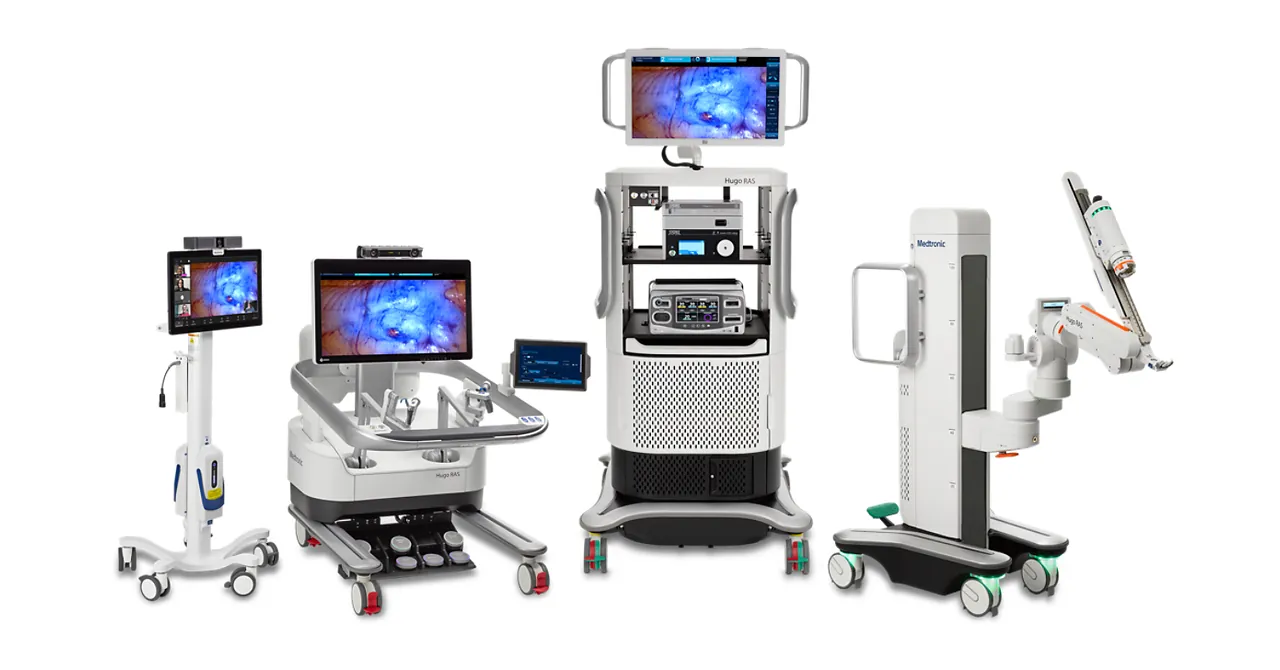
Medtronic said on Nov 17 that the FDA has cleared its Hugo surgical robot for general surgery in the US, covering upper abdominal general surgery, abdominal wall hernia procedures, inguinal hernia repair and appendectomy.
The company puts those procedures at about 3.5 million US surgeries a year, more than half of all US soft-tissue procedures. Hugo had been cleared only for urology since Dec 3, 2025. MEKAWIRE compares the step with Intuitive's 12,094 installed da Vinci systems and the other challengers we cover.
Medtronic said on Nov 17 that the US Food and Drug Administration has cleared its Hugo robotic-assisted surgery system for general surgery, the robot's second US indication after urology. The expanded 510(k) covers general surgical procedures in the upper abdomen, abdominal wall hernia procedures and two lower abdominal operations, inguinal hernia repair and appendectomy. The press release, issued from Galway, Ireland, names cholecystectomy (gallbladder removal), Roux-en-Y gastric bypass, ventral hernia repair and small bowel resection among the covered procedures.
Medtronic put the combined volume of those procedures at about 3.5 million US surgeries a year, which it described as more than half of all soft-tissue procedures performed in the country annually. The announcement came 349 days after the FDA's first Hugo decision on Dec 3, 2025 (MEKAWIRE calc. from the FDA database).
From one specialty to the largest one
Until this month Hugo was cleared in the US only for urologic procedures, under 510(k) K250725, which the FDA decided on Dec 3, 2025. In a Sept 16 release about a new instrument, Medtronic still described Hugo as a urology system in the US and said it was working to add general and gynecologic procedures. General surgery is now cleared. Gynecology is not part of the new clearance. Medtronic said on June 3 that it had submitted a 510(k) for gynecologic procedures.
Outside the US, Medtronic said in September, Hugo has been used in more than 35 countries across more than 50 procedures in urology, general surgery and gynecology. In the Nov 17 release the company said general surgery is the highest-growth procedure category for Hugo outside the US, ahead of urology and gynecology, and that global Hugo procedure growth runs at more than twice the rate of the robotic surgery market. It said Hugo is on track to surpass 50,000 procedures by the end of the Medtronic fiscal year. The release gives no US installed base and no US procedure count.
What Medtronic is selling against da Vinci
The pitch rests on design and on instruments hospitals already buy. Hugo is modular, so a surgical team uses only the robotic arms a given operation needs and positions them for the surgeon's technique and the patient's anatomy, while an open console keeps the surgeon connected with the operating room team. Surgeons can also use the LigaSure RAS Maryland vessel-sealing instrument, which the FDA cleared for Hugo in September. Medtronic says LigaSure technology has been used in more than 45 million open and laparoscopic procedures, and that the robotic version seals vessels up to 7 mm in diameter in about two seconds.
Matt Anderson, president of Medtronic's Surgical business, said in the release that Hugo gives hospitals a practical option to address capacity and access challenges. Francesco Bianco, a surgeon at UI Health in Chicago, said the system lets the academic health system offer additional treatment options and support surgical training.
The field Hugo now enters
- Medtronic
- Hugo
- FDA clearance for general surgery (upper abdominal, abdominal wall hernia, inguinal hernia, appendectomy)
- Nov 17, 2026 (announced)
- Medtronic
- Hugo
- First FDA clearance, urology (510(k) K250725)
- Dec 3, 2025
- Intuitive
- da Vinci
- 546 systems placed worldwide in Q3 2026; worldwide installed base 12,094
- Sept 30, 2026
- Stryker and CMR Surgical
- Versius
- About USD 400M preferred equity; Stryker exclusive US sales agent
- Oct 12, 2026
- Distalmotion
- DEXTER
- Term loan of up to USD 70M for US ambulatory surgery centers
- Oct 21, 2026
Figures from company releases, filings and the FDA database. Days between Hugo's two US steps: Nov 17, 2026 minus Dec 3, 2025 = 349 days (MEKAWIRE calc.).
MEKAWIRE analysis
General surgery turns Hugo into a real procurement choice for US hospitals, but Medtronic enters it against an installed base it cannot match soon.
Intuitive grew its da Vinci installed base to 12,094 systems by Sept 30, 2026 and placed 546 systems in the third quarter alone, according to its earnings release, and da Vinci procedures grew about 14% in that quarter. A hospital that already runs da Vinci for general surgery has trained staff and instrument contracts. Medtronic points to its long history with general surgeons, whose open and laparoscopic procedures have used its technologies for more than half a century. In our view, that history is the lever that could lower the switching cost. The strongest counter-argument: Medtronic has not published US placement figures, so the release does not show whether hospitals are replacing da Vinci or adding Hugo alongside it.
The other challengers in our coverage also lean on large medtech balance sheets. Stryker agreed on Oct 12 to make a preferred equity investment of about USD 400 million in CMR Surgical and to act as the exclusive US sales agent for Versius, and Distalmotion signed a term loan of up to USD 70 million in October to sell DEXTER to US ambulatory surgery centers.
Bull case: Medtronic converts its general surgery customers and starts reporting US placements. Bear case: hospitals keep da Vinci for general surgery and Hugo stays mostly a urology system in the US. Signals to watch: the first US placement or procedure figure in a Medtronic earnings release, an FDA decision on the gynecology 510(k) submission Medtronic announced on June 3, 2026, and Intuitive's full-year 2026 da Vinci procedure growth against its outlook of about 14% to 15%. Background on the market is in the MEKAWIRE explainer on surgical robots.
- Over 50,000 by end of Medtronic FY
- About 3.5M a year (company)
- 12,094 worldwide (Sept 30, 2026)
- More than 35 (Sept release)
- 349 (MEKAWIRE calc.)
- More than half (company)