Johnson & Johnson files Ottava surgical robot with the FDA, seeking a De Novo route into general surgery
Johnson & Johnson has submitted its Ottava soft-tissue surgical robot to the US Food and Drug Administration in a De Novo classification request covering several upper abdominal procedures, backed by a 32-patient gastric bypass study at six US hospitals.
The filing comes weeks after Medtronic and CMR Surgical won US clearances, widening the field challenging Intuitive's 10,763-system da Vinci base.
Johnson & Johnson said on 7 January 2026 that it had submitted its Ottava robotic surgical system to the US Food and Drug Administration in a request for De Novo classification, the last regulatory step the company has named before it can sell its first soft-tissue robot for general surgery. The filing lands five weeks after Medtronic won US clearance for its Hugo system on 3 December 2025 and three weeks after CMR Surgical cleared its Versius Plus robot on 16 December 2025, so the US market led by Intuitive now has three large challengers at or near the regulator's door.
J&J said it is seeking marketing authorisation for multiple procedures in general surgery within the upper abdomen, and named gastric bypass, gastric sleeve, small bowel resection and hiatal hernia repair as examples. The company said it chose the De Novo pathway, which the FDA uses for new types of device that have no legally marketed predicate, because of Ottava's novel architecture and differentiated technical capabilities. J&J stressed that the system remains under development and is not authorised for sale in any market, and it did not say when it expects a decision.
The application rests on a single investigational device exemption (IDE) study. The ClinicalTrials.gov record for the trial, called FORTE (NCT06709261) and sponsored by J&J's Auris Health unit, shows it started on 5 February 2025, reached primary completion on 20 October 2025 and enrolled 32 patients at six US hospitals: Orlando Health, Tampa General Hospital with the University of South Florida, IU Health North Hospital in Indianapolis, NYU Long Island, Duke Regional Hospital and UT Health Houston with Memorial Hermann. The first cases, Roux-en-Y gastric bypass operations, were performed in early 2025 at Memorial Hermann-Texas Medical Center by Dr. Erik Wilson of UT Health Houston, the study's lead investigator, whom J&J discloses as a paid consultant.
J&J has not published the study's outcome data. In its release the company said the trial data were filed to show safety and effectiveness and to support the system's ability to perform a range of procedures. A second front is already open: J&J said it received IDE approval in late 2025 for a US trial of Ottava in inguinal hernia repair, which it described, citing IQVIA hospital procedure data for 2023, as one of the most common operations in the United States.
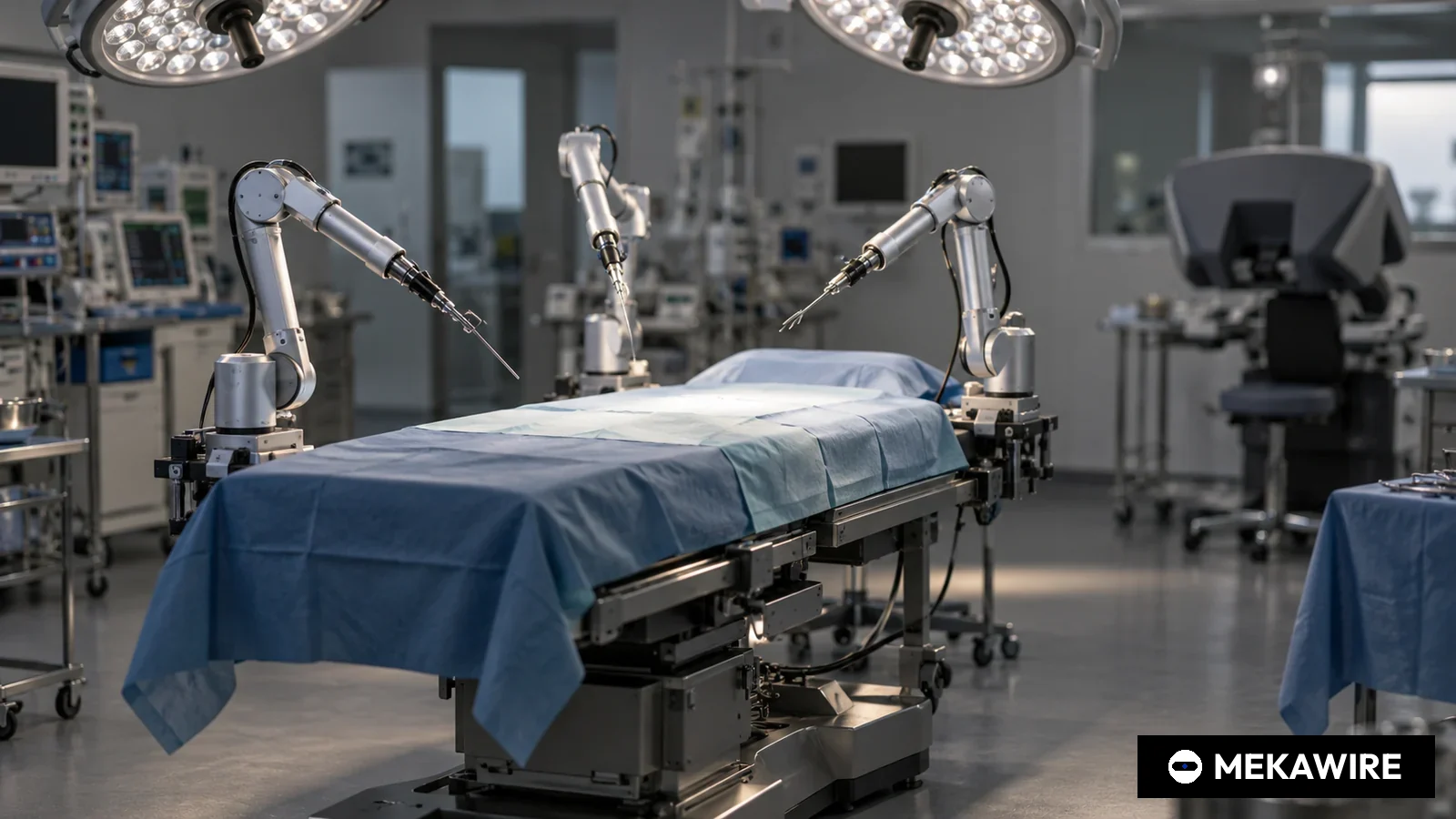
The design is what sets Ottava apart. When J&J first detailed the robot on 7 November 2023, it described four robotic arms built into a standard surgical table, a feature it calls Twin Motion that moves the table and arms together, and arms that fold away under the table when not needed, leaving 360 degree access to the patient. On 12 November 2024, when the FDA approved the first IDE, J&J said the low-profile arms allow robotic, laparoscopic, hybrid and open surgery on the same footprint. Ottava uses Ethicon instruments and is designed to connect in future to J&J's Polyphonic digital ecosystem.
Hani Abouhalka, Company Group Chair for Surgery at J&J MedTech, said the robot draws on the group's 140 years in surgery and on what robotic surgeons and hospitals have learned over the past 20 years, and that he looked forward to the next milestone on the path to commercialisation. Peter Schulam, Chief Scientific Officer of J&J MedTech, said the IDE study adds clinical evidence on system performance to a large body of preclinical work.
The filing caps a long and costly build. J&J agreed on 13 February 2019 to buy Auris Health, maker of the Monarch bronchoscopy robot, for about $3.4 billion upfront plus up to $2.35 billion in milestone payments, folding it in alongside the Verb Surgical venture it had formed with Verily. In November 2023 it targeted an IDE application in the second half of 2024; the FDA approved the IDE on 12 November 2024, the first patients were treated in early 2025, and the submission followed about eleven weeks after the FORTE study's completion date.
The incumbent is formidable. Intuitive reported that it placed 427 da Vinci systems in the third quarter of 2025, 240 of them its fifth-generation da Vinci 5, which the FDA cleared on 14 March 2024. Its installed base reached 10,763 systems at 30 September 2025, up 13% on a year earlier, worldwide da Vinci procedures grew about 19%, and quarterly revenue rose 23% to $2.51 billion.
The challengers are arriving in the same window. Medtronic's Hugo system was cleared on 3 December 2025 for urologic procedures including prostatectomy, nephrectomy and cystectomy, which Medtronic puts at about 230,000 US operations a year; Hugo is used in more than 30 countries and Medtronic plans to add general and gynecologic surgery. CMR Surgical, whose first Versius system won De Novo authorisation in October 2024, cleared Versius Plus for cholecystectomy, says it has completed more than 40,000 procedures outside the US and plans US commercialisation in 2026.
Open questions remain. J&J has disclosed neither the FORTE endpoints nor the results, the FDA has not signalled a timetable, and a 32-patient study must support a label spanning four procedure types. Hospitals will also want to see pricing and instrument costs, which J&J has not released. The next markers are the FDA decision, publication of the FORTE data, enrolment in the hernia trial, and how quickly Medtronic and CMR convert their December clearances into US installations during 2026.
- Intuitive
- da Vinci 5
- Cleared
- 2024-03-14
- da Vinci installed base, 30 Sep 2025
- 10,763
- Medtronic
- Hugo RAS
- Cleared for urology
- 2025-12-03
- Countries using Hugo (more than)
- 30
- CMR Surgical
- Versius / Versius Plus
- De Novo (Versius); 510(k) (Versius Plus, cholecystectomy)
- 2024-10
- Procedures completed outside US (more than)
- 40,000
- Johnson & Johnson
- Ottava
- De Novo request filed
- No data
- FORTE IDE study enrolment
- 32
Figures as disclosed by each company or the ClinicalTrials.gov registry; not estimated. Metrics are not like for like and are shown for scale only. CMR Versius De Novo month as stated by CMR.
As of Jan 7, 2026
MEKAWIRE analysis
Ottava's real weapon is the table rather than the arms. By turning the robot into operating room furniture, J&J is betting it can win rooms that da Vinci never reached, but it starts with one 32-patient study against an installed base of 10,763 systems.
The evidence for the bet sits in J&J's own design choices. Four arms that stow under a standard table, a Twin Motion feature that repositions patient and robot together, and a footprint that also allows open and laparoscopic work all target the space and turnover problems that keep robots out of smaller rooms. The De Novo request for four upper abdominal procedures shows J&J wants a broad general surgery label at launch rather than a narrow foothold, and the inguinal hernia IDE points at one of the highest volume operations in the US.
The strongest counter-argument is that Intuitive's lead is not mainly about hardware. Its 10,763 installed systems, a 427-unit quarterly placement run rate and 19% procedure growth mean surgeons are trained on da Vinci, hospitals have financed it and instrument supply is entrenched. Medtronic and CMR also reached US clearance first, so J&J will be the third new entrant, not the first.
Bull case: the FDA grants the De Novo request within 2026, the table-integrated design lets hospitals add robotic capacity without new rooms, and Ethicon's existing relationships across US operating rooms let J&J bundle Ottava with staplers and energy devices. A broad upper abdominal label followed by hernia would give it the volume procedures that matter for utilisation.
Bear case: the FDA asks for more data or narrows the label, delaying launch into 2027, while Intuitive keeps converting customers to da Vinci 5 and Medtronic and CMR lock in early US accounts. Without published outcome data, surgeons may treat Ottava as unproven, and a programme built on a $3.4 billion upfront acquisition must earn a return in a market where the leader is still growing.
- Signal 1, during 2026: the FDA's De Novo decision and the scope of the indication it grants.
- Signal 2, during 2026: publication or podium presentation of FORTE endpoints, including conversion and complication rates.
- Signal 3, late January 2026: J&J's fourth quarter results and Intuitive's 2025 full year results, for launch timing and da Vinci placement trends.
- Four arms integrated into a standard surgical table, Twin Motion, Ethicon instruments
- De Novo classification request to the US FDA, announced 7 January 2026
- Auris Health, bought in 2019 for about $3.4bn upfront plus up to $2.35bn in milestones
- IDE approved late 2025 for inguinal hernia repair
- Not authorised for sale in any market
- Intuitive da Vinci installed base 10,763 at 30 Sep 2025
- FORTE IDE study (NCT06709261), 32 patients, six US hospitals, 5 Feb 2025 to 20 Oct 2025
- Multiple upper abdominal general surgery procedures, incl. gastric bypass, gastric sleeve, small bowel resection, hiatal hernia repair
Why it matters
The Ottava filing turns J&J from a supplier of instruments used inside other companies' robots into a would-be platform owner in soft-tissue robotics. Ethicon already supplies staplers, energy devices and sutures to US hospitals; a J&J robot that runs exclusively on Ethicon instrumentation changes who captures the recurring instrument revenue that makes surgical robotics profitable.
Timing matters as much as technology. Medtronic's Hugo clearance on 3 December 2025 and CMR's Versius Plus clearance on 16 December 2025 mean US hospitals entering 2026 budgeting cycles can, for the first time, evaluate several multi-port alternatives to da Vinci. J&J's filing keeps it in that conversation even before authorisation, which is valuable for hospital capital committees that plan purchases a year or more ahead.
The choice of a broad upper abdominal label signals ambition. J&J says Ottava is designed for complex surgeries that need a multi-quadrant approach, where moving patient and robot together is the problem Twin Motion is meant to solve.
Rival analysis
Intuitive is the benchmark: 427 systems placed and 240 da Vinci 5 units in Q3 2025, an installed base of 10,763 and revenue of $2.51 billion in the quarter. Its moat is training, data and a huge base of instruments and service contracts, and da Vinci 5, cleared in March 2024, resets the technology bar with force feedback and much greater computing power.
Medtronic's Hugo has entered the US in urology, a specialty where Intuitive is deeply established; Medtronic has said general and gynecologic surgery come next. CMR's Versius family is also modular and compact, aimed at hospitals that lack dedicated robotic rooms, and starts in the US with cholecystectomy.
Ottava differs from all three by integrating the arms into the table. That trades placement flexibility for a smaller footprint and coordinated motion. Whether surgeons value that trade will decide whether J&J competes on design or merely on its Ethicon relationships.
Valuation context
J&J does not report Ottava as a separate business, so there is no disclosed revenue or valuation for the programme. The clearest financial anchor is the Auris Health deal of February 2019: about $3.4 billion upfront and up to $2.35 billion in contingent milestones, a total potential consideration of up to about $5.75 billion. Ottava's clinical sponsor on ClinicalTrials.gov is still Auris Health.
For comparison, Intuitive's quarterly revenue of $2.51 billion in Q3 2025 grew 23%, which shows the size of the prize but also how much of it the incumbent already captures. Any value J&J extracts will come mainly from instruments and service per procedure rather than from capital sales.
Supply-chain implications
J&J has said Ottava uses Ethicon instrumentation exclusively, so the instrument supply chain rides on Ethicon's existing manufacturing rather than a new vendor base. That is an advantage in scale and sterilisation logistics, and it also locks hospitals into one instrument source.
The table-integrated arms require precision actuators, reducers, encoders and force sensing in a compact envelope under the table, along with high reliability because a table failure takes the whole room down. J&J has not disclosed suppliers for these components. The Polyphonic digital ecosystem connection, which J&J describes as a future capability, will add software and data infrastructure dependencies.
Signals to watch
First, the FDA decision on the De Novo request and the exact indication text; a label that covers all four named procedures would be a strong result for a 32-patient study. Second, the release of FORTE outcomes, including conversion to open or laparoscopic surgery, operative time and complications, which J&J has not yet published.
Third, progress of the inguinal hernia IDE, which would broaden Ottava into very high volume work. Fourth, US installation counts for Hugo and Versius Plus during 2026, which will show how much demand there is for a second or third platform before J&J arrives.
Analyst view
Thesis: Ottava is a credible long-term challenger because of its table-integrated design and Ethicon's reach, but it is unlikely to dent Intuitive's placements before 2027. Confidence: medium.
Reasons for medium rather than high confidence: the design is genuinely differentiated and J&J has kept to its stated regulatory timeline since 2023, which supports the bull view. Against that, J&J has published no outcome data, the evidence base is a single 32-patient study, and FDA timing and label scope are unknown. Two rivals already hold US clearances, so hospitals have alternatives to evaluate without waiting for J&J.
Questions you should be asking
What were FORTE's primary endpoints and results, and how many of the 32 patients underwent each procedure type? How long does the De Novo review take for a system of this complexity, and will the FDA grant the full upper abdominal indication or start narrower?
How will J&J price Ottava relative to da Vinci 5, and will it offer placement models that shift cost from capital to per-procedure fees? What is the reliability record of the table-integrated arms, and how are service and downtime handled when the robot is part of the table?