MicroPort MedBot doubles revenue to RMB551 million as Toumai exports reach 73% of 2025 sales
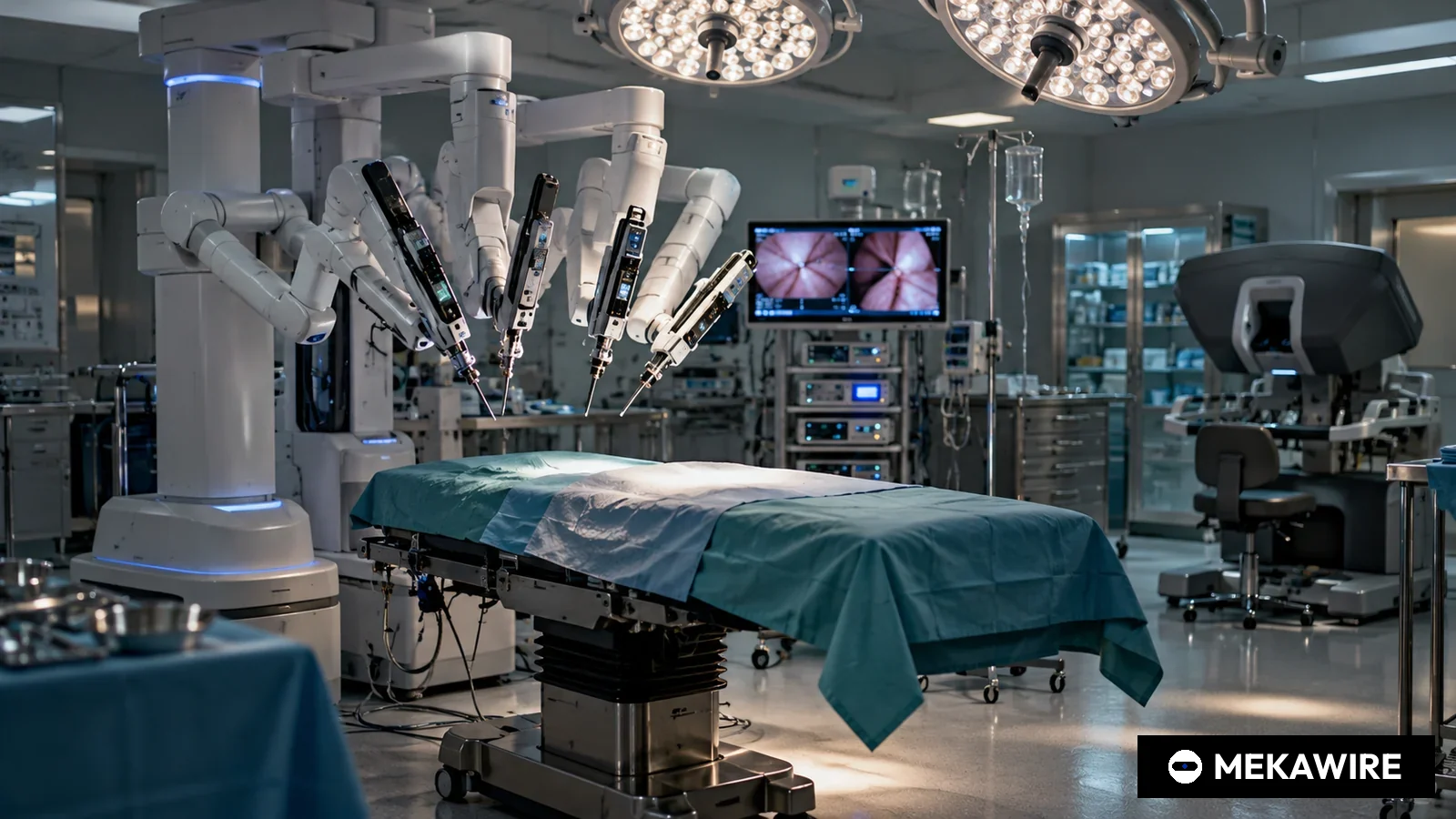
Shanghai MicroPort MedBot said revenue rose 114.2% to RMB551.1 million in 2025, with overseas sales of RMB400.2 million accounting for 73% of the total. The Hong Kong-listed surgical robot maker cut its net loss by 60.7% to RMB254.1 million as cumulative orders for its Toumai laparoscopic robot reached about 220 units.
Shanghai MicroPort MedBot (Group) more than doubled its revenue in 2025 on the strength of exports of its Toumai laparoscopic surgical robot. In an annual results announcement filed with the Hong Kong stock exchange late on 26 March 2026, the company reported revenue of RMB551.1 million for the year, up 114.2% from RMB257.2 million in 2024.
Overseas revenue rose 287% to RMB400.2 million, which the company said was 73% of the total, while domestic revenue was RMB150.8 million. Gross profit climbed to RMB266.6 million, lifting the gross margin to 48% from 34%. The net loss narrowed 60.7% to RMB254.1 million from RMB647.1 million, and the loss attributable to shareholders fell to RMB249.7 million. On the company's adjusted basis the loss was RMB165.0 million, against RMB482.6 million a year earlier. The board proposed no dividend.
Much of the improvement came from spending discipline. Research and development costs fell 30.0% to RMB216.0 million, and selling and marketing expenses of RMB203.6 million equalled 36.9% of revenue, down from 80.8% in 2024. Administrative expenses dropped 17.5% to RMB45.6 million. The filing put the free cash outflow at RMB63 million, compared with RMB388 million in 2024. Cash and cash equivalents stood at RMB636.3 million at the end of December, and interest-bearing borrowings were cut to RMB389.1 million from RMB634.5 million. The group had 464 employees.
Toumai is the engine. According to the filing, cumulative commercial orders reached about 220 units and more than 140 systems had been installed across more than 50 countries and regions. In 2025 alone the company booked more than 100 new overseas orders and completed 80 overseas installations. The pace is visible in the company's own disclosures this quarter. A voluntary announcement on 21 January cited more than 180 orders and over 120 installations; a second on 12 February reported more than 200 orders and about 130 installations, with 14 units in India, more than 10 in Brazil and 12 countries or regions each holding five or more units.
Telesurgery is the feature the company leans on to stand apart. MicroPort MedBot said its Toumai Remote system is approved in around 10 countries, including China, India and Brazil, and that close to 800 remote procedures have been performed across more than 20 countries with what it describes as a 100% success rate. Its SkyWalker orthopaedic robot, which has US Food and Drug Administration clearance, has more than 65 orders, more than 50 installations and over 3,000 surgeries. Annual production capacity at its Shanghai and Suzhou bases is 300 units.
The company trades in Hong Kong under the code 2252. In February the exchange approved the conversion of 5,989,798 unlisted shares, about 0.58% of issued capital, into H shares under the full circulation scheme, following a notification letter from the China Securities Regulatory Commission.
The competitive frame is set by Intuitive Surgical, which reported 2025 revenue of US$10.064 billion, placed 2,156 da Vinci systems during the year and ended December with an installed base of 11,106. Closer to home, Shenzhen Edge Medical, which listed in Hong Kong on 8 January 2026, reported 2025 revenue of RMB455.7 million, up 184.8%, a net loss of RMB88.6 million and a 66.0% gross margin, with 100 robots installed, 54 of them overseas. Beijing-based orthopaedic specialist Tinavi, listed on Shanghai's STAR Market, grew revenue 55.9% to RMB278.8 million but widened its attributable loss to RMB182.7 million.
- MicroPort MedBot
- HKEX 2252
- RMB
- 551.1
- 114.2
- -249.7
- 400.2
- 72.6
- Edge Medical
- HKEX 2675
- RMB
- 455.7
- 184.8
- -88.6
- 272.1
- 59.7
- Tinavi
- SSE STAR 688277
- RMB
- 278.8
- 55.9
- -182.7
- No data
- No data
- Intuitive Surgical
- Nasdaq ISRG
- USD
- 10,064
- 20.5
- 2856
- No data
- No data
Figures as disclosed in each company's 2025 annual results. Net result is profit or loss attributable to shareholders, except Edge Medical, which is net loss for the year. Edge Medical overseas revenue is revenue from products sold to overseas end users. Overseas share = overseas revenue / total revenue (MicroPort MedBot itself states 73%). Figures disclosed, not estimated.
As of Oct 1, 2026
A laparoscopic robot lets a surgeon sitting at a console steer slender instruments and a 3D camera inside the patient through small incisions. In the remote configuration the console and the patient-side arms are separated by a network link, so the surgeon and patient can be in different cities or countries. That model suits markets where specialist surgeons are scarce outside capital cities, which helps explain why India and Brazil appear at the top of Toumai's order book.
For the global market, the results show a Chinese surgical robot winning volume abroad before it dominates at home. Domestic revenue of RMB150.8 million was less than half of overseas sales. Hospitals in emerging markets that cannot justify da Vinci pricing are the natural buyers, and Edge Medical's majority-overseas revenue suggests the pattern is not unique to one company.
Risks remain. MicroPort MedBot is still loss-making, and its 48% gross margin trails Edge Medical's 66.0%, a sign that it is pricing aggressively or carrying heavier system costs. Many overseas sales run through distributors, which can flatter order counts before procedure volumes and consumables revenue follow. Intuitive's scale, and its installed base above 11,000 systems, gives it room to respond on price.
The next checkpoint is the interim report for the six months to June, due by the end of August 2026 under Hong Kong listing rules. Investors will look for whether recurring revenue from instruments and service grows alongside system sales, and whether order intake keeps pace with the 300-unit annual capacity.
MEKAWIRE analysis
MicroPort MedBot has proved that a Chinese surgical robot can sell at scale abroad; 2026 will show whether that volume turns into margin.
The evidence for the first half of that claim is in the filing. Overseas revenue nearly quadrupled to RMB400.2 million, orders moved from more than 180 to about 220 between January and March, and selling costs fell from 80.8% to 36.9% of revenue, which implies the distribution network is now paying for itself rather than being built from scratch.
The strongest counter-argument is that system sales are lumpy and front-loaded. A capital robot sold through a distributor is recognised once, while the economics of the category depend on instruments and service used in every procedure, and the company does not yet show those streams carrying the business.
Bull case. If installations follow orders and each overseas robot reaches steady procedure volumes, consumables could lift gross margin toward Edge Medical's level and bring adjusted break-even within reach. Telesurgery approvals in populous markets such as India and Brazil give Toumai a selling point of its own.
Bear case. Order growth may be bought with low system prices that the company cannot raise later, leaving it with a large installed base and thin margins. A price response from Intuitive or Medtronic in emerging markets, or tighter procurement pricing at home, would squeeze a balance sheet holding RMB636.3 million of cash against RMB389.1 million of borrowings.
Signals to watch:
- By 31 August 2026, the interim report, for gross margin and the split between system and recurring revenue.
- The next voluntary order update, and whether cumulative Toumai orders pass 300, the size of a year's capacity.
- Through 2026, new Toumai Remote approvals beyond the roughly 10 countries cited in March.
- RMB254.1 million (2024: RMB647.1 million)
- RMB551.1 million (+114.2%)
- 48% (2024: 34%)
- 300 units
- RMB400.2 million, 73% of total (+287%)
- close to 800 in 20+ countries
- RMB165.0 million (2024: RMB482.6 million)
- RMB636.3 million at 31 Dec 2025
- more than 140 in 50+ countries and regions
- about 220 units
Why it matters
MicroPort MedBot has shown, at a scale above half a billion yuan, a Chinese surgical robot business in which overseas customers pay for most of the revenue. The RMB400.2 million of overseas sales is larger than the entire 2025 revenue of Tinavi and close to Edge Medical's total, which makes MicroPort MedBot the reference case for whether Chinese medtech can export capital equipment rather than only consumables.
The filing also marks a change in operating model. Selling expenses fell from 80.8% to 36.9% of revenue and research spending dropped 30.0%, so the company grew revenue while shrinking its cost base. The adjusted loss of RMB165.0 million is now small relative to RMB636.3 million of cash, which reduces the near-term need to raise equity.
Rival analysis
Intuitive Surgical remains in a different league, with US$10.064 billion of 2025 revenue and 2,156 da Vinci placements in one year, against roughly 220 cumulative Toumai orders. The relevant contest for MicroPort MedBot is therefore not head-to-head share in the United States but who supplies hospitals that have never bought a robot.
In that contest Edge Medical is the most direct rival. It grew faster in 2025 (184.8% versus 114.2%), lost less (RMB88.6 million versus RMB254.1 million) and earned a far higher gross margin (66.0% versus 48%), with 100 robots installed, 54 overseas. Tinavi competes with SkyWalker in orthopaedics but remains mostly domestic and its loss widened. Medtronic's Hugo and CMR Surgical's Versius also target emerging markets, though neither discloses comparable unit numbers.
Valuation context
The results contain no valuation data and MEKAWIRE does not estimate one. What can be compared is the shape of the income statement. On disclosed figures, MicroPort MedBot's revenue is 1.21 times Edge Medical's (551.1 / 455.7), while its attributable loss is 2.8 times Edge Medical's net loss (249.7 / 88.6).
That gap is what investors will price. A buyer of 2252 is paying for the larger installed base, the broader product portfolio and the telesurgery approvals; a buyer of Edge Medical is paying for better unit economics. The February approval to convert 5,989,798 unlisted shares into H shares, about 0.58% of capital, slightly widens the tradable float but is too small to change the free float picture materially.
Supply-chain implications
MicroPort MedBot says it runs two production bases in Shanghai and Suzhou with capacity of 300 units a year, and describes a multi-level supply system covering precision parts, consumables, core components and integration. Capital expenditure in 2025 was only RMB2.6 million, which indicates existing capacity is sufficient for current order intake.
For the wider Chinese robotics supply chain, surgical robots draw on the same Yangtze River Delta base of precision reducers, servo motors, encoders and optics that serves industrial and humanoid robots. Gross margin improving from 34% to 48% while volumes rose suggests procurement scale is starting to work in the company's favour, though the filing does not break out component costs.
Signals to watch
The interim report, due by 31 August 2026, is the main test. The key lines are gross margin, the share of revenue from instruments and service, and trade receivables from overseas distributors, which would reveal whether orders are converting into paid installations.
Outside the accounts, watch for voluntary order announcements. The company issued two in the first quarter, at more than 180 and more than 200 orders. A move past 300 cumulative Toumai orders would equal a year of rated capacity. New Toumai Remote approvals in large markets, and any US regulatory step for Toumai, would change the competitive narrative.
Analyst view
Thesis: MicroPort MedBot has moved from a funding-dependent developer to a scaling exporter, and its 2026 results will be judged on margin, not growth. Confidence: medium. The revenue, cost and cash data are audited and strongly directional, which supports the first half of the thesis.
Confidence is not high because the filing does not show how much of the revenue is recurring, much of the overseas business runs through distributors whose sell-through is not disclosed, and a 48% gross margin leaves the company exposed if pricing pressure rises. Edge Medical's stronger margins show that a Chinese peer can do better on unit economics, which raises the bar for MicroPort MedBot.
Questions you should be asking
How much of the RMB539.3 million category covering surgical robot systems, instruments and accessories came from instruments, and how fast is per-system consumable revenue growing in the earliest overseas sites?
What share of the roughly 220 Toumai orders are firm hospital purchases versus distributor stock, and how many of the remaining uninstalled orders are expected to be delivered in 2026?
Does the company plan to seek US marketing authorisation for Toumai, and what pricing does it accept in markets such as India and Brazil relative to da Vinci?