Amazon puts its millionth robot to work in Japan and launches DeepFleet, an AI model it says cuts fleet travel time by 10%
Amazon said on 1 July 2025 that it had delivered its one millionth robot, to a fulfillment centre in Japan, for a fleet that now works across more than 300 facilities worldwide. It also introduced DeepFleet, a generative AI foundation model built with AWS tools that coordinates robot traffic and, by Amazon's account, improves the fleet's travel time by 10%.
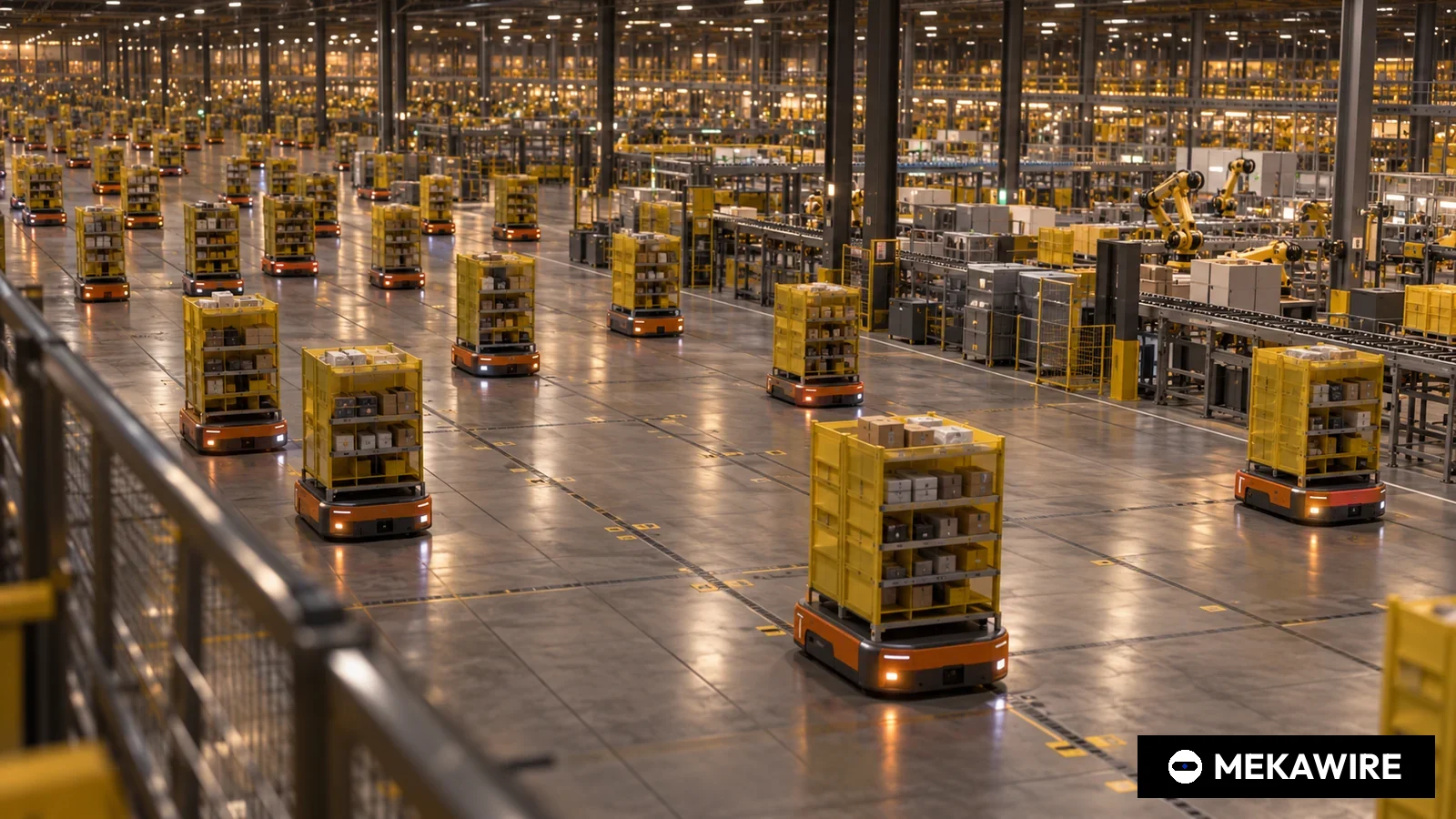
Amazon has passed one million robots in its operations network. In a post on its corporate newsroom dated 1 July 2025, Scott Dresser, vice president of Amazon Robotics, wrote that the millionth unit had been delivered to a fulfillment centre in Japan and joined a fleet that works across more than 300 facilities worldwide. In the same post the company introduced DeepFleet, a generative AI foundation model that coordinates how its robots move through a building, and said the model would improve the travel time of its robotic fleet by 10%.
The milestone caps a steep climb. On 18 October 2023 Amazon said it had more than 750,000 robots working alongside its employees. Adding 250,000 machines between those two disclosures implies fleet growth of about 33% in roughly 20 months, by MEKAWIRE calculation. Amazon did not say how the fleet splits by robot type, how many units sit in each building or what the programme has cost. Dividing one million robots by the 300 facilities it cites gives an average of at most about 3,300 robots per site, again by MEKAWIRE calculation, because the company gives the site count only as more than 300.
- 2023-10-18
- Sequoia and Digit announcement
- 750,000
- No data
- 2025-07-01
- Millionth robot delivered, Japan; DeepFleet launched
- 1,000,000
- 300
- 2025-07-31
- Second quarter 2025 results release
- 1,000,000
- No data
Robot counts are Amazon's stated thresholds (more than 750,000; one millionth unit; one million plus) and facilities are 'more than 300'. Growth 2023 to 2025 = 1,000,000 minus 750,000 = 250,000, or 33.3% (MEKAWIRE calculation). Average robots per facility of at most about 3,333 = 1,000,000 / 300 (MEKAWIRE calculation, upper bound). Figures disclosed, not estimated.
As of Oct 1, 2026
Amazon describes DeepFleet as a traffic management system for its warehouse floors. The model forecasts how robots will move and where congestion will build, so that routes can be planned around bottlenecks. Amazon said it built the model with Amazon SageMaker and other AWS tools, trained it on its own inventory movement data, and that it keeps learning as it runs. Faster robot travel, in the company's account, means orders move through a building faster and the network costs less to operate. Amazon repeated the 10% figure in its second quarter results on 31 July, where it described DeepFleet as making its one million plus robots work smarter by finding better paths and reducing bottlenecks.
The technical detail arrived on 11 August, when Joey Durham, a senior manager of applied science at Amazon Robotics, described the work on the Amazon Science blog alongside a paper on arXiv. The team trained on millions of hours of data from fulfillment and sortation centres and compared four designs. A robot-centric model with 97 million parameters, which looks at each robot together with its nearest 30 robots, 100 grid cells and 100 objects, performed best overall. A robot-floor model with 840 million parameters scored best on a timing measure, a graph-based floor model with 13 million parameters held up well for its size, and an image-style model that treats floor cells as pixels did not work well. Results improved as training data grew, which is the scaling behaviour that underpins the foundation model label. The near-term job is predicting congestion; the stated longer-term aim is to have the models assign robots to specific retrieval tasks.
Amazon has run robots in its fulfillment network since 2012. The fleet now includes Hercules drive units, which lift up to 1,250 pounds of inventory, Pegasus robots that carry single packages on precision conveyor belts, and Proteus, which Amazon calls its first fully autonomous mobile robot able to work safely around people. In October 2024 it opened a five-storey site of more than 3 million square feet in Shreveport, Louisiana, with ten times the robotics of earlier designs. It said that building had cut fulfillment processing times by up to 25% and that it expected a 25% improvement in cost to serve there during peak periods. In its second quarter release Amazon also highlighted Vulcan, its first robot that combines sight and touch.
No outside supplier operates at anything near that scale. Geek+, which listed in Hong Kong under code 2590 in July 2025, said in its interim results on 29 August that it had deployed more than 66,000 robots in more than 40 countries and regions, with first half revenue of RMB1.025 billion, up 31.0%. Symbotic reported fiscal third quarter revenue of $592 million, up 26%, on 6 August. AutoStore said on 14 August that about 1,750 of its systems were installed for about 1,250 customers, while second quarter revenue fell 13.1% to $133.9 million. Teradyne's robotics segment, which houses Universal Robots and MiR, reported second quarter revenue of $75 million.
- Amazon Robotics (in-house)
- As of 2025-07-01
- No data
- No data
- No data
- 1,000,000 robots, 300+ facilities
- Geek+
- H1 2025
- 1025
- RMB
- 31
- 66,000+ robots, 40+ countries and regions
- Symbotic
- Q3 FY2025 (to 2025-06-28)
- 592
- USD
- 26
- No data
- AutoStore
- Q2 2025
- 133.9
- USD
- -13.1
- About 1,750 systems, about 1,250 customers
- Teradyne Robotics
- Q2 2025
- 75
- USD
- No data
- No data
Revenue and installed base as reported in each company's results release (Geek+ 29 August 2025, Symbotic 6 August 2025, AutoStore 14 August 2025, Teradyne 29 July 2025). Amazon does not report robotics revenue; its robots are internal assets. Teradyne's release did not give a prior-year robotics comparison. — = not disclosed.
As of Oct 1, 2026
The workforce question follows every Amazon robotics announcement, and the company addressed it with training figures rather than headcount. Amazon said it has upskilled more than 700,000 employees since 2019 and that its next-generation sites need 30% more people in reliability, maintenance and engineering roles. It did not say how the million robots have changed staffing per building, and in October 2023 it had pointed to lower recordable and lost-time incident rates at robotics sites as the main worker benefit.
The open questions are about measurement. The 10% gain is Amazon's own figure, and the company has not published the baseline, the sites where it was measured or whether it holds at peak. The arXiv paper says the models were trained on movement data from hundreds of thousands of robots, which suggests DeepFleet does not yet cover the full fleet. Amazon also has not said whether DeepFleet will ever be offered to other warehouse operators through AWS.
The next markers are Amazon's third quarter results in late October 2025, the fourth quarter peak season, when any travel time gain should show up in throughput, and evidence that DeepFleet has moved from forecasting congestion to assigning tasks.
MEKAWIRE analysis
Amazon's advantage in warehouse robotics now lies less in the machines than in the movement data from a million of them, and DeepFleet is the first product built to turn that data into an edge suppliers cannot copy.
The evidence is in the training recipe. Amazon Science says DeepFleet improved as data volume grew, and only Amazon owns traffic logs from hundreds of thousands of robots across more than 300 sites. Geek+, the largest listed mobile robot supplier in this comparison, has more than 66,000 robots deployed across more than 850 end customers, each with its own data rights, which makes pooling far harder.
The strongest counter-argument is that 10% is modest and unaudited. Travel time is one input to throughput, and a warehouse limited by picking, packing or trucks will not get 10% more output from faster drive units. Suppliers can also reach good routing with classical planners and simulation, without a foundation model.
Bull case: DeepFleet moves from congestion prediction to task assignment, as Amazon says it intends, and the gain compounds across a fleet already above one million units, lowering cost per unit shipped through 2026. Amazon could also package the approach through AWS, turning internal know-how into a service.
Bear case: the 10% erodes once easy congestion is gone, and model maintenance across many building layouts adds cost. Fleet growth slows as Amazon spends more on next-generation sites such as Shreveport, leaving the million robot figure as a peak count rather than a trend.
- Late October 2025: whether Amazon's third quarter results give any DeepFleet throughput or cost data.
- Fourth quarter 2025 peak: whether Amazon reports faster processing at robotics sites during peak.
- Next Amazon Science or arXiv update: evidence that DeepFleet assigns retrieval tasks rather than only predicting congestion.
- More than 300 facilities worldwide
- 1 July 2025, Amazon newsroom post by Scott Dresser, VP Amazon Robotics
- One millionth robot delivered to a fulfillment centre in Japan
- DeepFleet, a generative AI foundation model for fleet coordination
- More than 700,000 employees upskilled since 2019
- Amazon SageMaker and AWS tools, trained on Amazon inventory movement data
- 10% improvement in robot fleet travel time
- More than 750,000 robots
- Robot-centric model, 97 million parameters
- 250,000 robots, about 33%
Why it matters
One million is the first public proof that a single operator can run mobile robots at fleet sizes larger than the combined installed base of most listed suppliers. It turns Amazon from the biggest customer of warehouse automation into its biggest operator, with a data asset that grows every shift.
DeepFleet matters more than the round number. It is the first time Amazon has applied the foundation model method, large models trained on broad data that improve with scale, to multi-robot traffic rather than to a single arm or a single robot. If the 10% travel time gain holds and extends to task assignment, the economics of a robotics building improve without buying a single extra robot.
Rival analysis
Geek+ is the closest listed comparison in mobile robots: more than 66,000 deployed, more than 850 end customers and RMB1.025 billion in first half 2025 revenue. Its fleet is spread over many customers, so any fleet model it builds must work across sites it does not own. Symbotic sells whole warehouse systems with its own software and grew revenue 26% to $592 million in its fiscal third quarter. AutoStore sells cube storage through integrators and saw second quarter revenue fall 13.1%.
The competitive threat to these suppliers is indirect. Amazon is not selling robots to third parties, but its scale sets customer expectations for software-driven gains, and its AWS arm already sells the cloud tools DeepFleet was built on. Teradyne's robotics arm, at $75 million of quarterly revenue, addresses factories rather than fulfillment, but faces the same pressure to show AI-driven fleet value.
Valuation context
Amazon does not break out robotics spending or value, so the one million robots cannot be priced from disclosures. The comparable listed businesses show how the market values the category: AutoStore earns an adjusted EBITDA margin of 47.6% on a cube storage model, Symbotic posted adjusted EBITDA of $45 million but a $32 million net loss in its fiscal third quarter, and Geek+ turned adjusted EBITDA positive at RMB11.62 million in the first half.
For Amazon, the value of DeepFleet shows up as lower cost per unit shipped rather than as revenue. The company has tied next-generation sites to a 25% expected improvement in cost to serve at peak in Shreveport. Investors should treat the 10% travel time claim as an operating metric, not a financial one, until Amazon links it to fulfillment cost.
Supply-chain implications
DeepFleet runs on AWS tooling, so the compute supply chain sits inside Amazon. The hardware chain is less visible. Amazon does not name component suppliers for drive units such as Hercules or for Proteus.
The Japan delivery of the millionth unit is a reminder that the fleet is global. Robots that run on shared models need consistent floor maps, fiducials and sensors across countries, which favours a standard hardware platform over a mix of vendors. Suppliers of motors, batteries and sensors for mobile robots gain from that volume but lose bargaining power to one dominant buyer.
Signals to watch
First, any Amazon figure that links DeepFleet to throughput, cost per unit or delivery speed, most likely in quarterly results or at its autumn operations events. Second, the arXiv and Amazon Science follow-ups: the team has said the next step is using the models to assign robots to retrieval tasks, which would move DeepFleet from prediction to control.
Third, the pace of fleet growth. Amazon added about 250,000 robots in roughly 20 months to mid-2025; a next disclosure will show whether that rate is holding as investment shifts to multi-storey robotic sites. Fourth, whether AWS or partners begin to offer fleet foundation models to other operators, which would put Amazon in direct competition with software from Geek+, Symbotic and AutoStore integrators.
Analyst view
Thesis: DeepFleet is strategically more important than the million robot count, because it shows Amazon converting fleet scale into a data advantage. Confidence: medium. The fleet numbers and model architectures are disclosed by Amazon, which supports the direction of the thesis. Confidence is not high because the 10% gain is self-reported without a baseline, the arXiv paper indicates training on hundreds of thousands rather than all robots, and no financial effect has been disclosed.
We would raise confidence if Amazon reports a cost or throughput figure attributed to DeepFleet, or if the models move into task assignment in production. We would lower it if later disclosures drop the DeepFleet claim or show fleet growth stalling.
Questions you should be asking
What baseline and which sites produced the 10% travel time improvement, and does it hold during peak?
What share of the one million robots currently run with DeepFleet predictions in the loop?
Will Amazon offer fleet foundation models through AWS to other warehouse operators, and on what data terms?
How many of the one million robots are drive units such as Hercules versus sortation, arms and autonomous mobile robots, and how fast is each group growing?