AutoStore ends 2025 with record quarterly orders and revenue, but full-year sales fall 10% and profit drops 40%
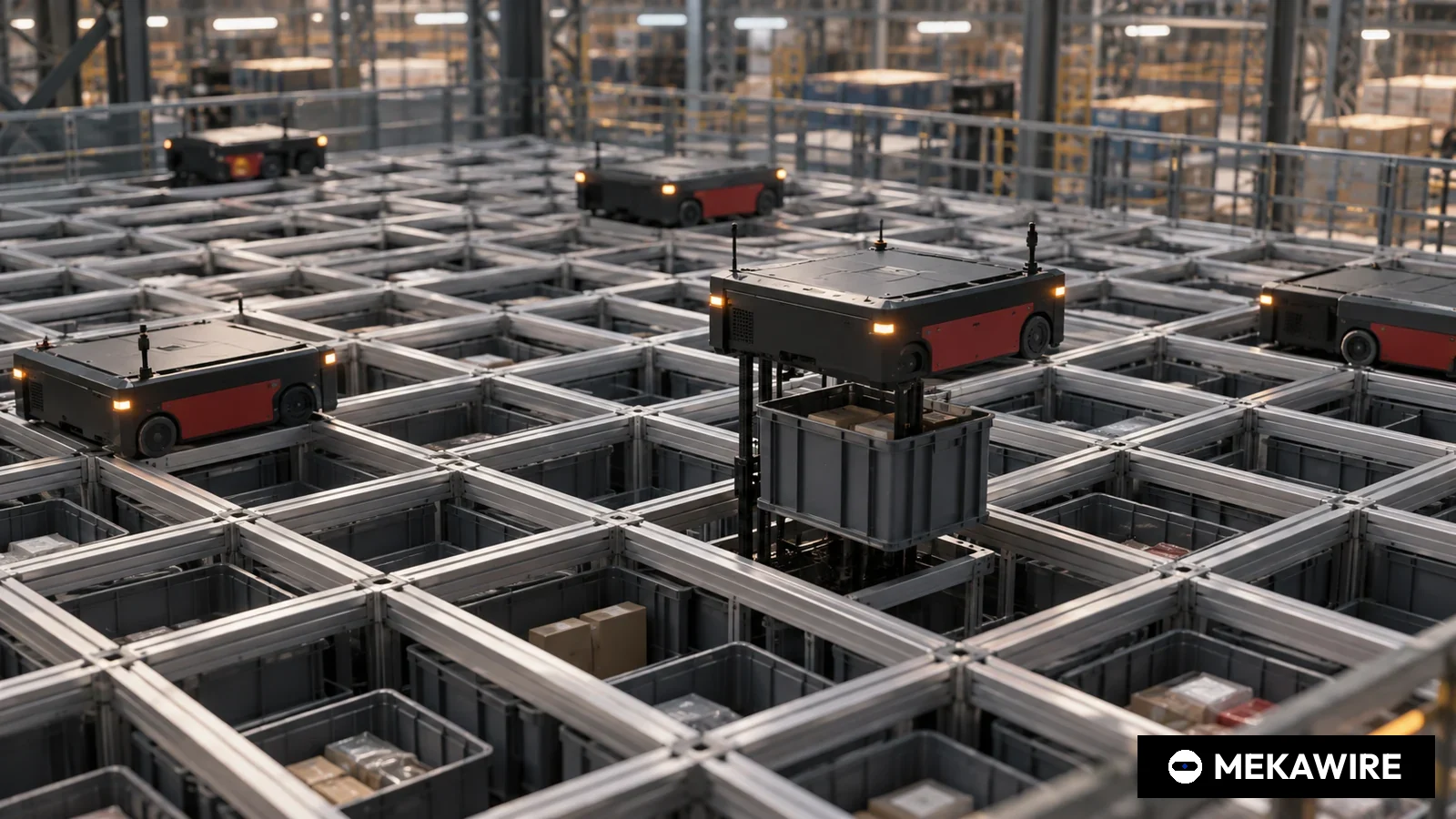
AutoStore said fourth-quarter 2025 revenue rose 9.0% to $179.7 million and order intake jumped 35.1% to $194.2 million, both company records. Full-year revenue still fell 10.4% to $538.6 million and net income dropped 40.1%, as the Norwegian cube storage maker absorbed longer customer decision cycles, restructuring and a robot write-down.
AutoStore closed 2025 with the strongest quarter in its history, but the record was not enough to rescue the year. The Norwegian maker of cube storage warehouse systems reported on 12 February 2026 that fourth-quarter revenue rose 9.0% from a year earlier to $179.7 million and order intake climbed 35.1% to $194.2 million, while revenue for the full year fell 10.4% to $538.6 million.
Fourth-quarter revenue was 29.3% higher than in the third quarter, the company said, and order intake rose 27.5% over the same span. The order backlog stood at $557.0 million at 31 December, up 21.8% on the year and 2.7% on the quarter. Gross margin edged up to 73.7% from 73.0%. Adjusted EBITDA was almost flat at $77.9 million against $77.0 million a year earlier, so the adjusted EBITDA margin narrowed to 43.3% from 46.7%. Operating profit (EBIT) fell 6.6% to $55.8 million, while net income rose 1.7% to $40.9 million. Cash flow conversion in the quarter was 84.3%.
The full-year accounts tell a harsher story. Adjusted EBITDA for 2025 dropped 19.4% to $228.1 million and the margin fell to 42.3% from 47.0%. EBIT slid 37.0% to $140.1 million and net income declined 40.1% to $81.8 million, according to the quarterly report. Order intake for the year rose 4.3% to $638.2 million, which gives a full-year book-to-bill ratio of about 1.18 by MEKAWIRE calculation. That gap between orders and shipped revenue is the main reason management argued the company enters 2026 in better shape than its annual numbers suggest.
Chief executive Mats Hovland Vikse wrote in the report that geopolitical and macroeconomic volatility through 2025 stretched customers' decision cycles, and that the fourth quarter brought positive momentum across a wide range of end markets. In the results release he credited a sharper strategy, 150 customers won during the year and the launch of eleven new products and features, which the company said extend the cube into adjacent warehouse workflows. The report did not name those products.
Several one-off items weighed on 2025. AutoStore started a transformation project in the first half of the year that included severance packages, and it wrote down inventory tied to its B1 Robot line. Excluding that write-down, full-year gross margin would have been 74.0%, the company said. It also made its final payment to rival Ocado Group in the second quarter of 2025 on a liability that matured on 30 June 2025, and it reports no remaining obligations to Ocado.
The balance sheet tightened. Operating cash flow fell 34.2% to $94.3 million, and cash at year end was $90.1 million compared with $296.1 million a year earlier. In November 2025 AutoStore refinanced with a $150 million term loan and a $350 million revolving credit facility and repaid $228.6 million under its previous facilities. In 2025 it also signed subscription contracts under its AutoStore as a Service model with a total contract value of $34.4 million, a small but growing recurring stream.
Founded in 1996, AutoStore says it has about 1,900 systems running in 65 countries, assembles products in Poland and Thailand and sells only through a network of system integrator partners. Its systems stack storage bins in a dense aluminium grid; battery powered robots travel on top of the grid, dig out the bins needed for an order and deliver them to picking stations called ports. Because the grid replaces aisles, the design packs far more goods into the same floor area than shelving served by people or forklifts.
The quarter compares unevenly with listed peers. Symbotic reported revenue of $630 million for the quarter to 27 December 2025, up 29%, with adjusted EBITDA of $67 million. Teradyne, owner of Universal Robots and Mobile Industrial Robots, booked $89 million of robotics revenue in the fourth quarter after cutting about 400 robotics jobs during 2025. Ocado's Technology Solutions arm grew revenue 13.0% to £561.2 million in fiscal 2025. AutoStore remains far smaller than Symbotic by revenue but converts a much larger share of each dollar into EBITDA.
- AutoStore
- NO
- Q4 2025
- USD
- 179.7
- 9
- 77.9
- 43.3
- AutoStore
- NO
- FY2025
- USD
- 538.6
- -10.4
- 228.1
- 42.3
- Symbotic
- US
- Q1 FY2026 (to 27 Dec 2025)
- USD
- 630
- 29
- 67
- 10.6
- Teradyne Robotics (Universal Robots, MiR)
- US
- Q4 2025
- USD
- 89
- No data
- No data
- No data
- Ocado Technology Solutions
- GB
- FY2025
- GBP
- 561.2
- 13
- 140.3
- 25
Figures as disclosed in company releases and reports, not estimated. Periods and currencies differ. Symbotic margin = 67 / 630; Ocado Technology Solutions figure is segment EBITDA as reported, margin = 140.3 / 561.2. Teradyne does not disclose robotics EBITDA or a comparable prior-year robotics figure in its Q4 release.
As of Oct 1, 2026
- Revenue
- 164.8
- 179.7
- 9
- 601.4
- 538.6
- -10.4
- Gross margin (%)
- 73
- 73.7
- No data
- 73.1
- 72.4
- No data
- Adjusted EBITDA
- 77
- 77.9
- 1.2
- 282.8
- 228.1
- -19.4
- Adjusted EBITDA margin (%)
- 46.7
- 43.3
- No data
- 47
- 42.3
- No data
- EBIT
- 59.7
- 55.8
- -6.6
- 222.5
- 140.1
- -37
- Net income
- 40.2
- 40.9
- 1.7
- 136.6
- 81.8
- -40.1
- Order intake
- 143.8
- 194.2
- 35.1
- 612.1
- 638.2
- 4.3
From AutoStore's Q4 2025 report. Book-to-bill = order intake / revenue: Q4 2025 = 194.2 / 179.7 = 1.08; FY2025 = 638.2 / 538.6 = 1.18 (MEKAWIRE calculation).
As of Oct 1, 2026
The risks are visible in the same report. Margin fell even as revenue recovered, which points to mix, transformation costs and price pressure rather than volume alone. AutoStore depends entirely on integrators to reach customers, and it acknowledged continued uncertainty over global trade flows. Its cash cushion is now much thinner after the debt repayment, and the company has not detailed what it plans for the B1 Robot line after the write-down.
Investors will look to the first-quarter 2026 report in April for proof that the record order book converts into revenue at stable margins, and to whether the subscription model and the eleven new products lift sales per customer during 2026.
MEKAWIRE analysis
The record fourth quarter marks the bottom of AutoStore's two-year slowdown, but not a return to the near 47% EBITDA margins of 2024.
The evidence for a turn is in orders rather than revenue. Fourth-quarter intake of $194.2 million exceeded revenue by about 8%, the backlog grew 21.8% in a year, and the full-year book-to-bill ratio of roughly 1.18 means revenue for 2026 is partly booked already. The evidence against a margin recovery is equally clear: adjusted EBITDA margin fell 3.4 percentage points in the quarter even as revenue rose 9.0%.
The strongest counter-argument is that one strong quarter after a weak year can reflect deferred projects released at once. If customers simply pushed 2025 decisions into the fourth quarter, the order rate could fall back in early 2026, and the backlog growth would prove a timing effect rather than recovered demand.
Bull case. Orders keep running ahead of shipments, the eleven new products and the subscription model raise revenue per system, and with the Ocado payments finished, cash generation rebuilds quickly. Margins drift back toward the mid 40s as transformation costs fade.
Bear case. Integrator partners stay cautious in Europe, Chinese and US rivals compete on price, and the company spends more on product and channel support to defend share. Revenue grows but EBITDA margin settles near 40%, and thin cash limits room for acquisitions or buybacks.
Signals to watch:
- April 2026: first-quarter 2026 order intake versus the $194.2 million fourth-quarter record.
- August 2026: second-quarter adjusted EBITDA margin relative to 43.3%.
- During 2026: total contract value signed under the subscription model against the $34.4 million signed in 2025.
- $538.6 million, down 10.4%
- about 1,900 systems in 65 countries
- $179.7 million, up 9.0% year on year
- $81.8 million, down 40.1%
- $638.2 million, up 4.3%
- $194.2 million, up 35.1% year on year
- 150
- 43.3% (Q4 2024: 46.7%)
- $557.0 million, up 21.8%
Why it matters
AutoStore counts about 1,900 installed cube storage systems, and its quarterly order intake is one of the few public, high frequency gauges of how much European and North American retailers and distributors are willing to spend on warehouse automation. A 35.1% jump in fourth-quarter orders after a year of falling revenue suggests that the capital spending pause of 2024 and 2025 was ending as 2026 began.
The results also show the price of that pause. Full-year net income fell 40.1% and cash dropped to $90.1 million after debt repayment, which leaves AutoStore with less financial room than it had a year earlier. Its next moves on product, channel and pricing will be made from a tighter position.
Rival analysis
Symbotic is the closest listed comparison in scale of ambition but runs a very different model. It sells complete systems and books revenue several times larger than AutoStore's, at an adjusted EBITDA margin of about 10.6% in the December quarter. AutoStore sells hardware and software through integrators and keeps a gross margin above 70%, which explains the margin gap.
Ocado's Technology Solutions unit competes for grocery fulfilment contracts, grew revenue 13.0% in fiscal 2025 and reported a 25.0% EBITDA margin on our calculation. Teradyne's robotics arm, with $89 million of fourth-quarter revenue, is not a direct rival in storage but competes for the same automation budgets with mobile robots and cobots. Private players such as Exotec in France and several Chinese warehouse robot makers bid for the same retail and e-commerce projects.
Valuation context
AutoStore does not pay a dividend and made no buybacks in 2024 or 2025. With full-year net income of $81.8 million and basic earnings per share of $0.024, the shares trade on expectations of a return to growth rather than on current earnings. The refinancing in November 2025, a $150 million term loan and a $350 million revolving facility, gives liquidity headroom but also signals that the company chose to run with lower cash.
The mix of a record backlog and compressed margins makes the valuation debate a question about operating leverage. If revenue in 2026 tracks the 1.18 full-year book-to-bill ratio and costs stay flat, EBITDA margin could recover; if the transformation programme and product spending continue, earnings will lag revenue.
Supply-chain implications
AutoStore assembles its products in Poland and Thailand and relies on an integrator network for design, installation and service. That keeps its capital needs light but makes it dependent on partners' capacity and appetite. A long delivery chain also exposes it to tariffs and freight costs, which management flagged as part of ongoing trade uncertainty.
The write-down of B1 Robot inventory shows that product transitions carry real inventory risk in a hardware business. The company has not explained publicly how the B1 line fits into its range going forward, a point integrators will want clarified before committing new projects.
Signals to watch
The first test is the first-quarter 2026 report in April. A quarter of order intake well below $194.2 million would suggest the fourth quarter was a release of deferred projects. A figure near or above it would support the turn thesis.
The second is margin. Adjusted EBITDA margin of 43.3% in the fourth quarter is the baseline. Further declines while revenue grows would point to structural price pressure. Third, watch subscription contract value against the $34.4 million signed in 2025 and any naming of the eleven new products in partner case studies.
Analyst view
Thesis: AutoStore has passed the low point of its demand cycle, but the structurally lower margin seen in 2025 is likely to persist through 2026 as competition and new product investment absorb part of the volume gain.
Confidence: medium. The order and backlog data are hard numbers and point clearly upward. Confidence is not high because one quarter is a short series, the company did not issue numeric guidance, and the drivers of the margin decline (mix, transformation costs, pricing) are not separated in the report.
Questions you should be asking
How much of the fourth-quarter order intake came from projects deferred earlier in 2025, and how much from new customers among the 150 added during the year?
What is the future of the B1 Robot line after the inventory write-down, and what was the size of that charge?
How quickly can the subscription model scale, and does it change how integrators are paid?