GlobalFoundries to test Atlas in 2027, first outside autos, and expands Spot to four fab sites
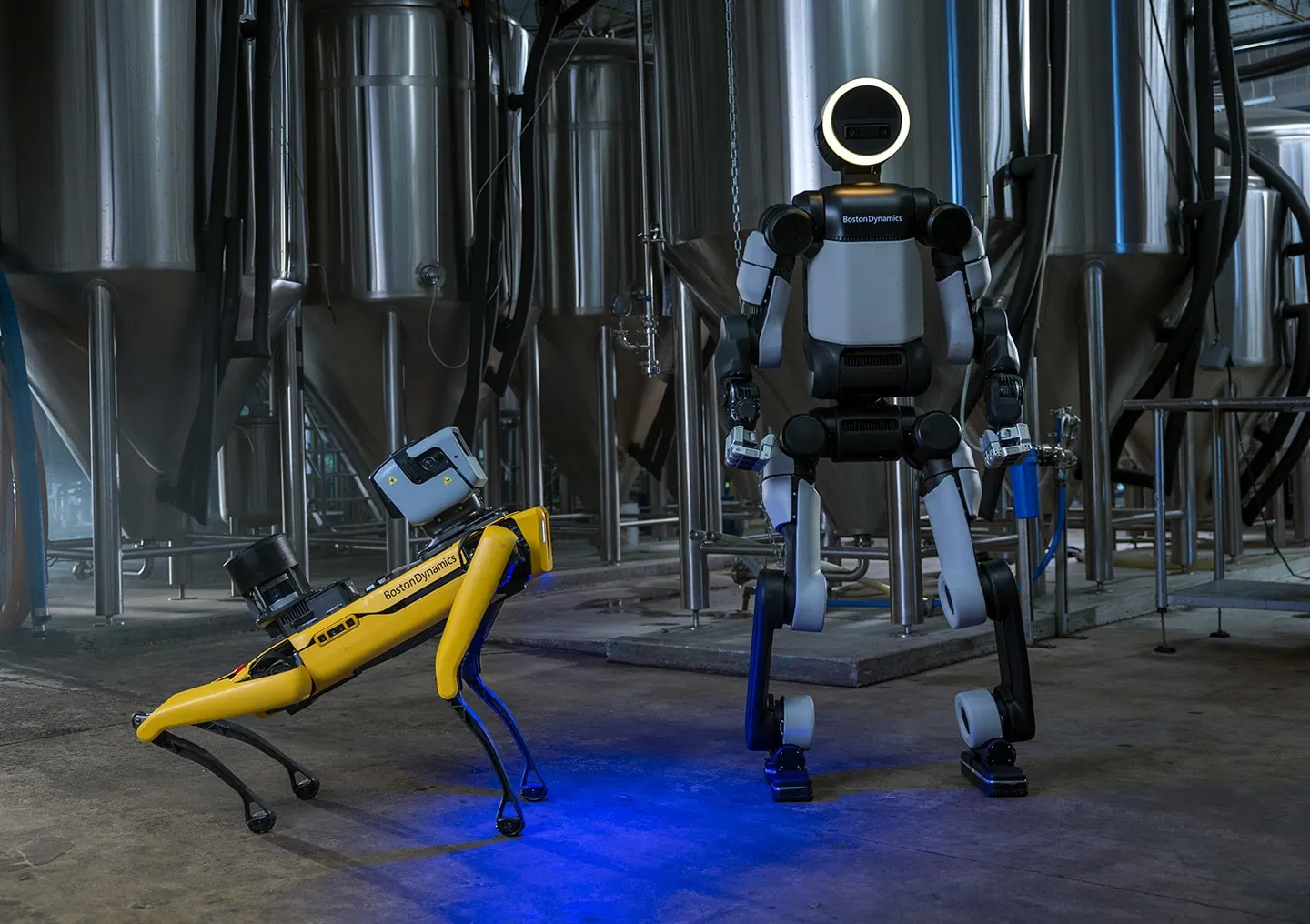
Boston Dynamics and GlobalFoundries said on Nov 17, 2026 that the chipmaker will be the first customer outside the automotive industry to test the Atlas humanoid, with onsite testing from early 2027 under an early adopter program.
Spot deployments expand to fabs in Malta, Burlington, Dresden and Singapore, where two Spots have completed more than 90,000 inspections since April. No Atlas unit count or purchase is disclosed. Boston Dynamics' nine-month net loss was 4.6 times its revenue (MEKAWIRE calc. from a DART filing).
Boston Dynamics and GlobalFoundries said in a joint press release on Nov 17, 2026 that the chipmaker will be the first customer outside the automotive industry to test the Atlas humanoid, with onsite testing at its facilities beginning in early 2027. The same agreement expands deployments of the Spot quadruped across GlobalFoundries manufacturing sites in Malta, New York; Burlington, Vermont; Dresden, Germany; and Singapore.
Spot is the deployed product, Atlas is a workshop
The two companies have worked together for more than four years, starting with Spot at the Burlington site. In Singapore, two Spot robots have travelled nearly 900 kilometres and completed more than 90,000 inspections in sub-fab areas since April, with a 99% mission success rate, according to the release. That works out to roughly 10 metres of travel per inspection (MEKAWIRE calc.). GlobalFoundries also moved 875 routine inspections onto the latest hardware and software in two weeks and said it has a road map to more than double that number using Spot's visual inspection functions.
Pradip Singh, chief manufacturing officer at GlobalFoundries, said in the release that Spot has helped the company shift from reactive to predictive maintenance by collecting data across thousands of inspection points.
The Atlas part is narrower. GlobalFoundries joins what Boston Dynamics calls its early adopter program and skills development workshop. The stated goals are to evaluate possible humanoid use cases, assess customer readiness and integration needs, and begin early testing and training for specific tasks. The release gives no number of robots, no task list and no purchase commitment. The companies describe it as the first program of its kind for semiconductor manufacturing.
The 2027 date matches what Boston Dynamics said in January
When Boston Dynamics presented the production Atlas on Jan 5, 2026, it said all 2026 deployments were already committed, with fleets going to Hyundai's Robotics Metaplant Application Center and to Google DeepMind, and that it planned to add customers in early 2027. GlobalFoundries is the first such customer it has named. Hyundai Motor Group, which controls Boston Dynamics, said at CES 2026 that Atlas would start parts sequencing work in its plants from 2028 and that it aims for a production system able to build 30,000 robots a year by 2028.
- Hyundai Robotics Metaplant Application Center
- Automotive
- 2026 fleets
- Training for manufacturing tasks
- Google DeepMind
- AI research
- 2026 fleets
- Foundation models for Atlas
- GlobalFoundries
- Semiconductors
- Testing from early 2027
- Early adopter program and skills development workshop
- Hyundai Motor Group plants
- Automotive
- From 2028
- Parts sequencing, then assembly by 2030
Compiled by MEKAWIRE from Boston Dynamics' releases of Jan 5, Sept 21 and Nov 17, 2026 and Hyundai Motor Group's CES 2026 release. No unit counts are disclosed for the first three rows. For the Hyundai plants, Boston Dynamics said in September 2026 that deployment would begin with 25,000 units at Hyundai Motor and Kia plants over the next few years.
As of Nov 17, 2026
MEKAWIRE analysis
The announcement says more about Spot than about Atlas. A chipmaker is widening a robot it has used for four years and agreeing to study a humanoid. Nothing in the release commits GlobalFoundries to buy Atlas, and testing does not begin until 2027.
The numbers behind the company explain why the installed base of Spot matters. Boston Dynamics posted a net loss of KRW 626.6 billion on revenue of KRW 136.0 billion in the first nine months of 2026, according to the quarterly report shareholder Hyundai Glovis filed on DART on Nov 16. The loss was 4.6 times revenue (MEKAWIRE calc.). Every fab that standardises on Spot adds recurring inspection work while Atlas is still in training. Background on the company's management and Hyundai's plans is in the MEKAWIRE explainer.
The counter-argument is that a semiconductor fab is a demanding reference. Sub-fab areas are full of pumps, pipes and gas lines that people service by hand, and a customer that already runs autonomous inspections at four sites has the data to say which tasks a humanoid could take.
Signals to watch are the start of onsite Atlas testing in early 2027, any named task or unit count from GlobalFoundries, and whether a second non-automotive customer joins the program.
- 4: Malta (New York), Burlington (Vermont), Dresden, Singapore
- 99% in Singapore sub-fab areas
- More than 90,000 by 2 Spots since April, nearly 900 km
- 875 in two weeks, road map to more than double
- From early 2027, first customer outside automotive
- KRW 626.6bn net loss on KRW 136.0bn revenue, 4.6x (MEKAWIRE calc.)
Why it matters
GlobalFoundries is set to become the first customer outside the automotive industry to test Atlas, with onsite trials planned from early 2027. Spot offers a separate measure of adoption: two robots completed more than 90,000 inspections in Singapore since April, with a 99% mission success rate in sub-fab areas. The Atlas trial will test whether Boston Dynamics can extend its humanoid program into chipmaking, where GlobalFoundries has yet to disclose a unit count or purchase.
Rival analysis
Hyundai Motor Group's plans to use Atlas in its car plants provide an automotive reference point for the GlobalFoundries trial. Boston Dynamics enters the trial with an existing customer relationship through Spot deployments, which gives it a route to test a second platform with the same operator. The supplied material identifies no rival deployments or comparable performance and cost figures for fab work.
Valuation context
Boston Dynamics recorded a KRW 626.6 billion net loss on KRW 136.0 billion in revenue in the first nine months of 2026, a ratio of 4.6 times calculated by MEKAWIRE from a DART filing. The supplied material provides no disclosed valuation or valuation estimate for Boston Dynamics, and no public market capitalization figures for GlobalFoundries or Hyundai Motor Group. GlobalFoundries disclosed no Atlas purchase, so the trial provides no transaction value.
Related papers
Boston Dynamics lists Whole-Body Dexterity, SOMA: Stack-of-Objects Manipulation using a Quadruped Robot, and Towards Autonomous Bricklaying Using Boston Dynamics Spot. Hyundai Motor Group lists DexStitch: Learning and Composing Dexterous Skills from Human Videos via Contact-Aware Robotic Inpainting. The supplied material gives no fab trial results from these papers.
Supply-chain implications
The Spot expansion covers GlobalFoundries fabs in Malta, New York, Burlington, Vermont, Dresden and Singapore. That footprint gives GlobalFoundries a way to test whether Singapore's sub-fab inspection performance can be repeated across its manufacturing network. Site-level robot counts outside Singapore, integration costs and details about component suppliers were not disclosed.
Signals to watch
Watch for GlobalFoundries to disclose Atlas trial tasks, acceptance criteria and any order after testing begins. For Spot, track whether the other fabs can match Singapore's 99% mission success rate in sub-fab areas and whether redeployed inspections more than double from the reported 875 over two weeks.
Analyst view
Singapore's inspection volume and mission success rate give investors a concrete operating baseline for Spot. An Atlas purchase would be a commercial milestone, and pricing and support costs would help show whether the work can contribute to narrowing Boston Dynamics' losses. The supplied financials give no product-level margins.
Questions you should be asking
Which fab tasks will Atlas perform, and what success criteria would trigger a purchase? How much operator time and maintenance does Spot require to sustain Singapore's mission success rate? What does each fab spend to deploy and support Spot, and how does that compare with the cost of the inspection work it takes on?