Agile Robots signs Google DeepMind research pact to run Gemini Robotics models on its industrial robots, widening Google's hardware bench
Munich-based Agile Robots said on 24 March 2026 it had formed a strategic research partnership with Google DeepMind to integrate Gemini Robotics foundation models with its hardware, starting with manufacturing use cases. The German company, which says it has installed more than 20,000 robotic solutions, becomes the latest hardware maker in Google's orbit after Boston Dynamics and Apptronik. No financial terms were disclosed.
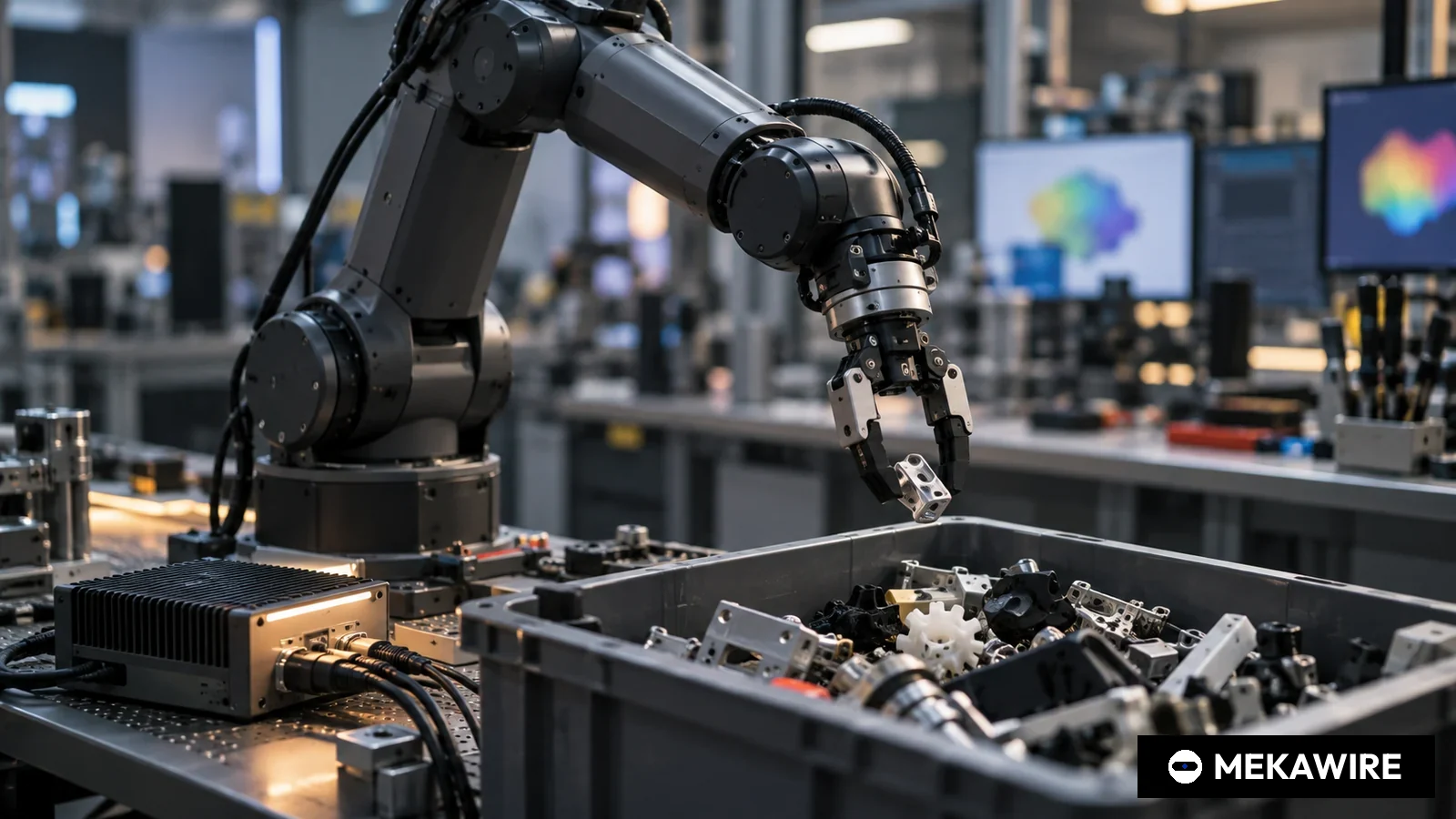
Agile Robots SE, the Munich automation group set up by researchers from the German Aerospace Center (DLR), said on 24 March 2026 that it had formed a strategic research partnership with Google DeepMind to run the Gemini Robotics family of foundation models on its robots. According to the company, the work will begin with industrial use cases in manufacturing, where customers need automation that stays reliable while adapting to changing tasks.
The release is short and leaves most commercial questions open. It discloses no financial terms, no equity stake and no exclusivity, and it does not say which Gemini Robotics model versions will be integrated or which Agile Robots machines will carry them first. What it does give is scale on the hardware side. Agile Robots says it has installed more than 20,000 robotic solutions worldwide; in February 2026 it put its team at more than 1,000 robotics and AI specialists, and in November 2025 it said revenue had doubled every year since its founding to reach €200 million.
Both companies describe the partnership as a data loop. Agile Robots contributes its industrial platform and live deployments, data from joint testing and real operation is fed back to improve the models, and better models are meant to let the robots take on more tasks in more plants. Zhaopeng Chen, Agile Robots' founder and chief executive, said putting the Gemini Robotics models into the company's systems placed it at the cutting edge. Carolina Parada, senior director and head of robotics at Google DeepMind, called the agreement an important step in carrying AI's impact into the physical world.
Agile Robots was founded in 2018. Its last equity round confirmed on a primary page in MEKAWIRE data is a $220 million Series C led by SoftBank Vision Fund 2, announced in September 2021. In November 2025 the company launched Agile ONE, its first humanoid for industrial work, with hands that carry fingertip sensors and force and torque sensing in every joint, and a layered AI design that separates task planning, fast reactions and fine motor control. It said full production would start in early 2026 at a new plant in Bavaria. On 4 February 2026 an Agile ONE switched on the Industrial AI Cloud that Deutsche Telekom and NVIDIA built in Munich, where Agile Robots, one of the first customers, said it would train its own foundation models.
The tie with Google is older than the announcement. When Google DeepMind introduced Gemini Robotics on 12 March 2025, it named Agile Robots as one of four trusted testers of the embodied reasoning model Gemini Robotics-ER, together with Agility Robotics, Boston Dynamics and Enchanted Tools, and named Apptronik as its humanoid partner. The March 2026 agreement turns Agile Robots from an early tester into a research partner.
It also completes a busy quarter for Google's robotics effort. On 5 January at CES, Boston Dynamics said it would bring Gemini Robotics models into its Atlas humanoid, with joint research due to start within months and an initial focus on car manufacturing. On 25 February Alphabet moved Intrinsic, the industrial robot software unit it created as an Other Bet in 2021, into Google as a distinct group working closely with Google DeepMind, Gemini and Google Cloud. On 11 February Apptronik, whose Apollo humanoid is one of the test platforms for Gemini Robotics 1.5, closed a $520 million extension that took its Series A past $935 million.
- Agile Robots
- DE
- 2018
- Strategic research partner (2026-03-24); Gemini Robotics-ER trusted tester (2025-03-12)
- Series C
- 220
- 2021-09-10
- Apptronik
- US
- 2016
- Humanoid partner; Apollo used to test Gemini Robotics 1.5
- Series A extension
- 520
- 2026-02-11
- Boston Dynamics
- US
- 1992
- Research partnership on Atlas (2026-01-05)
- No data
- No data
- No data
- Agility Robotics
- US
- 2015
- Gemini Robotics-ER trusted tester (2025-03-12)
- Series B
- 150
- 2022-04-22
Links from Google DeepMind, Boston Dynamics and Agile Robots releases. Rounds are the latest equity rounds confirmed on a company primary page in MEKAWIRE data, disclosed not estimated; Boston Dynamics is a Hyundai Motor Group subsidiary with no disclosed round; null means not disclosed.
As of Mar 24, 2026
Rival model builders are taking other routes. NVIDIA distributes its Isaac GR00T humanoid models openly to any hardware maker, Figure develops its Helix models in house for its own robots, and Physical Intelligence publishes its π model research and on 3 March released a memory system that lets its vision-language-action models handle tasks longer than ten minutes. Google's approach sits between these, keeping its most capable action model with selected partners while offering the planning model to all developers.
The technology behind the deal was set out with Gemini Robotics 1.5 in September 2025. It pairs two models. Gemini Robotics-ER 1.5, a vision-language model, plans multi-step jobs and can call digital tools such as Google Search; Gemini Robotics 1.5, a vision-language-action model, turns camera images and instructions into motor commands and reasons through a step before it moves. Google DeepMind reported that tasks shown only to its ALOHA 2 research robot during training also worked on Apptronik's Apollo and on a Franka two-arm system. ER 1.5 is open through the Gemini API, while the action model is limited to selected partners, which is why a formal partnership matters to a hardware maker.
For Google, Agile Robots adds a European industrial installed base and a broad portfolio of industrial systems rather than another humanoid alone. For Agile Robots, the agreement offers a frontier model family that a mid-sized hardware company would struggle to train by itself, even as it trains its own models on the Munich cloud. The layered design it described for Agile ONE leaves room for an external planning model above in-house motor control, so the two tracks need not collide.
The open questions are practical. The release gives no timetable, no named customer and no performance target, and industrial buyers judge robots on cycle time, uptime and safety certification, measures on which no Gemini Robotics model has published factory results. The data loop also raises an ownership issue that German manufacturers will press on, namely whether data gathered at their sites can train models that Google later serves to their competitors.
The next markers are concrete. Agile Robots has said Agile ONE production starts in Bavaria in early 2026, Boston Dynamics said in January that joint research with Google DeepMind would start within months, and Hannover Messe in April is the first large industrial fair since the announcement where a joint demonstration could appear.
MEKAWIRE analysis
Google DeepMind is building a hardware partner network for Gemini Robotics, and Agile Robots matters to it less as a humanoid maker than as an owner of more than 20,000 installed industrial systems that can supply real factory data.
The evidence is the sequence of the quarter. Boston Dynamics brings the most advanced humanoid, Apptronik a well funded second humanoid, Intrinsic the software layer for industrial cells, and Agile Robots a European customer base in assembly and handling. Each partner widens the range of bodies and tasks the models see, which is what Google DeepMind's cross-embodiment results reward.
The strongest counter-argument is that a research partnership without money, exclusivity or a deployment date is cheap to sign. Agile Robots trains its own models on Deutsche Telekom and NVIDIA hardware, and nothing in the release stops either side from working with other partners, so Google may end up as one model vendor among many rather than the platform.
Bull case: within a year Agile Robots runs Gemini Robotics models in paying customer cells in German plants, Google opens the action model more widely, and the installed base turns into a data advantage no single humanoid start-up can match. Agile Robots gains a credible software story for a future funding round.
Bear case: the work stays in labs, factory customers refuse to share data, and NVIDIA's open models become the default for European integrators. The partnership then reads as marketing, and Agile Robots carries the cost of supporting two AI stacks.
- 30 June 2026: whether Agile Robots or Google DeepMind names a first customer site using Gemini Robotics models.
- 30 September 2026: whether the next Gemini Robotics action model moves beyond trusted partners to general availability.
- 31 December 2026: Agile ONE output from the Bavarian plant, the clearest test of whether the hardware side can scale with the models.
- Integrate Gemini Robotics foundation models with Agile Robots hardware
- Agile Robots SE and Google DeepMind
- 24 March 2026, Munich
- Trusted tester of Gemini Robotics-ER since 12 March 2025
- Industrial use cases in manufacturing
- Not disclosed
- EUR 200 million (company, November 2025)
- More than 20,000 robotic solutions
Why it matters
The model race in robotics is turning into a distribution race. A foundation model improves with the variety of bodies, tasks and environments it sees, and a frontier lab without its own hardware has to borrow that variety from partners. Agile Robots brings something the humanoid partners cannot yet offer, a large installed base in real factories that already runs customer production.
For Europe the agreement is also a signal about where industrial AI will come from. Germany's strongest automation companies build excellent hardware but have not trained frontier scale models. Agile Robots is hedging, training its own models on the Deutsche Telekom and NVIDIA cloud in Munich while adopting Google's, and its choice is a template other Mittelstand suppliers may follow.
Rival analysis
Google DeepMind's main competitors for the role of robot model supplier are NVIDIA, which ships open Isaac GR00T models and the computers they run on, and independent labs such as Physical Intelligence and Skild AI that build general models meant to run on many robot bodies. Figure develops its Helix models for its own robots and is not competing for hardware partners.
Among hardware makers, Agile Robots competes in Germany with NEURA Robotics and with established arm makers such as KUKA and Universal Robots. The Google link gives Agile Robots a differentiator in sales talks, but it is not exclusive and could be matched by any rival that signs a similar agreement.
Valuation context
Agile Robots' last confirmed round is the $220 million Series C led by SoftBank Vision Fund 2 in September 2021, when the company said its valuation exceeded $1 billion. It has not disclosed a newer valuation in any primary release reviewed by MEKAWIRE. Since then it has doubled revenue each year to €200 million by its own account, launched a humanoid and grown to more than 1,000 staff, which implies a capital need well beyond the 2021 round.
Peers on the Google list have raised far larger sums recently, with Apptronik's Series A passing $935 million in February 2026 after an extension that the company said was priced at three times its earlier Series A valuation, with Google among the returning investors. A visible link to Google DeepMind is the kind of asset that supports a higher valuation in the next round, though MEKAWIRE has no primary evidence of a new round being in preparation.
Supply-chain implications
The agreement touches three layers. Models and planning come from Google DeepMind; training compute for Agile Robots' own models comes from the Industrial AI Cloud run by Deutsche Telekom on NVIDIA hardware; and robots, hands and sensors come from Agile Robots' own production, including the new Agile ONE plant in Bavaria.
For component suppliers the implication is a rising sensor content per robot. Agile ONE's hands carry fingertip sensors and force and torque sensing in every joint, and models that learn from contact need that data. Suppliers of torque sensors, tactile skins and compact actuators in Germany and Japan stand to gain if the data loop works.
Signals to watch
First, a named customer cell. A partnership becomes a business when a factory pays for a Gemini Robotics powered task, and Agile Robots' home market in Germany is the likeliest place for it.
Second, access terms. If Google DeepMind opens the Gemini Robotics action model beyond trusted partners, the value of being a partner falls; if it keeps it closed, Agile Robots' position strengthens. Third, Agile ONE volumes from Bavaria, which will show whether the hardware can scale alongside the software.
Analyst view
Thesis: Google DeepMind is assembling the broadest hardware bench of any robot model developer, and Agile Robots is a useful but non-exclusive addition whose main contribution is industrial data rather than humanoid capability.
Confidence: medium. The direction of Google's strategy is clear from four announcements in one quarter, but the Agile Robots release contains no money, dates or targets, and the company's parallel investment in its own models shows that neither side has bet everything on the other.
Questions you should be asking
Which Gemini Robotics models will Agile Robots receive, and on what licence terms? Who owns data collected on customer sites, and can it train models served to Agile Robots' competitors?
Will the Agile ONE humanoid be the first platform, or will Google's models start on Agile Robots' arms and hands where the installed base already sits? And how will the in-house models trained on the Munich cloud divide work with Google's models inside one robot?