China's top planner warns of a humanoid robot bubble as more than 150 makers crowd the market
The National Development and Reform Commission said on November 27, 2025 that China now has more than 150 humanoid robot companies, over half of them start-ups or entrants from other industries, and that it must guard against near-identical products flooding the market. The agency said it will build industry standards plus entry and exit rules for embodied AI, even as listed and private robot makers raised billions in the same weeks.
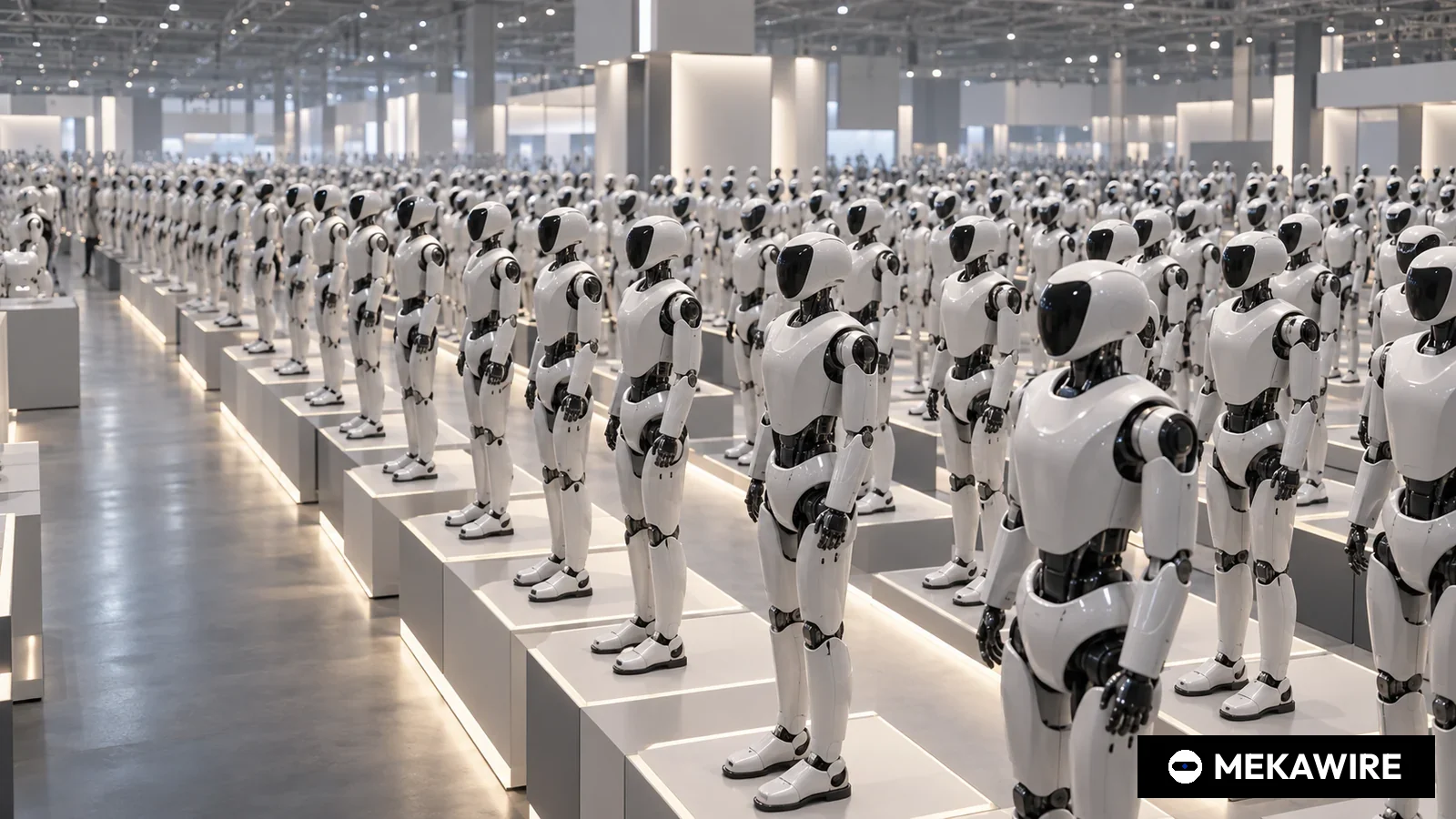
China's economic planning agency publicly acknowledged the risk of a humanoid robot bubble on November 27, 2025, saying the country already has more than 150 humanoid robot companies and that the number is still rising. Li Chao, deputy director of the National Development and Reform Commission's Policy Research Office and the commission's spokesperson, told the agency's monthly press conference in Beijing that balancing speed against bubbles is a recurring problem for frontier industries and that embodied AI is no exception.
According to the NDRC transcript, Li said the embodied AI industry, with humanoid robots as its flagship, is growing at more than 50% a year, and he cited market research forecasts that it will reach a market size of RMB100 billion by 2030. He added that more than half of the 150-plus humanoid makers are start-ups or companies crossing over from other sectors, and that technology routes, business models and application scenarios are not yet mature.
The key warning was narrow and specific. Li said the influx of new capital is good for innovation, but that the government must guard against two risks: highly repetitive products being launched in clusters, and research and development room being squeezed. The Chinese term he used, 上市, refers here to products reaching the market rather than to stock exchange listings, although the warning landed in the middle of an active fundraising season for the sector.
Li said the NDRC has been studying the industry with other government departments and will fold its response into the special plans being drafted under the 15th Five-Year Plan, which covers 2026 to 2030. He set out three lines of work. The first is to speed up industry standards and an evaluation system and to establish entry and exit mechanisms for embodied AI so that competition is fair. The second is to support companies, universities and research institutes in solving core technical problems, naming coordination between the large reasoning model and the small motion control model, matching cloud and on-device computing, and fusing simulated and real-robot data. The third is to build training grounds and pilot platforms and to share resources nationwide so that robots are deployed faster in real settings.
The embodied AI answer was one item in a wide-ranging briefing that the NDRC said drew more than 60 journalists from over 50 media outlets. The same session covered national pilot bases for AI applications, infrastructure REITs, winter energy supply and the 15th Five-Year Plan consultation, which shows how far humanoid robots have moved into mainstream industrial policy.
The warning came as capital continued to pour into China's robot makers. Hong Kong-listed UBTech agreed on November 25 to place 31,468,000 new H shares at HK$98.80 each, raising gross proceeds of about HK$3,109.04 million, according to its HKEX announcement; it earmarked about 75% of net proceeds for acquisitions or joint ventures over two years. Dobot, the Shenzhen cobot maker, agreed on November 6 to place 16,660,000 H shares at HK$46.80 for gross proceeds of about HK$779.7 million, with 40% of net proceeds set for research including wheeled and biped humanoid robots.
Private rounds kept closing too. RobotEra, founded in August 2023, said on November 27 that it had completed a Series A+ round of nearly RMB1 billion led by Geely Capital, with BAIC Capital, Alibaba Group and Haier Capital participating. Quadruped and humanoid maker DEEP Robotics said on December 9 that it had raised more than RMB500 million in a Series C co-led by CMB International and Huaxia Fund, with funds linked to China Telecom and China Unicom joining. On December 30, OneRobotics, the maker of SwitchBot home robots, listed in Hong Kong under stock code 6600 after raising HK$1,640.01 million at HK$73.80 a share, with its Hong Kong public tranche 254.50 times subscribed.
- UBTech
- Placing of new H shares
- 2025-11-25
- 3109.04
- HKD
- 2012
- Dobot
- Placing of new H shares
- 2025-11-06
- 779.7
- HKD
- 2015
- RobotEra
- Series A+
- 2025-11-27
- 1000
- RMB
- 2023
- DEEP Robotics
- Series C
- 2025-12-09
- 500
- RMB
- No data
- OneRobotics
- HKEX IPO (6600)
- 2025-12-30
- 1640.01
- HKD
- No data
Gross amounts as disclosed in HKEX announcements and company releases. RobotEra disclosed nearly RMB1 billion; DEEP Robotics disclosed more than RMB500 million; both are shown at the disclosed round figure. OneRobotics date is the listing date. Figures disclosed, not estimated.
As of Oct 1, 2026
The NDRC's language matters because it is the agency that drafts China's medium-term plans and approves major investment projects. Its signal is not a ban or a funding freeze. It points toward a standards-led shakeout in which certification and evaluation rules raise the cost of entry for companies that assemble similar bipedal robots from the same domestic actuator, reducer and sensor suppliers, while groups with their own models and production lines are better placed to meet new benchmarks.
The open questions are how strict the entry and exit mechanism will be and who will administer it. Li did not give a timetable, name a lead ministry or say whether the rules would be mandatory. Local governments, which have funded robot parks and subsidised purchases in many provinces, also have incentives that run against consolidation. And the RMB100 billion forecast he cited comes from third-party researchers rather than from an official projection.
Investors should watch for the 15th Five-Year Plan outline at the National People's Congress in March 2026, for a national standard framework for humanoid robots and embodied AI, and for whether fundraising by the leading companies slows or accelerates after the warning.
MEKAWIRE analysis
The NDRC warning is a steering signal for consolidation rather than a brake on China's humanoid push, and the capital raised around it shows money concentrating on companies with scale.
The evidence sits in the timing. Within five weeks of the press conference, UBTech and Dobot together raised about HK$3,888.74 million in gross placing proceeds, RobotEra and DEEP Robotics closed rounds of roughly RMB1 billion and more than RMB500 million, and OneRobotics listed with heavy retail demand. None of these companies is a newcomer assembling a first prototype; each had products in sale or deployment. A standards and entry regime would hurt the long tail of the 150-plus makers, not these groups.
The strongest counter-argument is arithmetic. If the RMB100 billion 2030 forecast Li cited were split evenly among the 150 companies he counted, each would average about RMB667 million in annual sales, which is a thin base for the valuations being paid. Price competition among similar bipedal designs could compress margins for leaders too, and an evaluation system takes years to bite.
Bull case: Clear national standards and an exit mechanism remove subscale players by 2027, procurement shifts to certified suppliers, and the leaders that raised capital in late 2025 win factory and service contracts at better prices. Government training grounds lower data costs for everyone that remains.
Bear case: Local subsidies keep weak companies alive, standards arrive slowly, and the market splits into dozens of near-identical products sold mainly to universities, exhibitions and state customers. Fundraising tightens after a correction and listed names such as UBTech and Dobot trade on revenue rather than narrative.
- March 2026: whether the 15th Five-Year Plan outline names embodied AI as a priority industry and refers to standards or entry rules.
- First half of 2026: publication of a national standard system for humanoid robots and embodied AI and the bodies that sign it.
- Full-year 2025 results in March 2026: UBTech and Dobot disclosures of humanoid unit sales and revenue, the first hard test of commercial demand.
- Humanoid robot companies in China
- 150
- companies (more than)
- Share that are start-ups or cross-industry entrants
- 50
- % (more than half)
- Embodied AI industry growth
- 50
- % a year (more than)
- Market size forecast for 2030
- 100
- RMB billion (third-party forecast cited)
Figures from the NDRC press conference transcript. Thresholds stated as lower bounds by the NDRC.
As of Oct 1, 2026
- Li Chao, deputy director of the NDRC Policy Research Office and spokesperson
- November 27, 2025, NDRC monthly press conference
- Clustered launches of highly repetitive products; squeezed R&D room
- Standards and evaluation system; entry and exit mechanism; core tech support; training and pilot platforms
- More than 50% a year (NDRC)
- 15th Five-Year Plan special plans (2026 to 2030)
- RMB100 billion (third-party market research)
- More than 150, over half start-ups or cross-industry entrants
Why it matters
The NDRC, the body that writes China's five-year plans, chose to address the word bubble directly in an official answer about humanoid robots. Until then the policy signal from Beijing, local governments and state funds had been almost uniformly expansionary. A warning from the planner shifts the burden of proof onto companies to show differentiated products and real demand.
The tools named are regulatory rather than financial. Standards, evaluation and an entry and exit mechanism are the same instruments China used to discipline crowded sectors such as new energy vehicles and solar manufacturing, where qualification lists determined who could sell and who received support.
Rival analysis
Among listed names, UBTech raised the largest sum in the window, about HK$3,109.04 million gross, and plans to spend roughly 75% of net proceeds on acquisitions and joint ventures, which positions it as a consolidator. Dobot's HK$779.7 million placing is smaller and spread across research, channels and working capital.
In the private market, RobotEra's nearly RMB1 billion Series A+ brought in carmakers Geely and BAIC, which signals demand for factory deployment, while DEEP Robotics drew telecom operators, which points to inspection and infrastructure use.
Valuation context
Placing discounts give a market read on appetite. UBTech priced its shares 11.39% below the previous close and 18.56% below the five-day average, according to its HKEX filing, a meaningful discount that still cleared more than HK$3 billion. OneRobotics' Hong Kong public tranche was 254.50 times subscribed.
Against those numbers, the cited RMB100 billion market size for 2030 implies an average of about RMB667 million a year for each of the 150 companies the NDRC counted (MEKAWIRE calculation). Valuations that assume a single company will take a large share of that market depend on consolidation actually happening.
Supply-chain implications
In MEKAWIRE's assessment, many of China's 150-plus humanoid makers buy from the same domestic pool of frameless torque motors, harmonic and planetary reducers, planetary roller screws, six-axis force sensors and dexterous hands. That shared supply base is what makes products repetitive: differentiation comes from software, integration and cost rather than hardware.
A standards regime could favour component suppliers that already meet automotive-grade quality systems and companies with vertical integration, and it could make it harder for assemblers without their own motion control and model stack to qualify.
Signals to watch
March 2026: the 15th Five-Year Plan outline at the National People's Congress and whether embodied AI appears with references to standards or orderly development. First half of 2026: a national standard framework for humanoid robots and embodied AI and the ministries and companies involved in drafting it.
March 2026: full-year 2025 results from UBTech and Dobot, including humanoid unit sales and revenue. Ongoing: whether the pace and size of private rounds for second-tier humanoid start-ups slows in the first quarter of 2026.
Analyst view
Thesis: the NDRC wants fewer, stronger humanoid companies and will use standards rather than money to get there. Confidence is medium. The direction is clear from the transcript, but there is no timetable, no lead ministry and no statement on whether rules will be binding.
Confidence is not higher because local governments control much of the subsidy and procurement flow and have their own champions. It is not lower because the NDRC tied the work to the 15th Five-Year Plan special plans, which gives it a formal channel and deadline.
Questions you should be asking
Will the entry and exit mechanism be a licence, a certification list or a voluntary benchmark? Which ministry will run the evaluation system, and will it cover safety, performance or both?
How will local governments that have subsidised robot parks respond if their companies fall below national standards? And will capital continue to concentrate on the few listed and late-stage names, or will the warning cool the whole sector?