Japan's first clinical robotic telesurgery: Hirosaki completes 5 hinotori cases
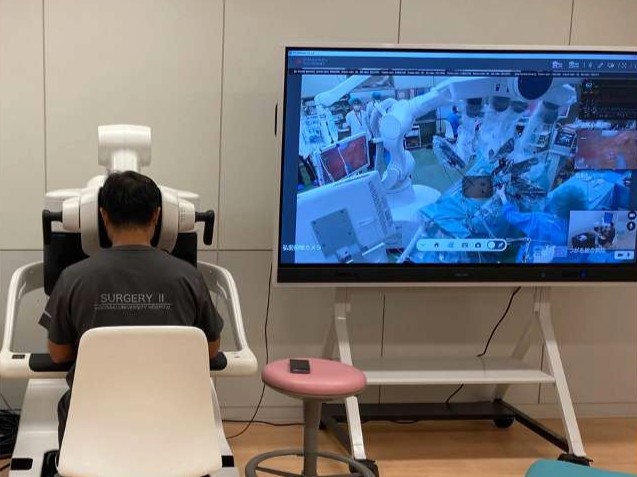
Hirosaki University said on Oct 15 that it has performed Japan's first clinical remote robotic surgery: 5 digestive-cancer operations completed safely since August on Medicaroid's hinotori system over an NTT East commercial line, with an experienced surgeon supporting from another hospital. The study is registered as jRCTs022240038.
Hirosaki University said at a press conference on Oct 14, 2026, and in a release dated Oct 15, that it has begun Japan's first clinical use of remote robotic surgery, in which an experienced surgeon at another site supports an operation through a surgical robot over a communications line. The first case was performed in August and 5 operations have been completed safely so far, the university said.
The announcement is six days old, but it marks a line Japan had not crossed before. Until now the Japan Surgical Society's telesurgery work was a demonstration programme; this is the first use on patients in the country, according to the university. What exactly was approved, and why it matters more for Japan's own surgical robot than for network engineers, is what follows.
A commercial fibre line, not a research network
The study links Hirosaki University Hospital with Tsugaru General Hospital in Goshogawara, Aomori Prefecture, over NTT East's commercial enterprise WAN service "Interconnected WAN", the university said. Patients are people with digestive cancers who qualify for surgery with the hinotori Surgical Robot System. A surgeon at the remote site supports the operation through the network while a surgeon stays at the patient's side; photos released by the university show a remote console with live video of the operating room and an ECG monitor at one site, and an assistant and a local surgeon at the robot at the other.
The study was approved by Hirosaki University's certified clinical research review board and is registered in Japan's jRCT system as jRCTs022240038. It runs as a specified clinical study under the society's Telesurgery Guidelines, second edition, with safety as the first priority, the release said. University president Fukuda, specially appointed professor Kenichi Hakamada, society chair Akinobu Taketomi and Masaki Mori, who chairs the society's telesurgery promotion committee, presented the work. The release gives no distance between the sites, no latency figure and no case durations.
Five fiscal years of groundwork paid for by AMED
The clinical study builds on a demonstration programme the Japan Surgical Society ran with funding from the Japan Agency for Medical Research and Development (AMED) from fiscal 2020 to fiscal 2024, five fiscal years, the university said. That work tested communication delay and stability, safe robot operation and the handling of emergencies, and its findings shaped the second edition of the guidelines this study follows.
The university frames the goal as access. Japan has too few surgeons, and specialists who handle complex operations are concentrated in cities. If telesurgery becomes practical, experienced surgeons could support regional colleagues over the network, patients could be treated near home, and the same link could be used for training. The release also names a longer-term aim of offering Japanese surgical skill and devices to countries where surgery is hard to obtain. That ambition points straight at the robot in the photos.
The robot is Japan's own
hinotori is made by Medicaroid, a Kobe company founded in 2013 with capital from Kawasaki Heavy Industries and Sysmex, according to Medicaroid's corporate history. hinotori received Japanese manufacturing and marketing approval in 2020, was extended to digestive surgery and gynaecology in 2022 and to thoracic surgery in 2024, and has approvals in Singapore (2023), Malaysia (2024) and Vietnam (2026) plus a CE mark under the EU Medical Device Regulation in 2026, the company says. Kawasaki also signed a medical robotics memorandum with Rome's Gemelli hospital in September, as [MEKAWIRE reported](/news/kawasaki-gemelli-university-hospital-mou-kic-eu-strasbourg-hinotori-nyokkey-forro-rome-20260914).
By MEKAWIRE's count, the first clinical telesurgery case came about 6 years after hinotori's Japanese approval (approval year 2020 to first case in August 2026). October brought three telesurgery reports into our database, and they prove different things.
- Hirosaki University Hospital and Tsugaru General Hospital (Japan)
- First case Aug 2026, announced Oct 14 to 15
- hinotori (Medicaroid)
- 5 patients, digestive cancers
- Not disclosed
- University release
- Korea University Anam Hospital, Seoul to Shanghai
- Oct 16, 2026
- Toumai (MicroPort MedBot)
- Animal model
- About 870 km
- Hospital release
- Kyushu University, Fukuoka to Beppu (Japan)
- Reported Oct 13, trial through 2027
- Microsurgery robot
- Trial, cases not reported
- About 110 km
- Outlet report, unconfirmed
Built from MEKAWIRE stories and the primary pages they cite. Distances as stated by the sources.
As of Oct 20, 2026
Korea University Anam Hospital [operated across about 870 km from Seoul to Shanghai](/news/korea-university-anam-hospital-cross-border-telesurgery-seoul-shanghai-870km-microport-toumai-20261019) on MicroPort MedBot's Toumai, but on an animal model. [Kyushu University's 110 km trial](/news/kyushu-university-iown-apn-remote-microsurgery-robot-beppu-110km-20261013) over NTT's IOWN network rests on outlet reports that MEKAWIRE has not confirmed with a university release. Hirosaki's step is the most modest in distance and the only one on patients.
MEKAWIRE analysis
Japan's first clinical telesurgery is a governance milestone more than an engineering one: it clears the path of guideline, ethics review and registered trial on an ordinary commercial line, and it gives a domestic robot the country's first clinical record.
The evidence is in what the study does not attempt. The network is a standard enterprise service, the sites are in one prefecture, and a surgeon stays at the bedside. None of that pushes technical limits. What is new is that a surgical society, a review board and a public registry have signed off on remote operation of a robot on patients, a template other hospital pairs can copy faster than anyone can build a new network.
For Medicaroid the record has commercial weight. Intuitive had 11,710 da Vinci systems installed worldwide on June 30, 2026, according to its earnings release ([MEKAWIRE explainer: surgical robots](/news/surgical-robots-market-2026-explained-11710-da-vinci-systems-8400-surgical-robots-sold-challengers-backed-by-medtech-giants-20261017)); Medicaroid does not disclose an installed base. A newer maker cannot win on unit count, but it can own a use case that Japan's guidelines and first patient data now attach to its system.
The strongest counter-argument is that 5 cases with a surgeon on site say little about what happens when a link fails mid-operation, and the release publishes no latency, intervention or complication data. Korea and China are testing longer and cross-border links. If the remote surgeon rarely had to act, the model may prove more useful for teaching than for treatment.
Bull case: results posted under the jRCT number show stable links and real interventions, more regional hospital pairs join, and hinotori's overseas approvals become an export story for supported telesurgery. Bear case: the study stays small, payers do not recognise remote support, and the milestone remains a press conference.
What would change our view: published latency and intervention data, a second hospital pair under the same guideline, or a reimbursement decision. Signals to watch: results filed under jRCTs022240038, whether the Kyushu trial (through 2027) produces a university release with patient cases, and Medicaroid's first remote use outside Japan, where hinotori now carries a CE mark. More on Japan's robot base: [MEKAWIRE Japan market explainer](/news/japan-robotics-market-2026-explained-36219-robot-installations-decade-low-exports-82-percent-of-shipments-20261017).
- 5 operations completed safely since the first case in August 2026
- hinotori Surgical Robot System (Medicaroid, Kobe)
- Hirosaki University Hospital and Tsugaru General Hospital, Goshogawara
- NTT East commercial enterprise WAN service Interconnected WAN
- Digestive cancers eligible for hinotori surgery
- Oct 14, 2026 press conference; university release dated Oct 15
- Specified clinical study under the Japan Surgical Society Telesurgery Guidelines, 2nd edition; jRCTs022240038
- AMED-funded demonstration research, fiscal 2020 to 2024
- Distance between sites, latency, case durations, complications
Why it matters
The first clinical telesurgery cases in Japan turn a decade of guideline work into a registered, reviewable study on patients. The precedent is procedural: any hospital pair that can meet the Japan Surgical Society's second-edition guideline, obtain certified review-board approval and register in jRCT now has a template. That lowers the barrier for regional hospitals far more than any network upgrade would.
It also ties the first patient data to a domestic platform. In a market where Intuitive's installed base sets the scale, being the robot named in the country's first clinical telesurgery is a differentiator Medicaroid can use with Japanese hospitals and in the four markets where hinotori is approved.
Rival analysis
Intuitive (11,710 da Vinci systems installed on June 30, 2026, per its Q2 release) dominates installed base; MEKAWIRE has no verified record of a clinical da Vinci telesurgery in Japan, so the comparison is about firsts, not capability. MicroPort MedBot's Toumai has been used for long-distance and cross-border demonstrations, including Korea University Anam Hospital's Seoul to Shanghai animal-model case on Oct 16. Kyushu University's IOWN trial points to a parallel Japanese track focused on microsurgery and photonic networks.
The Hirosaki model is the most conservative of the three: regional distance, commercial line, local surgeon present. Its advantage is regulatory standing, not reach.
Valuation context
Medicaroid is a private joint venture of Kawasaki Heavy Industries and Sysmex and discloses neither revenue nor installed base, so no valuation comparison is possible. Its value to the parents shows up in approvals (Japan 2020, Singapore 2023, Malaysia 2024, Vietnam 2026, CE mark 2026) and in clinical firsts such as this one. Investors in Kawasaki and Sysmex should treat the news as a qualitative milestone without a disclosed financial effect.
Supply-chain implications
The study uses a Japanese robot and a Japanese carrier's commercial WAN service. The network layer is an ordinary enterprise product, which means the binding constraints are clinical governance and staffing, not components. For component suppliers to surgical robots, a growing telesurgery use case raises the value of low-latency video, haptic and control electronics, but the release gives no technical data that would size that demand.
Signals to watch
Results or updates filed under jRCTs022240038. Whether the Kyushu University IOWN trial, which runs through 2027, produces a university release with patient cases. Medicaroid's first remote use of hinotori outside Japan, now that it holds a CE mark. A decision by Japanese payers on recognising remote support during robotic surgery.
Analyst view
Thesis: the milestone is governance, not engineering, and it strengthens a domestic platform at home. Confidence: medium. The facts are primary and clear, but five cases and no published latency or intervention data leave the clinical value open. A data release showing frequent, meaningful remote interventions would raise confidence; a study that stalls at a handful of cases would lower it.
Questions you should be asking
How often did the remote surgeon actually intervene in the five cases, and what latency did the link show? What is the fallback procedure if the link drops mid-operation? Will Medicaroid offer telesurgery support as a service with hinotori sales abroad? How many more hospital pairs are preparing under the same guideline?