Rhoda AI leaves stealth with a $450 million Series A to run factory robots on a model that learns from internet video
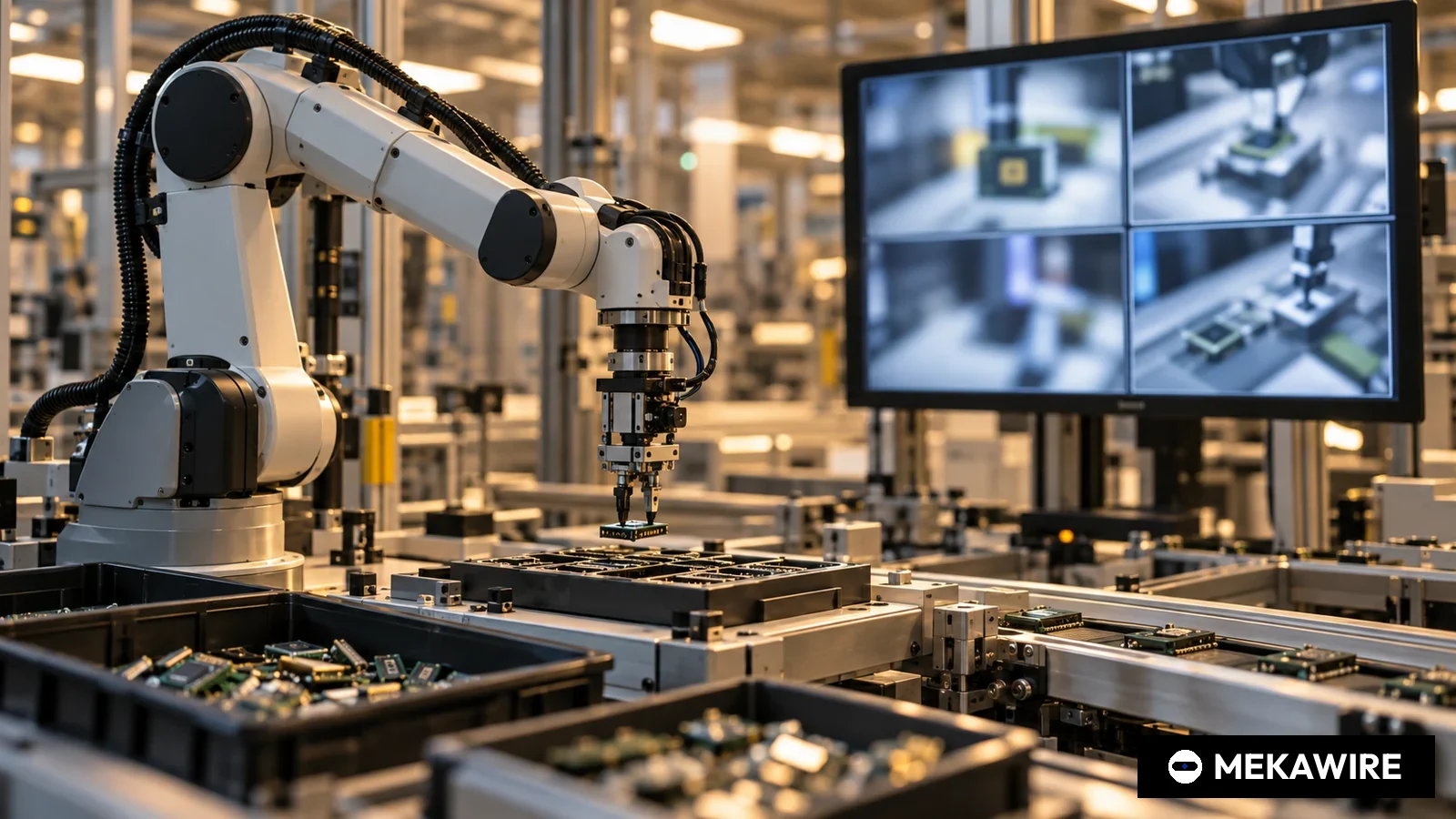
Palo Alto start-up Rhoda AI emerged on 10 March 2026 with a $450 million Series A from Khosla Ventures, Mayfield, Temasek and six other institutions, plus John Doerr. Its Direct Video Action model predicts video of a task and converts it into robot actions, and the company says new tasks can need as little as ten hours of teleoperation data. No lead investor, valuation or customer was disclosed.
Rhoda AI, a Palo Alto start-up that teaches robots by having them predict video, came out of stealth on 10 March 2026 with a $450 million Series A. The company said the money will pay for research and engineering, for more industrial deployments and customer pilots, and for a larger team.
The round drew Capricorn Investment Group, Khosla Ventures, Leitmotif, Matter Venture Partners, Mayfield, Premji Invest, Prelude Ventures, Temasek and Xora, along with individual backers including John Doerr, according to Rhoda's release. The company named no lead investor and disclosed no valuation. It said it had spent 18 months in stealth before the launch.
What Rhoda says it has built
Rhoda calls its core model Direct Video Action, or DVA, and the product layer built on it FutureVision, which the release describes as the foundation model that powers Rhoda systems today. The model is pretrained on internet-scale video; Mayfield put the corpus at hundreds of millions of videos in a post published on launch day. In operation the model predicts how the scene in front of the robot should unfold, turns that prediction into motor commands and repeats the cycle every few hundred milliseconds in a closed loop, the company said.
A technical post Rhoda published the same day, titled 'Causal Video Models Are Data-Efficient Robot Policy Learners', fills in the design. A causal video model forecasts future frames from the video history, the robot's joint readings and a language instruction. A separate inverse dynamics model then works out which actions would produce those frames; Rhoda says that component needs about 10 hours of robot-specific data and can be trained on random motions. A scheme the company calls Leapfrog Inference computes the next prediction while the robot is still executing the current one, so the model's latency does not stall the arm.
The post reports long autonomous runs rather than benchmark scores. A decanting task learned from 11 hours of robot data ran for 1.5 hours without interruption, and a container breakdown task trained on 17 hours of data ran for 160 minutes. Post-training for a new task takes 10 to 20 hours of task data, according to the post, and the release says some tasks need as little as ten hours of teleoperation. Rhoda published no success rates and no head-to-head numbers against other robot models.
As commercial evidence, the release says that in a recent high-volume manufacturing evaluation the system completed a component-processing workflow autonomously in under two minutes per cycle, beating the customer's performance targets. The customer was not named. Rhoda's website lists automotive, manufacturing, logistics and e-commerce as target sectors, shows returns processing, bearing decanting and container breakdown, and describes a wheeled robot with custom actuators rated at 25 kg of payload and 40 kg at peak, with a brake in every actuator.
The people behind it
Chief executive Jagdeep Singh co-founded QuantumScape, the solid-state battery developer, and led it until 15 February 2024, when he handed the CEO role to Siva Sivaram and stayed on as chairman, according to QuantumScape. Mayfield says Singh has now built seven companies. Chief science officer Eric Ryan Chan is a Stanford researcher in computer vision and generative modelling who previously designed generative models at World Labs, and Stanford professor Gordon Wetzstein, head of the university's Computational Imaging Lab, is part of the team, the release says. Singh said in the release that the next era of robotics requires models that understand how the world moves, which he set against models that only capture what a scene looks like or how it is described in language.
Where it sits among rivals
The round landed in the busiest quarter yet for US robot-AI financing. Skild AI raised $1.4 billion in a SoftBank-led Series C on 14 January at a valuation above $14 billion, Mind Robotics raised $500 million the day after Rhoda's launch and Sunday raised $165 million on 12 March, each according to the companies. Physical Intelligence closed a Series B led by CapitalG in November 2025. Most of these groups build vision-language-action (VLA) models, which attach an action output to a network pretrained on images and text. Rhoda's website argues that DVA generalises where conventional VLA pipelines struggle.
- Rhoda AI
- US
- Series A
- 450,000,000
- No data
- 2026-03-10
- Skild AI
- US
- Series C
- 1,400,000,000
- 14,000,000,000
- 2026-01-14
- Mind Robotics
- US
- Series A
- 500,000,000
- No data
- 2026-03-11
- Sunday
- US
- Series B
- 165,000,000
- No data
- 2026-03-12
- Dyna Robotics
- US
- Series A
- 120,000,000
- No data
- 2025-09-15
- Genesis AI
- FR
- Launch round
- 105,000,000
- No data
- 2025-06-30
Amounts and valuations as disclosed by each company; — where not disclosed. No estimates.
As of Oct 1, 2026
Why video instead of language
The bottleneck in robot learning is data. Teleoperated demonstrations, in which a person drives the robot through a task, are slow and costly to gather. Internet video is abundant and shows hands, tools and objects behaving under gravity and contact. A model trained to predict what happens next in such footage acquires a rough sense of physics, and Rhoda's bet is that this prior cuts the robot data each new task needs to a few working days of teleoperation. The cost is compute, because generating video frames is heavier than emitting a short action sequence, which is why the company engineered its inference around latency.
- Decanting
- 11
- 90
- 8.2
- Container breakdown
- 17
- 160
- 9.4
From Rhoda's research post 'Causal Video Models Are Data-Efficient Robot Policy Learners'. 1.5 hours = 90 minutes. Ratio = run minutes / robot data hours, rounded to one decimal. Not a success-rate measure.
As of Oct 1, 2026
Risks and open questions
Rhoda has shown long runs on a handful of tasks, not reliability statistics across a fleet. Without success rates, interventions per hour or comparisons with VLA baselines, outsiders cannot measure how much the video prior adds. The manufacturing evaluation has no named customer, and the company has not said who builds its hardware. Mayfield describes the model as labour as a service and writes that 1,000 deployed units would generate about $100 million in recurring annual revenue, which implies roughly $100,000 per robot per year, a price that has to beat the fully loaded cost of the shifts it replaces.
What to watch
Rhoda followed up on 10 September 2026 with a research post asking whether scaling web-video pretraining helps real robots do real work, so its scaling evidence is now public to test. A first named production customer, published intervention rates and the price of a deployed unit are the facts that would turn the round into a business.
MEKAWIRE analysis
Rhoda AI is the clearest test yet of whether video prediction, rather than language, should be the pretraining base for robot control, and $450 million gives it the runway to settle the question on factory floors.
The disclosures support the thesis. Rhoda's two long runs used 11 and 17 hours of robot data, a working week or less per task, and an unnamed manufacturer saw sub-two-minute cycles that met its targets. Nine institutions and John Doerr committed $450 million to a company with no public product history, which shows how much investors will pay for a distinct technical bet in robot intelligence.
The strongest counter-argument is that the method is not proprietary. Skild AI, Physical Intelligence and the large platform companies have the compute and video data to add prediction of future frames to their own stacks, and if approaches converge Rhoda's edge narrows to execution and hardware, where it has disclosed little.
Bull case: the low data requirement holds across dozens of tasks, pilots in automotive and logistics plants become paid fleets in 2027, and revenue per robot validates the labour-as-a-service model. A priced follow-on round then sets the valuation the Series A never disclosed.
Bear case: video generation proves too slow or too costly to run at the edge, success rates stall below what a production line tolerates and customers stay in evaluation. Rhoda then has to raise again with few hard metrics against rivals that already report revenue.
Signals to watch:
- Whether Rhoda follows its 10 September 2026 scaling study with success rates measured against named VLA baselines.
- A named manufacturing or logistics customer moving from evaluation to paid deployment by the end of the first quarter of 2027.
- A disclosed valuation or follow-on round in 2027, which would be the first public price for the company.
- Jagdeep Singh, co-founder of QuantumScape
- Direct Video Action (DVA), powering the FutureVision platform
- Series A, $450 million
- Rhoda AI, Palo Alto, California
- 10 March 2026
- Capricorn Investment Group, Khosla Ventures, Leitmotif, Matter Venture Partners, Mayfield, Premji Invest, Prelude Ventures, Temasek, Xora; John Doerr
- Not disclosed
- None named
- 18 months
- As little as 10 hours of teleoperation; 10 to 20 hours of task data in research post
Why it matters
Most of the capital that flowed into robot intelligence in early 2026 backed vision-language-action models, which inherit their world knowledge from image and text pretraining. Rhoda is the first heavily funded US company to stake its whole stack on video prediction as the pretraining objective, which makes its results a referendum on that design choice for the sector.
The practical stake is data cost. If a new industrial task really needs 10 to 20 hours of robot data, deployment shifts from a months-long data collection project to a commissioning exercise measured in days, and the economics of robots in high-mix manufacturing and returns processing change with it.
Rival analysis
Skild AI ($1.4 billion Series C at more than $14 billion in January) and Physical Intelligence (Series B led by CapitalG in November 2025) sell general robot brains across many bodies and already have broader public results. Mind Robotics, which raised $500 million on 11 March, pairs AI with an industrial customer base inherited from Rivian. Rhoda competes with all three for the same manufacturing and logistics pilots.
Rhoda's differentiation is architectural: video prediction plus an inverse dynamics model instead of a language backbone. Its weakness is disclosure. Rivals publish evaluations, customer names or revenue; Rhoda has offered two long runs and one anonymous evaluation.
Valuation context
Rhoda did not disclose a valuation and neither did any investor whose statement MEKAWIRE reviewed, so no price or step-up can be calculated from primary sources. Figures reported elsewhere were not confirmed by the company and are not used here.
On size alone, the $450 million Series A equals 32% of Skild AI's $1.4 billion Series C and 90% of Mind Robotics' $500 million Series A (amount divided by peer amount). Mayfield's statement that 1,000 deployed units equal about $100 million of recurring annual revenue implies about $100,000 per unit per year, the only unit-economics figure on the record.
Supply-chain implications
Rhoda's website describes its own wheeled robot with custom actuators, a 25 kg rated and 40 kg peak payload and a brake in every actuator, but names no contract manufacturer or actuator supplier. A company building bodies as well as brains takes on supply-chain risk that pure model developers avoid.
The heavier dependency is compute. Generating video in a loop every few hundred milliseconds requires substantial inference capacity, whether on the robot or nearby, which ties Rhoda's unit cost to GPU pricing and edge compute availability.
Signals to watch
Rhoda's 10 September 2026 post on scaling web-video pretraining is the first test of whether more video compute buys better robot performance; follow-up work with success rates would be the next.
Commercially, watch for the anonymous manufacturing evaluation to become a named customer, for a disclosed per-unit price, and for a priced round that finally marks the company.
Analyst view
Thesis: Rhoda AI is a credible, well-funded bet that video prediction can cut the robot data needed per task to a few days, and the coming year will show whether that advantage survives contact with production lines. Confidence: medium. Reasons: the team, the size of the syndicate and the 11-hour and 17-hour runs are concrete, but there are no success rates, baselines, named customers or prices.
We would raise confidence on a named customer with fleet-scale deployment and published intervention rates, and lower it if 2027 passes with Rhoda still citing anonymous evaluations.
Questions you should be asking
What are DVA's success rates and interventions per hour on the decanting and container breakdown tasks, and how do they compare with a VLA baseline trained on the same robot data?
Where does inference run, on the robot or on nearby servers, and what does that compute cost per robot per hour?
Who manufactures Rhoda's wheeled robot, and what will a deployed unit cost a customer per year?