Watney raises $80 million Series A to put dexterous robots on hyperscale data-centre floors
Watney has raised an $80 million Series A co-led by the Valor Atreides AI Fund and Hummingbird Ventures, taking its total funding past $100 million. The San Francisco company runs dexterous robots for hyperscale cloud operators and claims better than 99.99% reliability over hundreds of thousands of operating hours, but it disclosed no customer names, valuation or founders.
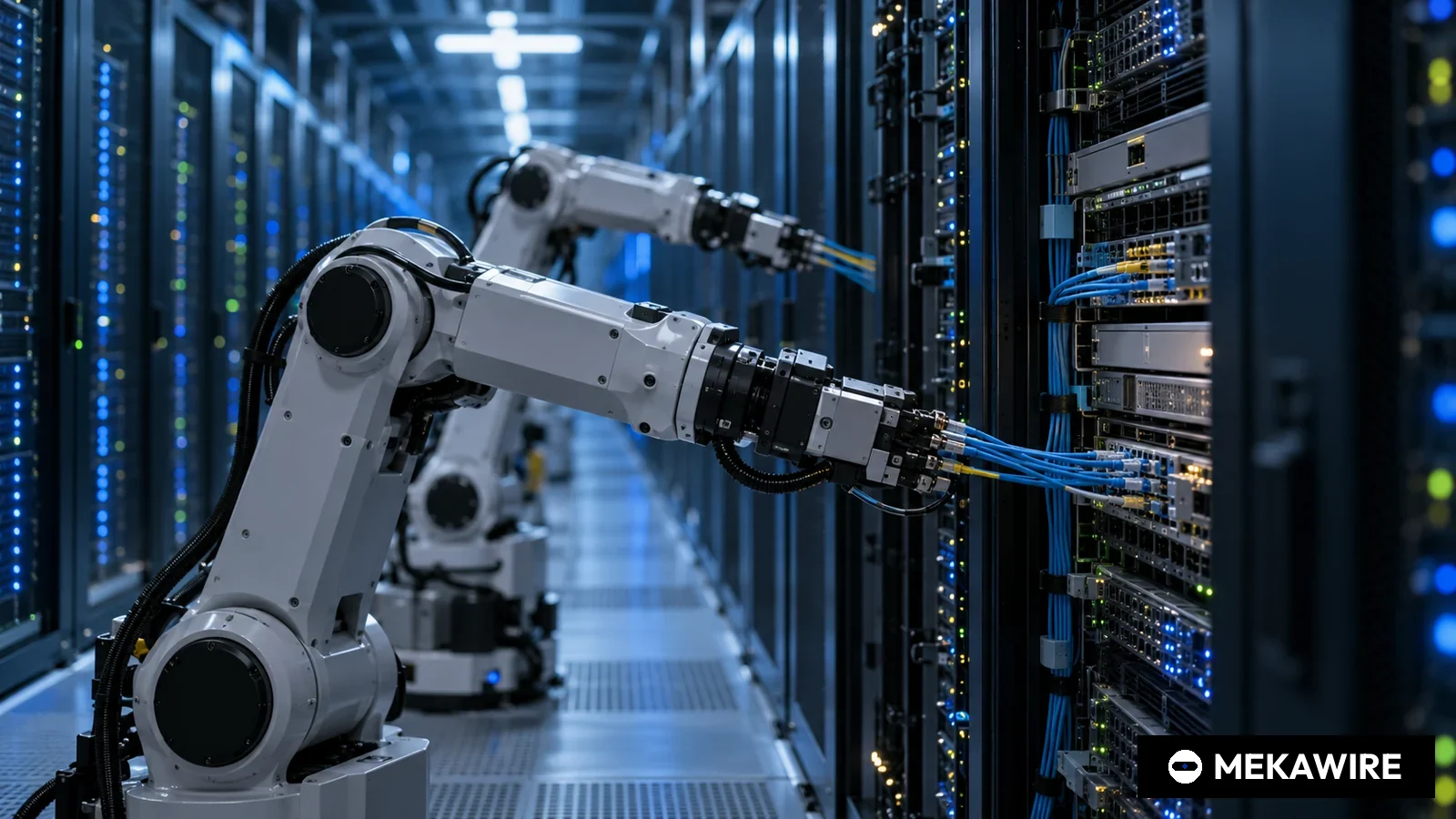
Watney, a San Francisco robotics start-up whose machines work inside data centres for the largest cloud operators, has raised $80 million in a Series A round and says its fleet has logged hundreds of thousands of operating hours at better than 99.99% reliability. The company announced the round on 17 September 2026 without naming a customer, a founder or a valuation.
That combination is the story. Watney is selling a reliability number to buyers who measure their own business in uptime, and investors have now put more than $100 million behind it. This article sets out what was disclosed, what was left out, and why we think the data-centre floor may be one of the first places where a task-specific robot earns steady revenue before humanoids do.
An AI-infrastructure fund and a venture firm split the lead
The round was co-led by the Valor Atreides AI Fund and Hummingbird Ventures, with Conviction, Abstract, A* and Grant Gordon also taking part, Watney said in its announcement. The company put its total funding at more than $100 million, which implies that it raised at least $20 million before this round. It did not disclose the valuation, the split between new and existing money, or how the proceeds will be spent, beyond saying that it is hiring in every function.
The Valor Atreides AI Fund has backed field robotics before. In February 2026 it co-led, with CapitalG, a $270 million Series B for Bedrock Robotics, which retrofits excavators and other heavy equipment for autonomous construction, at a $1.75 billion valuation, according to Bedrock's release. Hummingbird lists Watney in its portfolio as a company it first partnered with in 2026.
What Watney says its robots do, and what it leaves unsaid
Watney describes itself as a builder and operator of autonomous robotic systems for hyperscalers and neoclouds, and says it has worked with them since 2025 to speed up the deployment of compute. It claims to run the largest fleet of dexterous robots operating around the clock, every day of the year, in the United States. Hummingbird's portfolio entry is more specific, describing a robotic workforce for AI data centres that starts with what it calls last-mile cabling.
The company's careers page lists more than 25 open positions, all in San Francisco, from controls, embedded and machine-learning engineering to manufacturing, robotics technicians and teleoperation. It describes its founding team by background rather than by name, citing a former general sales manager for Apple's iPhone, a founding engineer at Worldcoin and an engineer behind the electric racing car built at ETH Zurich that the page calls the world's fastest. On its website Watney argues that critical infrastructure suffers from labour shortages, hazardous work and operational complexity, and says data centres are its first market.
Four nines is a data-centre metric, and Watney chose it on purpose
Four nines, or 99.99%, is the language of service-level agreements. Applied to a year of continuous operation it leaves room for roughly 53 minutes of failure. Watney did not say what its figure measures, whether task success, robot availability or something else. The distinction matters, because a robot that is available 99.99% of the time but finishes a cabling job on the first attempt far less often would be a very different product.
The second open point is how much of the work people still do. Watney is hiring teleoperators, which indicates that remote staff supervise or recover at least some tasks. That arrangement is common among robotics start-ups, and the economics turn on how many robots one operator can cover.
A small cheque in a quarter of large ones
- Watney
- US
- Series A
- 80
- No data
- 2026-09-17
- Humanoid
- GB
- Series A
- 152
- 1350
- 2026-07-21
- Holiday Robotics
- KR
- Series A
- 105
- No data
- 2026-07-13
- Mind Robotics
- US
- Series A
- 500
- No data
- 2026-03-11
- Dyna Robotics
- US
- Series A
- 120
- No data
- 2025-09-15
Disclosed figures from company announcements; no estimates. Peer median = median(152, 105, 500, 120) = 136; Watney ratio = 80 / 136 = 0.59. Q3 share = 80 / 1,607, where 1,607 is the sum of the eight robotics rounds of USD 80m or more announced July to September 2026 in MEKAWIRE data. Prior funding floor = total raised (over 100) minus 80.
As of Oct 1, 2026
In MEKAWIRE data, eight robotics rounds of $80 million or more were announced between July and September 2026, totalling $1.607 billion. Watney's is the smallest of them and accounts for 5.0% of that sum. D-Robotics, the Chinese maker of robot compute chips, announced a $400 million Series C on the same day. Against the other Series A rounds in the table, Watney raised 59% of the peer median of $136 million.
MEKAWIRE analysis
Watney's round prices the AI data-centre build-out as a market where a narrow, non-humanoid robot can earn hyperscaler revenue now, but the case rests on a reliability figure that only the company has measured.
The evidence for the thesis is in what Watney chose to disclose. It led with uptime and hours in service, not with a model, a demo video or a humanoid body. Its stated approach is to build machines that beat people on precision, reliability or scale rather than imitate them. Rack-level work in a data hall is repetitive and tightly specified, the conditions under which robots have historically succeeded, and its buyers already pay for reliability by contract.
The strongest counter-argument is buyer concentration. A handful of cloud operators account for most data-centre spending, they employ deep engineering teams, and any one of them could build similar machines in-house or press a supplier on price once the task is well understood. Watney names none of its customers, so outsiders cannot judge how many it has or how deep the relationships run.
Bull case. If the reliability claim holds up under customer audit, Watney becomes part of the commissioning process for new AI capacity and its revenue tracks data-centre construction rather than robotics sentiment. Moving from cabling into other rack tasks would multiply the work available per site, and the next round would be priced on contracts.
Bear case. If one large customer brings the work in-house or slows construction, a young company with an unnamed client base has little to fall back on. Teleoperation costs could also prove sticky, leaving margins closer to a field-services firm than a robot maker.
Signals to watch. A named customer or deployment site disclosed by 31 March 2027 would turn the claim into evidence. A public definition of the 99.99% figure, or third-party data behind it, before the next financing would show whether it is availability or task success. And the capital-spending guidance the largest cloud operators give with their results in January and February 2027 will set the size of Watney's market for the year after.
- San Francisco (all open roles)
- Series A, $80 million
- Valor Atreides AI Fund and Hummingbird Ventures
- 17 September 2026
- Hyperscalers and neoclouds, unnamed; working with them since 2025
- Not disclosed
- Last-mile cabling in AI data centres (Hummingbird portfolio)
- More than $100 million
- More than 99.99% across hundreds of thousands of operating hours (company figure)
- Conviction, Abstract, A* and Grant Gordon
Why it matters
Most of the capital that went into robotics in 2026 chased general-purpose machines, humanoids and robot foundation models whose revenue is still mostly ahead of them. Watney is a counter-example. It sells a narrow capability into a buyer group that is already spending heavily and already contracts on uptime, and it has chosen to present itself through operating hours rather than through demos.
If that model works, it shows robotics investors a second route to scale, one in which the robot is specified around a single repetitive job inside a controlled building and the customer is a handful of very large operators. That route has lower technical risk than a household humanoid and a shorter path to recurring revenue, but it also ties the company to one industry's construction cycle.
For the robotics supply base the round matters because data centres are a new end market. Actuators, grippers, vision modules and edge compute sold to Watney-type firms do not depend on car-plant or warehouse budgets, which have driven most industrial robot demand to date.
Rival analysis
Watney's direct competition is not other robot makers so much as the status quo, which is human technicians and contractors doing cabling and rack work, and the cloud operators' own engineering teams. Hyperscalers have the scale to build specialised machines in-house once the task is proven, and Watney's disclosure gives no sign of exclusivity or long-term contracts that would deter that.
Among venture-backed robotics companies in the MEKAWIRE database, the closest comparisons are by business model rather than by product. Dyna Robotics, which set out to commercialise embodied AI on low-cost robots, raised a $120 million Series A in September 2025. Mind Robotics, spun out of Rivian, raised a $500 million Series A in March 2026 for industrial deployment. Both bet on deployed hours rather than general capability, and both raised more than Watney at the same stage.
General-purpose platforms such as Figure, Apptronik and Humanoid could in principle target the same racks. Their pitch is breadth. Watney's is depth in one environment. The question for buyers is whether a single-purpose machine at very high reliability beats a flexible one at lower reliability, and in a facility where downtime is priced by contract, public data does not yet settle the answer.
Valuation context
Watney did not disclose a valuation, and MEKAWIRE does not estimate one. The comparable disclosed figures in our database are thin at this stage. Humanoid's $152 million Series A in July 2026 came at a $1.35 billion post-money valuation, and Walden Robotics launched with a $300 million seed at $1.1 billion. Both are general-purpose bets with larger rounds.
What can be computed from disclosed numbers is limited. Total funding of more than $100 million minus the $80 million Series A implies at least $20 million raised earlier. Watney's Series A equals 59% of the median of the four peer Series A rounds in our table ($136 million) and 5.0% of the $1.607 billion raised in the eight robotics rounds of $80 million or more that we recorded for July to September 2026.
The co-lead from the Valor Atreides AI Fund is the more telling signal. Its earlier robotics lead in our verified data, Bedrock Robotics' $270 million Series B at $1.75 billion, was also a narrow, task-specific autonomy company selling into an industry with labour shortages, construction. The pattern suggests that the fund prices field robotics on deployment evidence rather than on platform breadth.
Supply-chain implications
Watney has not disclosed its hardware suppliers, robot design or component sourcing. The company is hiring mechanical, embedded and controls engineers as well as manufacturing staff and robotics technicians, all in San Francisco, which indicates that it designs and builds at least part of its systems itself rather than integrating off-the-shelf arms.
Dexterous cabling work implies fine-force manipulation, precise vision for small connectors and compute close to the robot. Those categories are dominated globally by a small number of suppliers of precision reducers, servo motors, cameras and edge AI chips, many of them Japanese, Chinese, German and American. Until Watney discloses its bill of materials, exposure by country cannot be assessed.
The operational supply chain matters as much as the hardware. A fleet that runs every hour of the year needs spare parts, field technicians and teleoperators near each site. That makes Watney's cost base partly a services cost base, which will shape margins as it adds customers in new regions.
Signals to watch
First, customer disclosure. A named hyperscaler or neocloud, or a named site, by 31 March 2027 would be the clearest validation of the fleet-size and reliability claims. Absent that, investors and rivals are relying on the company's own statements.
Second, task expansion. Hummingbird describes cabling as the starting point. Any announcement of further rack tasks, such as hardware swaps or inspection, in the next two to three quarters would show whether the platform generalises within the data hall.
Third, the market. Capital-spending guidance from the largest cloud operators with their results in January and February 2027 sets the volume of new capacity Watney can serve. A slowdown there would hit a company like Watney before it reaches general-purpose robot makers.
Analyst view
Thesis. Watney is the clearest example yet of a robotics company selling a measured uptime figure, not a capability demo, into AI infrastructure, and the round prices that approach as investable at Series A scale.
Confidence. Medium. The business logic is sound and the investors have backed comparable field-autonomy models. Confidence is capped by the absence of any independent evidence. Customer names, the definition of the 99.99% figure, fleet size in units and revenue are all undisclosed.
What would change our view. A named customer and a defined reliability metric would raise confidence to high. Evidence that a large cloud operator is building equivalent robots in-house, or a long gap before the next disclosure, would lower it.
Questions you should be asking
What exactly does the 99.99% figure measure, robot availability, first-attempt task success or something else, and over how many robots and sites?
How many customers does Watney serve, and what share of revenue comes from the largest one? Are contracts priced per robot, per task or per hour?
What proportion of tasks currently involves a teleoperator, and what is the target ratio of robots to operators by the end of 2027?
Which tasks beyond cabling are in development, and does the company plan to sell outside data centres into the other infrastructure it mentions, such as energy?