1X puts a price on the home humanoid, opening NEO pre-orders at US$20,000 or US$499 a month with US deliveries in 2026
1X Technologies opened pre-orders on 27 October 2025 for NEO, a home humanoid priced at US$20,000 or US$499 a month, with US deliveries from 2026 and international expansion from 2027. The 66-pound robot runs 1X's Redwood AI onboard and relies on remote 1X experts for chores it has not yet learned.
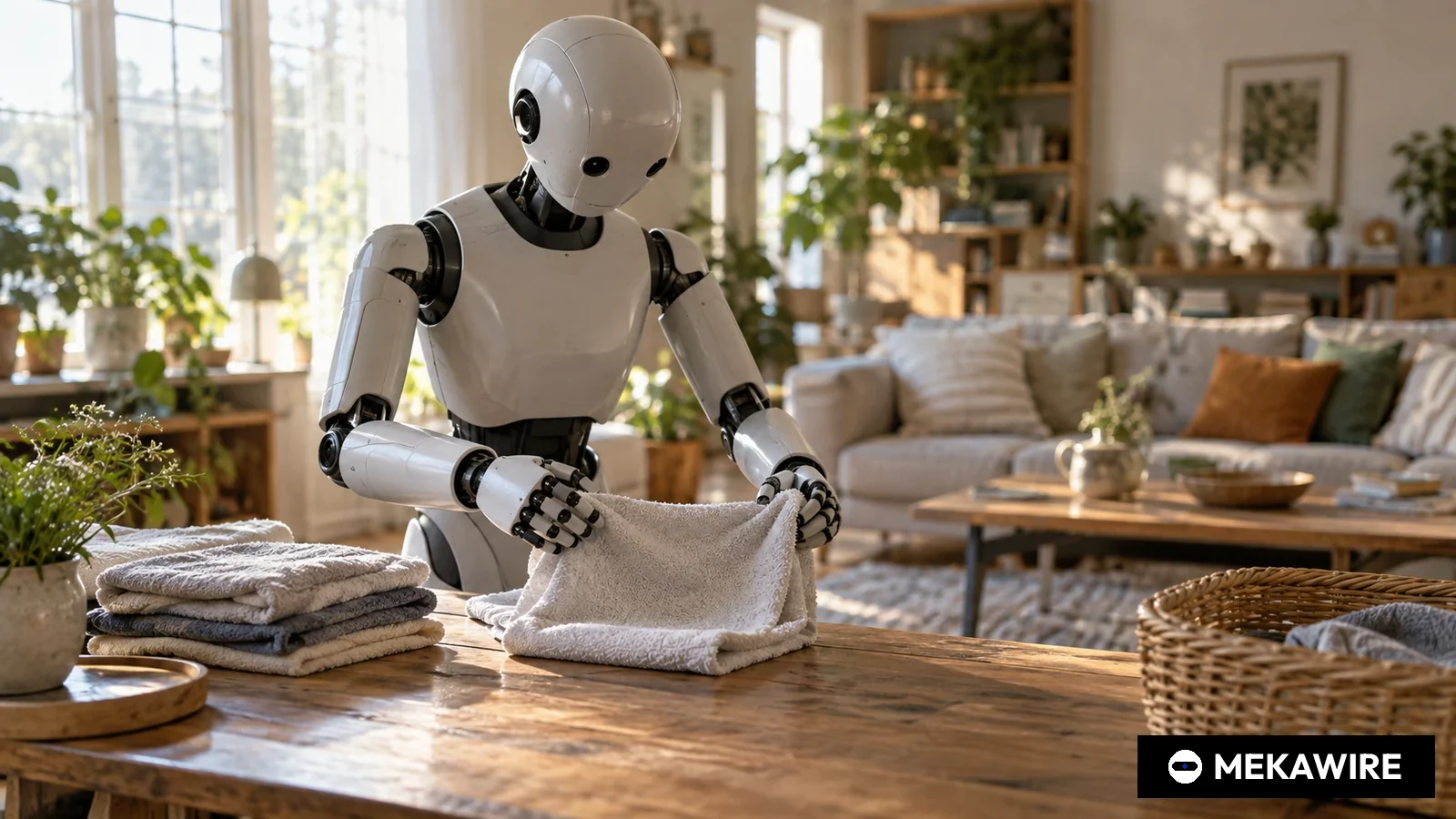
1X Technologies opened pre-orders for NEO on 27 October 2025, attaching a public price to a humanoid robot built for ordinary homes. Buyers can pay US$20,000 to own the robot with priority delivery in 2026, or subscribe for US$499 a month and accept a later delivery date, the Palo Alto company said in a release distributed through Business Wire. A US$200 deposit holds a place in the queue, and 1X's order page describes it as fully refundable.
The first robots are due to ship to customers in the United States in 2026, with international expansion starting in 2027, according to 1X. The release lists a weight of 66 pounds (29.94 kilograms), a lifting capacity of 154 pounds (69.85 kilograms) and a carrying capacity of 55 pounds (24.95 kilograms). Each hand has 22 degrees of freedom, and the company puts the operating noise at 22 decibels, which it compares with a modern refrigerator. NEO connects over Wi-Fi, Bluetooth and 5G and comes in tan, gray and dark brown. 1X's product page gives a height of 5 feet 6 inches.
The two price tiers differ in more than payment. The order page attaches a three-year warranty and priority delivery to the US$20,000 purchase, while the US$499 subscription carries what 1X calls a starter productivity package and standard delivery. At the subscription price, a customer pays US$5,988 a year, so the purchase price equals a little more than 40 months of fees. 1X did not say how many pre-orders it expected, how many robots it can build in 2026, or what happens to subscription units at the end of a contract.
What owners get on day one is spelled out with some caution. The order page says NEO arrives with basic autonomy for early owners and gains capability over time through software updates. The release describes a chores function in which an owner lists tasks, schedules a time and returns to a tidier home, and it names folding laundry, organising shelves and tidying as examples. Initial skills include opening doors, fetching items and switching lights. A built-in large language model handles conversation, with audio and visual recognition and a memory of earlier exchanges.
For anything NEO has not learned, 1X offers Expert Mode. A specialist from the company can supervise the robot remotely at times the owner schedules, and 1X presents this as one of the ways the robot acquires new skills. In practice it means early owners are buying a machine that is partly teleoperated, and that a 1X employee may see through its cameras inside the home during those sessions. The release does not set out the privacy controls for those sessions in detail.
The hardware reflects 1X's long bet on safety through compliance rather than stiffness. The company says NEO uses its patented Tendon Drive, in which high torque density motors pull on tendon transmissions to produce gentle motion, and a soft body made of 3D lattice polymer structures. The control software is Redwood AI, which 1X described on 10 June 2025 as a 160 million parameter vision-language transformer that runs entirely on the robot's embedded GPU at about 5 Hz. Redwood was trained on teleoperated and autonomous episodes from 1X's EVE and NEO robots, including demonstrations collected in the company's offices and employees' homes, and it coordinates arms, hands, legs and pelvis together.
1X began in Norway in 2014 and now operates from Palo Alto. The OpenAI Startup Fund led its US$23.5 million Series A2 in 2023, and the company announced a US$100 million Series B in January 2024 with EQT Ventures in the lead. Bernt Børnich, the founder and chief executive, said in the release that humanoids had passed from science fiction through research and were now becoming a product with NEO.
Rivals are moving towards the same customer but had not put a price on it. Figure AI unveiled Figure 03 on 9 October 2025 with washable textile coverings, foam padding against pinch points and 2 kW wireless charging, and said its BotQ plant can initially build 12,000 humanoids a year. Figure raised US$1 billion at a US$39 billion post-money valuation in September 2025. Apptronik closed US$403 million of Series A money in early 2025, and Agility Robotics, which sells its Digit robot into logistics, last disclosed a US$150 million Series B in 2022. None of them had published a consumer price by 27 October 2025.
- 1X Technologies
- 2014
- Series B
- 100
- No data
- 2024-01
- US$20,000 or US$499/month
- Figure AI
- No data
- Series C
- 1000
- 39
- 2025-09
- No data
- Apptronik
- 2016
- Series A (two closes)
- 403
- No data
- 2025-03
- No data
- Agility Robotics
- 2015
- Series B
- 150
- No data
- 2022-04
- No data
- Skild AI
- 2023
- Series A
- 300
- 1.5
- 2024-07
- No data
Funding figures as disclosed by the companies or lead investors, not estimated. Apptronik amount = US$350m Series A (Feb 2025) + US$53m additional close (Mar 2025). Skild AI builds robot models rather than its own humanoid and is included as a funding reference. Null = not disclosed. Consumer price from 1X's 27 October 2025 release; none of the peers had published a consumer price by that date.
As of Oct 27, 2025
The open questions are mostly about what US$20,000 buys in 2026. 1X has not published task success rates, the share of chores NEO completes without Expert Mode, or a service network for repairs. A 66-pound robot with 154 pounds of lifting capacity moving among children and pets will also draw scrutiny from regulators and insurers, and the company has not named any third-party safety certification in the release.
The next markers are the start of US deliveries in 2026, any disclosure of pre-order volumes or production capacity, the first owner reports on how often Expert Mode is needed, and the 2027 international launch.
MEKAWIRE analysis
NEO's price makes the home humanoid a product that can be judged on delivery, but in 2026 customers are paying for a teleoperation service as much as for autonomy.
The evidence sits in 1X's own wording. The order page promises basic autonomy that grows over time, Expert Mode puts a remote 1X specialist in the loop for unknown tasks, and Redwood's training data comes largely from teleoperated episodes. Each Expert Mode session therefore doubles as data collection inside real homes, which no rival had at scale in October 2025. A public price and refundable deposit also give 1X a demand signal that funding rounds alone cannot provide.
The strongest counter-argument is that early buyers fund a research programme rather than a finished appliance. If most chores still need a human operator, the economics resemble a remote cleaning service with an expensive robot attached, and privacy concerns could cap adoption before the model improves.
Bull case: Redwood and its successors absorb enough Expert Mode data in 2026 that the share of autonomous chores rises quickly, and the US$499 subscription lets 1X build a recurring revenue base before Figure or Tesla publish consumer prices. A visible fleet in homes would also strengthen 1X's next fundraising.
Bear case: delivery slips, hardware reliability in cluttered homes falls short, and a privacy or safety incident turns the remote operator model into a liability. With a US$100 million Series B as its last disclosed round, 1X has far less capital than Figure to absorb a slow ramp.
Signals to watch:
- 2026: first US customer deliveries and whether 1X discloses unit volumes
- 2026: published data on the share of tasks completed without Expert Mode, and privacy controls for remote sessions
- 2027: start of international deliveries named in the release
- US$20,000 early access purchase or US$499 a month subscription
- US$200, described by 1X as fully refundable
- NEO, a home humanoid robot
- US shipments from 2026, international expansion from 2027
- Three years on the US$20,000 early access tier (order page)
- 27 October 2025, Palo Alto (1X release via Business Wire)
- Expert Mode, in which a 1X specialist supervises NEO remotely at scheduled times
- Redwood AI, a 160 million parameter vision-language transformer (published 10 June 2025)
- 22 degrees of freedom per hand; 22 dB
- 66 lb (29.94 kg); lifts 154 lb (69.85 kg), carries 55 lb (24.95 kg)
Why it matters
Until 27 October 2025 every Western humanoid company sold either to factories and warehouses or to research labs, and none had a public consumer price. 1X has now set one, with a deposit, delivery year and warranty terms, which turns the home humanoid from a demo category into something buyers can order and later judge against what arrives.
The subscription tier matters as much as the headline price. At US$499 a month, NEO is priced against household services rather than appliances, and the arrangement keeps the robot connected to 1X for updates and Expert Mode. That structure gives 1X recurring revenue and a continuous stream of in-home data, the two things investors in robot foundation models most want to see.
Rival analysis
Figure AI is the closest rival in intent. Figure 03, shown on 9 October 2025, was designed with washable soft goods, foam padding and wireless charging for homes, and Figure has far more capital after its US$1 billion Series C at a US$39 billion valuation. But Figure had not published a price or a delivery date for households, and its stated near-term deployments remained commercial.
Apptronik and Agility Robotics are concentrating on industrial and logistics work, where pallets, totes and fixed routes make reliability easier to prove. Skild AI and Physical Intelligence are building models rather than consumer robots. For now 1X competes for household buyers mainly with robot vacuums and human cleaners, which sets a high bar on price and reliability.
Valuation context
1X's last disclosed round is a US$100 million Series B in January 2024, led by EQT Ventures, after a US$23.5 million Series A2 led by the OpenAI Startup Fund in 2023. No post-money valuation was published for either round, so any valuation comparison with Figure's US$39 billion would be estimation, which MEKAWIRE does not do.
The NEO pricing gives a rough sense of the revenue that delivery could support. Each early access unit at US$20,000 is equivalent to a little over 40 months of subscription fees (US$20,000 / US$499). 1X has not disclosed order volumes, gross margins or production capacity, so the revenue scale for 2026 cannot be derived from public data.
Supply-chain implications
1X builds its own actuation. The company describes its Tendon Drive as using high torque density motors driving tendon-based transmissions, which reduces reliance on the precision reducers that dominate industrial robot joints. The soft lattice polymer body is a custom part as well, which keeps key components in-house but also places manufacturing scale-up risk on 1X itself.
Compute runs onboard. Redwood AI is described as running on NEO's embedded GPU at about 5 Hz, with speech handled by an offboard large language model. That split means connectivity matters for conversation and Expert Mode but less for basic manipulation, and it puts 1X's bill of materials exposure on GPU modules, batteries, cameras and motors rather than reducers.
Signals to watch
The first is the 2026 US delivery start and whether 1X reports units shipped. The second is any data on autonomy: the share of chores completed without Expert Mode, average task times and failure rates in real homes.
The third is policy. Remote operators seeing inside homes will attract attention from US state privacy regulators and consumer groups, and 1X's published privacy controls will shape adoption. The fourth is the 2027 international launch, which will test whether the subscription model can work under European data protection rules.
Analyst view
Thesis: NEO's pre-order turns the home humanoid into a priced product, but 2026 units will rely heavily on remote human help, so the near-term value lies in data collection and brand position rather than labour replacement. Confidence: medium.
The confidence is medium because the price, terms and Redwood architecture are on 1X's own pages, while the most important variables (order volumes, autonomy rates and production capacity) are undisclosed. A disclosure of several thousand deliveries with rising autonomy would move the view higher; delivery slips or a privacy incident would move it lower.
Questions you should be asking
How many pre-orders has 1X taken, and what share are subscriptions rather than purchases? What production capacity has the company secured for 2026?
What proportion of the chores shown at launch can NEO complete without Expert Mode, and what controls do owners have over when remote specialists can see through the robot's cameras? Which safety standards, if any, has NEO been tested against for use around children and pets?