AMD pays about $8.2B in stock for World Labs, 2026's priciest robotics and physical-AI deal, for a lab with no disclosed revenue
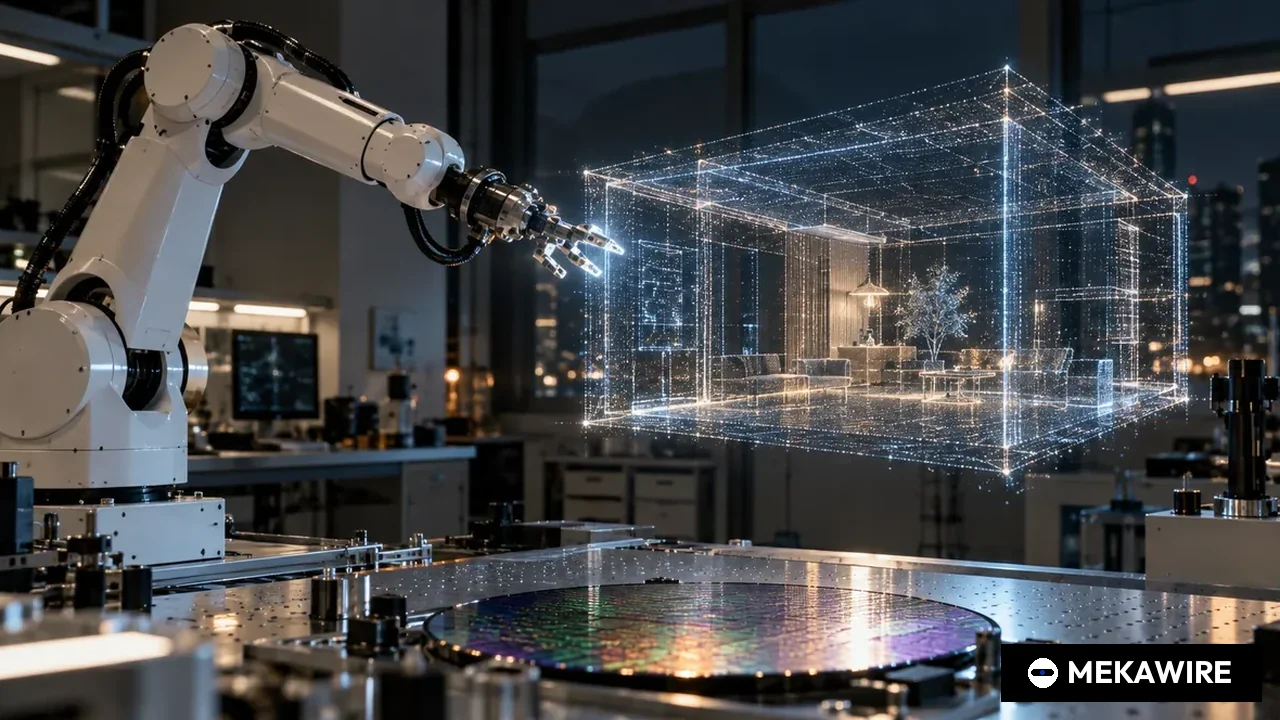
AMD will buy Fei-Fei Li's World Labs for about $8.2 billion in shares, the largest robotics or physical-AI acquisition value in MEKAWIRE's 2026 records and about 1.5 times the enterprise value SoftBank agreed for ABB's whole robot division. AMD frames it as model expertise for its chip roadmap, not a robot product.
AMD will pay about $8.2 billion in its own shares for World Labs, a San Francisco lab with no disclosed revenue, and its press release never calls it a robotics deal. The price is still the largest robotics or physical-AI acquisition value MEKAWIRE has recorded in 2026, about 1.5 times the $5.375 billion enterprise value SoftBank agreed for ABB's entire robot division.
That gap is the story. ABB Robotics booked about $2.3 billion of revenue in 2024; World Labs has published none. This article sets out what AMD actually said it is buying, how the price compares with every 2026 deal in our records, and why a chipmaker would pay a robot-division price for a model team.
What the release says, and what it leaves out
AMD said in a release on September 28 at 4:05 p.m. EDT that it had signed a definitive agreement to acquire World Labs, which it described as an AI model and research lab led by Fei-Fei Li. The transaction is all stock, valued at about $8.2 billion, and is expected to close by the end of 2026, subject to regulatory approvals and customary conditions.
World Labs, headquartered in San Francisco, builds spatial-intelligence models that generate, reconstruct and simulate interactive 3D environments from text, images and video, along with technology for robotic learning and simulation, the release said. After closing, Li, co-founder and chief executive of World Labs, becomes AMD's executive vice president and chief scientist, reporting to chair and CEO Lisa Su. The team will keep working on model research.
AMD's stated rationale is about compute, not robots. As AI spreads into reasoning, robotics, simulation and physical AI, demands on infrastructure diversify, the company said, and World Labs' model expertise will give it deeper insight into evolving workloads and help shape its technology roadmaps. Su said building the next compute platforms requires a deep understanding of how models are evolving. The release gives no revenue, headcount, product plan or break fee, and does not say whether World Labs' tools will remain available on other vendors' hardware.
The biggest price tag of the year belongs to a lab
- AMD
- World Labs
- Sep 28, 2026
- About US$8.2bn
- All AMD stock
- Pending, close expected by end of 2026
- SoftBank Group
- ABB Robotics
- EU clearance Mar 11, 2026
- US$5.375bn enterprise value
- Not stated in our record
- Closing expected mid to late 2026
- Mobileye
- Mentee Robotics
- Jan 6, 2026
- US$900m
- US$611.9m cash plus 26.3m Class A shares
- Closed Feb 3, 2026
- Kraken Robotics
- Covelya Group
- Mar 3, 2026
- About C$615m
- C$480m cash plus 15.9m shares
- Closed Jul 2, 2026
- UBTech
- Zhejiang Fenglong (43%)
- 2026, two steps
- RMB1.665bn
- Share purchase and partial offer
- Completed Apr 24, 2026
- Serve Robotics
- Diligent Robotics
- Jan 20, 2026
- US$29.0m
- Serve stock, incl. up to US$5.3m earnout
- Closed Jan 27, 2026
- Skild AI
- Fetch Robotics (from Zebra)
- Apr 15, 2026
- US$20m
- US$9m cash, US$9m Skild equity, escrow
- Closed Mar 27, 2026
Disclosed deal values from company releases, filings and regulator decisions already verified by MEKAWIRE; deals with undisclosed prices (Amazon/Fauna, Qualcomm/PickNik, NEURA/ADLATUS, Symbotic/cellumation) excluded. Currencies not converted. Multiples: AMD price divided by the other deal's disclosed value.
As of Oct 15, 2026
Set against verified 2026 deals, AMD's offer stands apart. It is 9.1 times what Mobileye paid for Mentee Robotics, and larger than SoftBank/ABB, Mobileye/Mentee, Serve/Diligent and Skild/Fetch combined ($6.32 billion), by MEKAWIRE arithmetic. The deals below it bought revenue, factories or robots. AMD is buying researchers and models.
Method: multiples are the AMD price divided by each deal's disclosed value; the combined figure sums only US-dollar deals and does not convert currencies.
Why a chip company wants the simulator
A world model learns how a 3D scene looks and changes, so developers can generate situations a robot would otherwise have to meet physically and test policies against them. NVIDIA has built a stack around that idea: Isaac simulation, Cosmos world models and Jetson robot computers. In July NVIDIA released Cosmos 3 Edge, a 4-billion-parameter open-weight model that plans robot actions on a Jetson Thor, with Doosan Robotics, Siemens, Agile Robots and Skild AI among the evaluators NVIDIA named. AMD had no in-house model team at this layer.
The timing also fits a pattern. Five days earlier Qualcomm agreed to buy PickNik, steward of the open-source MoveIt motion planner, to pull robot software onto its Dragonwing chips. Two chipmakers bought robot-software layers within a week. The difference is that MoveIt already counts more than 560 contributors, according to PickNik, while World Labs' robotics work is described in a single clause of AMD's release.
MEKAWIRE analysis
AMD is buying a model company, not a robot company; the bet is that the value in physical AI will sit in the models that generate and simulate the world, and that owning a team building them lets AMD design chips for those workloads before NVIDIA's customers ask for them.
- World Labs
- Spatial-intelligence models that generate and simulate 3D environments; robot learning and simulation tools
- About US$8.2bn
- Sep 28, 2026
- Acquisition value (AMD stock)
- General Intuition
- Action and world models trained on gameplay video
- US$6.2bn
- Sep 29, 2026
- Valuation stated by company, pre or post not specified
- Skild AI
- Robot foundation model
- US$14bn
- Jan 14, 2026
- Disclosed post-money, Series C
- Figure AI
- Humanoid robots and in-house models
- US$39bn
- Sep 16, 2025
- Disclosed post-money
Disclosed figures only, not estimates. World Labs has no verified funding round in MEKAWIRE, so no step-up can be computed.
As of Oct 15, 2026
The evidence for the thesis is in the release's own wording, which ties the deal to roadmaps rather than products, and in the market's pricing of the layer. General Intuition, which trains action models on gameplay video, said on September 29 it was valued at $6.2 billion; AMD's price is 1.32 times that. The strongest counter-argument is that $8.2 billion buys a team that can walk, and that NVIDIA's lead in robotics comes from years of developer tooling, not from a research group. Equity consideration helps AMD on the first point, if vesting ties researchers to the company; it does nothing for the second.
Bull case: World Labs' models become a reference workload, AMD tunes Instinct GPUs and Ryzen embedded parts for 3D generation and simulation, and robot developers gain a second supplier for training infrastructure. Bear case: the team stays a research lab, tools drift toward AMD-only hardware and lose developers, and the deal becomes an expensive hire.
What would change our view
Three signals would confirm or break the thesis. First, regulatory clearance and the closing date, due by the end of 2026. Second, whether AMD ships a robotics or simulation SDK built on World Labs models within a year of closing. Third, whether World Labs keeps publishing tools that run on non-AMD hardware, which would show AMD buying influence over workloads rather than locking them in. The open question is whether a $8.2 billion research lab can do for AMD in robotics what Isaac and Cosmos took NVIDIA most of a decade to do.
- AMD
- About $8.2B, all in AMD stock
- Fei-Fei Li becomes EVP and chief scientist, reporting to Lisa Su
- World Labs (San Francisco)
- September 28, 2026, 4:05 p.m. EDT
- World Labs revenue, headcount, product plans, break fee
- By end of 2026, subject to regulatory approvals
- 1.53x ABB Robotics' enterprise value; 9.1x Mobileye's price for Mentee Robotics
Why it matters
A chip company paid the year's highest robotics-related price for the model layer robots are trained in, not the silicon they run on. If world models become the default place robot policies are trained and tested, whoever owns them can steer developers toward their compute.
The deal also confirms that buyers now price this layer on talent and model capability rather than revenue, which resets comparables for every world-model and robot-foundation-model company raising money.
Rival analysis
The benchmark is NVIDIA, which pairs GPUs and Jetson modules with Isaac simulation and Cosmos world models; Cosmos 3 Edge (July 2026) is open-weight and was evaluated by Doosan Robotics, Siemens, Agile Robots and Skild AI. Qualcomm bought the motion-planning layer with PickNik five days before AMD's announcement.
AMD gains a model team but no developer tooling, reference designs or robot-side computer yet. Robot foundation-model companies such as Skild AI and Physical Intelligence are potential customers of either stack, and their choice will decide whether a second stack matters.
Valuation context
About $8.2B in AMD stock is the only disclosed figure; World Labs has published no revenue and MEKAWIRE holds no verified World Labs funding round, so no step-up or revenue multiple can be computed.
Against verified comparables, the price is 1.53x ABB Robotics' $5.375B enterprise value (itself 17.2x 2024 EBITDA), 1.32x General Intuition's $6.2B valuation and 0.59x Skild AI's $14B post-money. It is a talent-and-capability price for a team, set in a currency (AMD shares) whose value moves with the stock.
Supply-chain implications
Paying in stock means no cash outflow; dilution falls on AMD shareholders. The supply-chain relevance is in chip design: 3D generation and physics simulation shift requirements for memory bandwidth and compute architecture, and owning a team that builds those workloads lets AMD design for them earlier.
For robot makers nothing changes in the near term. Over two to three years, a credible second simulation and training stack would reduce single-vendor exposure for companies that today train mostly on NVIDIA tooling, provided World Labs' tools stay hardware-neutral.
Signals to watch
Regulatory clearance and closing, targeted by end of 2026; any AMD robotics or simulation SDK or reference design within 12 months of closing; whether World Labs keeps releasing tools that run on non-AMD hardware; robotics hiring under Li; mention of World Labs workloads in AMD's Instinct roadmap.
Analyst view
Strategically coherent, commercially unproven; confidence medium. The release's own wording points to roadmap influence rather than near-term robotics revenue.
The robotics payoff depends on AMD turning a research team into developer tooling robot companies adopt, which took NVIDIA years. We would raise confidence on a shipped SDK with named robotics users, and lower it if key researchers leave within the first year.
Questions you should be asking
Will World Labs' products stay hardware-neutral? Does AMD plan robot-side compute to compete with Jetson Thor? What retention terms tie key researchers to AMD? Which regulators review the deal and could they impose conditions? Will World Labs keep publishing research openly?