FANUC opens its robots to ROS 2 and NVIDIA as a record iREX 2025 turns Tokyo into a physical AI showcase
FANUC released an open-source ROS 2 driver, made Python standard on its robots and showed NVIDIA-based physical AI demonstrations at the International Robot Exhibition in Tokyo. Yaskawa Electric and SoftBank Corp. signed a memorandum to build office robots that split AI between the mobile network edge and the robot. Organisers counted a record 673 exhibitors and 156,110 visitors over the show's four days.
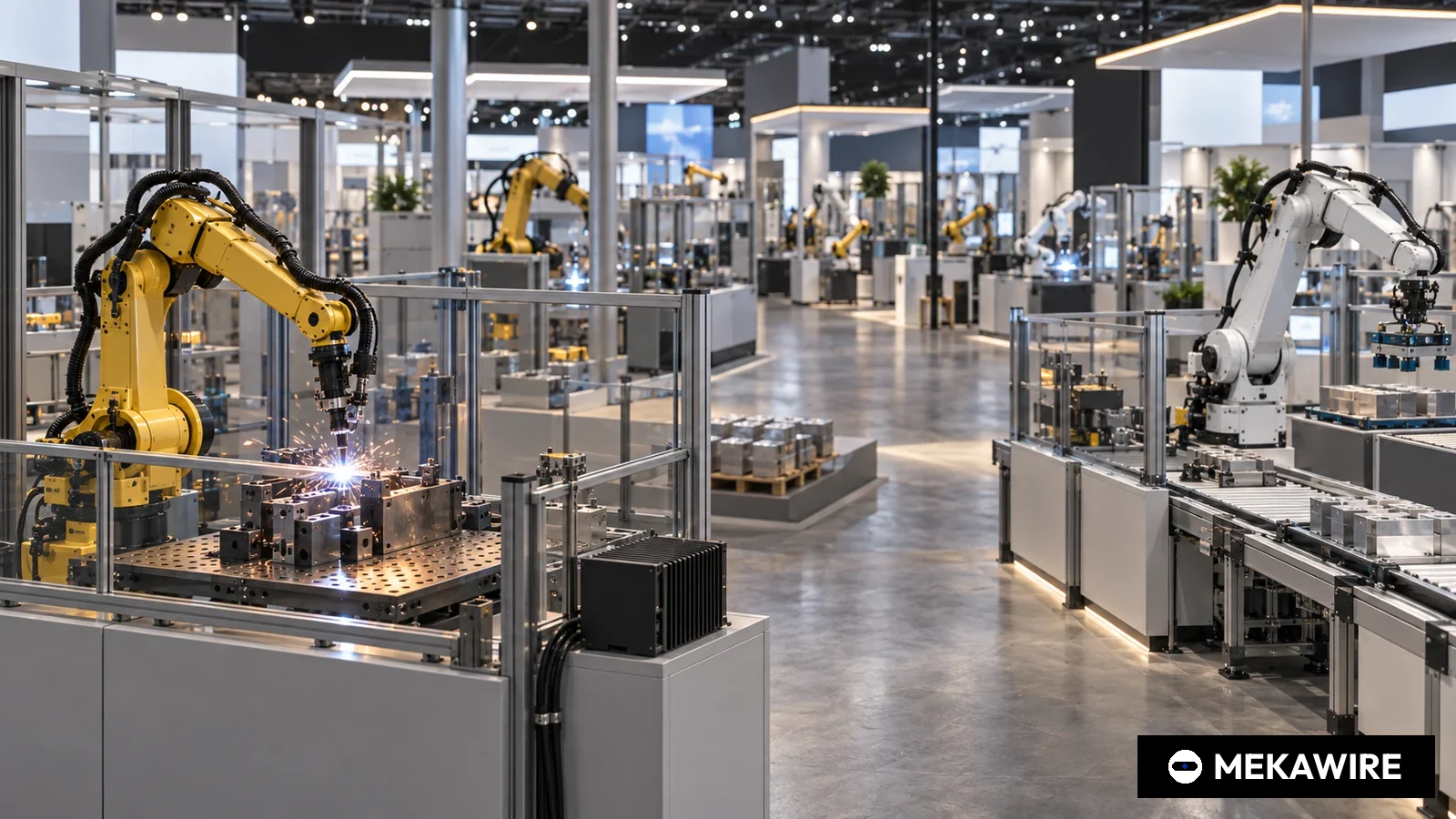
FANUC, the Japanese industrial robot maker, used the 2025 International Robot Exhibition (iREX) in Tokyo to open its robots to outside software. The company released an open-source ROS 2 driver, made Python a standard programming language on its robots and presented a physical AI collaboration with NVIDIA, according to its product announcement. The show ran at Tokyo Big Sight from December 3 to 6 and drew 673 exhibitors, the most in its history, and 156,110 visitors, according to final figures published by the organisers, the Japan Robot Association (JARA) and the Nikkan Kogyo Shimbun.
FANUC said the ROS 2 driver supports the ros2_control framework for real-time motion control, runs at an ultra-high-speed control cycle of 1 millisecond and covers its line-up from 3 kg payload robots to 2.3 tonne models, including the CRX collaborative series. The source code is published on GitHub under the FANUC-CORPORATION account. The repository is licensed under Apache 2.0, with its main branch targeting ROS 2 Jazzy Jalisco and a separate branch for Humble Hawksbill.
On the AI side, FANUC said it runs NVIDIA Jetson computers on its robots and has linked its ROBOGUIDE offline simulation software with NVIDIA Isaac Sim, so that customers can rehearse production lines inside photorealistic virtual factories before touching real equipment. FANUC robots are offered as OpenUSD SimReady assets inside Isaac Sim. At the show the company demonstrated robots that take spoken instructions, avoid obstacles, route cables with two arms and track moving parts while tightening screws.
Yaskawa Electric, FANUC's closest domestic rival, staged a different bet. On December 1 it announced a memorandum of understanding with SoftBank Corp., the Japanese mobile operator, to develop physical AI for spaces shared with people. In the first use case, a robot in an office linked to a next-generation building management system finds and retrieves a specific smartphone from a shelf. SoftBank said a vision-language model it developed runs on multi-access edge computing (MEC) servers, reads sensor, camera and building data and issues task-level instructions, while a vision-language-action model developed by Yaskawa turns those instructions into motion on a MOTOMAN NEXT robot. The two companies showed the system at Yaskawa's main booth and did not disclose financial terms.
The exhibition's own numbers show where the momentum sits. Exhibitors rose to 673 from 654 at the previous show in 2023, and visitors to 156,110 from 148,125, while the number of booths fell to 3,334 from 3,508, according to the organisers' report. Overseas participation grew to 140 companies with 481 booths, from 121 companies with 443 booths in 2023, although they came from 13 countries and regions against 18 two years earlier. Attendance peaked at 47,464 on December 5, and 10,147 visitors came from 95 countries and regions. A Humanoid Robot Forum featured talks on physical AI from NVIDIA, Kawasaki Heavy Industries and China's Unitree Robotics.
- Exhibitors
- 654
- 673
- 2.9
- Booths
- 3,508
- 3,334
- -5
- Visitors (four days)
- 148,125
- 156,110
- 5.4
- Overseas exhibitors
- 121
- 140
- 15.7
- Overseas exhibitor booths
- 443
- 481
- 8.6
- Overseas exhibitor countries and regions
- 18
- 13
- -27.8
Source: iREX 2025 results report by Japan Robot Association and Nikkan Kogyo Shimbun. Change = (2025 figure / 2023 figure minus 1) x 100, a MEKAWIRE calculation rounded to one decimal. Figures disclosed, not estimated.
As of Oct 1, 2026
For FANUC the shift is cultural as much as technical. Founded in 1972, the company built its position on tightly controlled hardware, controllers and its own programming environment, which kept integrators inside a FANUC ecosystem. Opening a supported ROS 2 path and Python as standard lets university labs, AI start-ups and system integrators drive FANUC arms with the same open tools they already use for perception and planning.
Rivals have moved in the same direction at different speeds. Universal Robots, owned by Teradyne, has long courted the developer community with its own ROS driver, and ABB and KUKA offer simulation and open interfaces of their own. Yaskawa has chosen to pair its MOTOMAN NEXT platform with telecom and AI partners rather than lead with an open driver. NVIDIA, for its part, used the show's Humanoid Robot Forum to argue the case for physical AI in front of Japanese manufacturers.
In plain terms, ROS 2 is the open-source middleware most robotics researchers use to connect sensors, planners and motors, and ros2_control is its standard layer for commanding joints in real time. A 1 millisecond cycle means an outside program can stream new joint targets a thousand times a second, which is what learned policies need to react to a changing scene. Isaac Sim lets engineers generate training data and test policies on digital copies of FANUC robots. The Yaskawa and SoftBank design takes a different route, keeping a large model on the network edge for reasoning and a smaller action model on the robot for movement.
- FANUC
- NVIDIA
- December 2025
- Industrial robots 3 kg to 2.3 t, CRX cobots
- Jetson on robot, ROBOGUIDE linked to Isaac Sim
- ROS 2 driver (Apache 2.0, 1 ms cycle), Python standard
- Yaskawa Electric
- SoftBank Corp.
- December 1, 2025
- MOTOMAN NEXT
- SoftBank VLM on MEC, Yaskawa VLA on robot
- No data
Compiled from FANUC product announcement, FANUC GitHub repository, Yaskawa Electric and SoftBank Corp. releases. null = not disclosed.
As of Oct 1, 2026
Open questions remain. FANUC did not publish customer names, pricing or a timetable for production deployments of the voice-driven applications it showed. Its GitHub repository listed 33 open issues as of October 2026, a sign that the driver is still being hardened by its users. The Yaskawa and SoftBank arrangement is a memorandum, not a supply contract, and its reliance on MEC means that latency and coverage of the mobile network become part of the robot's safety case.
The organisers have scheduled a new event, RoboNext 2026, for December 2026, with the next full International Robot Exhibition due in December 2027. Both will show whether open interfaces and edge AI move from booth demonstrations into installed cells.
MEKAWIRE analysis
Japan's two leading robot makers are giving up some of the lock-in of closed controllers to stay inside the AI software stack, betting that precision hardware will remain the part customers cannot replace.
The evidence is in what each company chose to show. FANUC put an Apache 2.0 driver on GitHub, made Python standard and tied its simulator to Isaac Sim, while Yaskawa handed high-level reasoning to a SoftBank model running on network servers. Neither move would have been needed if the value in industrial automation still sat mainly in proprietary programming environments. The record exhibitor count with fewer booths also suggests more, smaller participants, consistent with software and component suppliers crowding into the show.
The strongest counter-argument is that open interfaces mainly serve research labs and start-ups, which buy few robots, while FANUC's large automotive and electronics customers buy proven cells from integrators and rarely change their software. On that reading the ROS 2 driver is marketing to developers rather than a change in how most FANUC robots are programmed.
Bull case: if AI policies trained in simulation become a normal way to program cells, the robot maker that is easiest to drive from Python and Isaac Sim wins the hardware order, and FANUC's installed base and service network let it capture that demand without building its own foundation model. Yaskawa's edge architecture could open office, hospital and retail work that factory robots never reached.
Bear case: opening the controller lowers switching costs, letting customers pair cheaper arms, including Chinese ones, with the same AI software, and turning robot arms into commodities priced on payload and reach. The MEC approach could stall if operators cannot guarantee latency indoors.
Signals to watch:
- FANUC's full-year results for the year to March 2026, due in late April 2026, for any disclosure on AI-related orders or CRX demand.
- RoboNext 2026 in December 2026, to see whether Yaskawa and SoftBank show a paying customer for the office use case.
- The International Robot Exhibition in December 2027, as a check on whether ROS 2 and Python support has spread across Japanese makers.
- 2025 International Robot Exhibition (iREX), Tokyo Big Sight, December 3 to 6, 2025
- 3,334 (3,508 in 2023)
- 156,110 (148,125 in 2023)
- 673, a record (654 in 2023)
- RoboNext 2026 in December 2026; next iREX in December 2027
- Jetson on robots, ROBOGUIDE linked to Isaac Sim, OpenUSD SimReady assets
- Open source on GitHub, Apache 2.0, ros2_control, 1 ms control cycle
- MoU announced December 1, 2025; VLM on MEC plus Yaskawa VLA on MOTOMAN NEXT
- 3 kg to 2.3 tonnes
Why it matters
FANUC's decision to publish a supported ROS 2 driver under a permissive licence and to make Python standard removes one of the practical barriers that kept AI developers away from its arms. Most learned manipulation policies are written in Python and tested in ROS based stacks, so until now pairing them with a FANUC controller required custom bridges or third party drivers. A 1 millisecond streaming interface across a range from 3 kg to 2.3 tonnes means the same software path can reach small collaborative robots and heavy payload machines.
The Yaskawa and SoftBank memorandum matters for a different reason. It is one of the first concrete attempts by a Japanese robot maker to place part of a robot's intelligence in the telecom network rather than on the machine or in a distant cloud. If it works, it gives operators a new reason to sell private 5G and edge capacity to building owners, and gives Yaskawa a path into non-factory settings.
Rival analysis
Among Western peers, Universal Robots has the longest record of courting developers with its own ROS driver and an open add-on ecosystem, which helped it become the reference cobot in research labs. ABB and KUKA lean on their own simulation tools and open interfaces, and ABB's robotics business was agreed to be sold to SoftBank Group in October 2025, which ties another major arm maker to a Japanese AI strategy. FANUC's move narrows the developer gap with Universal Robots while keeping its advantage in heavy payload industrial arms.
In Japan, Yaskawa chose partnership over openness in this round, pairing MOTOMAN NEXT with SoftBank's AI-RAN. Kawasaki Heavy Industries used the show's Humanoid Robot Forum to discuss physical AI, and Chinese makers, with Unitree among the forum speakers, are pushing low cost humanoids that are natively programmed in open stacks. The competitive line is shifting from who has the best proprietary teach pendant to whose hardware is easiest to drive from shared AI tools.
Valuation context
No financial terms were disclosed for either the FANUC and NVIDIA collaboration or the Yaskawa and SoftBank memorandum, and neither company quantified expected revenue. MEKAWIRE therefore does not attach a valuation effect. The disclosed figures in this story are operational, namely the exhibition statistics and the driver's technical specifications.
The relevant valuation question for listed Japanese robot makers is whether AI features restore order growth after a weak period in their home market. Investors should look for any break out of AI related or software revenue in FANUC's and Yaskawa's results, which so far report robots as hardware segments.
Supply-chain implications
The FANUC stack combines NVIDIA Jetson modules as on-robot compute with FANUC's own controllers, servo motors and reducers, and with ROBOGUIDE linked to Isaac Sim for digital twins. That shifts some value towards GPU compute suppliers and simulation software while leaving the precision mechanical parts with FANUC and its Japanese component base.
The Yaskawa and SoftBank design adds telecom infrastructure to the bill of materials, with MEC servers and AI-RAN equipment owned by the operator. For component makers such as Harmonic Drive Systems and Nabtesco, the immediate effect is neutral, since both architectures still need high precision joints, but wider adoption of AI programming could expand the pool of applications and therefore unit demand.
Signals to watch
First, FANUC's results for the year to March 2026, expected in late April 2026, and any comment on CRX demand or AI enabled applications. Second, commits, releases and issue closures on the FANUC-CORPORATION fanuc_driver repository, which show how actively the company maintains the driver.
Third, RoboNext 2026 in December 2026 and the International Robot Exhibition in December 2027, which will show whether Yaskawa and SoftBank move from a booth demonstration to a deployed office or building management customer, and whether other Japanese makers follow FANUC with official ROS 2 support.
Analyst view
Thesis: FANUC and Yaskawa are trading part of their software lock-in for a place in AI driven automation, and the hardware franchise is strong enough to make that trade pay. Confidence: medium. The moves are concrete and public, with code on GitHub and a named architecture from Yaskawa and SoftBank, but there is no disclosed customer, revenue or deployment timetable yet.
Confidence would rise to high if FANUC disclosed AI linked orders or if Yaskawa and SoftBank named a paying office or facility customer by the end of 2026. It would fall if the driver repository stagnated or if the memorandum produced no follow-on agreement.
Questions you should be asking
Will FANUC extend official ROS 2 support to all current controller generations, and will it offer commercial support contracts for the driver?
How does SoftBank guarantee latency and availability for MEC hosted robot instructions inside buildings, and who carries liability if a network fault affects a robot's behaviour?
Will opening FANUC controllers make it easier for customers to mix FANUC arms with lower cost competitors under one AI software layer, and how will FANUC price against that?