FieldAI raises $405 million in two back-to-back rounds to sell one physics-first brain for any robot body
FieldAI, an Irvine, California developer of robot autonomy software, said on August 20, 2025 that it had raised $405 million across two consecutive rounds from investors including Bezos Expeditions, BHP Ventures, Intel Capital, Khosla Ventures, NVIDIA's NVentures and Temasek. The company did not disclose a valuation and says its Field Foundation Models already run on quadrupeds, humanoids, wheeled robots and passenger-scale vehicles at industrial sites in Japan, Europe and the US.
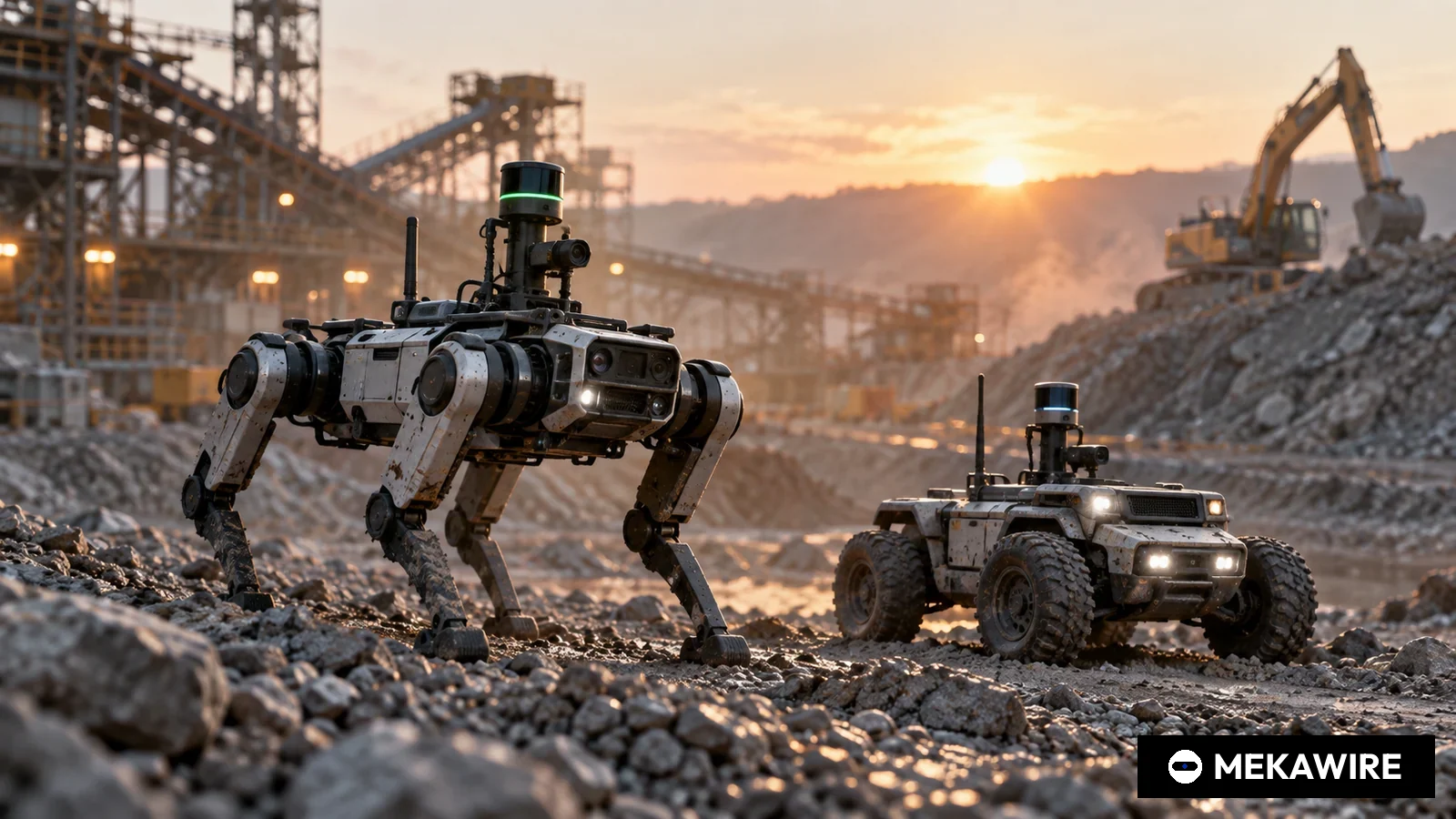
FieldAI, an Irvine, California company that writes autonomy software for robots working on building sites, in mines and in plants, said on August 20, 2025 that it had raised $405 million in two consecutive funding rounds. The company said the later round was oversubscribed after rapid customer adoption and several expansion contracts. It did not disclose a valuation or how the total splits between the two rounds.
The money and who put it in
The investors named in the release are Bezos Expeditions, BHP Ventures, Canaan Partners, Emerson Collective, Intel Capital, Khosla Ventures, NVentures, the venture arm of NVIDIA, Prysm and Temasek, alongside others it did not name. FieldAI listed Gates Frontier and Samsung as earlier backers. The list has an industrial tilt. BHP Ventures belongs to one of the world's largest miners, Intel Capital and NVentures sit on the compute side of the robot stack, and Temasek, Emerson Collective and Bezos Expeditions are long-horizon holders.
FieldAI said it will use the money for global growth, for product development across locomotion and manipulation, and for hiring, with a plan to double its headcount by the end of 2025.
What FieldAI sells
The product is a family of what the company calls Field Foundation Models, or FFMs. FieldAI describes them as physics-first models built to reason about uncertainty, risk and physical limits, so that a robot can work through a site without a prior map, without GPS and without a predefined route. According to the release, FFMs have run on quadrupeds, humanoids, wheeled robots and passenger-scale vehicles, and have been tested and deployed in hundreds of complex industrial environments across construction, energy, manufacturing, urban delivery and inspection, in Japan, Europe and the United States. The company's own boilerplate adds mining, logistics and federal work.
Founder and chief executive Ali Agha presented the approach as a rejection of fitting large language and vision models onto robots and patching their hallucinations later. He said FieldAI had designed risk-aware architectures from the ground up. Vinod Khosla of Khosla Ventures said the company's speed of deployment would unlock long-term economic value, and Jay Park of Prysm Capital said risk-aware deployment is a critical element for scaling AI.
Where it comes from
The team's record is older than the company. FieldAI's own timeline traces it to NASA's BRAILLE project from 2016 to 2018, which tested autonomy for exploring subsurface voids at Lava Beds National Monument as a Mars analogue. The group then competed in the DARPA Subterranean Challenge, where FieldAI says it won the Urban Circuit in 2020, coordinated up to 11 legged, wheeled and flying robots, and achieved the first fully autonomous exploration over many kilometres by a quadruped. In DARPA's RACER off-road programme, the company says, the team became the first to finish all eight courses on its first attempt in 2022. FieldAI was founded in 2023. The release says its leaders come from DeepMind, Google Brain, Tesla Autopilot, NASA JPL, SpaceX, Zoox, Cruise, Amazon, DARPA and the Toyota Research Institute.
How it compares
The raise puts FieldAI among the best-funded developers of robot brains. Skild AI, which also sells a general model meant to run many robot bodies, raised a $300 million Series A at a $1.5 billion valuation in July 2024. Among humanoid makers, Figure raised a $675 million Series B in February 2024, Apptronik a $350 million Series A in February 2025 followed by a $53 million additional close in March, and 1X Technologies a $100 million Series B in January 2024. By a MEKAWIRE calculation, FieldAI's $405 million is 1.35 times Skild AI's Series A and about the same as Apptronik's combined $403 million.
The business models differ. Humanoid makers sell a body together with the software that runs it. FieldAI sells only the brain and says it is agnostic about the body. Its early markets are outdoor and semi-structured industrial sites, where a robot has to cope with dust, mud, shifting layouts and no satellite signal, rather than car plants with fixed stations.
- FieldAI
- US
- 2023
- Two consecutive rounds (combined)
- 2025-08-20
- 405
- No data
- Skild AI
- US
- 2023
- Series A
- 2024-07-09
- 300
- 1.5
- Figure AI
- US
- No data
- Series B
- 2024-02-29
- 675
- No data
- Apptronik
- US
- 2016
- Series A plus additional close
- 2025-02-13 and 2025-03-18
- 403
- No data
- Agility Robotics
- US
- 2015
- Series B
- 2022-04-22
- 150
- No data
- 1X Technologies
- US
- 2014
- Series B
- 2024-01-13
- 100
- No data
Latest rounds each company announced before 2025-08-20, from company releases. Apptronik amount is a MEKAWIRE calculation: $350m Series A (2025-02-13) + $53m additional close (2025-03-18). FieldAI disclosed neither valuation nor the split between its two rounds. Ratios in text: 405 / 300 = 1.35; 405 / 675 = 0.60. Figures disclosed, not estimated.
As of Oct 1, 2026
What is still unknown
The release leaves the commercial questions open. FieldAI gives no revenue, no count of robots running its software, no named customers and no prices. Its figure of hundreds of environments covers tests and deployments together, which makes it hard to judge how much of the work is paid production. Without a valuation, outside investors cannot benchmark the price against Skild AI or Physical Intelligence.
MEKAWIRE analysis
FieldAI's raise shows that investors will pay humanoid-scale money for a robot brain that earns revenue on rough industrial sites before it ever reaches a humanoid.
The investor list supports that reading. A miner's venture arm, Intel Capital and NVIDIA's fund sit next to Khosla Ventures and Temasek, a mix that points to buyers who want autonomy for machines already working outdoors. FieldAI's DARPA SubT and RACER record also gives it field results that few foundation-model startups can show, because those programmes scored autonomy without GPS or maps in tunnels, caves and off-road terrain.
The strongest counter-argument is that body-agnostic claims are cheap to make and expensive to prove. Each new embodiment brings its own failure modes, and a company integrating with quadrupeds, wheeled vehicles and humanoids at once risks spreading its engineers thin while hardware partners keep the customer relationship.
Bull case. Construction, mining and energy operators already pay every day for inspection and site work, and many already own legged robots and vehicles. If FFMs make those machines autonomous without mapping each site first, FieldAI can book software revenue years before humanoids reach volume and use the resulting data to move into manipulation.
Bear case. The two-round structure and the missing valuation leave room for dilution and preference terms that outsiders cannot see. Platform suppliers such as NVIDIA, also an investor, and rivals such as Skild AI could turn navigation autonomy into a commodity, leaving FieldAI to compete on integration services with thinner margins.
Signals to watch, with dates.
- By December 31, 2025: whether FieldAI says it has doubled headcount, as the release plans.
- First half of 2026: whether any of the expansion contracts the release cites is named, with a customer and a fleet size.
- During 2026: a public demonstration of FFMs handling manipulation, the second product area the new funds are meant to support.
- Field Foundation Models (FFMs)
- August 20, 2025, 10:00 ET
- Two consecutive rounds; the latest oversubscribed
- Not disclosed
- Double headcount by end of 2025
- $405 million
- 2023, Irvine, California
- Bezos Expeditions, BHP Ventures, Canaan Partners, Emerson Collective, Intel Capital, Khosla Ventures, NVentures (NVIDIA), Prysm, Temasek
- Gates Frontier, Samsung
- Quadrupeds, humanoids, wheeled robots, passenger-scale vehicles
Why it matters
FieldAI is the clearest case so far of a robot brain company raising humanoid-sized money while selling mainly into non-humanoid machines. Its release lists quadrupeds, wheeled robots and passenger-scale vehicles alongside humanoids, and its target industries are construction, energy, mining and inspection. That makes the round a bet that embodied AI pays first where labour is scarce, sites are dangerous and the robot does not need hands.
The round also tests whether a model built around explicit risk and uncertainty can compete with the vision-language-action approach most rivals use. Ali Agha's comments set FieldAI against companies that adapt large language and vision models for robots. If customers come to value predictable failure behaviour more than broad task coverage, the field may split between risk-aware navigation models for heavy industry and generalist manipulation models for factories and homes.
Rival analysis
Skild AI is the most direct rival in pitch, with a general model meant to run many robot bodies and a $300 million Series A at $1.5 billion in July 2024. Physical Intelligence pursues a similar cross-embodiment goal with a stronger focus on manipulation. Humanoid makers such as Figure, Apptronik, Agility Robotics and 1X Technologies develop their own models but tie them to their own hardware, which limits them as suppliers to third-party fleets.
FieldAI's differentiator is its outdoor field record from DARPA SubT and RACER and a starting customer base in heavy industry. Its weakness is that manipulation, where the largest labour pools sit, is still listed as a development area for the new money rather than a shipped capability.
Valuation context
FieldAI disclosed no valuation, so no step-up can be computed from primary data. The $405 million total sits between Skild AI's $300 million Series A and Figure's $675 million Series B. By a MEKAWIRE calculation it is 1.35 times Skild AI's Series A (405 / 300) and 0.60 times Figure's Series B (405 / 675).
Raising in two consecutive rounds rather than one priced round usually signals that a company took early money at one price and then a larger tranche once demand appeared. Without disclosure of the split or the terms, outsiders cannot tell whether the later round was priced well above the first.
Supply-chain implications
As a software supplier, FieldAI depends on hardware partners for robot bodies and on edge compute for onboard inference. NVentures and Intel Capital both sit on the cap table, which keeps the company close to the two largest suppliers of the chips its models would run on, though the release names no compute supplier or chip.
On the demand side, BHP Ventures gives FieldAI a route into mining, an industry with fleets of vehicles and long inspection routes. Samsung's earlier investment links it to a large Korean industrial group with its own robotics interests.
Signals to watch
December 31, 2025 is the deadline FieldAI set itself for doubling headcount. A public update would show whether the money is being turned into engineering and field capacity at the pace promised.
In the first half of 2026, the more important signal is a named customer with a fleet size, or a named hardware partner for humanoids. Either would turn the claim of hundreds of environments into a measurable commercial base.
Analyst view
Thesis: FieldAI is better placed than most robot brain startups to earn revenue early because it starts from navigation in harsh outdoor sites, a problem customers already pay to solve. Confidence: medium. The field record and the industrial investor list support the thesis, but the release discloses no revenue, customers or unit counts.
The main reason to hold back on a high-confidence view is concentration of the claims in one release. Until FieldAI or a customer publishes deployment details, the commercial case rests on the company's own description.
Questions you should be asking
How much of the $405 million came in each round, and at what price? Which customers signed the expansion contracts the release mentions, and how many robots do they cover?
Which humanoid platforms have run FFMs, and in what tasks? Will FieldAI license models, sell per-robot subscriptions, or deliver integrated solutions with hardware partners?