Galbot raises RMB 2.5 billion as China's Big Fund makes its first embodied AI bet at a RMB 20 billion valuation
Beijing humanoid robot maker Galbot announced on 2 March 2026 that it had closed a RMB 2.5 billion round, which Haidian district officials called the largest single financing in China's embodied AI sector.
The state Big Fund invested in embodied AI for the first time through the National Artificial Intelligence Industry Investment Fund, alongside Sinopec, CITIC and SAIC's finance arm, and the Zhongguancun Science City administration put Galbot's valuation at RMB 20 billion.
Galbot, the Beijing developer of wheeled humanoid robots founded in 2023, announced on 2 March 2026 that it had completed a new financing round of RMB 2.5 billion. The Haidian District Bureau of Commerce said in a release dated 16 March that the amount set a new record for a single round in China's embodied AI industry, and that it was the first time the national "Big Fund" had invested in an embodied AI company, doing so through the National Artificial Intelligence Industry Investment Fund.
The Zhongguancun Science City administration, in an account republished on 11 March by the Beijing International Science and Technology Innovation Center portal, said Galbot's valuation had risen to RMB 20 billion with the deal. The commerce bureau described Galbot as the highest valued unlisted company in China's humanoid robot sector and said its cumulative funding now ranked first among Chinese embodied AI companies. Neither government release disclosed a round letter, a share count, the split between primary and secondary capital or a dollar figure, and Galbot has not posted the terms on its corporate website.
The investor list reads like a cross section of the Chinese state economy. Zhongguancun Science City named the National Artificial Intelligence Industry Investment Fund, which it identified with the third phase of the Big Fund, together with China Petrochemical Corporation (Sinopec), CITIC Investment Holdings, SAIC Motor's financial holding arm, BOC Financial Asset Investment and Summitview Capital, the semiconductor investor known in Chinese as Zhongxin Juyuan. The administration noted that the group spans a national industrial fund, an energy major, a central automotive group and the chip supply chain.
The March round follows one of RMB 1.1 billion that Galbot announced in June 2025. According to the Zhongguancun release from that time, CATL and Puquan Capital led that deal, with CDB Science and Technology Innovation, the Beijing Robotics Industry Fund and GGV Capital among the other investors, bringing Galbot's two year total to more than RMB 2.4 billion. The March 2026 account said the new round also beat a record Galbot set at the end of 2025; the size of that late 2025 round is not stated in the official material MEKAWIRE reviewed.
On the commercial side, Zhongguancun Science City said Galbot had signed deep cooperation agreements with CATL, Bosch and Toyota and that its cumulative orders reached several thousand units. It said the Galbot G1 was already fastening screws in CATL battery plants, and that after the robot appeared on the CCTV Spring Festival Gala stage, nearly 300 G1 units were added to orders on Lunar New Year's Eve, prompting the company to reallocate production capacity. The same account said CCTV had named Galbot its designated embodied large model robot.
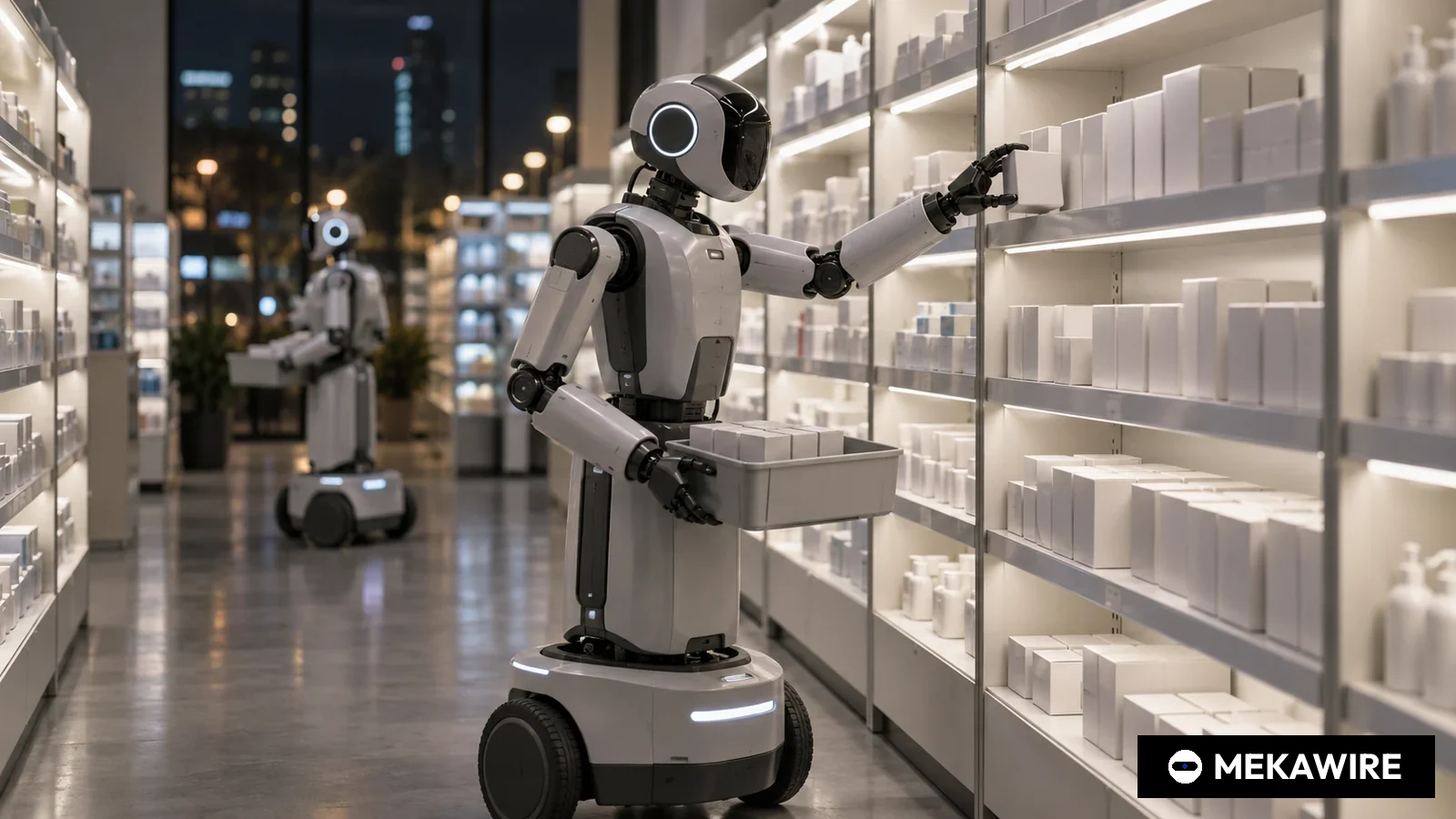
The G1 is not a walking humanoid. Galbot's product page lists a dual arm upper body on a four wheel omnidirectional base, a maximum height of 1,730 mm, a weight of 92.5 kg, seven degrees of freedom per arm, a payload of 5 kg per arm and 10 kg combined, a 710 mm arm length from shoulder to wrist, a top speed of 1.5 m/s, a 48 V 30 Ah battery rated for eight hours of work with a 3.5 hour charge, and an NVIDIA AGX Orin 64GB module rated at 275 TOPS. The company lists five deployment scenarios: its automated "space capsule" retail kiosks, supermarkets, homes, instant retail warehousing and industrial manufacturing.
The technical bet behind the valuation is data. Zhongguancun Science City said Galbot trains its models mainly on synthetic simulation data and uses real robot data as a supplement, and that the company has built what it called the world's largest embodied AI dataset, at the ten billion sample scale. In January 2025 Galbot released GraspVLA, which the June 2025 government release described as the first end to end embodied model pretrained on billion scale synthetic action data. The approach is meant to cut the cost of collecting teleoperated demonstrations, which rivals such as AgiBot have pursued at scale.
- Galbot
- New round (no letter disclosed)
- 2026-03-02
- RMB
- 2500
- 20,000
- Galbot
- Prior round
- 2025-06-24
- RMB
- 1100
- No data
- Robot Era
- Strategic round
- 2026-03-05
- RMB
- 1000
- No data
- LimX Dynamics
- Series B
- 2026-02-02
- USD
- 200
- No data
- EngineAI
- Series B
- 2026-04-10
- USD
- 200
- No data
Amounts and valuations as disclosed by the company or by Beijing government releases, not estimated, not converted. Robot Era's valuation was described only as above RMB 10,000 million and is left as —. Galbot's late 2025 round is omitted because no official figure was found.
As of Oct 1, 2026
Galbot's raise landed in a crowded quarter for Chinese embodied AI. LimX Dynamics announced a USD 200 million Series B on 2 February, and three days after Galbot, Robot Era said it had closed a RMB 1 billion strategic round that the Haidian commerce bureau said lifted its valuation above RMB 10 billion. EngineAI followed with a USD 200 million Series B in April. Among listed peers, UBTech trades in Hong Kong and Unitree went on to list on Shanghai's STAR Market in August 2026 under code 688836. Outside China, Galbot's customer list puts it in direct competition for factory pilots with US and European humanoid developers courting the same carmakers and battery makers.
For the global industry, the significance lies less in the headline amount than in who wrote the cheques. A state fund created to back AI, an oil refiner, a financial conglomerate and a carmaker's finance arm have now tied their balance sheets to a single robot company. That gives Galbot potential anchor customers in energy retail, automotive and battery plants, and it signals that Beijing's industrial policy machinery now treats embodied AI as part of the same strategic stack as chips and compute.
There are clear limits to what is known. Galbot has not published revenue, delivery counts or the conversion rate of its "several thousand" cumulative orders into installed units, and the RMB 20 billion valuation comes from a district administration's account rather than from a filing. No listing timetable appears in the official material reviewed. Later in the year the company opened pre-orders on 3 September 2026 for a consumer agent robot it calls Galaxy Cub, and on 10 August said it was leading a newly approved national key laboratory for embodied AI large models, according to its news page.
MEKAWIRE analysis
Galbot's round shows Chinese state capital moving from subsidising robot hardware to picking a national champion in embodied AI software and data.
The evidence is in the cap table. The Big Fund's first embodied AI investment went to a company whose differentiation is a simulation first training pipeline rather than actuators or a walking platform, and the co investors are prospective customers in energy, autos and finance rather than pure venture funds. The June 2025 round was led by CATL, an industrial buyer, and the March 2026 round widened that buyer base.
The strongest counter argument is that the valuation rests on unaudited claims. A RMB 20 billion figure stated in a government WeChat account, with no revenue or delivery data, is a weak anchor, and state investors may be guided by policy goals rather than returns.
Bull case: Galbot converts its several thousand unit order book into steady deliveries at CATL, Bosch and Toyota plants and in hundreds of retail kiosks, its synthetic data pipeline keeps model costs below teleoperation heavy rivals, and the state backed shareholder base gives it a smooth path to a domestic listing.
Bear case: wheeled robots prove adequate only for narrow tasks, orders turn out to be framework agreements, and rivals with walking platforms and deeper hardware supply chains, from Unitree to UBTech, capture the factory market while Galbot's valuation outruns its revenue.
Signals to watch:
- By 31 December 2026: whether Galbot or any investor publishes formal round terms, revenue or delivery numbers.
- Q4 2026: first shipment figures for Galaxy Cub, for which pre-orders opened on 3 September 2026.
- First half of 2027: any HKEX or SSE listing filing, which would be the first audited view of Galbot's finances.
- RMB 2.5 billion
- 2023, Beijing Haidian
- 2 March 2026
- RMB 20 billion (Zhongguancun Science City)
- Several thousand units cumulative, with CATL, Bosch and Toyota
- Galbot G1, wheeled dual arm, 7 DoF per arm, 10 kg combined payload
- RMB 1.1 billion, June 2025, led by CATL and Puquan Capital
- National AI Industry Investment Fund (Big Fund, first embodied AI deal)
- Sinopec, CITIC Investment Holdings, SAIC financial arm, BOC Financial Asset Investment, Summitview Capital
Why it matters
This is the clearest signal in the first quarter of 2026 that China's central industrial funds have moved into embodied AI. The Big Fund was built to finance semiconductors; its AI vehicle choosing Galbot as its first embodied AI investment tells portfolio managers and rival founders where policy capital will flow next. It also sets a domestic price benchmark of RMB 20 billion for an unlisted humanoid developer that has not disclosed revenue.
For buyers, a state backed balance sheet reduces counterparty risk. Factory operators weighing multi year robot programmes care whether a supplier will exist in five years, and Galbot can now point to shareholders that include Sinopec and CITIC.
Rival analysis
Galbot's closest domestic rivals split into two camps. AgiBot and UBTech pursue full humanoid platforms with large real world data collection; Unitree sells high volume legged hardware and listed on the STAR Market in August 2026. Robot Era and LimX Dynamics raised large rounds in the same quarter, but Robot Era's RMB 1 billion is less than half of Galbot's figure.
Galbot's wedge is a wheeled, dual arm design with a simulation first model. That trades mobility for stability and cost, which suits battery plants, retail kiosks and pharmacies. If walking humanoids become cheap enough, that wedge narrows; if factory work stays mostly stationary, Galbot's design is the more practical one.
Valuation context
If the RMB 20 billion figure is a post money valuation, the RMB 2.5 billion round bought 12.5 percent of the company (2.5 / 20). The June 2025 release put cumulative funding above RMB 2.4 billion before the late 2025 round and the March 2026 round, so total capital raised now exceeds RMB 4.9 billion even before counting the undisclosed late 2025 amount.
Without revenue, no multiple can be computed. The comparison that matters is with listed peers: Unitree's STAR Market valuation and UBTech's Hong Kong market capitalisation will set the ceiling for any Galbot listing price.
Supply-chain implications
The G1 uses an NVIDIA AGX Orin 64GB module rated at 275 TOPS, according to Galbot's product page, which leaves the company exposed to US export policy on edge compute. Its arms, wheel base and battery pack draw on the same Chinese motor, reducer and battery suppliers that serve electric vehicles.
The investor list hints at vertical ties. CATL is both an earlier lead investor and a customer, SAIC brings automotive plants, and Summitview Capital links the round to the domestic chip ecosystem that could eventually supply a replacement for the NVIDIA module.
Signals to watch
Watch for audited numbers. Any HKEX or SSE prospectus would show revenue, gross margin and delivery counts for the first time. Watch also whether the National AI Industry Investment Fund makes a second embodied AI investment, which would show whether Galbot was a one off or the start of a portfolio.
On the commercial side, track whether CATL, Bosch or Toyota disclose Galbot deployments in their own releases, and how many Galaxy Cub units ship after pre-orders opened on 3 September 2026.
Analyst view
Thesis: Galbot has become the state's preferred embodied AI software platform, and its valuation now carries a policy premium. Confidence: medium. The investor list and the Haidian bureau's statement that this was the Big Fund's first embodied AI deal are well documented; the commercial claims (several thousand units ordered, nearly 300 G1 units added after the Spring Festival Gala) come from government accounts rather than audited filings, which is why confidence is not high.
The main swing factor is whether simulation trained models keep closing the gap with teleoperation trained ones in messy factory tasks.
Questions you should be asking
How many of the several thousand ordered units have been delivered and paid for?
Is the RMB 20 billion valuation pre money or post money, and what share of the round was new capital?
What did the late 2025 round raise, and who led it?
Will Galbot replace the NVIDIA compute module with a domestic chip, and on what timetable?