Gecko Robotics doubles its valuation to $1.25 billion in a Cox-led Series D as navies and power plants buy its inspection data
Gecko Robotics said on 12 June 2025 that its Series D valued the Pittsburgh company at $1.25 billion, double the price of its previous round, with Cox Enterprises leading as a new investor and USIT, XN, Founders Fund and Y Combinator returning. The company did not state the round size on its own release; it is selling its Cantilever software platform, fed by climbing, flying and swimming robots, to defence, energy and manufacturing customers.
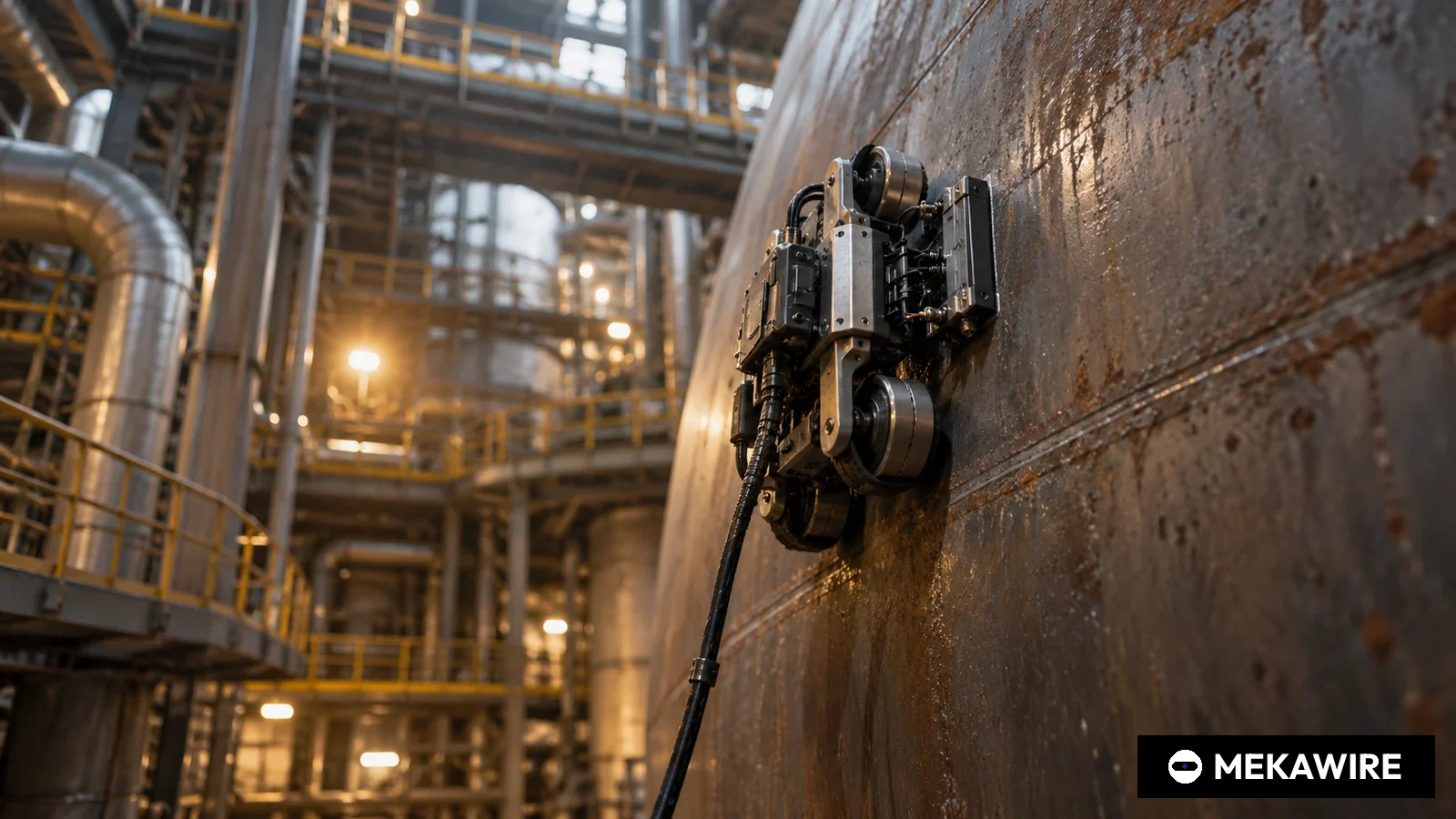
Gecko Robotics, the Pittsburgh company that sends wall-climbing robots across boiler walls, tanks and ship hulls to gather inspection data, said on 12 June 2025 that a Series D round had valued it at $1.25 billion. The company said the figure was double the valuation of its previous funding round. That makes Gecko one of a small group of American industrial robotics start-ups to reach a billion-dollar price on the strength of maintenance and inspection work rather than humanoid prototypes.
Cox Enterprises led the round as a new investor, according to Gecko's announcement. Existing backers USIT, XN, Founders Fund and Y Combinator also took part. Gecko's own release does not give the amount of cash raised, and the law firm Goodwin, which said it advised Gecko on the financing, described the deal only by its $1.25 billion valuation. MEKAWIRE therefore does not report a round size.
Gecko said the capital would accelerate growth in three markets it named explicitly, defence, energy and manufacturing. The company built the announcement around its operating platform, Cantilever, and a hardware and software line it calls AIR, short for AI plus robotics. Its robots climb, fly and swim to collect data on structures such as U.S. Navy warships, power plants and public infrastructure, the release said, and Cantilever turns that data into recommended actions. Gecko gave three examples of such decisions: predicting pipeline explosions, modernising a C-130 aircraft and running a power plant at 3% to 5% greater efficiency.
The release also listed the commercial threads behind the price. Gecko pointed to its partnership with NAES to modernise the energy sector, a new extended reality product developed with L3Harris Technologies and growing work with Abu Dhabi National Oil Company. When NAES and Gecko announced their deal on 27 February 2025, they said the initial agreement exceeded $100 million with potential to grow beyond $250 million. NAES describes itself as America's largest independent power operator, with 65 gigawatts under management.
Jake Loosararian, Gecko's co-founder and chief executive, said in the release that the company designed Cantilever around an ontology that questions the integrity of incoming data, because in the built world, as he put it, data is guilty until proven innocent. He said a lack of quality data on physical infrastructure explained the surge in demand for Gecko. Andrew Davis, senior vice president of strategy and investments at Cox Enterprises, said Cox backs durable companies solving complex, high-value problems. Trae Stephens, a partner at Founders Fund, said Gecko was applying AI to building and maintaining critical infrastructure while much of the technology industry chased consumer applications.
The jump is steep against Gecko's disclosed history. In March 2022 the company said it had raised $73 million in a Series C led by XN at a post-money valuation of $533 million, with Founders Fund, XYZ, Drive Capital and Snowpoint Ventures among the investors. On 5 December 2023 it added $100 million to that round, taking the Series C to $173 million, and gave board seats to Gaetano Crupi of USIT and Trae Stephens of Founders Fund. That extension release did not state a valuation. Measured against the 2022 post-money figure, the Series D price is about 2.35 times higher.
- Series C
- 2022-03-03
- 73,000,000
- 533,000,000
- XN (lead)
- Series C extension
- 2023-12-05
- 100,000,000
- No data
- USIT, Founders Fund (board seats)
- Series D
- 2025-06-12
- No data
- 1,250,000,000
- Cox Enterprises (lead, new)
Series C total 173,000,000 = 73,000,000 + 100,000,000. Valuation step-up = 1,250,000,000 / 533,000,000 = 2.35x versus the March 2022 post-money. Gecko says the Series D doubled the valuation of its previous round; the December 2023 valuation was not disclosed. Figures disclosed, not estimated.
As of Oct 1, 2026
Defence has become the clearest engine of that growth. Gecko pitched the 2023 extension at faster maintenance cycles for Navy surface ships, the Columbia-class submarine programme and the Air Force's modernisation of Sentinel missile silos. Nine months after the Series D, on 17 March 2026, Gecko said it had won a five-year IDIQ contract with a $71 million ceiling and a $54 million initial award to assess and maintain 18 ships of the U.S. Pacific Fleet, including destroyers, amphibious warships and littoral combat ships. The company said its technology identifies repairs 50 times faster than manual methods.
Inspection robotics has drawn heavy capital on both sides of the Atlantic. Swiss quadruped maker ANYbotics raised a $50 million Series B in May 2023 and a further $60 million in December 2024 to drive U.S. expansion. FieldAI, which develops autonomy software for robots in industrial field sites, said in August 2025 that it had raised more than $400 million across two consecutive rounds. Exyn Technologies, which builds robotic autonomy for GPS-denied environments, raised a $35 million Series B in 2022 and closed a Nasdaq listing in May 2026. Gecko is the only one of the group to publish a billion-dollar private valuation from its own newsroom.
- Gecko Robotics
- US
- Series D
- No data
- 1,250,000,000
- 2025-06-12
- FieldAI
- US
- Two consecutive rounds (combined)
- 405,000,000
- No data
- 2025-08-20
- ANYbotics
- CH
- Additional funding
- 60,000,000
- No data
- 2024-12-12
- Exyn Technologies
- US
- Series B
- 35,000,000
- No data
- 2022-12-22
Figures as disclosed by each company on its own or its investors' pages; null means not disclosed. Gecko's release states the Series D valuation but not the amount raised. ANYbotics also took an undisclosed strategic investment in September 2025; Exyn closed a Nasdaq IPO on 2026-05-18 (proceeds not shown). Figures disclosed, not estimated.
As of Oct 1, 2026
The technology difference is one of emphasis. Legged rivals sell mobility, a robot that can walk a plant on a schedule and read gauges or listen for leaks. Gecko started with a robot that climbs vertical steel carrying inspection sensors, which yields dense measurements of surfaces that are otherwise sampled by hand, and it now adds drones, robot dogs and fixed sensors, according to the NAES release. The hardware is treated as a data feeder. The product Gecko charges for is the Cantilever layer that stores the asset history, flags degradation and recommends repairs.
The risks sit in the same places as the opportunity. Gecko's growth leans on government buyers whose budgets and procurement timetables it cannot control, and its largest disclosed contracts are framework agreements whose ceilings exceed the money committed up front. The undisclosed round size also leaves outsiders unable to judge how much of the $1.25 billion price was paid in fresh capital. Competitors with cheaper mobile platforms are pushing into the same plant budgets, and customers may resist storing sensitive asset data on a single vendor's platform.
The next milestones are already dated. The Navy contract runs for five years from March 2026, and Gecko's release ties its work to the Navy's goal of 80% fleet readiness by 2027. The NAES agreement was framed with headroom beyond $250 million. In November 2025 Gecko signed three agreements with ADNOC and its technology venture AIQ, including a multi-year rollout of Cantilever across ADNOC Gas assets, and on 28 September 2026 it said it was adopting NVIDIA's OpenShell software to put enforceable limits on the AI agents that drive its robots.
MEKAWIRE analysis
Gecko's billion-dollar price rests less on its climbing robots than on owning the condition history of assets whose owners cannot afford downtime, and the contracts it signed after the round suggest investors priced that correctly.
The evidence is in the sequence of disclosures. The 2022 Series C described Gecko as a robotics and enterprise software company; by 2025 every customer announcement names Cantilever first and the robots second. The NAES deal, the ADNOC Gas rollout and the Pacific Fleet IDIQ are all multi-year commitments to a data platform, which is a recurring revenue shape that hardware-first inspection rivals have struggled to show in public.
The strongest counter-argument is that the valuation was set before most of that revenue was contracted and that the company still does not disclose revenue, round size or headcount. A platform claim is only as good as its switching costs, and large asset owners have historically kept inspection vendors on short, competitive contracts.
The bull case is that Gecko becomes the system of record for steel assets in navies and power fleets, where every additional robot pass deepens a data set no competitor can reconstruct. Defence demand for ship maintenance capacity and power demand from data centres would then compound in its favour.
The bear case is that Cantilever turns out to be a services business wearing software clothes, with margins set by field crews and robot deployments. If government ceilings are not converted into orders, the 2025 price could prove hard to defend in a later round.
- By March 2027: how much of the Navy IDIQ's $71 million ceiling has been ordered beyond the $54 million initial award.
- By end of 2027: whether Gecko reports progress against the Navy's 80% fleet readiness goal cited in its release.
- Next funding or contract announcement: whether NAES spending passes the $250 million potential flagged in February 2025, and whether Gecko finally discloses round sizes.
- Series D
- 12 June 2025
- Not stated in Gecko's release
- Pittsburgh, Pennsylvania
- Cantilever operating platform
- Cox Enterprises (new)
- $173 million after $100 million extension (December 2023)
- Series C, $73 million at $533 million post-money (March 2022)
- USIT, XN, Founders Fund, Y Combinator
- $1.25 billion, double the previous round
Why it matters
Gecko's Series D is one of the few billion-dollar private valuations in robotics that rests on industrial maintenance revenue rather than a general-purpose robot thesis. Investors paid for a company that, by its own description, sells an operating platform for physical infrastructure, with robots as the data collection layer. That framing matters for the whole inspection segment because it sets a valuation reference that hardware-centric peers will be measured against.
The timing also matters. The round closed between two large contract announcements, the NAES power deal of February 2025 and the Navy IDIQ of March 2026, which means the valuation was set on pipeline and partnerships and then partly validated by signed work. For buyers in defence and power, Gecko's capital base now makes it a credible long-term supplier rather than a pilot vendor.
Rival analysis
ANYbotics is the most direct rival for plant inspection budgets in oil and gas and power. Its disclosed funding, a $50 million Series B in 2023 and a further $60 million in late 2024, is a fraction of Gecko's Series C alone, and it has not published a valuation. Its pitch centres on the ANYmal quadruped walking routine inspection rounds, which competes with Gecko's drones and robot dogs but not with its climbing crawlers on vertical steel.
FieldAI is the better-funded threat in software. Its more than $400 million raised across two rounds in 2025 is aimed at autonomy for robots in unstructured field sites, the layer that could make any vendor's hardware cheaper to deploy. Exyn Technologies, now listed on Nasdaq, competes in robotic autonomy for GPS-denied environments. Boston Dynamics, owned by Hyundai Motor Group, has the deepest pockets of any legged-robot maker. None of these peers has announced a Navy fleet maintenance contract of the kind Gecko disclosed in March 2026, which is the clearest point of differentiation.
Valuation context
The only valuations Gecko has published are $533 million post-money for the March 2022 Series C and $1.25 billion for the June 2025 Series D, a step-up of about 2.35 times over roughly three years and three months. Gecko's own claim that the Series D doubled its previous round implies an undisclosed mark of roughly $625 million at the December 2023 extension, but the company never stated that figure and MEKAWIRE does not treat it as verified.
Because the round size was not disclosed on Gecko's or Goodwin's pages, the dilution taken by existing holders cannot be calculated. Against the cumulative $173 million Series C, the Series D valuation is about 7.2 times the capital raised in that round, a multiple that only makes sense if Cantilever revenue is recurring and growing. The absence of revenue disclosure is the main gap for any outside valuation work.
Supply-chain implications
Gecko's hardware does not depend on the precision reducers and high-volume joint actuators that dominate humanoid supply chains. The more important dependency is compute and AI tooling, illustrated by Gecko's September 2026 adoption of NVIDIA's OpenShell to fence the AI agents that drive its robots.
On the services side, Gecko's growth depends on trained field crews and on customer data access. The ADNOC agreements of November 2025 included exploring robotic system manufacturing in the UAE and training UAE nationals through ADNOC Technical Academy, a sign that localisation of manufacturing and labour will be part of how Gecko wins sovereign energy customers.
Signals to watch
The first signal is task-order flow under the Navy IDIQ. The $71 million ceiling against a $54 million initial award gives a clean measure of whether the Navy expands Gecko's role across more of the Pacific Fleet before 2031. A second is the NAES relationship, which both companies said could grow beyond $250 million.
Third, watch for Gecko disclosing revenue, headcount or a round size in any future financing or debt raise; a priced follow-on above $1.25 billion would confirm the platform thesis. Fourth, the ADNOC Gas Cantilever rollout is the test of whether Gecko can replicate its U.S. model in a foreign national oil company.
Analyst view
Thesis: Gecko is transitioning from an inspection robot vendor into a data platform for steel-intensive assets, and its defence position gives it a moat that legged-robot competitors lack. Confidence: medium.
The confidence is medium rather than high because the core financial facts that would confirm the thesis, revenue, gross margin, round size and contract conversion rates, are not public. The positive evidence is qualitative but consistent: every major customer announcement since 2025 is framed around Cantilever, and the customers are large, slow-moving institutions that rarely switch vendors mid-programme. A downgrade would follow if Navy orders stall below the initial award or if Gecko raises again without a step-up.
Questions you should be asking
How much cash did Cox Enterprises and the returning investors actually commit in the Series D, and was any of it secondary purchase of existing shares?
What share of Gecko's revenue comes from software subscriptions to Cantilever versus robotic inspection services, and how does that mix differ between defence and commercial customers?
How many of the 18 Pacific Fleet ships covered by the IDIQ had been inspected by Gecko systems by the time of the September 2026 OpenShell announcement, and what maintenance days did that save?