Geek+ turns an adjusted profit in 2025 as US sales overtake China
Hong Kong-listed warehouse robot maker Geek+ reported 2025 revenue of RMB3.17 billion, up 31.6%, and its first full-year adjusted net profit of RMB43.8 million, while its IFRS loss narrowed to RMB10.4 million. The United States became its largest single market and new orders rose 31.7% to RMB4.14 billion as the company pushes a warehouse foundation model and a wheeled humanoid toward production.
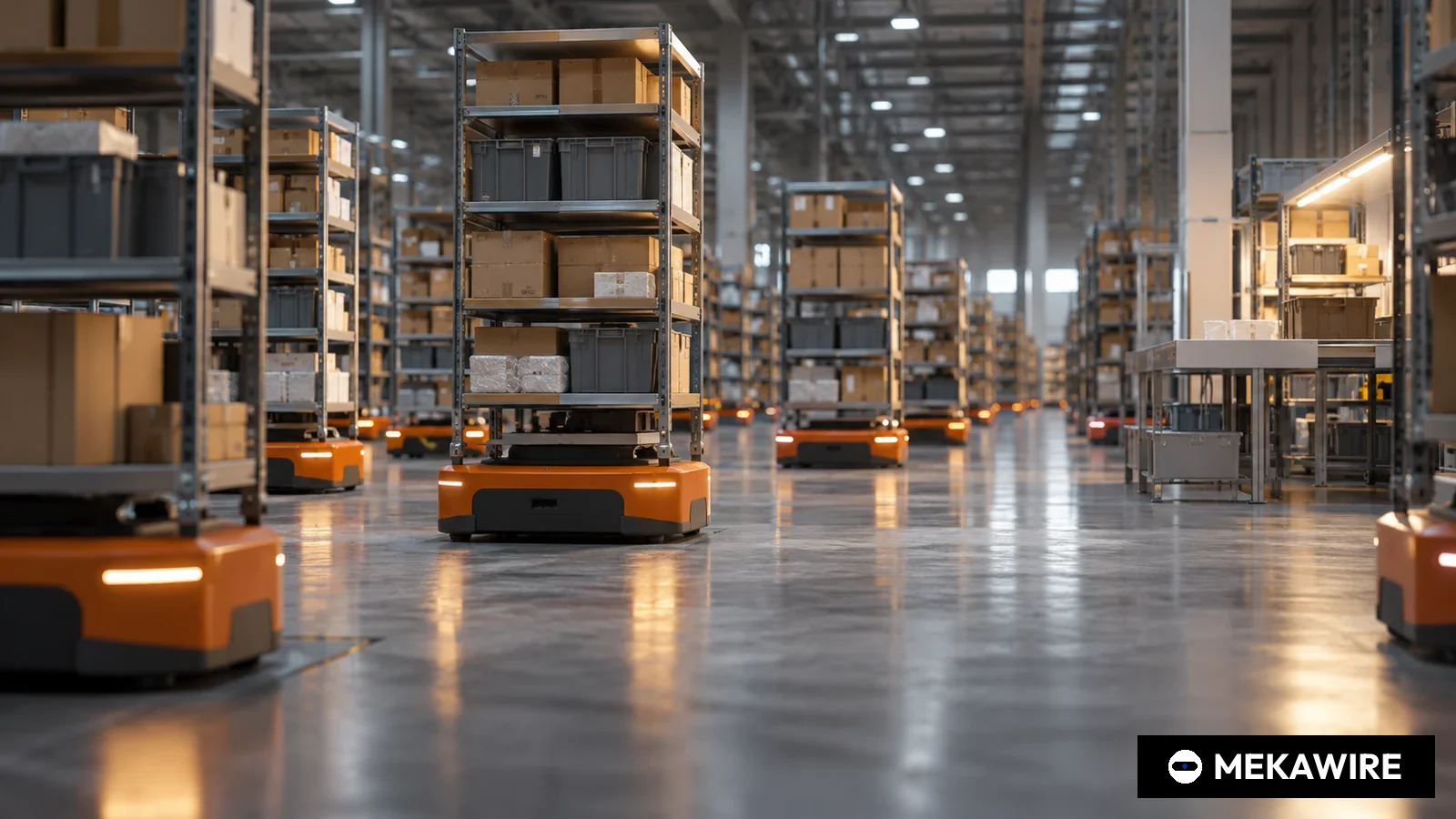
Beijing Geekplus Technology, the Hong Kong-listed warehouse robot maker that trades as Geek+, reported its first full year of positive adjusted earnings on March 30, 2026. Its annual results filing also shows that the United States has overtaken mainland China as the company's largest single source of revenue.
Revenue for 2025 rose 31.6% to RMB3,171.0 million from RMB2,409.0 million a year earlier, according to the announcement. Gross profit climbed to RMB1,125.0 million and the gross margin widened to 35.5% from 34.8%. The loss for the year under IFRS shrank to RMB10.4 million from RMB831.5 million, while adjusted net profit, a non-IFRS measure, swung to RMB43.8 million from an adjusted loss of RMB92.2 million. Operating cash flow turned positive at RMB85.7 million and new orders rose 31.7% to RMB4,137 million, the company said.
The distance between the two profit lines comes from three items the company strips out. In 2025 it excluded RMB42.1 million of share-based payments and RMB33.3 million of listing expenses, and it removed a RMB21.2 million credit from changes in redemption liabilities attached to special rights held by pre-IPO investors. In 2024 that same redemption item was a RMB685.8 million charge, which accounts for most of that year's reported loss.
The geographic split is the most striking part of the filing. Revenue from the US market reached RMB839.2 million, up 33.4% on the year, ahead of mainland China at RMB783.9 million, which grew 16.7%. Europe was the fastest riser, up 81.0% to RMB782.0 million, while Asia-Pacific grew 13.3% to RMB765.9 million. Markets outside the mainland produced 75.3% of revenue at a gross margin of 46.6%, according to the company, and accounted for nearly 80% of new orders. Orders from the Americas grew by more than 50%.
- United States
- 839.2
- 629.1
- 33.4
- 26.5
- Mainland China
- 783.9
- 671.5
- 16.7
- 24.7
- Europe
- 782
- 432.1
- 81
- 24.7
- Asia-Pacific
- 765.9
- 676.3
- 13.3
- 24.2
- Total
- 3171
- 2409
- 31.6
- 100
From the Geek+ annual results announcement for 2025. Change = 2025 / 2024 minus 1. Share = regional revenue / total revenue. Shares do not sum exactly to 100 because of rounding. Figures disclosed, not estimated.
As of Oct 1, 2026
Warehouse fulfillment generated RMB3,020.7 million, or 95.3% of revenue, while industrial material transport fell to RMB147.9 million from RMB226.1 million. The company said it now serves about 950 end customers, including more than 80 Fortune Global 500 companies, with a repurchase rate among large customers of about 78%, and has shipped more than 72,000 robots to over 40 countries and regions. Orders for its subscription-based service grew by more than 90%. Product launches during the year included the RS Air tote-to-person robot, a PopPick Lite shelf-to-person workstation and an ultra-thin pallet storage robot that the company says lifts efficiency by 30%.
The embodied AI push sits on top of that logistics base. Geek+ set up a subsidiary, Beijing Geekplus Embodied Intelligence, in July 2025, launched a warehouse foundation model called Geek+ Brain in August and unveiled an unmanned picking workstation built around a robot arm in October. For 2026 it plans to refine its wheeled humanoid Gino1, reach mass production of the complete unit and put it into commercial use. Research and development spending rose to RMB335.1 million from RMB282.0 million, and 434 of its 1,054 employees work in R&D.
Founded in 2015 by chief executive Zheng Yong, Geek+ listed its H shares in Hong Kong on July 9, 2025, raising net proceeds of HK$2,813.8 million. By December 31, 2025 it had used HK$511.1 million, or 18.2%, of that money. Cash and cash equivalents stood at RMB2,974.8 million at year end against RMB636.0 million a year earlier. The board did not recommend a final dividend.
Among Hong Kong-listed Chinese robot makers that reported 2025 results in the same week, Geek+ sits between the industrial automation group Estun Automation and the humanoid specialist UBTech on revenue, and is the most international. UBTech grew faster but lost RMB789.8 million, Dobot posted a RMB84.0 million loss on far smaller sales, and Estun returned to a RMB41.7 million profit with only 29.9% of revenue from abroad. In warehouse automation Geek+ competes with Norway's AutoStore, Symbotic and Locus Robotics in the US, France's Exotec and domestic rivals such as Hai Robotics and Quicktron.
- Geek+
- 2590
- 3171
- 31.6
- 35.5
- -10.4
- 335.1
- 10.6
- 75.3
- UBTech
- 9880
- 2001
- 53.3
- 37.7
- -789.8
- 507.5
- 25.4
- No data
- Dobot
- 2432
- 492.2
- 31.7
- 46.1
- -84
- 114.7
- 23.3
- No data
- Estun Automation
- 2715
- 4888
- 21.9
- 29
- 41.7
- 418.7
- 8.6
- 29.9
All figures from each company's annual results announcement for the year ended December 31, 2025 filed with HKEX (Geek+ via its IR site). Revenue growth = 2025 revenue / 2024 revenue minus 1. R&D / revenue = R&D expense / revenue. Overseas share for Geek+ is revenue outside mainland China; null where not disclosed as a single figure. Figures disclosed, not estimated.
As of Oct 1, 2026
The core technology is simple to describe and hard to scale. In a goods-to-person warehouse, mobile robots carry shelves, totes or pallets to a fixed station so that workers stop walking the aisles. The commercial value sits in the scheduling software that keeps hundreds of robots moving without congestion. Geek+ Brain and the picking station target the step that still needs people, which is grasping individual items of varied shape at the station, and Gino1 extends the same idea to a robot that can work at stations designed for humans.
Risks remain. The adjusted margin is thin at about 1.4% of revenue, the business still lost money under IFRS, and the US, now its biggest market, is exposed to trade policy between Washington and Beijing. The humanoid has no disclosed customer, price or volume target. Investors will next see the annual general meeting, which Hong Kong rules require by June 30, 2026, and interim results for the first half, due by August 31, 2026.
MEKAWIRE analysis
Geek+ shows that the most bankable embodied AI business among China's listed robot makers is a warehouse company that earns three quarters of its revenue abroad, and its humanoid ambitions will be judged against that base.
The evidence is in the filing. Overseas sales carry a 46.6% gross margin against a group average of 35.5%, the US and Europe together added about RMB560 million of revenue in one year, and the company generated positive operating cash flow while still funding RMB335.1 million of R&D. Few Chinese robot makers with humanoid programmes can point to that combination.
The strongest counter-argument is that the profit is an accounting construction. Without the RMB21.2 million redemption credit the adjusted figure would be smaller, IFRS still shows a loss, and 2025 benefited from one-off IPO cash.
Bull case: subscription orders keep growing above 90%, Europe and the Americas sustain double-digit gains, and Geek+ Brain lets the company sell unmanned picking on top of its installed fleet of more than 72,000 robots. That would make Gino1 an upsell to existing customers rather than a separate bet.
Bear case: tariffs or local content rules squeeze US margins, mainland pricing pressure persists at 16.7% growth, and Gino1 consumes IPO cash without customers. The company would then look like a profitable hardware integrator priced as an AI story.
Signals to watch:
- The annual general meeting, due by June 30, 2026, and any update on IPO proceeds spent beyond the 18.2% used in 2025.
- Interim results due by August 31, 2026, for whether the US stays ahead of mainland China and whether IFRS profit turns positive.
- A first named commercial deployment of Gino1 during 2026, as the company has promised.
- RMB4,137 million, up 31.7%
- RMB839.2 million, ahead of mainland China at RMB783.9 million
- RMB335.1 million
- RMB3,171.0 million, up 31.6%
- 35.5% (34.8% in 2024)
- RMB2,974.8 million
- RMB85.7 million, positive
- RMB10.4 million (RMB831.5 million in 2024)
- RMB43.8 million (adjusted loss of RMB92.2 million in 2024)
- 75.3% of total, gross margin 46.6%
Why it matters
Geek+ showed a full year of positive adjusted earnings and operating cash flow in its first annual report as a listed company, and it did so while increasing spending on embodied AI. That matters for the wider China humanoid trade because it offers a counter-model to companies such as UBTech, whose humanoid revenue is growing fast but whose losses remain large. The Geek+ approach funds foundation models and a humanoid from a cash-generating installed base.
The geographic data also changes the picture of Chinese robot exports. With the US at RMB839.2 million and Europe at RMB782.0 million, more than half of Geek+ revenue now comes from the two markets where trade friction with China is highest. Any assessment of Chinese embodied AI companies going abroad should treat Geek+ as the reference case for what that exposure looks like in practice.
Rival analysis
Within Hong Kong, the cleanest comparisons are UBTech, Dobot and Estun, all of which reported 2025 results between March 30 and March 31, 2026. UBTech grew revenue 53.3% to RMB2,001.0 million but lost RMB789.8 million and spent RMB507.5 million on R&D, about a quarter of revenue. Dobot grew 31.7% to RMB492.2 million with the highest gross margin of the group at 46.1% but still lost RMB84.0 million. Estun is larger at RMB4,888.0 million and returned to profit, yet only 29.9% of its revenue came from overseas.
In warehouse automation the real competitors are AutoStore, Symbotic, Locus Robotics, Exotec, Hai Robotics and Quicktron. Geek+ says it holds 23% of the global warehouse fulfillment market and 48.5% of the shelf-to-person segment. Those shares are the company's own claims and should be read as such, but the 81.0% revenue jump in Europe suggests it is taking business in AutoStore and Exotec home markets.
Valuation context
The filing does not give a market value, and MEKAWIRE does not estimate one here. What can be measured is the balance sheet. Year-end cash of RMB2,974.8 million is close to a full year of revenue, and only 18.2% of the HK$2,813.8 million IPO proceeds had been used by December 31, 2025. The company therefore has room to fund Gino1 and Geek+ Brain without new equity in 2026.
On the earnings line, adjusted net profit of RMB43.8 million equals about 1.4% of revenue. The improvement from 2024 is real at the operating level, as gross profit grew faster than revenue, but much of the headline swing in IFRS loss comes from the disappearance of a RMB685.8 million redemption liability charge that existed only because of pre-IPO investor rights.
Supply-chain implications
Geek+ runs a lean manufacturing footprint, with 57 of its 1,054 employees in supply chain and manufacturing and 481 in sales and marketing, 352 of them overseas. That structure reflects a business whose value lies in software and project delivery more than in assembly. The company earmarked 15% of IPO proceeds for supply chain development.
For component suppliers, the relevant demand drivers are drive units, batteries, lidar and depth cameras for mobile robots, and now robot arms and grippers for the unmanned picking station. If Gino1 reaches mass production in 2026 as planned, Geek+ will join the list of Chinese buyers of joint actuators and dexterous hands, a market where domestic suppliers already serve UBTech, AgiBot and Unitree.
Signals to watch
First, the 2026 interim results, due by August 31, 2026, will show whether the US remains the largest market and whether the IFRS line turns positive without the redemption credit. Second, the conversion of subscription orders, which grew by more than 90% in 2025, into recurring revenue will indicate whether Geek+ can shift from project sales toward a service model.
Third, watch for a first named Gino1 customer and any price or volume target. Fourth, the use of IPO proceeds, reported at the annual general meeting due by June 30, 2026 and again in interim results, will show how quickly cash is moving into embodied AI research.
Analyst view
Thesis: Geek+ has become the reference case for a Chinese robot company that can fund embodied AI from a profitable, international core business. Confidence: medium. The supporting evidence is audited revenue, margin and cash flow data in a regulatory filing. Confidence is not high because adjusted profit is thin, IFRS still shows a loss, and the humanoid and foundation model have no disclosed commercial metrics.
The key variable is the US. A business that earns 26.5% of revenue in one market, at margins above the group average, is exposed to policy decisions it cannot control. The filing gives no breakdown of US margins or local assembly, which leaves that exposure hard to size.
Questions you should be asking
How much of the 46.6% overseas gross margin comes from the US specifically, and how much US revenue is assembled or configured locally?
What share of the RMB4,137 million in new orders is subscription-based, and over what contract length will it be recognised?
What does Gino1 cost to build, which customers are piloting it, and does it use in-house or third-party actuators and hands?
Why did industrial material transport revenue fall from RMB226.1 million to RMB147.9 million, and is that business being de-emphasised?