Genesis AI raises $105 million seed from Eclipse and Khosla to build a universal robot brain on its own simulation engine
Genesis AI, a physical AI lab based in Paris and Palo Alto, came out of stealth on July 1, 2025 with $105 million co-led by Eclipse and Khosla Ventures, with Bpifrance, HSG, Eric Schmidt and Xavier Niel also investing. The company, which later called the round seed funding, plans a universal robotics foundation model trained on a data engine that mixes in-house physics simulation, generative modelling and real robot data, and did not disclose a valuation.
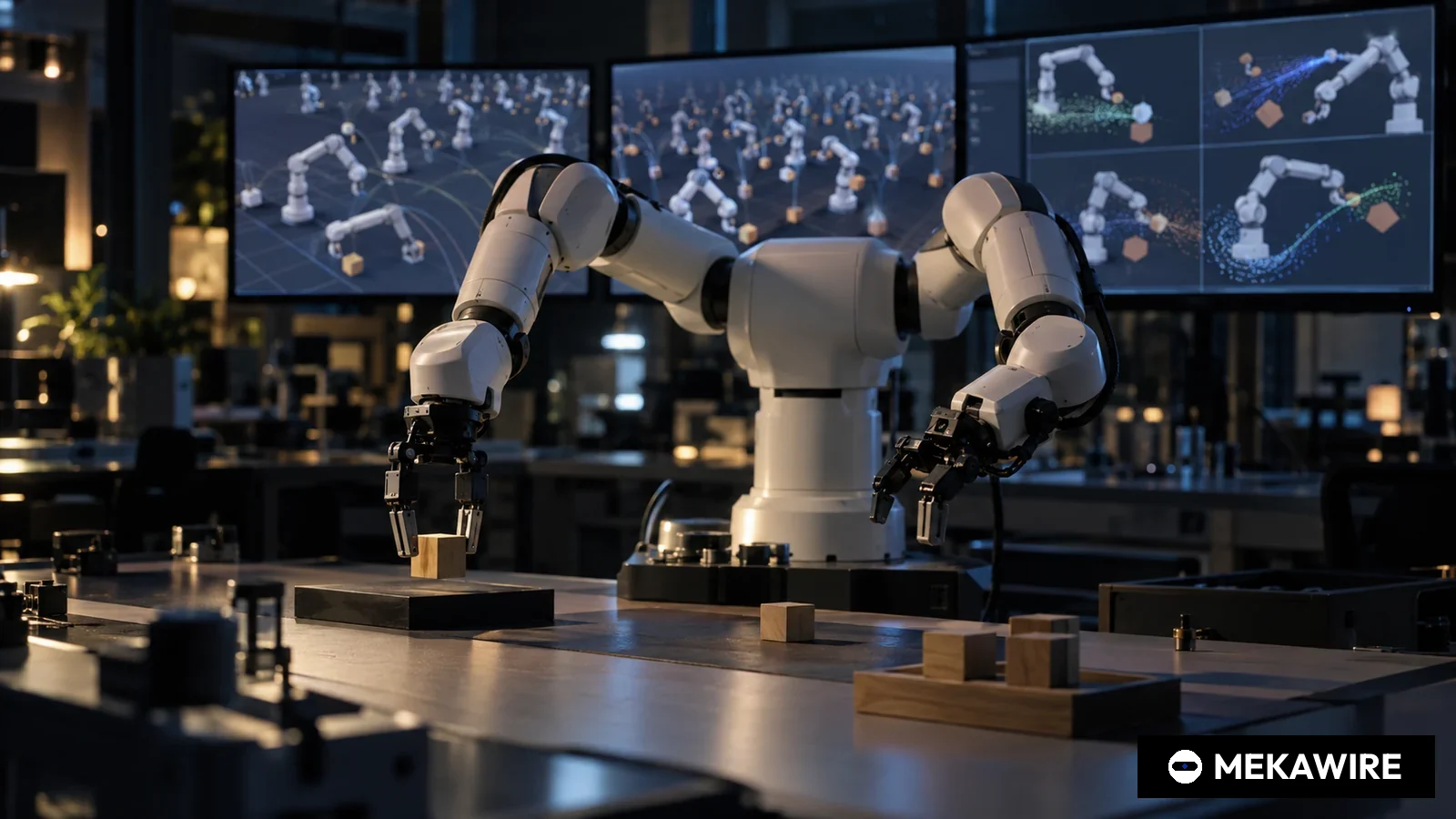
Genesis AI, a robotics lab with offices in Paris and Palo Alto, came out of stealth on July 1, 2025 with $105 million to build what it calls a universal robotics foundation model and a horizontal robotics platform. Eclipse and Khosla Ventures co-led the financing, which the company later described as seed funding. The announcement went out at 09:00 Eastern time and did not state a valuation.
The round
Besides the two co-leads, the release named Bpifrance, the French state investment bank, the investment firm HSG, former Google chief executive Eric Schmidt and French telecoms entrepreneur Xavier Niel as backers. In a March 11, 2026 release the company again put the total at $105 million in seed funding and added AI researchers Daniela Rus and Vladlen Koltun to its list of supporters. A seed round of that size was unusual for a company that had not yet shown a product, a customer or a robot of its own.
Genesis presented itself as a global physical AI research lab and a full-stack robotics company. Its stated mission is to "unlock unlimited physical labor" by putting general-purpose robots to work on the physical tasks that underpin the economy. The release framed the market with four figures of its own. Physical labour accounts for $30 trillion to $40 trillion of global GDP, more than 95% of it is still not automated, 75% of companies worldwide struggle to fill jobs, and in most automated industries the ratio of robots to human workers rarely goes above one to 30.
A data engine before a model
The core of the pitch is data, not hardware. Genesis said it is building a scalable data engine that combines high-fidelity physics simulation, multimodal generative modelling and large-scale collection of real robot data. The simulation stack was developed in house, according to the company, and is meant to produce synthetic training data at a scale that teleoperation alone cannot reach. Kanu Gulati of Khosla Ventures described the result as a continuous closed loop in which simulation data and real-world robot data feed each other.
In plain terms, a robot foundation model learns to map what a robot sees and is told to the motions it should make, and it needs millions of examples to generalise. Collecting those examples with human operators steering real arms is slow and expensive. A fast physics simulator can generate many more attempts, including failures, at almost no marginal cost, but policies trained only in simulation often break when they meet real friction, lighting and clutter. Genesis is betting that mixing both sources in one pipeline narrows that gap faster than either alone. The company also said it plans to open-source components of its data engine and of its foundation model.
The team already had a public track record in simulation. Genesis World, an open-source physics platform for robot learning, began as an academic project in December 2024 and is now developed with support from Genesis AI, according to its documentation. The code is released under the Apache 2.0 licence. Its documentation today describes a unified multi-physics engine, a photorealistic renderer called Nyx and a cross-platform compiler called Quadrants behind a single Python interface, and the GitHub repository had about 30,000 stars by October 2026.
Who is behind it
Zhou Xian leads the company as chief executive, and the March 2026 release names Théophile Gervet as his co-founder. According to the launch release, the founding team came from Mistral AI, Nvidia, Google, Carnegie Mellon University, MIT, Stanford, Columbia and the University of Maryland, with backgrounds in physics simulation, graphics, robotics and large-scale model training. The operating company is a French SAS, which gives Europe a rare home-grown entrant among well-funded robot brain developers.
Zhou said in the release that general-purpose robots powered by physical AI would define the next major chapter of human history. Charly Mwangi, a partner at Eclipse, said general-purpose robotics stands to affect trillions of dollars of labour value across sectors. In its own post on the deal, Eclipse tied the investment to labour shortages in manufacturing, construction, healthcare and agriculture.
How it compares
The round put Genesis among the better-funded companies chasing a general robot brain, though well short of the largest. Skild AI raised a $300 million Series A at a $1.5 billion valuation in July 2024. Dyna Robotics announced a $23.5 million seed round in March 2025. On the humanoid side, Figure AI raised $675 million in a Series B in February 2024 and 1X Technologies $100 million in a Series B in January 2024. By a MEKAWIRE calculation, Genesis's seed was 4.5 times Dyna's seed and 35% of Skild's Series A.
- Genesis AI
- FR / US
- No data
- Seed
- 2025-07-01
- 105
- No data
- Dyna Robotics
- US
- 2024
- Seed
- 2025-03-25
- 23.5
- No data
- Skild AI
- US
- 2023
- Series A
- 2024-07-09
- 300
- 1.5
- Figure AI
- US
- No data
- Series B
- 2024-02-29
- 675
- No data
- 1X Technologies
- US
- 2014
- Series B
- 2024-01-13
- 100
- No data
Latest rounds each company had announced on or before 2025-07-01, from company releases. Amounts in USD millions, post-money in USD billions, — where not disclosed. Genesis AI's round type is the company's own description in its 2026-03-11 release. Ratios in text are MEKAWIRE calculations: 105 / 23.5 = 4.47; 105 / 300 = 0.35. Figures disclosed, not estimated.
As of Oct 1, 2026
The difference is in what each company sells. Figure and 1X build their own humanoids and train models for them. Skild AI and Physical Intelligence offer models meant to run on many robot bodies, and NVIDIA supplies simulation, models and onboard computers to almost all of them. Genesis is closest to the model companies but claims to own the simulator as well, which would let it control the cost of its main input.
Risks and open questions
At launch Genesis named no customers, no robot hardware partners, no model release date and no valuation. Its claims about the simulator's role rest on the company's own description, and the gap between simulated and real-world performance has humbled many earlier efforts. The promise to open-source parts of the stack also leaves open how much of the value Genesis can keep once rivals can use the same tools.
What came next
By March 2026 the company had hired Vivian Sun, previously head of automated driving at Amazon, as vice president of commercial and strategy, and that release carried a Paris and San Carlos, California dateline. Its website now promotes a product called Eno with targeted customer deployments planned by the end of 2026.
MEKAWIRE analysis
Genesis AI's $105 million seed is a bet that whoever owns the cheapest source of robot training data will own the robot brain, and Europe got its first serious contender in that race.
The evidence sits in how the company spent its first words. The release put the data engine ahead of the model and named in-house simulation as the core asset, and the team had already shipped an open-source simulator before taking outside money. Two US funds known for deep-tech bets co-led, while Bpifrance and Xavier Niel gave the deal a French anchor.
The strongest counter-argument is that simulation has been the promised shortcut in robotics for a decade and real-world data still decides deployments. Rivals with fleets in factories and homes collect that data as a by-product of paid work, while a lab without robots in the field has to buy or build it.
Bull case: if Genesis can show that its mixed pipeline trains policies that transfer to real robots with far less teleoperation, its cost per training example falls below rivals' and the open-source simulator becomes a funnel for developers and hardware makers. A first commercial product by the end of 2026 would then justify a much larger round.
Bear case: if transfer from simulation stays weak, Genesis ends up competing with free tools from NVIDIA and Google DeepMind on the simulator and with better-funded model companies on the brain. The seed would then fund research that others can copy from its own open-source releases.
Three signals to watch:
- By December 31, 2026: whether the targeted customer deployments of Eno promised on the company's website take place, and with which robot makers.
- Through 2026: whether Genesis open-sources components of its data engine or foundation model as it pledged on July 1, 2025.
- First half of 2027: whether the company discloses a priced round with a valuation, which would test investor appetite for a European robot brain against Skild AI and Physical Intelligence.
- Seed (as described by the company in March 2026)
- $105 million
- Eclipse, Khosla Ventures
- July 1, 2025, 09:00 ET
- Not disclosed
- Data engine combining in-house physics simulation, generative modelling and real robot data
- Zhou Xian (CEO); Théophile Gervet (co-founder)
- Paris and Palo Alto
- Components of the data engine and foundation model
- Bpifrance, HSG, Eric Schmidt, Xavier Niel
Why it matters
The Genesis round is the clearest sign from mid-2025 that investors were willing to pay for the data layer of robotics as a separate asset. Most robot brain companies of the period raised money on the strength of a model demo or a fleet. Genesis raised $105 million on a team and a simulator, and its release talks about the data engine before it talks about the model. If that ordering holds, the scarce input in robotics is not compute or model architecture but cheap, varied, physically accurate training examples.
The deal also matters for geography. A French SAS with a Paris office, backed by Bpifrance and Xavier Niel alongside Eclipse and Khosla Ventures, gives Europe a contender in a segment otherwise led by US companies such as Skild AI and Physical Intelligence and by Chinese groups that bundle models with hardware. European industrial buyers that prefer a supplier under EU jurisdiction now have at least one candidate to watch.
Rival analysis
Skild AI is the closest comparison in ambition. It raised a $300 million Series A at a $1.5 billion valuation in July 2024 to build a general model for many robot bodies. Physical Intelligence pursues a similar cross-embodiment goal. Both lean on large real-world datasets gathered from many robot types. Genesis differs by claiming its own simulator as the main data source, with real data used to correct it.
NVIDIA is both partner and rival to every company in this group. Its Isaac simulation tools and GR00T models compete directly with a Genesis data engine, and NVIDIA can give them away to sell chips. Google DeepMind's MuJoCo plays a similar role in research. Genesis's open-source simulator is its answer, a way to win developer attention before it has a commercial model. Dyna Robotics, which raised a $23.5 million seed in March 2025, shows the alternative path of commercialising quickly with low-cost robots and real deployments.
Valuation context
Genesis did not disclose a valuation, so any comparison rests on round size. By a MEKAWIRE calculation its $105 million is 4.47 times Dyna Robotics' seed and 0.35 times Skild AI's Series A. Skild's $1.5 billion post-money in July 2024 gives a reference point for what a model-first robot company could command after a large Series A, but no figure for Genesis can be derived from it.
The seed label matters for future dilution. A company that takes $105 million at seed stage has signalled a high price, and the next round will need evidence such as a model release, a paying customer or a hardware partnership to step up from there. The March 2026 release still described the total as $105 million in seed funding, which suggests no further priced round had been announced by then.
Supply-chain implications
Genesis sits upstream of robot makers. Its inputs are GPU compute for simulation and training, real robot hardware for data collection and engineering talent in physics and graphics. The release did not name a compute supplier or hardware partner. Because simulation is compute-heavy, access to GPUs at a sustainable price is a direct cost driver for the business.
Downstream, a horizontal platform needs robot makers willing to run a third-party brain. Humanoid companies such as Figure and 1X build their own models, so Genesis's natural customers are makers of arms, mobile manipulators and industrial cells without large AI teams, and integrators serving manufacturing, logistics and services. The Eno product the company now advertises, with targeted deployments by the end of 2026, will show which of these segments it chose.
Signals to watch
The first signal is commercial. The company's website promises targeted customer deployments of Eno by the end of 2026. Named customers, robot types and sites would turn the pitch into a business, and their absence by early 2027 would weigh on the next raise.
The second is technical. Genesis pledged on July 1, 2025 to open-source components of its data engine and foundation model. Releases of model weights or benchmark results showing transfer from simulation to real robots would be the strongest evidence for its thesis. Adoption of Genesis World, already at about 30,000 GitHub stars by October 2026, is a leading indicator of developer pull. The third is financial, a priced round with a disclosed valuation.
Analyst view
Thesis. Genesis AI is a credible but early bet that the cheapest robot training data will come from simulation corrected by real data, and that owning the simulator is a durable edge. The team's open-source record and the quality of its co-leads support the bet.
Confidence: medium. The reasons for not going higher are concrete. At launch the company named no customer, robot partner, model release date or valuation, and the gap between simulated and real-world performance has defeated simpler versions of this strategy before. The reasons for not going lower are equally concrete. The simulator exists, is public and is widely followed, the company has since added commercial leadership from Amazon's automated driving unit, and it has stated a product timeline.
What would change the view upward is a released model that works on third-party hardware with little real-world fine-tuning. What would change it downward is a slip in the Eno deployment target or a pivot to building its own robot, which would put it head to head with better-funded humanoid makers.
Questions you should be asking
How much of the training data for Genesis's first model will come from simulation and how much from real robots, and will the company publish that ratio? Which robot bodies will the first model support, and will Genesis supply hardware itself or rely on partners?
What exactly will be open-sourced, and on what licence? If the data engine is released under the same Apache 2.0 terms as Genesis World, how does the company plan to keep a commercial edge over rivals who adopt it? And at what valuation, and with which lead, will the next round be priced?