Gemini Robotics 2.5 hits 96% on Mercedes-Benz kitting with Apptronik Apollo
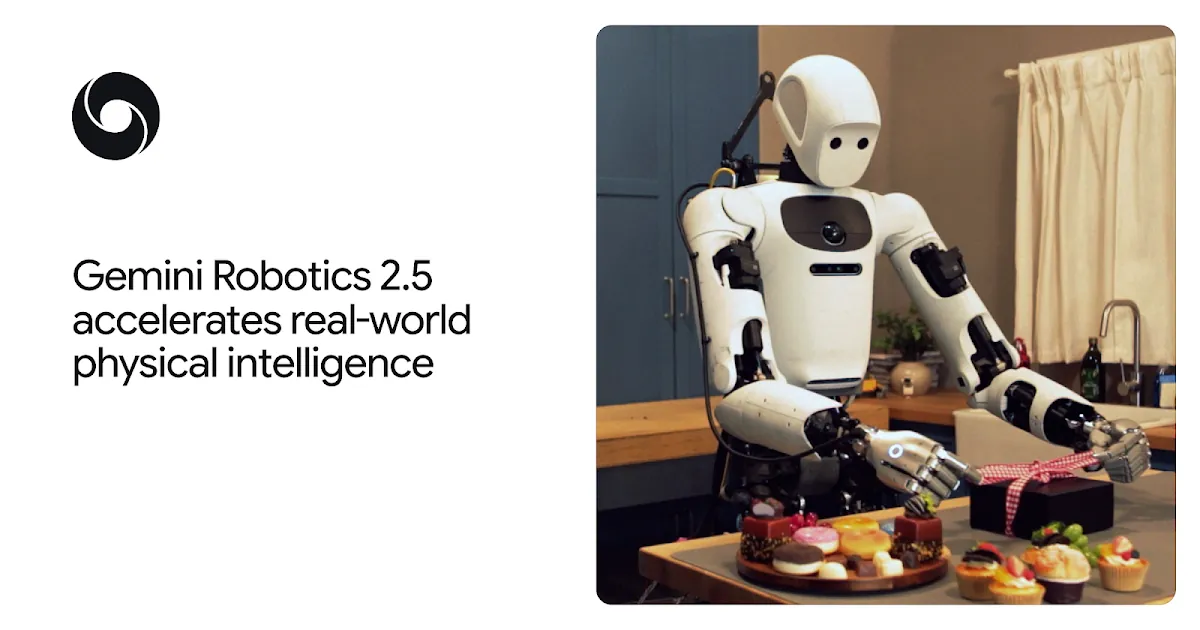
Google DeepMind released Gemini Robotics 2.5 on Nov 10, a vision-language-action model it says completes tasks 30% to 100% more often and 20% to 30% faster than its predecessor across more than 200 tasks.
In a pilot on Mercedes-Benz production lines in Kecskemét and Sindelfingen, Apptronik's Apollo 2 humanoid running the model sorted metal brackets into sequenced trays with a 96% success rate. The model is rolling out to robotics partners only.
Google DeepMind said in a blog post on Nov 10 that Gemini Robotics 2.5 is its most capable vision-language-action (VLA) model so far. Tested on more than 200 distinct tasks, it raised success rates by 30% to 100% depending on task type and finished tasks 20% to 30% faster than earlier baselines, according to the post. The model goes to robotics partners first; DeepMind announced no public API.
The factory number
The headline result comes from Mercedes-Benz. On active production lines in Kecskemét, Hungary, and Sindelfingen, Germany, Apptronik's Apollo 2 humanoid with Gemini Robotics 2.5 performed kitting, picking metal brackets from bulk bins and placing them into sequenced trays, at a 96% success rate. The robot used a five-finger SharpaWave hand with 22 degrees of freedom. The post gives no pilot length or number of attempts. Seen from the line, 96% still means about four kits in every hundred need a person to correct them.
Where 2.5 improved on 2
- Pack pastries with tongs
- 5%
- 100%
- Close lid of toolbox
- 0%
- 93%
- Unhang mug to table
- 29%
- 75%
- Untie ribbon bows
- 0%
- 70%
- Hang a cardigan
- 0%
- 62%
- Sweep trash into dustpan
- 0%
- 52%
- Pack rice cooker
- 0%
- 40%
- Fold pants
- 0%
- 40%
- Simple average
- 4.3%
- 66.5%
DeepMind blog chart values. Simple average of the eight rows is a MEKAWIRE calculation.
As of Nov 14, 2026
Across the eight multi-step and dexterous tasks DeepMind charted, the simple average success rate rose from 4.3% with Gemini Robotics 2 to 66.5% with 2.5 (MEKAWIRE calc. from the chart values). Five of the eight tasks went from zero to a measurable rate. The hardest ones remain far from factory grade: folding pants and packing a rice cooker sit at 40%.
DeepMind also published ASIMOV-Jailbreak, an open benchmark of hundreds of adversarial prompts across dozens of scenes. It reports 99.5% jailbreak resistance for Gemini 4 Argon, against 82% for Gemini Robotics ER 2; that figure belongs to the reasoning model, not to the 2.5 action model. Reasoning guidance at inference raised safe task completion by 33% around obstacles and 43% around nearby people.
MEKAWIRE analysis
DeepMind is now selling reliability, not demos: a production-line percentage is the claim that matters to buyers.
Gemini Robotics 2, released on July 30, introduced whole-body control; three and a half months later the step is in task completion, and the evidence comes from a carmaker's line, not a lab. The counter-argument is the denominator. Without attempt counts, cycle times or intervention rates, 96% cannot be compared with a fixed automation cell, and the 40% rows show where general models still fail. Apptronik, which closed a Series A extension of $520 million in February, gains a reference customer; partners such as Agile Robots, which DeepMind thanks in the post, may be next. Watch for a Mercedes-Benz statement on volumes, a public API date and independent results on ASIMOV-Jailbreak.
- Robotics partners only
- Kecskemét (HU) and Sindelfingen (DE)
- Gemini 4 Argon 99.5% jailbreak resistance vs 82% for ER 2
- Nov 10, 2026, DeepMind blog
- More than 200 tasks
- 30% to 100% higher success, 20% to 30% faster
- 96% kitting success, Apollo 2 humanoid
- 4.3% to 66.5% (MEKAWIRE calc.)
Why it matters
The reported 96% kitting success puts Gemini Robotics 2.5 and Apollo 2 into a specific automotive production workflow at two Mercedes-Benz plants. DeepMind also reports 30% to 100% higher task success and 20% to 30% faster execution than its predecessor across more than 200 tasks. Sample size, intervention rates and production economics are missing, so the pilot does not establish readiness for broader deployment.
Rival analysis
Agile Robots offers factory automation hardware and AI software, with Audi among its listed customers; its subsidiary Franka supplies torque-sensing arms. Sharpa focuses on tactile hands, haptic gloves and manipulation robots, making dexterity components another relevant competitive axis. No comparable kitting benchmarks or deployment economics are supplied, so these companies cannot be ranked against Apollo 2 on performance or cost.
Valuation context
Agile Robots has a disclosed $8.5B valuation and $720M in reported funding, including a $500M Series F announced Nov 12. Apptronik's reported $1.25B total funding is capital raised, not a valuation; no valuation is supplied. DeepMind is an Alphabet subsidiary with no standalone valuation supplied, and the input provides no market capitalization figures.
Related papers
DeepMind's listed papers include Grounded-Dreamer: Robot Learning from World Model Synthetic Data with Physical Grounding. Franka's list includes FoveaVLA: Foveation Actions Replace the Wrist Camera in VLAs. Only titles are supplied, so neither paper establishes the cause of the reported gains or validates the Mercedes-Benz result.
Supply-chain implications
The pilot combines DeepMind's model, Apptronik's Apollo 2 hardware and Mercedes-Benz production sites. Partner-only model access makes access terms and integration support relevant deployment dependencies. Component suppliers, manufacturing capacity, hardware prices and service arrangements are not supplied, leaving scaling costs and bottlenecks unresolved.
Signals to watch
Watch for paid deployments beyond the two pilot plants, repeatable success across shifts and disclosed human intervention rates. Cycle times, uptime and cost per completed kit would make the performance claims commercially assessable. The reported 99.5% jailbreak resistance for Gemini 4 Argon does not establish physical safety; the input supplies no physical safety validation.
Analyst view
The pilot is a concrete signal of industrial applicability, but the investment case depends on sustained throughput and support costs. Partner-only access makes commercial terms and partner expansion important indicators of adoption. The supplied evidence supports monitoring deployment conversion, while revenue, margins and customer commitments remain undisclosed.
Questions you should be asking
How many kitting attempts underpin the 96% success rate, and what human assistance or recovery was required? What are cycle time, uptime and total cost per completed kit against Mercedes-Benz's existing process? What commitments, access terms and physical safety requirements govern expansion beyond the pilot?